Mexico is too large and too varied to treat as a single ten-day destination. The country rewards repeat trips, so a first itinerary becomes better when it accepts that limitation instead of trying to combine Mexico City, Oaxaca, the Yucatán, Pacific beaches and colonial towns in one exhausting loop.
For ten days, Mexico City and Oaxaca make an unusually strong pair. One is a huge capital built in layers; the other is a smaller city where markets, food traditions, nearby archaeological sites and craft villages can fill several days without requiring constant hotel changes. The route also works well for travellers who want culture and food rather than a beach holiday.
If your priority is cenotes and the Caribbean, use our Yucatán Peninsula itinerary instead. This article is deliberately about a different Mexico: neighbourhoods, museums, highland landscapes, markets and the slower pleasure of staying long enough to learn how each city moves.
Quick trip summary
- Spend 5 nights in Mexico City and 4 nights in Oaxaca, keeping the final night or departure buffer flexible.
- Choose one Mexico City neighbourhood base and avoid crossing the metropolis repeatedly for meals.
- Use a direct flight or a comfortable intercity bus between Mexico City and Oaxaca rather than adding several intermediate stops.
- Reserve high-demand museums, restaurants or archaeological visits only where advance booking genuinely matters.
- Build in altitude, heat and food-adjustment buffers instead of planning every hour.
Why Mexico City and Oaxaca work so well together
Mexico City gives you scale: major museums, pre-Hispanic history, architecture, neighbourhood life and one of the world’s great food scenes. Oaxaca gives you a contrasting rhythm. Its historic centre is walkable, excursions are compact enough for day trips, and evenings can be spent around the same plazas rather than in traffic.
The pairing also limits logistical friction. Mexico City is a major international gateway, while Oaxaca is connected by air and long-distance bus. You can make the transfer once, settle again and then explore from a stable base. That is far more efficient than adding three or four destinations simply because they look close on a map.
Altitude is another reason not to rush. Mexico City sits high enough that some visitors feel tired during the first day or two. A lighter arrival day, regular water and a gradual increase in walking can improve the whole trip.
A realistic itinerary at a glance
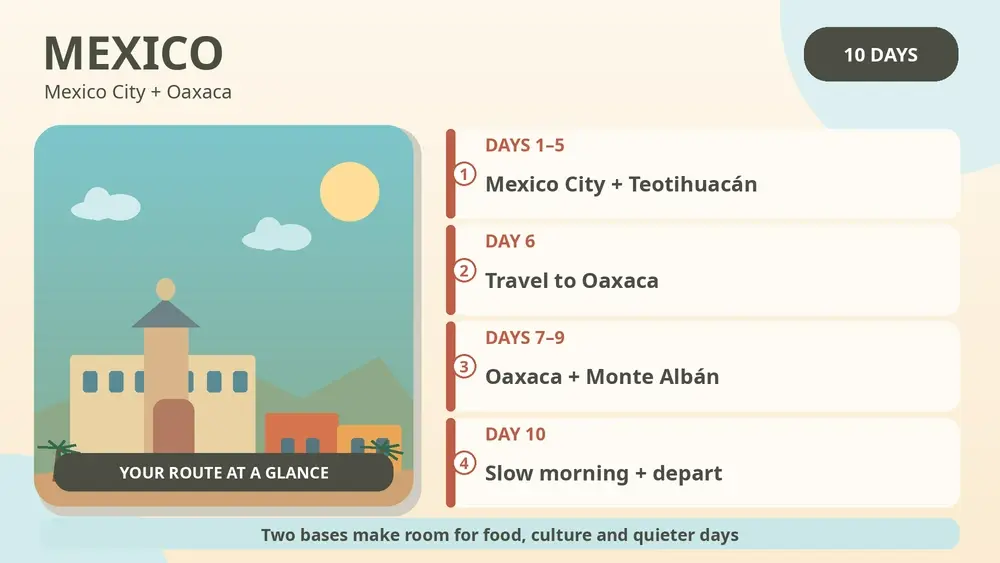
| Days | Base | Main focus |
|---|---|---|
| 1–5 | Mexico City | Historic centre, Chapultepec, neighbourhoods and Teotihuacán |
| 6 | Transfer | Mexico City to Oaxaca |
| 7–9 | Oaxaca | Historic centre, markets, Monte Albán and one focused excursion |
| 10 | Oaxaca / departure | Slow morning and onward journey |
Day-by-day plan
Day 1: Arrive and stay local
Choose a hotel in Roma Norte, Condesa, Juárez, Polanco or the historic centre according to what you value most. Do not spend the first afternoon crossing the city for a checklist attraction. Walk nearby, have an early meal and learn the rhythm of your immediate neighbourhood.
Traffic and altitude make arrival days unpredictable. If you feel good, add a short walk; if not, protecting your energy is a better investment than forcing the first museum.
Day 2: Historic Mexico City
Spend the day around the Zócalo, cathedral area, Templo Mayor surroundings and streets of the Centro Histórico. The objective is not to enter every building but to understand the layers of the city before moving to other neighbourhoods.
Start early, take breaks and be selective about museums. One substantial museum plus street-level exploration usually creates a better day than four rushed interiors.
Day 3: Chapultepec and one major museum
Give Chapultepec enough time to feel like a district rather than a single attraction. The National Museum of Anthropology can absorb several hours, and trying to combine it with multiple large museums often leaves visitors mentally exhausted.
Finish in nearby Polanco or return toward Roma/Condesa for an easy evening. This is a good day to book one special dinner because the daytime route is geographically coherent.
Day 4: Teotihuacán without overloading the evening
Visit Teotihuacán early and treat it as the main event. Sun exposure, walking and the transfer make it more tiring than a normal city day. Check current access rules and opening information through Mexico’s National Institute of Anthropology and History before you go.
When you return, keep the evening simple. A relaxed meal close to the hotel is more sensible than another cross-city attraction.
Day 5: Neighbourhood day
Use this day for Coyoacán, San Ángel, Roma, Condesa or a food-focused walk depending on your interests. Pick one or two areas rather than collecting neighbourhood names.
This is also your weather and energy buffer. If an earlier museum was closed or you lost time to a delay, you can move it here without breaking the itinerary.
Day 6: Travel to Oaxaca
A flight saves time; a good intercity bus can be comfortable and lets you see the landscape. Compare the complete door-to-door time rather than the headline journey time. Airport transfers and check-in can erase part of the difference.
After arrival, do little more than walk the historic centre, find the main market area and choose dinner close to your accommodation.
Day 7: Oaxaca city properly
Spend a full day in the centre: churches, markets, small museums, courtyards and food. Oaxaca is a place where stopping for chocolate, mezcal, mole or a market lunch is part of the experience, not wasted time.
Avoid scheduling every tasting in advance. Leave room for recommendations you receive after arrival.
Day 8: Monte Albán
Visit Monte Albán early, then return to the city for a slower afternoon. The archaeological site is exposed and can be hot, so water, sun protection and sensible footwear matter.
A half-day structure works well because it avoids combining Monte Albán with another long excursion merely to maximise the number of sights.
Day 9: Choose one excursion
Pick one direction: artisan villages, Hierve el Agua if access and road conditions suit you, or a mezcal-focused outing with a reputable operator. Do not try to stack all three into the same day.
This choice is where the trip becomes personal. A family with young children may prefer shorter village stops; food-focused adults may value a producer visit; keen walkers may prefer a landscape day.
Day 10: Leave space
Keep the final morning for breakfast, a market revisit and packing. If you are connecting to an international flight from Mexico City, consider whether an overnight there is safer than a tight same-day connection.
Mexico rewards unhurried repeat visits. Leave Puebla, the Pacific coast and other regions for a later trip rather than treating them as omissions.
Where to stay and how many hotel changes to make
In Mexico City, neighbourhood choice changes the trip more than a small difference in hotel quality. Roma Norte and Condesa are convenient for restaurants and evening walks; the historic centre puts monuments close but can feel quieter or more intense depending on the block; Polanco offers polished hotels and easy access to Chapultepec at a higher price.
In Oaxaca, staying within comfortable walking distance of the historic centre is valuable because it lets you return to the hotel during the hottest or busiest part of the day. You do not need to sleep directly on the main square; being several blocks away can be quieter.
For only ten days, two main hotels are enough. Every extra hotel change steals time through packing, check-out, luggage storage and orientation.
Transport: what is worth booking in advance
Mexico City traffic can make short map distances surprisingly slow. Use the Metro and Metrobús where practical, combine them with authorised taxi or ride-hailing options, and group each day geographically.
Between the two cities, compare flight and bus schedules based on your hotel locations. A bus station may be easier to reach than an airport, while a flight can be useful if you find a well-timed fare.
For Oaxaca excursions, a driver, small-group tour or organised transport can be easier than renting a car for a single day. If you do drive, understand local insurance, parking and road conditions rather than choosing a rental only because the base rate looks low.
Food and daily rhythm
Food is one of the strongest reasons to slow this route down. In Mexico City, mix markets, neighbourhood restaurants, bakeries and street food instead of reserving every meal. In Oaxaca, allow time for moles, tlayudas, chocolate, regional corn dishes and mezcal in contexts where you can actually understand what you are tasting.
Use ordinary food-safety judgement: choose busy vendors with high turnover, drink safe water and give your stomach time to adapt. A packed tasting schedule on the first day is rarely necessary.
Families, children and older travellers
With children, reduce the number of museums and use parks, markets and short neighbourhood walks to break up the day. Chapultepec is especially useful because it provides space between indoor attractions.
Older travellers may appreciate private transfers for Teotihuacán and Oaxaca excursions, elevators in hotels and rooms away from noisy streets. Historic paving and archaeological terrain can be uneven, so footwear and a slower pace matter.
Multigenerational groups should not assume everyone must do the same activity. A morning excursion and a shared dinner often works better than keeping a large group together from breakfast to bedtime.
Budget: where the money really goes
The largest variables are accommodation level, restaurant choices and domestic transport. Mexico can feel good value compared with some North American and European cities, but premium hotels, tasting menus and private tours can quickly change the total.
Budget for airport transfers, archaeological entrance fees, museum tickets, day trips and tips rather than comparing only room rates. Keep a separate contingency for schedule changes or a final-night airport hotel if your international connection requires it.
If cost matters, spend on location before luxury. A well-located mid-range hotel can reduce daily transport and return-trip fatigue.
Best time to go
Highland Mexico does not have one universal “best” month. Mexico City and Oaxaca have distinct dry and rainy patterns, and temperatures change with elevation. Dry-season weather can be convenient, while rainy months may bring greener landscapes and afternoon showers rather than continuous rain.
Major holidays, festivals and events can transform both price and atmosphere. If you want a specific celebration, plan around it deliberately; if not, avoiding peak dates can make rooms and transport easier.
Check current local conditions shortly before departure rather than relying on a climate chart alone.
Mistakes that make this trip harder than it needs to be
- Trying to add the Yucatán or a Pacific beach to the same ten-day trip.
- Booking a hotel far from the neighbourhoods you actually want to use every evening.
- Treating Teotihuacán as a quick stop between several other major attractions.
- Underestimating Mexico City traffic and altitude.
- Scheduling multiple long Oaxaca excursions on consecutive days.
- Connecting from Oaxaca to a long-haul international flight with no margin for disruption.
How I would adapt the itinerary
With seven days, stay only in Mexico City or divide the trip 4/3 and skip the Oaxaca day trip. With two weeks, add Puebla between the two cities or extend Oaxaca with a second focused excursion rather than immediately flying to another region.
Travellers who mainly want beaches should not force this route to become something it is not. Pair the Yucatán guide with a future Mexico trip instead. Food-focused travellers can easily spend extra days in both cities without running out of meaningful experiences.
Before booking the trip
- Check passport and entry requirements for your nationality close to departure.
- Review current archaeological-site opening information and any reservation rules.
- Choose neighbourhoods before choosing hotels.
- Leave a connection buffer if your international flight requires a domestic positioning flight.
- Download offline maps and keep the hotel address available without internet.
The most useful mindset for Mexico is to plan for depth, not coverage. Ten days in Mexico City and Oaxaca will show you only a fraction of the country, but that is precisely why it can feel like a real journey rather than a transfer schedule.