Slovenia is small enough to encourage overconfidence. Ljubljana, Lake Bled, Bohinj, the Soča Valley, caves, vineyards and the Adriatic coast all look close, so travellers often build a daily itinerary that zigzags across the country. The better approach is to use the compact geography to reduce stress, not to increase the number of stops.
Eight days works well with Ljubljana plus one Alpine base and one short coastal/Karst finish. This structure gives you city time, mountain scenery, a weather buffer and a completely different Mediterranean-influenced finale without requiring a new hotel every evening.
Quick trip summary
- Use three bases at most: Ljubljana, Julian Alps, and coast/Karst.
- Do not treat Bled and Bohinj as interchangeable; give the Alps more than a photo stop.
- Drive the Soča Valley only if mountain-road conditions and weather suit your group.
- Book caves and the most popular summer accommodation in advance.
- Keep one mountain day flexible because cloud can change the value of viewpoints and hikes.
Who this itinerary is for — and when to change it
This route is designed for a first or early visit with a moderate pace. It assumes that the goal is to understand the destination rather than collect the highest possible number of stops. Couples, solo travellers, families and mixed-age groups can use the same geographic structure, but activity intensity should change with mobility, climate, jet lag and personal interests.
Before booking every attraction, identify the two experiences you would most regret missing. Protect those first, then build the rest of the trip around them. Weather-dependent beaches, mountains, wildlife, boats and scenic roads should remain movable, while museums, markets and neighbourhood time can often shift more easily.
Where to stay: choose the base before the hotel
Accommodation is a transport decision as much as a comfort decision. Check how you will reach the first activity in the morning, what happens after dinner, whether the property has lifts or parking, and how luggage will move on transfer days. A cheaper room that creates two difficult journeys every day can cost more in taxis, time and energy than a slightly more expensive base in the right place.
| Base | Why it works — and the trade-off |
|---|---|
| Ljubljana centre | Walkable, lively and ideal for the first 2 nights; a car is more burden than benefit in the core. |
| Bled | Convenient for the lake and restaurants, but busy and more expensive in peak season. |
| Bohinj | Quieter, closer to mountain atmosphere and excellent for hiking; fewer evening choices. |
| Piran / Slovenian coast | Atmospheric car-light finish; parking is usually easier outside the historic core than at the door of the hotel. |
The four decisions that shape this trip most
| Decision | Best default | When to change it |
|---|---|---|
| Ljubljana car | No | Collect it when leaving the capital if the rest of the route is a road trip. |
| Alpine base | Bohinj or Bled | Choose Bled for convenience, Bohinj for nature and a quieter evening. |
| Soča route | Yes if weather/roads fit | Use a simpler highway/Karst route when mountain driving is not appropriate. |
| Cave | Choose one major cave system | Visiting several can crowd out the coast and Alps. |
Make these choices before filling the calendar with attractions. They determine how many hotel changes, early starts and fragile connections the trip contains. Once the structure is right, individual sightseeing choices are much easier to adjust.
A realistic day-by-day route
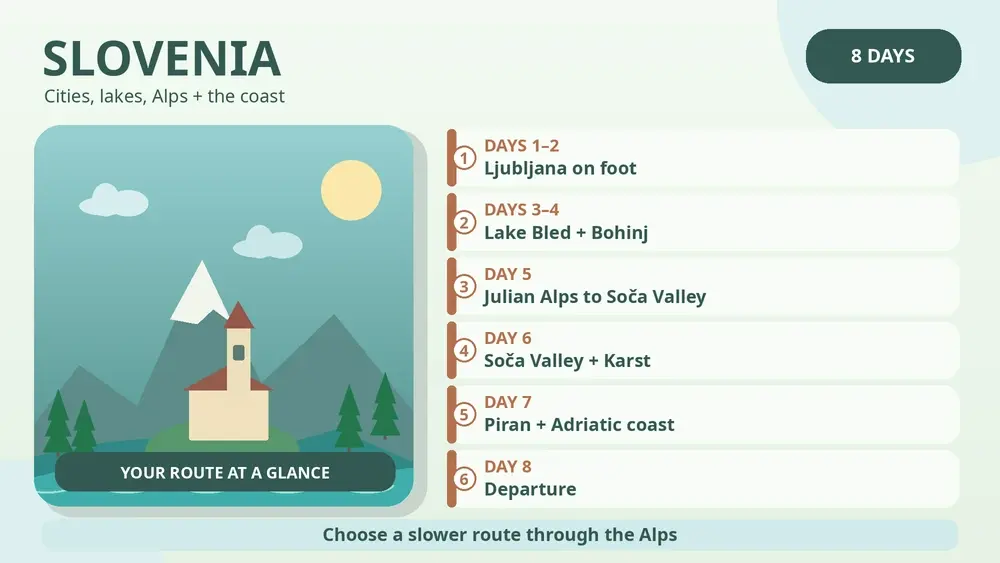
Days 1–2: Ljubljana without a car
Use arrival day for the riverside centre, market area and castle district.
On day two, add museums, Tivoli or a food-focused walk rather than a distant excursion.
Pick up the car only when you are ready to leave the city.
Days 3–4: Bled and Bohinj
Move to your Alpine base and spend the first afternoon around Lake Bled or a nearby gorge depending on timing.
Use the best-weather full day for Bohinj, cable-car views or a hike that fits fitness and trail conditions.
Do not stack Bled island, castle, Bohinj, Vintgar and a major hike into one day.
Day 5: Julian Alps to Soča Valley
Drive a mountain route only if conditions are suitable and everyone is comfortable with winding roads.
Stop selectively for viewpoints and short walks; the road itself is part of the day.
Sleep in or near the Soča Valley rather than continuing to the coast after a full mountain day.
Day 6: Soča Valley and Karst transition
Choose one river activity, waterfall or historic stop in the morning.
Then move toward the Karst/coast, possibly adding a cave if timing is realistic.
Avoid booking a fixed late cave entry after an unpredictable mountain drive.
Day 7: Piran and the coast
Park once and enjoy Piran on foot.
Add a short swim, salt-pan visit or neighbouring coastal town only if it does not turn the day into a parking exercise.
Use the evening for the seafront rather than driving back inland.
Day 8: departure
Travel toward Ljubljana, Trieste, Venice or another departure point according to the wider trip.
Allow border/traffic and rental-return margin.
Do not plan a major cave or hike before an early flight.
Pace check: if this stage runs late, remove the lowest-priority activity rather than stealing time from meals, sleep or the next transfer. A resilient itinerary should become simpler when something changes, not more frantic.
What is worth booking in advance
Book the components that are genuinely scarce or that would break the route if unavailable: limited transport, a special accommodation, a high-priority guided activity or a reservation required by a park or attraction. Do not pre-book every hour. Leaving some meals, beaches, short walks and neighbourhood time open gives you somewhere to move when weather or energy changes.
Keep confirmations offline and note cancellation windows. If two weather-sensitive activities are booked on consecutive days, understand whether either can move. The strongest itinerary is not the one with the most reservations; it is the one that still works when one reservation fails.
Transport reality: plan door to door
Slovenia is compact, but mountain roads, parking and border-season traffic can stretch travel times. Ljubljana works well without a car; the Julian Alps and Soča Valley are far easier with one. If you prefer public transport, simplify the route around Ljubljana, Bled/Bohinj and the coast rather than trying to reproduce a road itinerary exactly. The official tourism site provides practical transport and accessibility information that is worth checking close to travel.
Door-to-door time is the number that matters. Add hotel checkout, reaching the station, airport, ferry or pickup point, waiting, boarding, luggage, local transport at the other end and the possibility that everyone needs food immediately after arrival. This is why a “one-hour flight” or “two-hour drive” can consume half a day. Our guide to building realistic 7-, 10- and 14-day itineraries explains how to treat transfer days honestly.
Food strategy: make meals part of the route
Slovenian food changes with geography: Ljubljana offers modern restaurants and markets, Alpine areas bring hearty mountain dishes, the Karst is associated with cured meats and wine, and the coast adds Mediterranean flavours. Use lunch as the flexible meal on driving days and reserve dinner only when staying in a smaller village with limited options.
One planned meal per day is usually enough. Keep another meal flexible so it can respond to where you actually are, not where an old itinerary expected you to be. With children, older travellers or very hot/cold weather, eating before everyone becomes exhausted is often more important than reaching a restaurant that looked perfect months earlier.
When to go and how the season changes the plan
Late spring through early autumn offers the easiest road-trip conditions, but summer crowds and thunderstorms can affect Alpine plans. Winter is a different itinerary and requires winter-driving and mountain-safety planning. Shoulder seasons can be excellent for cities and wine regions while high mountain routes may still have weather constraints.
Instead of searching for one universal “best month,” decide which compromise you prefer: better weather, fewer visitors, lower prices, longer daylight, beach conditions, snow or wildlife. No period maximises everything. Recheck short-term weather and official access information shortly before each critical outdoor day.
Budget: where spending actually improves the trip
Slovenia can be good value compared with some Alpine neighbours, but Bled accommodation, car rental and premium experiences increase the total. Staying in Bohinj or a nearby village can offer better value than the most famous lakefront rooms. Collecting the car after Ljubljana also avoids urban parking costs.
The most useful upgrades are often logistical rather than luxurious: a hotel that removes a daily transfer, a direct ride after a long flight, a flexible ticket, an additional night in a weather-dependent region or a guide where interpretation genuinely adds value. Cut low-value extras before cutting the pieces that keep the route reliable. Our realistic travel-budget guide can help you account for the smaller costs between headline bookings.
Common mistakes to avoid
- Trying to see Ljubljana, Bled, Bohinj, Postojna and Piran in two days.
- Keeping a rental car in central Ljubljana without needing it.
- Driving a mountain pass as if it were a normal fast transfer.
- Visiting Bled only for a photo and missing the surrounding Alpine region.
- Booking too many caves, castles and viewpoints instead of leaving weather flexibility.
Most difficult trips are not ruined by one large mistake. They become tiring through a sequence of optimistic assumptions: a transfer that “should” be quick, a famous walk assumed to suit everyone, a meal delayed until everyone is hungry and a departure day with no margin. Leave space before you need it.
Families, older travellers and mixed-age groups
Slovenia is strong for families because distances are short and there are lakes, caves, gentle walks and compact towns. Choose trails by actual difficulty rather than social-media popularity. Older travellers can enjoy scenic drives, lake promenades, cable cars and caves, but should confirm steps and underground walking distances before booking.
For mixed-age groups, agree which experiences everyone will share and which can be optional. Splitting for two hours is often healthier than forcing the whole group through one person’s priority. Build seating, toilets, shade or warm shelter, step-free access and realistic meal times into the plan with the same seriousness as headline attractions. Our guide to travelling with parents and older adults develops this approach in more detail.
If you have more or less time
With five days, use Ljubljana + Bled/Bohinj + one cave/coastal day. With ten to twelve days, add wine country, Logar Valley or extra Soča nights rather than simply driving into another country because the border is close.
When shortening the trip, remove an entire base before cutting every destination to one night. When lengthening it, add depth before distance. An extra morning in a place you already understand often produces a better memory than another multi-hour transfer to a new pin on the map.
Useful official resources
Opening hours, transport timetables, road conditions, trail rules, sea conditions and visitor procedures can change. Use official sources for the details that affect your exact travel dates and recheck them shortly before departure.
Final planning checklist
- Confirm passport, visa, entry and transit requirements for your nationality and route.
- Book the genuinely scarce transport or accommodation segment before secondary attractions.
- Check the exact luggage journey between bases, including stairs, boats, station exits and rental-car rules.
- Save offline copies of essential reservations, insurance details and each accommodation address.
- Recheck weather, road, park, trail, sea or transport notices shortly before each critical day.
- Keep at least one flexible half-day that can absorb rain, fatigue, a delay or a cancellation.
- Choose clothing and footwear for the actual surfaces and climate, not only for photographs.
- Leave a generous buffer before international flights and other connections that are expensive to miss.
The purpose of a good itinerary is not to prove that you covered the maximum distance. It is to make the important experiences easier to enjoy and to leave enough energy for the unexpected parts that become the best memories. Use this route as a framework, then remove anything that does not fit your interests, mobility or travel rhythm.