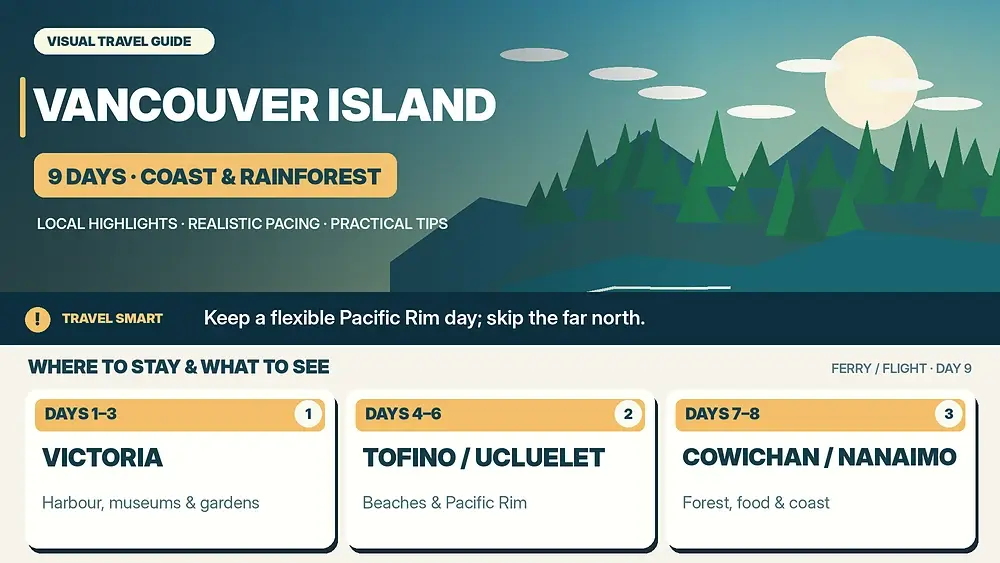
Vancouver Island is large enough to look manageable on a map and still surprise first-time visitors with its driving times. Mountains, ferry terminals, winding roads and irresistible coastal stops make a ten-day trip much better when it focuses on the southern and central island rather than trying to reach every community from Victoria to Cape Scott.
The route below combines Victoria, the Pacific Rim and the east coast with three main bases. It leaves northern Vancouver Island for another trip, because adding it would turn relaxed coastal days into long transit stages.
Wildlife, rainforests and ocean experiences are central to the island, but none should be treated as guaranteed. Weather and animal movement change daily, so a strong plan includes worthwhile beaches, towns and short walks even when a boat trip or wildlife sighting does not happen as expected.
Quick trip summary
- Allow 10 days for southern and central Vancouver Island.
- Use Victoria, Tofino/Ucluelet and one east-coast base.
- Do not add the far north unless you have more time.
- Reserve summer ferries, Pacific Rim accommodation and key wildlife tours early.
- Treat wildlife sightings as possibilities, not promises.
Who this trip is best for
This trip suits road trippers who enjoy ocean scenery, temperate rainforest, small cities, wildlife and a mixture of easy and moderate outdoor activity. Families and older travellers can enjoy most of the route without difficult hiking.
It also suits travellers who want a Canada trip with varied landscapes but limited hotel changes. Anyone focused on remote wilderness expeditions or northern communities should plan a separate, longer island itinerary.
How many days do you really need?
Ten days is a strong first-trip length. Seven days can work with Victoria and Pacific Rim only, while two weeks allows Campbell River, Strathcona or the north without making every other day a transfer.
A shorter trip works only if you shorten the geography as well as the calendar. Removing sleep and meal buffers while keeping every region usually creates a trip that looks efficient on paper and feels exhausting in practice. Extra nights are most valuable when they reduce a difficult transfer, create a weather buffer or let you experience a place at a different time of day.
Where to stay and how to choose your bases
Three bases keep the route simple. Add a fourth only if it clearly reduces driving for an activity you care about, not merely because another town appears on the map.
| Base | Why it works |
|---|---|
| Victoria | Best for arrival, harbour atmosphere, gardens, museums and southern-island day trips. |
| Tofino or Ucluelet | Best for Pacific Rim beaches, rainforest walks, surf culture and marine excursions. |
| Nanaimo, Parksville or Comox Valley | Useful east-coast base for beaches, food, forests and onward ferry or driving connections. |
Choose each base by what you want to do in the first and last two hours of the day. Check parking or station access, stairs, restaurant hours and how far you will carry luggage. A location that saves forty minutes twice a day is often worth more than a prettier room far from the experiences you came for.
A realistic day-by-day itinerary
Day 1: Arrive in Victoria
Collect the car only when you need it, settle in and explore the harbour and walkable central area.
If you arrive by ferry or flight, avoid an immediate multi-hour drive to the west coast.
Day 2: Victoria and the south island
Choose museums, gardens, a coastal walk or a wildlife tour if conditions suit.
Keep marine activities on a day when you can move other sightseeing around the weather.
Day 3: Victoria to Pacific Rim
Drive toward Tofino or Ucluelet, allowing far more time than the map suggests for stops, road works and scenic detours.
Buy groceries before the final part of the drive if your accommodation is self-catering.
Day 4: Pacific Rim beaches and rainforest
Use short rainforest walks and beach time to understand the landscape before committing to a longer activity.
Check tide, surf and storm conditions; the ocean is beautiful but not automatically safe for swimming.
Day 5: Wildlife, paddling or a flexible ocean day
Take a responsible marine excursion, paddle with a guide or choose a second beach-and-trail day.
If a boat is cancelled, keep the day useful rather than trying to drive back across the island.
Day 6: A slower Pacific Rim day
Spend another day around the west coast, adding a short hike, cultural experience or relaxed town time.
Three nights here are more useful than one rushed “Tofino day” between long drives.
Day 7: Cross to the east coast
Drive toward Nanaimo, Parksville or Comox Valley, stopping at forests or lakes en route when conditions allow.
Treat the crossing as a scenic travel day and avoid adding a late-evening wildlife excursion.
Day 8: East-coast communities and beaches
Explore the chosen base with an easy beach, food stop, market or forest walk.
The east coast is a good place to reduce the pace after more weather-dependent west-coast days.
Day 9: Optional Campbell River, Strathcona edge or local day
Choose one larger excursion north or inland, or keep the day local if the group is tired.
Do not add a distant destination simply because this is the last full day; choose the experience with the best conditions.
Day 10: Ferry or flight onward
Return the car and connect to the mainland or your next destination.
Reserve a generous ferry or airport buffer, particularly in busy summer periods.
Transport: what works best
A rental car gives the best flexibility once you leave Victoria, but the route includes ferries, road works and mountain driving that can lengthen journey times. Fuel before remote stretches and do not rely on a last-minute charging plan if using an electric vehicle.
Ferry reservations can be important during busy periods, especially when travelling with a vehicle. Arrive with enough check-in margin and avoid building an international flight around the minimum theoretical connection.
Calculate transfers door to door, not only by the time shown on a timetable. Add checkout, parking, waiting, luggage, boarding and the local connection at the other end. Download offline maps and save accommodation addresses before long rural drives or journeys with several connections.
Best time to visit
Late spring through early autumn offers the broadest mix of activities and longer daylight. Summer is busiest and requires earlier accommodation planning, while spring and autumn can be excellent for a quieter trip with more variable weather.
The west coast is known for rain and dramatic storms outside summer. That can be part of the appeal, but dress for it and choose accommodation that is comfortable enough to enjoy when outdoor plans shorten.
Weather averages help you choose a season, but they cannot decide tomorrow’s plan. Keep at least one weather-sensitive day flexible and reorder outdoor activities when wind, rain, heat, visibility or sea conditions make another day more sensible.
How to pace each day
The island’s scale is the biggest planning trap. Victoria to Pacific Rim and west coast to the east coast are real travel stages, not empty gaps that can absorb several major attractions.
A useful rule is to plan one anchor experience before lunch and one lighter activity after it. That keeps the day interesting without making every meal, transfer and viewpoint compete for time. If weather or transport shifts, drop the lowest-priority stop instead of borrowing time from sleep or pushing dinner late into the evening.
Protect one quiet evening every two or three days. Laundry, a supermarket stop, an early dinner or simply sitting near the hotel may look unproductive in an itinerary, but those pauses often determine whether the second half of the trip remains enjoyable.
Travelling with children
Families can build days around beaches, aquariums or museums, short rainforest walks and simple wildlife experiences. Ocean safety deserves extra attention because cold water, surf and logs can make a beach dangerous even when it looks calm.
With children, reduce the number of transitions rather than simply shortening every activity. A beach, playground, easy viewpoint, boat ride or food stop can become the reward around which the adult sightseeing is built. Carry water and snacks, know where the next toilet is, and avoid scheduling the longest transfer at the time of day when everyone is already tired.
Travelling with older adults or limited mobility
Many rainforest and coastal viewpoints have short access routes, but boardwalks can be wet and uneven. Choose ground-floor or lift-access rooms and ask tour operators about boarding conditions before marine excursions.
For older travellers or anyone with limited mobility, check the details behind words such as “easy” and “accessible”: surface, gradient, steps, distance from parking, boat boarding, shade and toilet availability. A scenic drive plus two short walks can produce a better day than one famous hike that consumes all available energy.
Food and meal planning
Victoria offers the widest restaurant choice, while Pacific Rim and east-coast communities are strong for seafood, bakeries, cafés and locally produced food. Reserve popular summer dinners if eating at a specific restaurant matters to you.
One planned meal per day is usually enough. Keep another flexible so you can eat close to where you actually finish, repeat somewhere you liked or adapt to opening hours. In rural areas and small islands, kitchens may close earlier than in major cities, so keep a simple backup for late arrivals.
Budget: where the money really goes
Accommodation in Pacific Rim is often the largest expense, followed by the rental car, ferries and wildlife tours. Staying three nights in one west-coast base is usually better value than splitting nearby towns into multiple one-night stays.
Compare total-day cost rather than isolated prices. A better-located room may remove taxis, a direct transfer may save a hotel night, and a guided excursion can be good value when it replaces complicated independent logistics. The easiest savings usually come from fewer hotel changes, simpler meals on transfer days and avoiding duplicate transport.
Safety and practical preparation
Respect cold-water conditions, wildlife distance rules and trail closures. Carry bear-aware habits in natural areas, follow local guidance and never approach marine or land animals for a photograph.
Carry essential medication, water, sun and rain protection and a charged phone, but do not assume mobile coverage will be continuous in mountain, coastal or rural areas. Tell someone your plan before remote walks, respect local closures and turn around when conditions are worse than expected. For health, entry or security questions that can change quickly, use current official guidance rather than an old blog post.
Mistakes that make this trip harder than it needs to be
- Trying to drive the island from end to end in ten days.
- Underestimating the Victoria–Pacific Rim travel day.
- Booking key summer accommodation too late.
- Treating wildlife sightings as guaranteed.
- Ignoring ferry reservation and check-in requirements.
- Assuming every beach is safe for swimming.
Vancouver Island feels far larger when you stop at beaches, forests and cafés, which is exactly why a shorter geographic route creates a better holiday.
If you have less time
With seven days, use Victoria and Tofino/Ucluelet, with one overnight or transit stop only if needed. Skip the east-coast extension.
The best shortened itinerary normally removes one region or island completely. Keeping the same number of bases and simply cutting nights creates more packing and less experience, which is the opposite of what a short trip needs.
If you have more time
With fourteen days, add Comox Valley, Campbell River, Strathcona or the north, but keep multiple nights in each region rather than creating a chain of one-night stops.
Use additional days to deepen the route rather than extend the driving radius automatically. A second hike, market morning, village stay or weather buffer often reveals more than another distant pin on the map.
What to book early and what can stay flexible
Reserve summer Pacific Rim accommodation, vehicle ferries and any must-do wildlife tour. Keep beaches and forest walks flexible around weather.
Book the pieces that can genuinely sell out or derail the route first: key accommodation, limited-capacity transport and any activity that matters enough to define the trip. Leave ordinary sightseeing movable. Recheck operating days, road or trail conditions and local transport shortly before departure, because seasonal destinations often change faster than old itineraries suggest.
Useful official resource
For current access, transport, seasonal opening information and visitor rules, check Tourism Vancouver Island before travel.
Final planning checklist
- Choose a south-and-central route rather than the whole island.
- Reserve vehicle ferries in busy periods.
- Book Pacific Rim lodging early.
- Carry rain layers and respect ocean conditions.
- Leave wildlife days flexible.
- Keep the final ferry or flight connection generous.
Final thoughts
Vancouver Island is most satisfying when the distances are treated honestly. The island is not a single attraction but a sequence of coastal environments that need time to feel different from one another.
Ten days is enough to combine a city, the wild Pacific coast and the gentler east side without spending the trip proving how far you can drive.