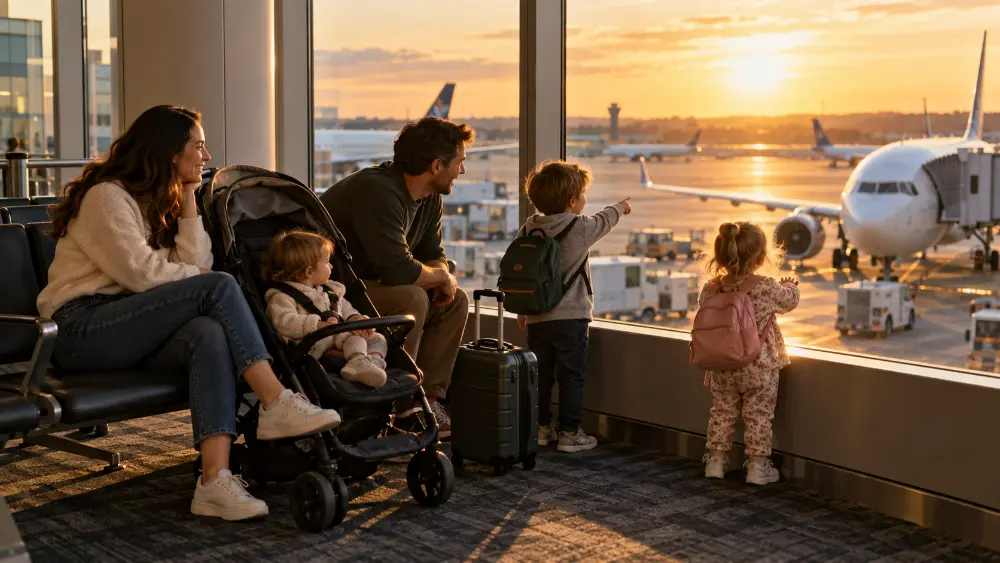
Travelling with children is not simply adult travel with smaller suitcases. The trip works better when the plan changes with the child’s age, energy and ability to handle waiting. A baby may travel happily through a museum but need feeding and sleep infrastructure; a toddler may need movement every hour; a teenager may tolerate long days but want some control over the itinerary.
The most useful family travel rule is to protect the weak points of the day: hunger, sleep, waiting, heat and transitions. When those are managed, children are often capable of much more than adults expect.
Family travel priorities
- Plan around meals, sleep and transport transitions before adding attractions.
- Choose fewer accommodation changes than you would on an adults-only trip.
- Keep one easy backup activity for bad weather or low energy.
- Give older children real choices within the plan.
- Carry enough essentials for delays, not just the scheduled journey time.
1. Plan for the child you have now
Advice that worked six months ago may no longer fit. A crawling baby, a newly walking toddler and a four-year-old have different needs even if all three are described as “young children.” Build the itinerary around current routines and abilities, not what the child managed on the previous holiday.
| Age/stage | What often matters most | Useful planning response |
|---|---|---|
| Baby | Feeding, sleep, shade, changing | Shorter activity blocks, easy return to accommodation, reliable supplies |
| Toddler | Movement, snacks, naps, unpredictability | Parks between attractions, fewer queues, stroller/carrier decision |
| School age | Variety, participation, physical energy | Mix museums with outdoor time; give simple choices |
| Teenager | Independence, interests, social connection | Include their priorities and allow some unstructured time |
2. Choose destinations by logistics as well as attractions
A place can have excellent children’s attractions and still be tiring if every day requires long transfers, steep walking or complicated meal planning. Look at how the family will move between the airport, accommodation and the places you want to visit.
For a first city trip with young children, a compact neighbourhood near public transport can be more valuable than a larger apartment far away. For a beach holiday, walking distance to the beach may matter more than a sea view. For older children, access to activities can reduce the need for constant parental entertainment.
3. Accommodation can solve half the trip
Family accommodation is not only about bed count. Check whether sleeping spaces can be separated, whether there is a lift, how dark the room becomes, whether a fridge is available, and how easy it is to get breakfast or food after a late arrival.
- Laundry becomes disproportionately useful on trips longer than four or five days.
- A kitchenette can reduce pressure around breakfast and snacks even if you eat most meals out.
- A separate sleeping area can let adults stay awake after a young child goes to bed.
- A bathtub may matter for some families; others need only a reliable shower.
- Check cot/crib availability in writing if it is essential rather than assuming it will be provided.
Our hotel vs apartment vs hostel vs resort guide compares accommodation types from a practical point of view.
4. Flying with babies
With babies, the challenge is usually supplies and comfort rather than entertainment. Build your cabin bag around feeding, changing and temperature. Pack more nappies and clothes than the flight duration suggests because airport time and delays count too.
Airline rules for infant tickets, bassinets, strollers, car seats and liquids for baby food vary. Confirm with the airline and departure airport. If a bassinet is important, request it early but still plan for the possibility it is unavailable.
5. Flying with toddlers
Toddlers often struggle most with forced stillness and transitions. Let them move before boarding when possible. Board early only if the extra time on the aircraft helps your family; for an active toddler, being among the last groups can reduce the time confined to the seat.
Do not introduce every toy at once. Rotate small activities. Download familiar videos, bring simple snacks and keep one new or rarely seen item for the final part of the journey. Avoid toys with many tiny pieces that can roll under seats.
6. School-age children can become travel partners
Give them a job: track the next metro stop, choose between two lunch places, count bridges on a river cruise or keep a simple photo diary. Participation turns waiting into part of the trip and reduces the sense that adults are dragging them from place to place.
Attractions work better when paired: one adult-priority visit followed by something physical or playful. A long museum morning can be followed by a park, playground, pool or food market rather than another museum.
7. Teenagers need ownership, not a children’s programme
Teenagers may be perfectly capable of adult-paced sightseeing but dislike having no say. Give each person one or two priority choices for the trip. A teenager who chooses a neighbourhood, sports venue, shop, concert or food experience is more invested in the rest of the itinerary.
Build in some time that is not interpreted as wasted: a slow breakfast, shopping hour or time back at the hotel can prevent conflict on longer trips.
8. Manage food before everyone is hungry
Family travel becomes difficult very quickly when food decisions are delayed until children are exhausted. Know where the next meal could happen before leaving an attraction-heavy area. Carry a simple snack even in food-rich cities; queues, closures and unfamiliar menus can turn a ten-minute delay into a major problem.
If allergies or medical dietary needs are involved, research local terminology and emergency procedures before travel. Do not rely on a generic travel article for medical or allergen safety decisions.
9. The one-major-thing rule
For young children, plan one major fixed attraction per half day, not three. Everything else can be optional. This does not mean doing less overall; it means creating a schedule that can expand when the day is going well and contract without feeling like failure.
In a city, one museum plus lunch plus a park and a neighbourhood walk may produce a fuller day than racing through three ticketed attractions.
10. Decide what naps mean for the trip
Some children sleep well in a stroller or carrier; others need a dark room. Do not build the whole itinerary around advice from families whose child sleeps differently. If room naps are essential, choose accommodation centrally so returning midday does not consume two hours.
11. Choose transport by total family effort
Public transport may be cheapest but not easiest with a stroller and luggage. Taxis or ride-hailing can be efficient, but child-seat rules and availability vary by country and service. Rental cars can simplify rural trips but add parking, navigation and car-seat logistics.
Compare the whole family effort. A direct train with reserved seats can be much easier than a short flight once airport transfers and security are included.
12. Documents and health preparation
Children can have different passport-validity periods and document requirements from adults. Some destinations or airlines may ask for additional documents when a child travels with one parent or another adult. Check official sources for the child’s nationality and route.
The WHO travel and health guidance highlights that infants and young children can require additional consideration before international travel. For destination-specific vaccines, medicines or health concerns, use professional medical advice rather than a generic packing list.
13. Build one bad-day version of the itinerary
Ask: what will we do if it rains all day, someone sleeps badly or a child wakes with no energy? Have one low-effort option near the accommodation — indoor play, aquarium, pool, café-and-walk day, shopping centre, cinema or simply an afternoon off.
A backup day reduces pressure because you do not have to invent a plan while the family is already tired.
14. The small family items that save disproportionate stress
- Refillable water bottle where practical
- Snacks that travel well
- Wet wipes even after the nappy years
- Small first-aid basics appropriate for your family
- One spare outfit in the day bag for younger children
- Offline entertainment
- A small bag for wet or dirty clothes
- Comfort item for sleep
- Photographs or copies of important documents stored securely
The best family trip is not the busiest one
Children remember unusual details adults often ignore: a tram, a bakery, feeding ducks, a hotel breakfast, a train ride or a playground with a view. Leave enough space for those moments. The itinerary should support the family experience rather than compete with it.
Related guides
- How to build a realistic 7-, 10- or 14-day itinerary
- Travelling with parents and older adults
Practical notes that make the plan work in real life
Before departure, write the critical information in one place: booking references, the first accommodation address, transport details, insurance contact if applicable, and the phone numbers you would need if your device stopped working. Keep a secure offline copy as well as the online version. This is a small task, but it prevents several common travel problems from becoming larger than they need to be. Build margins around the parts of the trip that are difficult to replace. A local café can move to another hour; an international flight cannot. A free neighbourhood walk can be shortened; a prepaid tour may have a fixed departure. Giving the least flexible items more time is a better strategy than trying to make every minute efficient. Finally, review the plan from the perspective of the least experienced or least mobile traveller in the group. Check the distance from platform to hotel, how luggage will be handled, where meals can happen and what the alternative is if the day becomes too hot, wet or tiring. A plan that still works on an imperfect day is usually a strong plan.