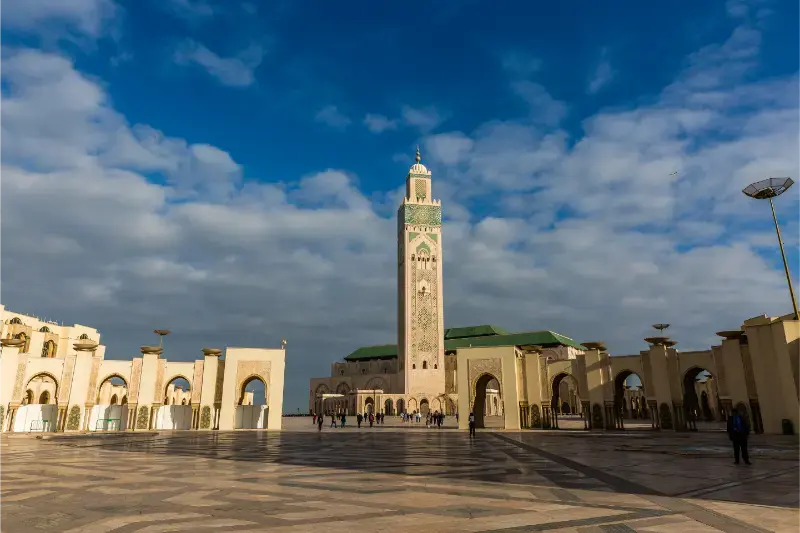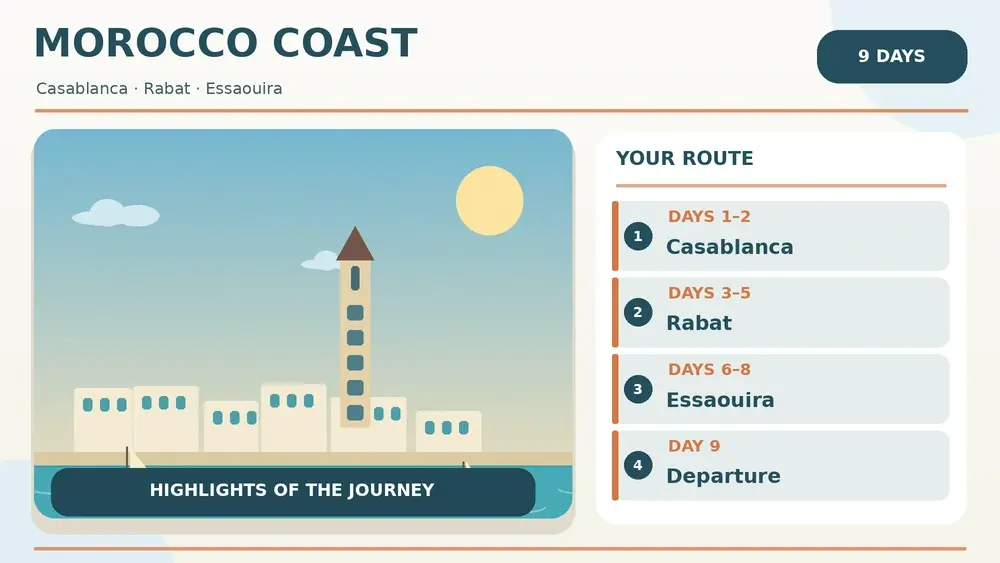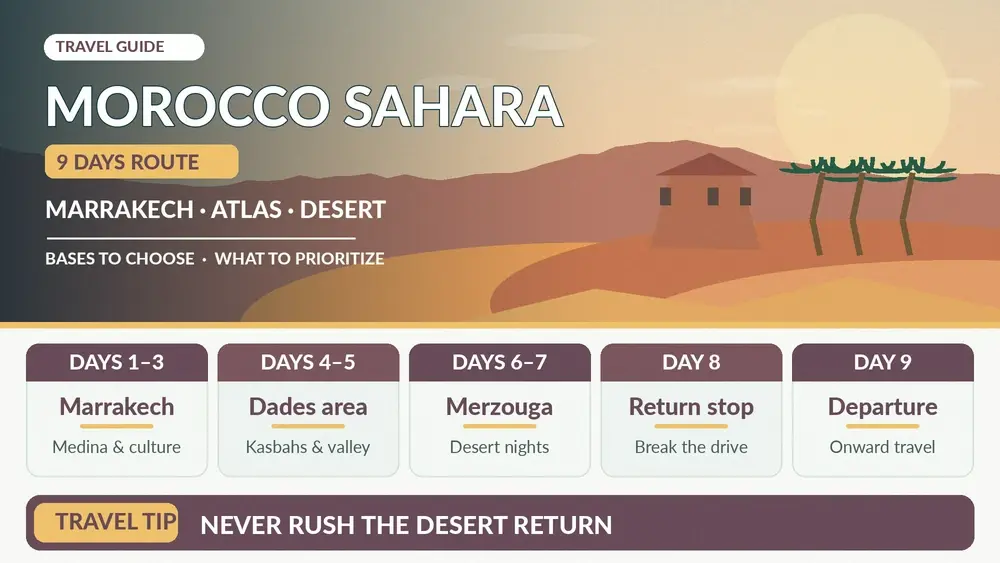
Morocco can tempt first-time visitors into a route that looks impressive on paper—Marrakech, Aït Ben Haddou, desert dunes, Fes, Chefchaouen and the Atlantic coast in a single week. The result is usually many hours in a vehicle and too little time inside the places you crossed the country to see. An eight-day trip becomes much stronger when you choose one region and let contrast come from city, mountains and coast.
This route uses Marrakech as the cultural anchor, the Atlas foothills for a change of pace and Essaouira for Atlantic air and a walkable medina. It deliberately does not force a Sahara detour into the same week. The desert is worthwhile, but it deserves more than a photo stop attached to two very long road days.
Quick trip summary
- Use Marrakech, an Atlas-area stay and Essaouira as three distinct experiences.
- Do not add Merzouga to an eight-day route unless long driving is genuinely part of what you want.
- Choose a riad only after checking vehicle access, stairs and luggage arrangements.
- Private drivers can be valuable for mountain transfers, but confirm exactly what is included.
- Dress and behaviour should respond to local context without turning the trip into a list of rigid rules.
Who this itinerary is for — and who should change it
This route is designed for a first visit with a moderate pace: enough structure to avoid wasting days on poor logistics, but enough freedom to respond to weather, energy and unexpected discoveries. It suits couples, solo travellers, families and mixed-age groups who would rather remember several places clearly than remember a blur of transfers.
If your priority is nightlife, serious hiking, luxury resorts or a single specialist interest, use the route as a geographic framework and replace the lower-priority days. A useful itinerary is not a test of how many attractions you can complete. It should make the important parts easier while leaving room to stop when something is better than expected.
Where to stay: location decisions that change the trip
Accommodation has more impact than the room itself. Check the first journey each morning, the last journey at night, luggage access, hills or stairs, nearby food and whether you can return for a break. A cheaper property that creates two difficult transfers every day can cost more in time, taxis and energy than a slightly more expensive base in the right place.
| Base | Best use and trade-off |
|---|---|
| Marrakech Medina | Immersive and atmospheric, ideal if you want to walk to souks and historic sights. Some riads require several minutes on foot from vehicle access. |
| Marrakech Hivernage / Gueliz | Easier vehicle access, modern hotels and a less intense arrival experience; useful for travellers who prefer lifts and wider streets. |
| Atlas foothills / Imlil region | A mountain base for walking and scenery. Accommodation standards and road access vary, so ask specific questions. |
| Essaouira Medina or edge | The medina is compact and atmospheric; staying near an accessible gate can make luggage and taxi transfers much easier. |
A realistic day-by-day route
Days 1–2: Marrakech with orientation before intensity
Use arrival day to settle into the neighbourhood, especially if the riad is inside the medina. Learn the route to the nearest easy taxi pickup point before dark.
On the first full day, combine one or two historic interiors with souk time and a long lunch rather than trying to “complete” the medina.
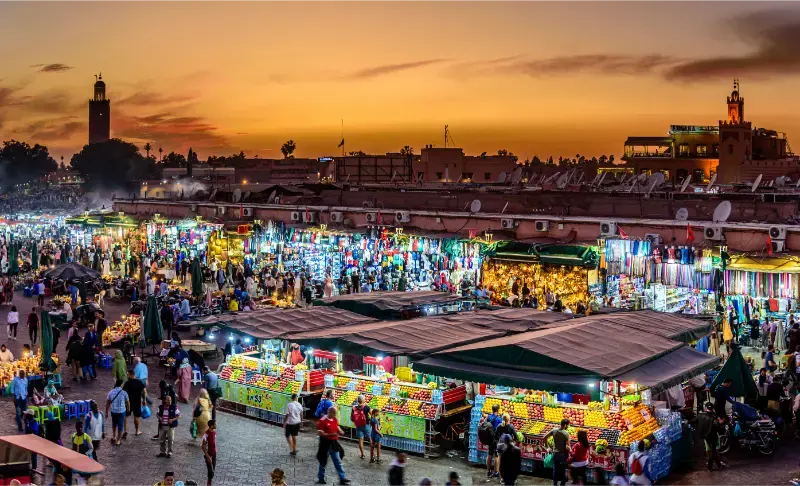
The main square changes character through the day, so returning later can be more rewarding than constantly moving to a new district.
Day 3: gardens, neighbourhoods and a slower Marrakech day
Use the second full day for a garden, museum or modern neighbourhood, giving your senses a break from the densest souk lanes.
A hammam can fit here if it interests you, but research the style and privacy level first because local and spa-oriented experiences differ.
Keep the evening open for a rooftop dinner or an early night before the mountain transfer.
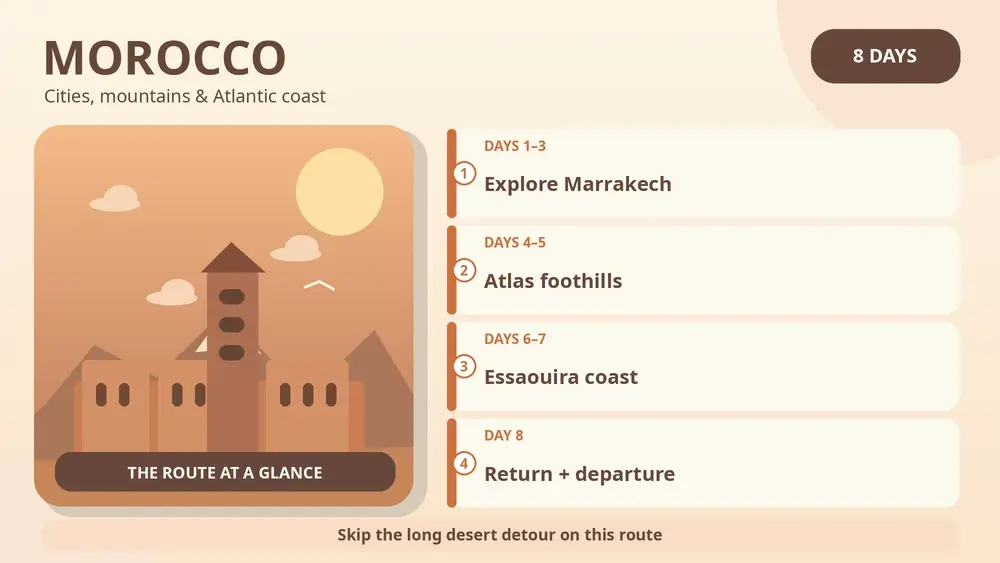
Days 4–5: Atlas foothills instead of a rushed desert dash
Transfer into the High Atlas foothills and use the afternoon for village scenery or a short walk with an appropriate local guide.
On the full day, choose a hike suited to the group’s fitness and weather. Elevation, sun and rough surfaces matter more than the kilometre number alone.
If mobility is limited, a scenic drive, terrace lunch and short village walk can still provide a meaningful contrast to Marrakech.
Day 6: transfer to Essaouira
Travel west to the Atlantic and let the journey occupy much of the day. Do not book a precise late-afternoon activity that depends on perfect road timing.
After arrival, walk the medina walls, harbour area or beach according to wind and energy.
Essaouira is compact enough that simply wandering can be the day’s best activity.
Day 7: Essaouira at coastal pace
Use the full day for the medina, ramparts, beach and food without over-planning. Wind can change beach comfort, so keep indoor cafés and galleries as natural alternatives.
A seafood lunch can be the anchor instead of another excursion.
Families may prefer sand and open space after Marrakech, while older travellers often appreciate the flatter central layout compared with some hill towns.
Pace check: if the previous stage ran late, remove the lowest-priority stop rather than stealing time from meals, sleep or the next transfer. The route is deliberately built with places where you can simplify it without breaking the whole trip.
Day 8: return and departure logic
Return to Marrakech with enough margin for your onward travel. If the international flight is early, sleep in Marrakech the previous night instead of risking a long same-day road transfer.
A driver booked through a reliable accommodation or operator can reduce stress.
Do not plan a final shopping sprint that makes you late for the airport.
Transport reality: what the map does not show
Marrakech is best explored largely on foot inside the medina, but cars cannot reach every riad. Ask for the exact drop-off point and whether staff can assist with luggage. For Atlas and Essaouira transfers, private drivers, shared shuttles and buses each have advantages. The official tourism site provides general travel information, while rail is useful on other Moroccan routes but does not connect every destination in this itinerary. For longer intercity extensions, ONCF schedules are worth checking directly.
Door-to-door time is the number that matters. Add checkout, reaching the station or port, waiting, boarding, transfers, finding the new accommodation and the possibility that everyone wants food immediately after arrival. This is why a “two-hour journey” can easily occupy half a day. Our guide to building realistic itineraries explains how to protect transfer days instead of pretending they are normal sightseeing days.
Food strategy: eat well without making meals another timetable
Moroccan meals can become some of the trip’s strongest memories when you vary settings: a simple lunch, a riad dinner, bread and olives in the mountains, seafood on the coast. Do not judge every restaurant by how close it is to a famous square. Travellers with allergies should communicate ingredients carefully, especially where sauces, nuts or shared preparation are involved. Carry water during hot sightseeing days and remember that meal timing may shift during religious periods.
One planned meal per day is usually enough. Leave the other meal flexible so it can respond to where you actually are, not where you expected to be six months earlier. Keep a simple backup option close to the hotel for evenings when the group is tired. This matters even more with children and older adults, because hunger turns a minor transport delay into a much larger problem.
When to go and how weather changes the route
Marrakech can be very hot in summer while the mountains are cooler and evenings at elevation can feel quite different. Spring and autumn are popular for combining city and outdoor time. Winter can be pleasant in the city but cold in the High Atlas, with snow affecting higher routes. Essaouira is famous for wind, which can make a warm-looking forecast feel cooler. Pack layers for the route rather than for one city.
Instead of searching for one universal “best month,” choose which compromise matters most: comfortable temperatures, swimming, long daylight, lower prices, fewer visitors or full seasonal transport. Every destination trades one advantage for another. Build at least one indoor, low-effort or easily movable half-day into the plan so weather does not force you into a bad decision.
Budget: where spending improves the trip
Riads range from simple guesthouses to high-end boutique properties, and the visual appeal of a courtyard does not tell you how accessible or quiet the room will be. Private transfers are a meaningful expense but can save time for groups. Agree on the price and inclusions for guides and drivers before the service begins. A well-located accommodation that is easy to find can be worth more than a cheaper room deep in confusing lanes after a late arrival.
The most valuable upgrades are often logistical rather than luxurious: a central hotel, a direct transfer after a long flight, a reserved seat on a scarce connection or a guide who turns a wildlife or archaeological visit into something you understand. Cut low-value extras before cutting the pieces that keep the route reliable.
Common mistakes to avoid
- Adding the Sahara desert to an eight-day route without acknowledging the long drives.
- Booking a medina riad without asking about stairs and vehicle access.
- Treating every souk interaction as either a threat or a performance instead of normal commerce with negotiation.
- Planning a mountain hike from an online distance alone without checking elevation and conditions.
- Scheduling the Essaouira return immediately before a critical flight with no buffer.
Most itinerary problems do not come from one disastrous decision. They come from stacking small optimistic assumptions: a transfer that “should” be quick, a hotel that is “only” a kilometre away, a hike described as easy, and a dinner reservation on the opposite side of town. Leave margins in the plan before you need them.
Families, older travellers and mixed-age groups
Children often respond well to the variety of courtyards, markets, animals, mountains and beach, but sensory overload is real. Build quiet hotel time into Marrakech days. Older travellers should prioritize accommodation with clear access and lifts where needed; many beautiful traditional properties have steep stairs. In the mountains, a short scenic outing is preferable to pushing a group onto a hike that only one person wanted.
For mixed-age groups, decide which experiences everyone will share and which are optional. Splitting for two hours can be healthier than forcing the entire group through one person’s priority. Build toilets, shade, seating, lifts, step-free transport and realistic meal times into the plan with the same seriousness as famous attractions. Our guide to travelling with parents and older adults covers this style of planning in more detail.
If you have more or less time
With ten to twelve days, add Aït Ben Haddou/Ouarzazate or another Marrakech night. For a true Sahara experience, add several days and redesign the route around it rather than attaching it. With five or six days, keep Marrakech plus Essaouira and use a day trip toward the Atlas instead of another hotel change.
When shortening the trip, remove an entire base before cutting every destination to one night. When lengthening it, add depth before adding distance. An extra morning in a place you already understand often creates a better memory than another three-hour transfer to a new pin on the map.
Useful official resources
Timetables, closures, ticket systems and access rules can change. Recheck the details that affect your exact travel dates shortly before departure and again before any critical transfer.
Final planning checklist
- Confirm passport, visa and transit requirements for your own nationality and route.
- Book the genuinely scarce ticket or transport segment before non-refundable secondary activities.
- Check the exact luggage journey from one accommodation to the next, not only the main train, road or ferry time.
- Save offline copies of reservations, insurance details and the address of each accommodation.
- Recheck weather, transport notices and official access information shortly before each important day.
- Keep one flexible half-day that can absorb rain, fatigue or a delayed transfer.
- Choose footwear and clothing for the real surfaces and climate, not only for photographs.
- Leave a generous buffer before international flights and other connections you cannot easily replace.
The goal is not to return home with proof that you visited everything. It is to come back with a clear memory of how the places felt, enough energy to enjoy them and confidence that the route helped rather than controlled you. Use this plan as a strong starting point, then remove anything that does not fit your interests, mobility or travel rhythm.