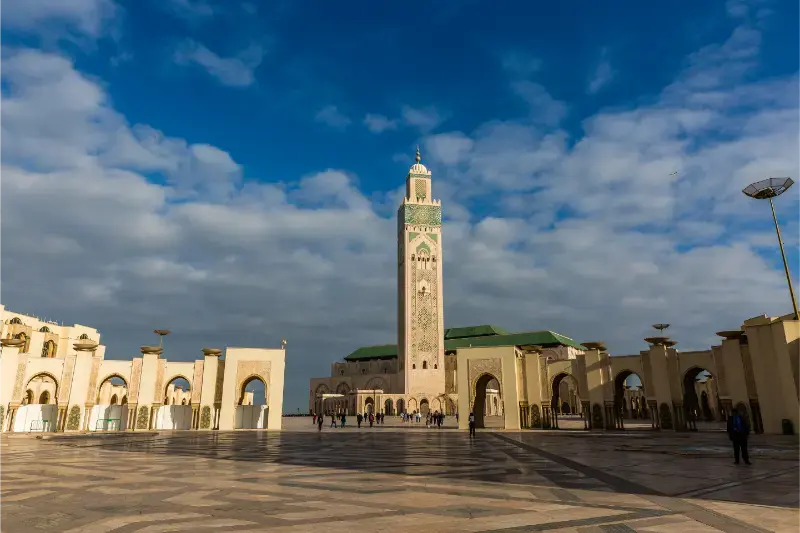
Morocco is often planned around Marrakech, Fez and the desert, which leaves the Atlantic side treated as arrival infrastructure. That misses a different version of the country: modern Casablanca, elegant Rabat and wind-shaped Essaouira.
This nine-day route stays on the Atlantic axis and does not return to Marrakech simply because it is famous. Casablanca and Rabat use rail; Essaouira becomes the slower final section reached by road.
The official Moroccan tourism office describes Casablanca as the country’s major modern metropolis and Rabat as a modern capital with deep historical roots and an Atlantic coastline. Essaouira is promoted separately as a medina-and-beach destination, which is exactly the contrast this route uses.
Quick trip summary
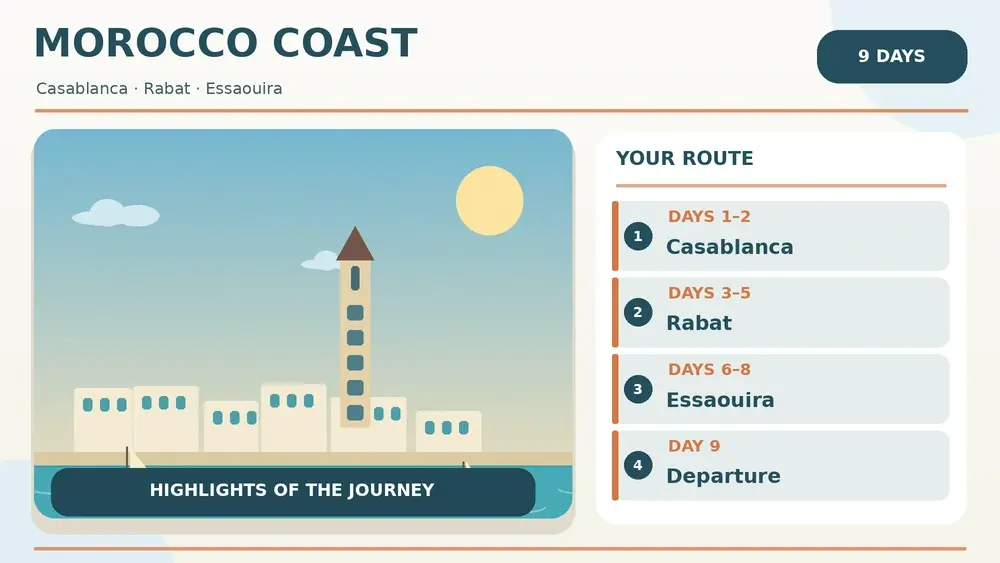
- 2 nights Casablanca, 3 Rabat, 3 Essaouira, Day 9 departure/transfer.
- Use train between Casablanca and Rabat.
- Use road transport for Rabat/Essaouira, often via Casablanca or another practical connection.
- Do not add Marrakech unless you extend the trip.
- Expect wind to shape Essaouira beach days.
Why this route works
Casablanca works well for architecture, the Hassan II Mosque area and contemporary urban Morocco when given two nights instead of an airport layover.
Rabat is calmer and more walkable than Casablanca and deserves three nights for Oudayas, Chellah, museums and coastline.
Essaouira is the natural slow finish: medina, harbour, seafood, beach and Atlantic light rather than another inland city.
A realistic itinerary at a glance
| Days | Base | Main focus |
|---|---|---|
| 1–2 | Casablanca | Modern city, architecture and Atlantic waterfront |
| 3–5 | Rabat | Capital, Oudayas, Chellah and coast |
| 6–8 | Essaouira | Medina, harbour, beach and slow days |
| 9 | Departure | Road/airport connection |
Day-by-day plan
Day 1: Casablanca arrival
Keep the day to the central city, Corniche or an easy meal according to arrival time. Casablanca is large, so avoid an airport-to-sightseeing marathon.
Day 2: Casablanca properly
Visit the Hassan II Mosque according to current visitor arrangements, then add Art Deco streets, the old medina or Corniche. Do not treat the city solely as one mosque plus the station.
Day 3: Train to Rabat
Take the straightforward rail move, check in and use the afternoon for the Kasbah of the Oudayas and riverfront.
Day 4: Rabat history
Visit Chellah, Hassan Tower/Mohammed V area and one museum or garden without crossing the city repeatedly.
Day 5: Rabat coast and neighbourhood day
Use the quieter pace for gardens, the coast, cafés or contemporary culture. This is the buffer that keeps the capital from becoming a checklist.
Day 6: Road transfer to Essaouira
Use the most practical coach/private transfer for your dates. Treat the road as the main activity and keep the first evening for the medina and harbour.
Day 7: Essaouira medina and harbour
Walk the ramparts, market lanes and fishing harbour slowly; strong Atlantic wind can make the beach better for watching/watersports than lying still.
Day 8: Slow coastal day
Choose a beach walk, surf lesson, nearby countryside or simply another medina day. Essaouira earns its value through repetition and atmosphere.
Day 9: Departure
If flying from Casablanca or Marrakech, position conservatively rather than depending on a long road transfer before check-in.
Where to stay and how many hotel changes to make
In Casablanca, choose rail/central access rather than a remote beach hotel if sightseeing is the purpose.
Rabat’s central areas near the medina or modern city make most days simple.
Inside Essaouira medina, luggage access can be limited; ask your riad how the final walk from taxi drop-off works.
On a multi-base itinerary, location often matters more than a small room-rate difference. A hotel that removes two daily transfers can save more energy than an upgraded room far from the places you actually want to visit.
Historic buildings can be atmospheric but may have stairs, small lifts, difficult vehicle access or late-night street noise. Read recent reviews for these practical details rather than relying only on star rating or photographs.
Transport: what is worth planning in advance
Casablanca–Rabat is well suited to rail, which is easier than driving between the major cities.
Essaouira lacks the same direct rail convenience, so compare reputable coach and private-transfer options.
Do not rent a car for Casablanca/Rabat city sightseeing unless you also need countryside flexibility.
Judge every transfer door to door. The advertised rail, bus, flight or ferry time is only one part of the move; checkout, terminal access, waiting, luggage and the final connection to the next hotel all consume usable day.
Book restricted tickets early only when the plan is genuinely fixed. Weather-sensitive days and remote transfers benefit from flexibility, even when the flexible fare costs a little more.
Food and daily rhythm
Casablanca gives modern variety, Rabat is excellent for calmer city dining and Essaouira naturally shifts toward seafood.
Inside medinas, choose restaurants by recent quality and hygiene reviews rather than the most aggressive invitation.
Meals should slow the itinerary rather than fill gaps between attractions. One regional lunch can add more to the memory of a trip than another rushed museum squeezed into late afternoon.
Mix local specialties with simple meals. Trying to make every breakfast, lunch and dinner an iconic food experience is tiring, expensive and particularly awkward on transfer days.
Families, children and older travellers
The mix of waterfronts, medina exploration and open spaces works well with children.
Older travellers should check riad stairs and medina walking surfaces.
Private road transfer to Essaouira can be worthwhile when luggage or mobility makes coach stations difficult.
For multigenerational travel, the realistic pace is the pace at which the least mobile member of the group still enjoys the day. That usually creates a better trip for everyone.
Children often respond better to variety than to quantity: a castle after a museum, a beach after an archaeological site or a short boat ride after a city walk.
Budget: where the money really goes
Rail between the major northern cities is efficient; the road transfer to Essaouira is where private transport can increase cost.
Riad charm is valuable only when the room is comfortable, quiet enough and accessible for your group.
Compare total trip cost rather than headline price. A cheaper hotel can become more expensive after taxis, parking, breakfast and the time lost reaching it.
The best splurges usually remove friction: a better-located room, a direct transfer, a guide where context matters or an extra night that prevents an exhausting one-day move.
Best time to go
Essaouira is famous for Atlantic wind, which can be refreshing in summer and cool at other times.
Spring and autumn balance city sightseeing with comfortable coast weather, but conditions vary day to day.
Shoulder season often gives the best balance of weather and crowds, but transport and attraction schedules can be reduced. Check the actual month rather than relying on a generic ‘best time’ sentence.
Heat, rain, wind and daylight should change the order of the day. Move exposed outdoor sights to the most comfortable hours and keep indoor alternatives available.
Comfort, accessibility and realistic pacing
The route deliberately becomes slower as it moves south-west.
Use the extra Rabat night to absorb arrival fatigue or poor weather instead of adding another famous city.
Travel fatigue compounds. A difficult transfer on Day 3 can reduce the quality of Days 4 and 5, which is why this itinerary avoids unnecessary one-night stops.
A free half-day is not wasted. It is a practical buffer for weather, laundry, a delayed departure, a child who needs rest or a place you discover only after arriving.
Small decisions that improve the trip
Do not force Marrakech into the route
It changes the trip from Atlantic Morocco into a highlights circuit.
Give Casablanca two nights
The city deserves more than airport logistics.
Finish in Essaouira
The coastal rhythm is an ideal contrast after two large cities.
What I would leave out on this length of trip
Leave Marrakech, Fez and the desert for other itineraries already covered on the site.
Skip same-day Essaouira from another distant city if you can sleep there instead.
Mistakes that make this trip harder than it needs to be
- Treating Casablanca as only an airport.
- Staying one night in Rabat.
- Assuming Essaouira is guaranteed sunbathing weather.
- Booking inaccessible riads for travellers with mobility issues.
- Renting a car unnecessarily in the big cities.
- Driving long-distance to an airport on the final morning.
How I would adapt the itinerary
With six days, use Casablanca/Rabat plus two Essaouira nights.
With twelve days, add El Jadida or another Atlantic stop with at least two nights rather than returning inland.
Before booking
- Check current mosque visiting arrangements.
- Compare rail and coach schedules.
- Ask riads about luggage access.
- Pack a wind layer.
- Protect the departure transfer.
Practical questions
Is Casablanca worth visiting?
Yes if modern architecture, urban Morocco and the Hassan II Mosque interest you. It should not be judged by Marrakech expectations.
Rabat or Casablanca for more nights?
Rabat is calmer and usually easier to enjoy slowly; Casablanca is larger and more urban.
Is Essaouira only a beach town?
No. Its medina, harbour, food and atmosphere are at least as important as the beach.
A final planning principle
This route works because it stops treating famous inland cities as mandatory.
A themed regional trip can show more of Morocco’s character than a rushed national checklist.
Final thoughts
Casablanca, Rabat and Essaouira form a coherent Atlantic journey with modernity, history and coast.
Nine days are enough precisely because the route refuses to detour inland for another headline city.