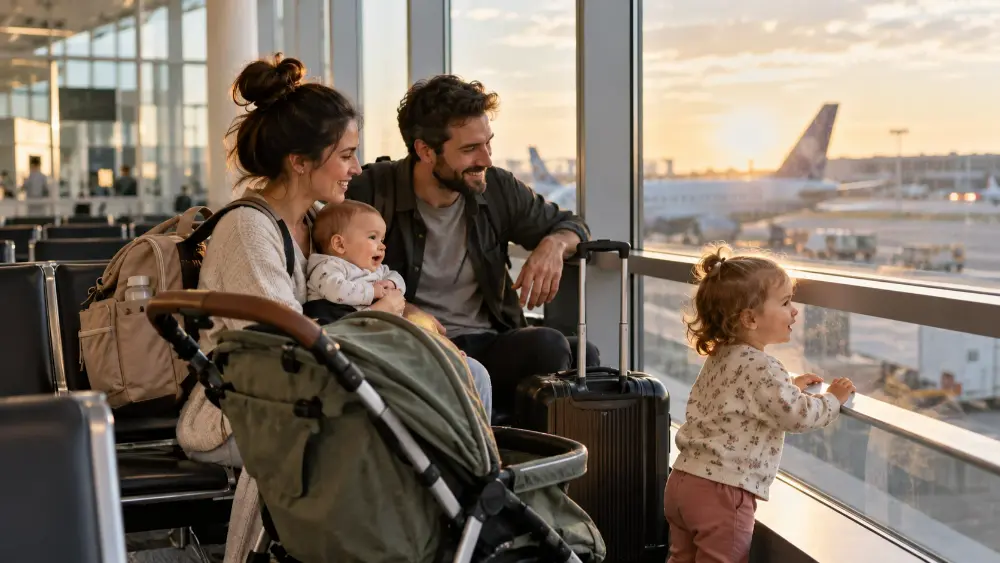
Flying with a baby for the first time can make even an experienced traveler feel like a beginner. You are planning around a person who cannot explain what feels uncomfortable, cannot carry a bag and may sleep at exactly the wrong time. The answer is not to predict every cry. It is to remove the problems you can solve before leaving home and accept that a slower trip can still be a wonderful trip.
At a glance
A realistic first-flight guide for parents traveling with a baby, covering safe seating, documents, feeding, airport routines, baggage and arrival-day plans.
- Flight: Total door-to-door time, layovers, stroller policy
- Seating: Airline-approved child restraint and seat position
- Arrival: Car-seat transfer, cot confirmation, gentle first day
This guide concentrates on the journey itself: deciding whether a flight makes sense, comparing infant ticket rules, choosing seating, packing a workable cabin bag, feeding during travel and designing a gentle first day. For the wider holiday, see our family-travel guide for different ages and the international-trip planning checklist. Rules for babies differ by airline, nationality, route and age; check the operator and authorities rather than relying on an old forum answer.
Choose the flight around the whole journey
A nonstop flight is often worth more than a superficially cheaper itinerary with a tight connection. Count time from your front door to the accommodation, not just hours in the air. A connection adds another boarding, another possible gate change and another period when your baby may need feeding or changing. If a connection is unavoidable, choose a comfortable buffer and check whether you must reclaim luggage or pass immigration at the intermediate airport.
Departure time matters, but there is no universally perfect baby flight. Some babies settle on an evening service; others struggle after a disrupted bedtime. Start with your child’s usual patterns, then consider the arrival time. Landing late at night with a long transfer and no open food options may be harder than taking a daytime flight. A schedule that works for the adults also matters: exhausted caregivers find every small problem larger.
Compare total costs. Infant fares, taxes, baggage allowances, stroller rules, seat selection and bassinet requests vary. A low headline fare may become poor value if the family must pay separately for hold luggage, adjacent seats and essential equipment. Ask the airline what is included for a lap infant versus an infant in their own seat, and keep the answer in writing.
Decide on a safe seating and restraint plan
A baby on an adult’s lap is allowed on many flights subject to airline and route rules, but permitted is not the same as safest. The US Federal Aviation Administration recommends that children under two use an approved child restraint system in their own airplane seat, particularly because unexpected turbulence can occur. Read the FAA’s guidance for flying with children and confirm your restraint, child size and seat position with the airline before paying for tickets.
Do not assume a car seat approved for road use is automatically approved for aircraft use in every country. Check its certification label and the operating airline’s policy. If you plan to use a bassinet, remember that availability and weight limits vary and requests may not be guaranteed. A bassinet is not a substitute for appropriate restraint when the crew requires seats to be secured. An adult traveling alone with a baby should think through how to reach the toilet, collect food and handle a delay without help.
The practical booking question is not simply “window or aisle?” It is whether the adult can reach baby supplies, whether a companion can help, whether the stroller can be used until boarding and how the child will be restrained during taxi, takeoff, turbulence and landing.
Check baby documents before paying for nonrefundable travel
International travel can require a separate passport for the infant, plus destination-specific visas or travel authorizations. Requirements depend on nationality and itinerary. Verify them through the destination government and the IATA Travel Centre, then check transit countries separately. Do not assume that being listed in a parent’s booking replaces the baby’s own documents.
Where only one parent or guardian travels, some border authorities or airlines may request additional evidence of parental responsibility or consent. Requirements are not universal. Research the precise journey and carry relevant documentation where appropriate. If the child has a different family name, give yourself more time to identify what documents may avoid confusion at check-in or a border.
For health preparation, discuss the destination and your baby’s age with an appropriate clinician before travel, particularly when routine immunizations, seasonal diseases, altitude, heat or local healthcare access might matter. The CDC’s guidance on traveling safely with infants and children offers useful questions to consider, although individual advice should come from a professional familiar with the child.
Pack one small bag that works during a delay
The best cabin-bag setup is not the most elaborate; it is the one another caregiver can understand in seconds. Keep diapers, wipes, changing mat, spare clothes for baby and an adult, small disposal bags, comfort items and feeding supplies in clearly separated pouches. Put a full change of clothes where it can be reached without removing every other object. Pack more essentials than the planned flying time suggests because airport delays and missed transfers are real possibilities.
Check current airport and airline rules for liquids, expressed milk, formula, sterilized water and baby food. Screening exceptions and container rules vary by country and sometimes by terminal. You may need to present items separately. Never depend on an airline to supply a particular brand, size or quantity of formula. A lightweight blanket or familiar sleep item can help with comfort, but follow safe-sleep guidance and never use a loose item in a way that compromises safety.

A useful test is to imagine the baby needs changing while the seat-belt sign is on, then the flight is delayed for two hours. What must be immediately available, and what can safely stay in a checked suitcase? That distinction creates an efficient bag.
Use a simple airport routine
Arrive with more margin than you would when traveling alone. Know whether online check-in is possible for the infant, whether documents must be inspected at the counter and where oversize or gate-checked equipment is accepted. Photograph the stroller and any car seat before handing it over; attach identifying details and keep any claim receipts.
If two adults are traveling, divide responsibilities explicitly. One handles passports, boarding passes and the queue; the other concentrates on the baby and the accessible pouch. Switch roles when needed. If you travel alone, place tickets and phone somewhere reachable with one hand. Ask staff for assistance early rather than waiting until boarding has begun.
Boarding first is not always the best choice. Extra time in a confined aircraft can make a restless baby more uncomfortable. If the airline offers family boarding, evaluate it against the child’s mood and whether you must install a child restraint. With two caregivers, one may board to arrange seats while the other stays with the baby until closer to departure, if airline procedures allow.
Manage feeding, ears and sleep without forcing a timetable
Offer feeding according to the baby’s normal needs, with attention to takeoff and descent if appropriate for your child. Sucking or swallowing may help equalize ear pressure, but it is not a guarantee and you should not force feeding when the baby refuses. Ask a pediatric clinician about ear problems or recent illness instead of improvising a treatment at the gate.
Prepare to feed in the seat you have booked, respecting seat-belt and crew instructions. If you bottle-feed, check options for safe warming and water supply rather than assuming cabin staff can sterilize equipment. Keep food hygiene practical and conservative, especially on long connections. A familiar settling sequence—feeding, quiet voice, sleep sack if appropriate—may translate better than trying to reproduce the entire home routine.
Sleep may be shorter or more fragmented. That does not mean the flight has failed. Alternate small tasks between caregivers, take breaks where possible and prioritize the baby’s immediate needs over entertaining the entire cabin. Most fellow travelers simply want clear, calm behavior from adults handling a difficult moment.
Plan the transfer and first 24 hours
Arrival is the part many families underplan. Before departure, decide how you will travel from the airport, whether an appropriate child restraint is required and supplied, and where you can obtain essentials near the accommodation. A promised taxi child seat should be confirmed, not assumed. If you bring your own restraint, confirm its compatibility and installation requirements.
Choose accommodation for function before aesthetics: elevator or ground-floor access, reliable temperature control, space for a cot and room to prepare feeds or snacks. Ask whether a cot must be reserved and what bedding is supplied. A beautiful apartment up four narrow flights of stairs may feel much less beautiful with a stroller, luggage and a sleeping child.
On arrival day, choose one gentle activity: a short walk, a grocery stop or simply time outside in a nearby park. Avoid prepaid timed attractions immediately after a long flight. For destination selection and pacing, our realistic itinerary-building guide explains why fewer commitments often produce better holidays.
Common first-flight problems and realistic responses
The flight is delayed: move supplies from the overhead bin to your day bag while you can, check where changing facilities are located and protect any essential medication or feeding items. The stroller does not appear at the aircraft door: follow the airport’s oversize-baggage procedure and ask staff where it will be returned. The baby cries during boarding: focus on needs rather than apologies; check temperature, feeding, a diaper change and whether your baby needs quiet or movement.
An adult is overwhelmed: switch roles when possible. If alone, simplify; it is fine to stop trying to entertain and concentrate on one need at a time. The child sleeps through the planned sightseeing: keep the day flexible. The trip is not a competition to see everything, and sleep is part of the schedule now.
A first-flight checklist you can actually use
- Confirm infant booking, separate travel documents and transit rules.
- Check seating and restraint approval with the airline, plus stroller and baggage policies.
- Arrange a safe transfer and confirm any cot or baby equipment at the accommodation.
- Put feeding supplies, changing essentials and spare clothing in reachable cabin pouches.
- Allow generous airport and connection time, and keep the arrival day light.
- Check destination-specific health advice with a qualified professional.
Frequently asked questions
Is flying with a baby easier before or after the first birthday?
There is no universal easier age. Some younger babies sleep more, while some older babies tolerate routine changes better but need more movement. Choose based on the child’s health, travel duration, your support and your confidence in managing the full journey rather than an internet rule.
Can I take a stroller to the aircraft door?
Some airlines allow gate-checking; others require equipment to be handed over earlier, and the return point may differ by airport. Verify the exact arrangement for each operating airline and connection rather than relying only on the booking website.
Should we book many activities on day one?
Usually not. Immigration, baggage collection, transfers and feeding can make arrival unpredictable. Protect a few flexible hours, buy essentials and build your schedule around rest before adding timed visits.
Do babies need their own passport abroad?
In many international situations they do, but the precise documentation depends on the child’s nationality and route. Check each relevant government and airline before booking; a birth certificate alone is not a substitute for required travel documents.
The most reassuring first flight is rarely the one where nothing goes wrong. It is the one where the adults have a few sensible options when something does. Leave room for the baby to be a baby—and enough room in the itinerary for everyone to enjoy the destination.