Spain is one of the easiest large European countries to overplan. The rail map invites you to add another city because the transfer looks short, while social media makes it feel almost irresponsible to skip Seville, Granada, Bilbao, San Sebastián, Mallorca or the Costa Brava. In ten days, that instinct usually turns a holiday into a sequence of station platforms.
This route deliberately stays outside Andalusia, which already deserves its own 10-day Andalusia itinerary. Madrid, Valencia and Barcelona create a strong first journey because the contrasts are real: monumental capital, Mediterranean city and a visually distinctive Catalan finale. More importantly, the high-speed rail network lets you travel centre to centre without using another airport.
The order can be reversed according to flights. What matters is keeping three bases, giving each city enough time to develop beyond a checklist, and treating train days as part of the journey rather than pretending they cost no time.
Quick trip summary
- Use three bases only: Madrid, Valencia and Barcelona.
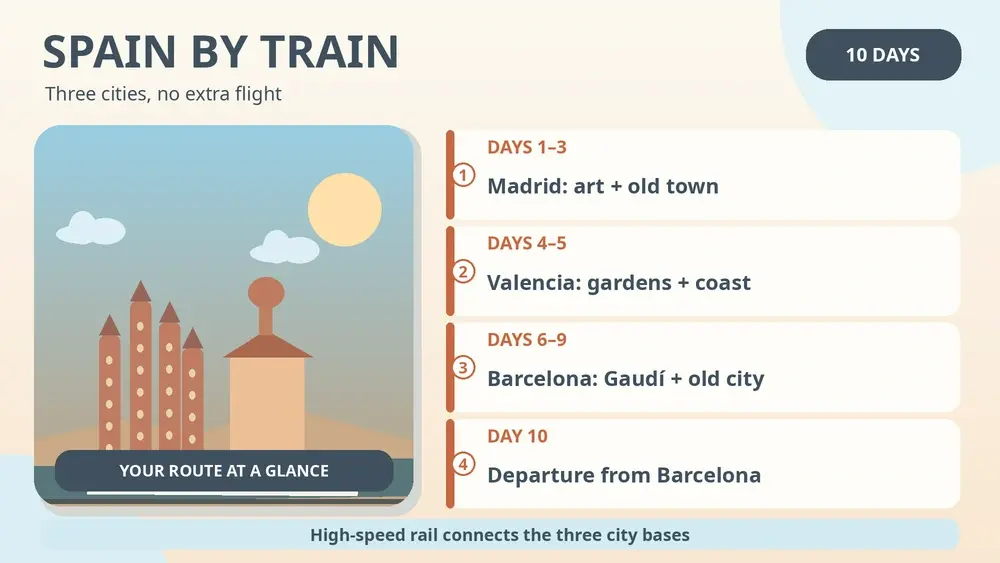
- Spend 3 nights in Madrid, 2 in Valencia and 4 in Barcelona, with the final departure day kept simple.
- Book long-distance trains once dates are fixed; keep most urban transport flexible.
- Group museums and landmarks geographically instead of crossing each city repeatedly.
- If you want Andalusia too, extend the trip rather than squeezing Seville into these ten days.
Why Madrid, Valencia and Barcelona make a coherent first route
Madrid gives the trip historical weight and world-class museums, but it also works as a neighbourhood city if you stop treating Puerta del Sol as the centre of everything. Retiro, Lavapiés, La Latina, Chamberí and the streets around the major art museums can each support a different kind of day.
Valencia changes the scale. It is easier to navigate, flatter, closer to the sea and gives you a useful breathing space between the two largest cities. The old town, Turia Gardens, City of Arts and Sciences and beach areas can be combined without a frantic schedule.
Barcelona then deserves the longest stay because advance reservations and geographic spread matter more. Gaudí sites, the Gothic quarter, Montjuïc, waterfront and neighbourhood time compete for attention. The route works especially well by rail: Renfe operates high-speed services between Madrid and Valencia, and Madrid–Barcelona is also a major high-speed corridor.
A realistic itinerary at a glance
| Days | Base | Main focus |
|---|---|---|
| 1–3 | Madrid | Historic centre, art, Retiro and one neighbourhood-focused day |
| 4–5 | Valencia | Old town, Turia Gardens, City of Arts and Sciences and Mediterranean evening |
| 6–9 | Barcelona | Gaudí, old city, Montjuïc and neighbourhood time |
| 10 | Barcelona / departure | Slow morning and onward flight or train |
Day-by-day plan
Day 1: Arrive in Madrid and keep the radius small
Choose a base with direct metro or walking access to the areas you actually plan to visit. After a flight, use the first afternoon for Plaza Mayor, nearby streets, an early meal and perhaps a short sunset walk rather than starting with a timed museum. Madrid evenings run late, but jet lag and travel fatigue do not care about local dining culture.
Day 2: Prado area, Retiro and the east side of the centre
Make one major museum the anchor. The Prado can absorb several hours, so pair it with Retiro Park and the streets around Barrio de las Letras rather than another huge collection. If the Reina Sofía matters more to you, build the day around that instead. The important choice is depth over museum quantity.
Day 3: Historic Madrid plus a neighbourhood you would actually return to
See the Royal Palace area, then spend the second half of the day in La Latina, Malasaña, Chamberí or another district that fits your interests. This is also the best buffer for a museum reservation you could not get on Day 2. Do not add Toledo merely because it is possible; three Madrid nights are already short.
Day 4: Train to Valencia and an easy first afternoon
Take a morning or midday high-speed train and remember that checkout, station time and hotel check-in turn even a fast service into a meaningful part of the day. After arrival, walk the old town and find dinner rather than scheduling the City of Arts and Sciences immediately.
Day 5: Valencia from the Turia to the sea
Use the Turia Gardens as the spine of the day. Visit the City of Arts and Sciences only to the depth that interests you; not every traveller needs every ticketed component. Later, move toward the beach or Cabanyal for a contrasting evening. If paella is a priority, lunch is the culturally natural time to make it the main meal.
Day 6: Train to Barcelona and settle before sightseeing hard
Travel to Barcelona, leave luggage and explore the area around your hotel. Staying in Eixample can simplify Gaudí days; Gràcia feels more residential; the Gothic quarter is atmospheric but can be noisy and less convenient with a car or heavy luggage. Keep this day deliberately light.
Day 7: Sagrada Família and a Gaudí-focused route
Book the Sagrada Família at a time that does not force you to sprint across the city. Pair it with one other major Gaudí site, not three. The visual intensity is real, and interiors become less memorable when they are stacked. Use the evening in Gràcia or Eixample rather than returning automatically to La Rambla.
Day 8: Gothic Barcelona and the waterfront
Start in the old city before the busiest part of the day, but avoid treating every medieval lane as a separate attraction. Move gradually toward El Born and the waterfront. This is a good day to keep reservations minimal because wandering is part of the experience.
Day 9: Montjuïc or a slower neighbourhood day
Choose Montjuïc if you want museums, viewpoints and open space. Otherwise use the day for markets, parks, a beach walk or the neighbourhood that most interested you earlier. Do not force a Costa Brava day trip into the schedule unless it is more important to you than Barcelona itself.
Day 10: Departure
Keep the morning close to the hotel and allow airport time that reflects your terminal and luggage situation. Barcelona’s airport transfer is straightforward, but a final morning becomes stressful quickly if it depends on several timed attractions.
Where to stay and how many hotel changes to make
In Madrid, Sol is central but not automatically best. Areas near Retiro, Barrio de las Letras, Chamberí or even Atocha can make more sense depending on museums and train departure. The station matters more when you are continuing to Valencia with luggage.
In Valencia, the old town is practical for a short first visit, while Ruzafa offers restaurants and a more lived-in evening atmosphere. Beach accommodation is better for a sea-focused trip than for a two-night cultural stop.
In Barcelona, spend more on location if it saves repeated cross-city journeys. Four nights justify a comfortable base, and a lift or reliable air conditioning can matter more than decorative charm in an older building.
Transport: what is worth booking in advance
Long-distance rail is the backbone of this itinerary. Book the fixed intercity legs once your hotels are confirmed, but use the operator’s current timetable rather than copying a departure time from an article. Renfe explicitly markets both Madrid–Valencia and Madrid–Barcelona as city-centre high-speed routes.
Urban transit works well in all three cities. You rarely need a rental car, and parking would add cost and complexity. Taxis or ride services can be useful after a late dinner or for travellers with mobility limits, but should supplement rather than replace the networks.
If flying open-jaw into Madrid and out of Barcelona is reasonably priced, it removes the need to backtrack. Compare total trip cost, not only airfare; a cheaper round trip can lose its advantage once an extra hotel night or long return train is added.
Food and daily rhythm
Madrid rewards tapas and market grazing, Valencia deserves at least one proper rice lunch, and Barcelona has excellent food well beyond the most photographed streets. The best strategy is to plan one or two priority meals in each city and leave the rest flexible.
Meal timing can be later than some visitors prefer. Families and older travellers do not need to force a local clock that makes them uncomfortable; an early lunch, café break and simpler evening meal can preserve energy for sightseeing.
Families, children and older travellers
Children usually respond better to one major interior followed by a park, playground or open walk. Retiro, Turia Gardens and Barcelona’s waterfront make this route easier than an itinerary built entirely around cathedrals and museums.
Older travellers should treat station changes as real physical work. Reserve seats, travel with luggage you can manage, and avoid accommodation that requires steep stairs unless you have confirmed a lift.
For multigenerational groups, a taxi from station to hotel can be money well spent even when the metro is cheaper. Save walking capacity for the city itself.
Budget: where the money really goes
Rail fares vary strongly by flexibility and booking time. Advance purchase can reduce costs, but the cheapest ticket is not always worth it if your flight arrival makes a missed connection possible.
Barcelona accommodation can dominate the budget, followed by major attraction tickets. Valencia is often where you can rebalance spending with lower hotel or meal costs.
Do not buy city passes automatically. Compare them against the exact museums and transport you will use. A pass that pushes you to add attractions can cost both money and the slower pace this itinerary is designed to protect.
Best time to go
Spring and autumn are the easiest all-round periods for this route, with good city walking conditions and fewer heat-management problems. Summer can be excellent if you accept midday breaks and reserve air-conditioned accommodation.
Madrid can feel much hotter than visitors expect, while Barcelona and Valencia add humidity. Winter is cooler and can be very good for museums and food, although beach time becomes secondary.
Major festivals, football fixtures and holiday weekends can change hotel prices dramatically. Check the calendar before judging a city as permanently expensive.
Small decisions that improve the trip
Book only the reservations that control the day
Sagrada Família and a few other high-demand sights are worth fixing early. Everything else should fit around those anchors. When every meal, museum and train has a precise time, one delay can make the itinerary feel like a chain of obligations rather than a trip.
Use Valencia as a real destination, not a stopover
Two nights is short, so resist arriving late and leaving early. The reason to include Valencia is to change the rhythm of the journey: less monumental than Madrid, less reservation-driven than Barcelona, and with enough space to spend part of a day outside without a ticket.
Travel light enough to enjoy the train advantage
High-speed rail is pleasant when you can move through stations independently. Oversized luggage turns each transfer into a project. A smaller case also makes hotel storage, lifts and walking the final few blocks much easier.
Choose museums by interest, not reputation
Spain’s major museums are exceptional, but there is no prize for seeing all of them. Pick the collections that fit your interests, then use the time saved for neighbourhoods, parks and meals that distinguish one city from another.
What I would leave out on this length of trip
I would leave Seville, Granada and the Balearic Islands for another trip. Adding one more flight or a very early train may be technically possible, but it removes the margin that makes the three-city route comfortable.
I would also skip a long day trip from Barcelona unless you have already visited the city. Girona or the Costa Brava are better reasons to extend the itinerary than reasons to compress Barcelona.
Mistakes that make this trip harder than it needs to be
- Using four or five hotels in ten days.
- Booking the cheapest non-flexible train immediately after an inbound flight.
- Scheduling multiple major Gaudí interiors on the same day.
- Treating Valencia as only a place to sleep between Madrid and Barcelona.
- Eating every meal in the most touristed streets because they are convenient.
- Adding Andalusia because the rail map makes it look close.
How I would adapt the itinerary
With seven days, choose Madrid plus Barcelona and save Valencia. With twelve to fourteen, keep the same three bases and add a day trip such as Toledo, Girona or the Costa Brava rather than adding another hotel every two nights.
Travellers who prefer the coast can shift one Madrid night to Valencia or Barcelona. Art-focused travellers should do the opposite and protect more Madrid time.
Before booking the trip
- Compare open-jaw flights before booking a round trip.
- Reserve the fixed long-distance trains once dates are stable.
- Book only the highest-demand Barcelona attractions well ahead.
- Check lift and air-conditioning details for summer accommodation.
- Keep at least one unscheduled half-day in Barcelona.
Spain becomes more enjoyable when the itinerary stops trying to prove how much of the country you covered. Madrid, Valencia and Barcelona already deliver three very different experiences, and the train keeps the journey connected without turning airports into a fourth destination.