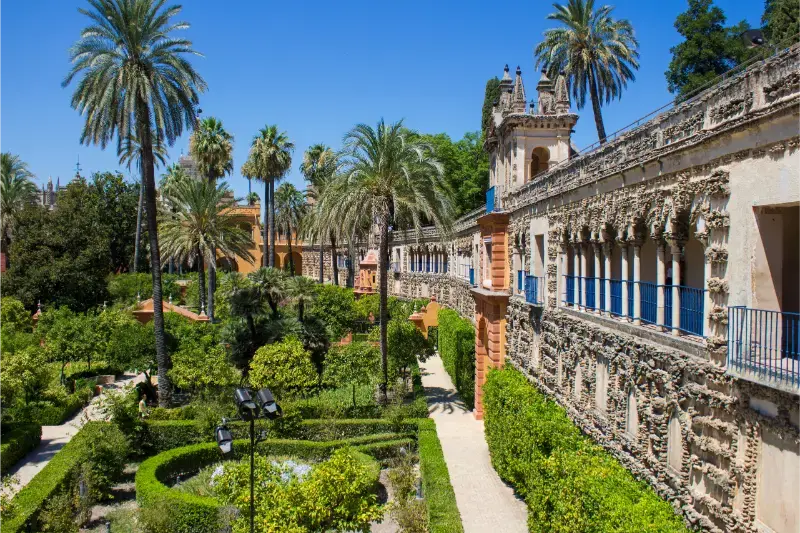
Andalusia can look deceptively compact on a map. Seville, Córdoba, Granada, Málaga, Ronda, Cádiz and the white villages all seem close enough to combine, and that is how many ten-day itineraries become a sequence of check-outs rather than a holiday.
A better first trip uses three bases at most. Seville deserves several nights, Córdoba can work as either a one-night stop or a day trip, and Granada needs enough time for the Alhambra plus the city beyond it. This route chooses depth over collecting provinces.
If you enjoy this pace, it connects naturally with our Portugal itinerary or Croatia guide on a different trip: the same principle applies across southern Europe—fewer bases usually produce better days.
Quick trip summary
- Use Seville and Granada as the two main bases; make Córdoba a day trip or one-night stop.
- Book the Alhambra as soon as your dates are firm because entry is capacity controlled.
- Use high-speed and intercity trains for the core route; a car is unnecessary inside the major cities.
- In hot months, move major outdoor sightseeing to mornings and late afternoons.
- Do not add Ronda, Málaga, Cádiz and several white villages unless you have more than ten days.
Why three famous cities are enough for ten days
Seville, Córdoba and Granada are not interchangeable. Seville is a large, lived-in city with monumental architecture and neighbourhood evenings; Córdoba is compact and works beautifully as a concentrated historic stop; Granada combines the Alhambra with hill districts, tapas culture and views toward the Sierra Nevada.
The rail network makes this route efficient. You can arrive in one city, walk or use local transport for several days, then move by train without dealing with parking or central driving restrictions.
The official Andalusia tourism website is useful for checking regional events and current attraction information, but your itinerary should still leave free time for plazas, neighbourhoods and meals.
A realistic itinerary at a glance
| Days | Base | Main focus |
|---|---|---|
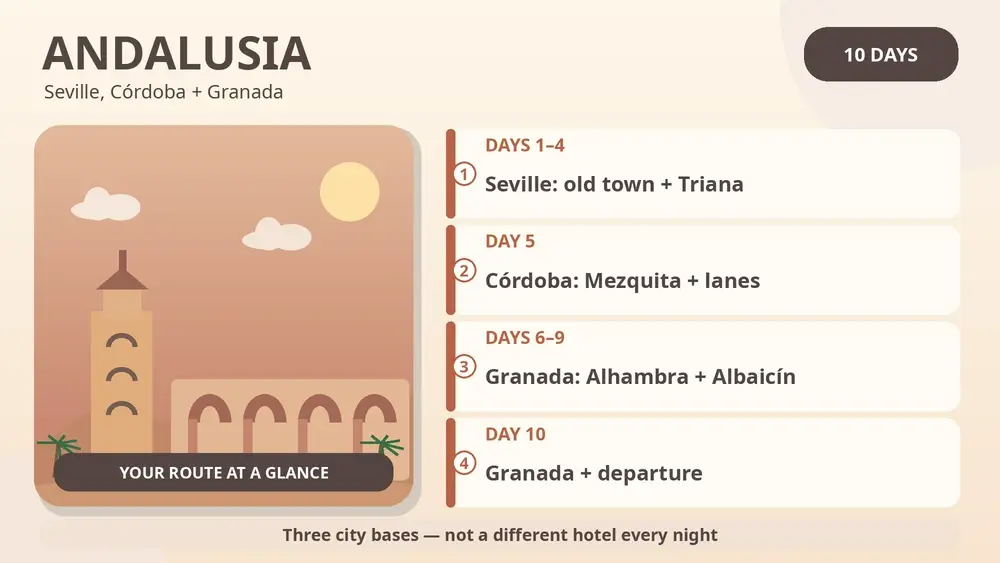
| 1–4 | Seville | Historic core, Triana, parks and one slower neighbourhood day |
| 5 | Córdoba | Mezquita-Catedral and old city |
| 6–9 | Granada | Alhambra, Albaicín, Sacromonte and city life |
| 10 | Granada / departure | Buffer and onward journey |
Day-by-day plan
Day 1: Arrive in Seville
Stay central enough to walk to the historic core but not necessarily on the busiest street. Use the first evening for a river walk, Alameda, Santa Cruz or Triana depending on where you sleep.
Seville is a city where atmosphere starts to make sense after sunset. Do not waste arrival day chasing a long monument list.
Day 2: Cathedral, Alcázar and the old centre
Give the major monuments a full day with a proper lunch break. Timed-entry tickets can reduce uncertainty, but stacking the cathedral, Alcázar, archives and several museums in one continuous block is tiring.
Return to the same streets later in the evening when the light and temperature change; seeing an area twice at different times often gives more value than adding another distant sight.
Day 3: Triana and the river
Cross to Triana, explore its market and ceramic traditions, then use the river corridor as a lower-intensity day. The official tourism site highlights Triana as a distinct cultural neighbourhood, and it is worth experiencing as more than a photo stop.
This is a good flamenco evening, but choose a performance style that suits you rather than assuming the most heavily advertised show is the only option.
Day 4: Seville beyond the headline sights
Use Plaza de España and María Luisa Park in the morning, then choose one museum, neighbourhood or food-focused afternoon. In summer, structure the day around heat rather than willpower.
If you want a day trip, Cádiz is possible, but on a first ten-day route I would keep this fourth day in Seville unless the coast is a major priority.
Day 5: Córdoba
Travel early by train. If staying overnight, leave bags and explore the Mezquita-Catedral area, Jewish Quarter, Roman bridge and quieter lanes after day-trippers leave.
If you prefer only two hotel bases, visit Córdoba as a day trip from Seville and take a direct train to Granada the next day. The one-night version is more atmospheric; the day-trip version is simpler.
Day 6: Move to Granada
Arrive without trying to visit the Alhambra immediately after check-in. Walk the lower centre, have a relaxed meal and orient yourself around the hills.
Granada involves more slopes than Seville or Córdoba. A hotel that looks close in map distance may still require a steep climb, which matters with luggage or limited mobility.
Day 7: Alhambra day
Treat the Alhambra as the main event, not a two-hour stop. Confirm the exact entry conditions for your ticket and allow time for the Nasrid Palaces, Generalife and the walk between areas.
Keep the evening flexible. A viewpoint at sunset is appealing, but you may prefer a simple dinner after several hours on your feet.
Day 8: Albaicín and Sacromonte
Explore the hill districts slowly, using buses or taxis for part of the climb if that makes the day more enjoyable. The value is in lanes, viewpoints and changes of perspective rather than a single attraction.
This is another good evening for flamenco if you skipped it in Seville, but the experiences are different enough that enthusiasts may enjoy both.
Day 9: Granada at a local pace
Use the final full day for the cathedral area, markets, tapas neighbourhoods or a short excursion if you have energy. Keeping one uncommitted day is useful if weather or ticket availability affected earlier plans.
Travellers who want mountains can investigate Sierra Nevada options, but do not force a long excursion simply to fill the day.
Day 10: Departure buffer
Have breakfast, revisit a favourite street and leave enough time for the station or airport. If flying from Málaga, account for the transfer rather than treating “Granada to Málaga” as a local airport ride.
Where to stay and how many hotel changes to make
In Seville, Santa Cruz is atmospheric but can be busy; Arenal is convenient for the river and centre; Alameda offers a more local evening feel. Choose according to your preferred night-time environment, not just daytime attractions.
In Córdoba, one night near the old city is enough if you want the evening atmosphere. If you dislike hotel changes, skip the overnight and visit by train.
In Granada, consider slope as well as location. Albaicín is beautiful but less convenient with heavy luggage; the lower centre can make transport and evening meals easier.
Transport: what is worth booking in advance
Train is the default for this route. It avoids city-centre parking and turns transfer days into simple point-to-point moves. Book earlier for fixed dates if you want better fares and preferred departure times.
Within cities, walk strategically and use buses or taxis when hills or summer heat make them worthwhile. Saving energy for the Alhambra or a long evening is not “cheating” the itinerary.
A rental car becomes more useful only if you add pueblos blancos or rural areas. For the three-city core, it is mostly an extra responsibility.
Food and daily rhythm
Andalusia rewards a later daily rhythm. Tapas, markets, terraces and long lunches can be part of the itinerary rather than breaks from it. In hot weather, a slower midday and active evening often matches local conditions better than a northern-European sightseeing schedule.
Do not chase a list of famous dishes in every city. Try local specialities, but leave room to return to places you enjoy. The best meal of a trip is not always the one with the longest reservation queue.
Families, children and older travellers
Families should balance monumental interiors with parks, plazas and shorter walking loops. Seville’s María Luisa Park and riverfront are useful reset spaces after formal sightseeing.
Older travellers may want hotels with lifts, especially in historic buildings, and should check walking gradients in Granada. A taxi to a hill viewpoint followed by a downhill walk can transform the day.
In July and August, heat management becomes a family and mobility issue, not merely a comfort preference. Early starts, shade, water and indoor breaks matter.
Budget: where the money really goes
Rail fares, Alhambra tickets and well-located hotels are the main items worth planning early. Restaurant spending can range widely, but sharing dishes and eating at local bars makes it easy to control without turning meals into austerity exercises.
City-centre parking can erase the apparent savings of a cheap rental car. If you are not visiting rural Andalusia, compare the full transport cost rather than the advertised daily rental rate.
Spend on location and timed tickets before upgrading every hotel category. Less commuting is often the more valuable luxury.
Best time to go
Spring and autumn are popular for good reason, but festival dates can also mean high prices and crowds. Winter can be excellent for city sightseeing, although evenings are cooler and daylight shorter.
Summer is possible, but the itinerary must change. The middle of the day should be lighter, and outdoor sites should be moved to morning or evening.
Check event calendars because Semana Santa, Feria periods and local festivals can dramatically change availability and atmosphere.
Mistakes that make this trip harder than it needs to be
- Trying to fit Seville, Córdoba, Granada, Málaga, Ronda and Cádiz into ten days.
- Renting a car for city-to-city travel when you do not need it.
- Waiting until the last moment to look for Alhambra tickets.
- Ignoring summer heat when planning afternoon walking.
- Choosing an Albaicín hotel without checking access and gradients.
- Treating Córdoba only as a two-hour stop between trains.
How I would adapt the itinerary
With seven days, use Seville and Granada as the two bases and make Córdoba a day trip from Seville. With fourteen days, add Cádiz or a short rural/white-village segment rather than simply extending every city.
Beach-focused travellers can finish in Málaga or the Costa del Sol, but that creates a different trip. If your priority is architecture, history and food, the three-city route already has enough depth.
Before booking the trip
- Reserve the Alhambra once your Granada dates are fixed.
- Compare rail times before choosing hotel nights.
- Check whether your accommodation has a lift and easy luggage access.
- Plan heat-sensitive sightseeing around the season.
- Review current regional events on the official Andalusia tourism site.
Andalusia is not improved by seeing more towns per day. It becomes memorable when you have time to notice how Seville changes after dark, how Córdoba empties in the evening and how Granada’s hills look different from one viewpoint to the next.