
The Florida Keys stretch for more than 100 miles below the mainland, and the Overseas Highway crosses 42 bridges. That makes the drive iconic, but it also means a Key West hotel is not a sensible base for daily reef trips in Key Largo or vice versa.
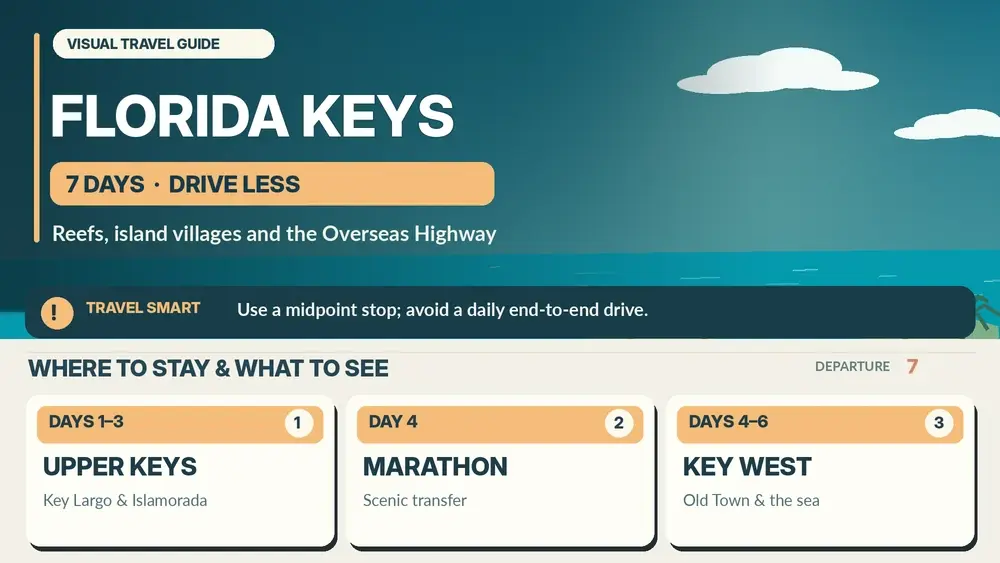
This seven-day route uses two main bases: Key Largo or Islamorada for the Upper Keys and Key West for the Lower Keys, with Marathon as a deliberate stop or day rather than another compulsory hotel change.
The official Florida Keys tourism site describes five distinct destination areas—Key Largo, Islamorada, Marathon, the Lower Keys and Key West—connected by the 113-mile Overseas Highway. The geography makes a one-way, two-base trip much more comfortable than constant backtracking.
Quick trip summary
- 3 nights Key Largo or Islamorada, 3 nights Key West, Day 7 departure.
- Use Marathon and the Seven Mile Bridge area during the transfer rather than changing hotels again.
- Book reef/snorkel trips with weather flexibility.
- Avoid weekend/holiday drive assumptions based on empty-road map estimates.
- Consider open-jaw flights or a final Miami buffer if the international flight is expensive to miss.
Why this route works
The Upper Keys provide the strongest reef/snorkelling/diving access and an easier first drive from Miami.
Marathon naturally breaks the highway and offers wildlife/bridge/coast stops without requiring another checkout.
Key West deserves several nights for history, walking, food and evenings when day visitors have left.
A realistic itinerary at a glance
| Days | Base | Main focus |
|---|---|---|
| 1–3 | Key Largo / Islamorada | Reef, mangroves and Upper Keys |
| 4 | Overseas Highway / Marathon | Scenic transfer and Middle Keys stops |
| 4–6 | Key West | Old Town, history and flexible sea day |
| 7 | Departure | Key West flight or mainland return |
Day-by-day plan
Day 1: Miami to Upper Keys
Collect the car and drive south without turning every roadside attraction into a stop. Check in before dark and use a waterfront dinner as the first Keys experience.
Day 2: Reef or marine day
Choose snorkelling, diving, glass-bottom boat or eco-tour according to swimming ability. Weather and sea conditions should decide whether the trip goes ahead.
Day 3: Islamorada/Upper Keys
Use mangroves, paddling, fishing culture, galleries or a slower beach/water day. The official tourism site distinguishes Islamorada’s boating/fishing identity from Key Largo’s reef gateway role.
Day 4: Drive to Key West via Marathon
Stop in Marathon/Seven Mile Bridge area and perhaps one Lower Keys nature stop. The Overseas Highway is the day’s scenic spine; do not try to visit every key.
Day 5: Key West history and walking
Leave the car parked and use Old Town, Hemingway/Truman-style history, architecture and waterfront areas on foot or local transport.
Day 6: Key West flexible day
Choose a responsible boat/snorkel trip, Dry Tortugas planning if it is a true priority and booked, beaches or another historical/cultural day. Do not book the whole day around sunset.
Day 7: Departure
Fly from Key West if the ticket works or drive north with a major buffer. A Key West–Miami airport drive is not a local transfer and traffic incidents can erase optimistic timing.
Where to stay and how many hotel changes to make
Key Largo is practical for reef access; Islamorada feels more spread out and relaxed.
In Key West, paying for walkability can save parking and make evenings much easier.
One Upper Keys base plus Key West is enough for a week; Marathon works naturally as a transfer stop.
On a multi-base trip, location matters more than a small difference in nightly price. A room that removes repeated transfers can add more value than a prettier property that forces extra driving or taxis every day.
Read recent guest reviews for practical details that booking photos rarely show: stairs, lift size, road noise, parking access, breakfast hours, room ventilation and the final walk from transport.
Transport: what is worth planning in advance
A car is useful for the Upper/Middle Keys and highway transfer, but mostly unnecessary once parked in central Key West.
There is essentially one main road, so accidents and peak traffic can have disproportionate effects.
If returning to Miami for a flight, consider a mainland final night when the ticket is costly or departure is early.
Measure every move door to door rather than by the headline journey time. Checkout, reaching the station or airport, waiting, luggage and the final connection to the next hotel can turn a short transfer into half a day.
Use inflexible tickets only when the saving is meaningful and the day is genuinely fixed. Weather-sensitive road, ferry and outdoor plans benefit from flexibility.
Food and daily rhythm
Seafood, Cuban influences and casual dockside meals fit the route naturally.
A famous Key West dinner is more enjoyable when you are not hunting for parking at the same time.
Use meals to control the rhythm of the day. A long regional lunch can be an experience and a recovery period, especially after hiking, museums, boat trips or an early start.
Do not make every meal another attraction. Mix local specialties with simple food so that the destination, not the restaurant schedule, remains the centre of the trip.
Families, children and older travellers
Glass-bottom boats, aquariums/wildlife centres and shallow-water experiences can suit non-swimmers.
Older travellers should ask about boat boarding and sun exposure.
Key West walking days reduce the car-seat/parking cycle for families.
For multigenerational travel, the useful pace is the one at which the least mobile member still enjoys the day. That usually produces a better experience for everyone.
Children often respond better to a change of format than to another famous sight: a beach after a museum, a ferry after a city walk, or wildlife after a road day.
Budget: where the money really goes
Keys accommodation is often expensive; two bases reduce cleaning/parking/check-in costs.
Marine activities are the main splurge, so choose one excellent reef day rather than paying for similar boat trips repeatedly.
Compare total trip cost rather than headline prices. Parking, transfers, luggage, tours, resort fees and time lost reaching a remote hotel can erase an apparent saving.
The best splurges usually remove friction: a central room, a safe private transfer, a direct train or ferry, a guide where context matters or one extra night that prevents an exhausting move.
Best time to go
Heat, thunderstorms, hurricane risk and winter cold fronts can all affect water plans.
Sea conditions matter more than sunshine alone for snorkelling and boats.
Shoulder season often balances weather, demand and prices well, but ferries, mountain services, rural restaurants and scenic roads may operate less frequently.
Heat, rain, wind, snow and daylight should change the order of a day. Use comfortable hours for exposed outdoor sights and keep lower-effort alternatives available.
Comfort, accessibility and realistic pacing
Three nights in each main base make the highway a scenic transfer rather than a daily commute.
Keep departure day conservative because one road connects much of the island chain.
Travel fatigue compounds. One difficult transfer can reduce the quality of the following two days, which is why this route avoids one-night bases unless geography genuinely requires them.
A free half-day is not wasted time. It is insurance for weather, laundry, a delayed transfer, a tired child or a place you discover only after arrival.
Small decisions that improve the trip
Use two bases
Upper Keys and Key West are far enough apart to justify the split.
Make Marathon the transfer day
It breaks the road naturally without another hotel.
Park in Key West
Walking is part of the experience.
Protect the Miami flight
Highway 1 does not offer many alternatives.
What I would leave out on this length of trip
Leave a full Everglades road trip for another segment unless you add several days.
Skip driving Key West–Key Largo–Key West for attractions on consecutive days.
Mistakes that make this trip harder than it needs to be
- Using Key West as the base for the whole chain.
- Underestimating traffic on the one main highway.
- Booking water trips with no weather backup.
- Paying for a car that never moves in Old Town.
- Treating Marathon as only a gas stop.
- Driving directly to a tight Miami flight.
How I would adapt the itinerary
With four days, use Key West plus one Upper Keys night.
With ten days, add a mainland Everglades section or more slow Keys time, not more hotel changes.
Before booking
- Book reef trips with cancellation policy.
- Check hurricane-season insurance.
- Plan Key West parking.
- Keep road-trip fuel/water stocked.
- Protect the final flight.
Practical questions
Key Largo or Islamorada?
Key Largo is strongest for reef access; Islamorada is excellent for a laid-back boating/fishing atmosphere.
Do I need a car in Key West?
Not if you stay centrally; walking, bikes and local transport are often easier.
How long does the Overseas Highway take?
The pure drive is only part of the story. Traffic and scenic stops make it a real travel day.
Final thoughts
The Florida Keys are more enjoyable when the Overseas Highway is used as a journey once rather than a commute every day.
An Upper Keys base and Key West give a week enough reef, road-trip scenery and old-town evenings without wasting hours backtracking.