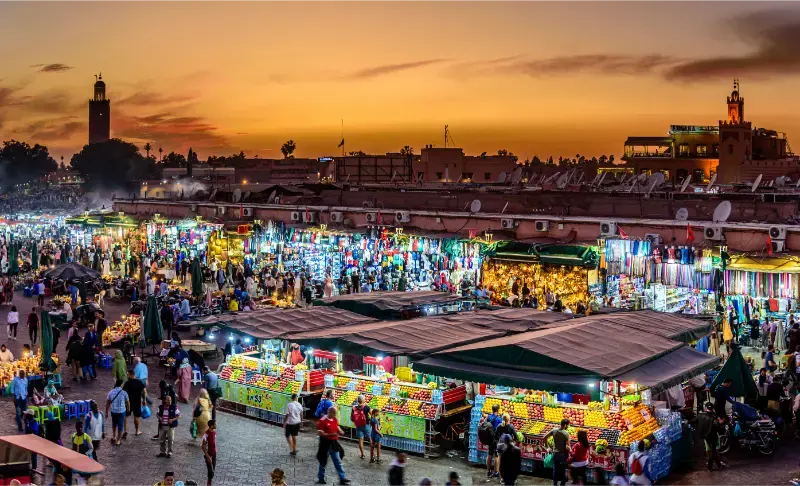
The classic Marrakech-to-Merzouga desert tour is often sold in three days, which is technically possible and usually means very long hours in a minibus. If the Sahara is one of the main reasons for travelling to Morocco, nine days allow the road itself to become part of the trip rather than an obstacle.
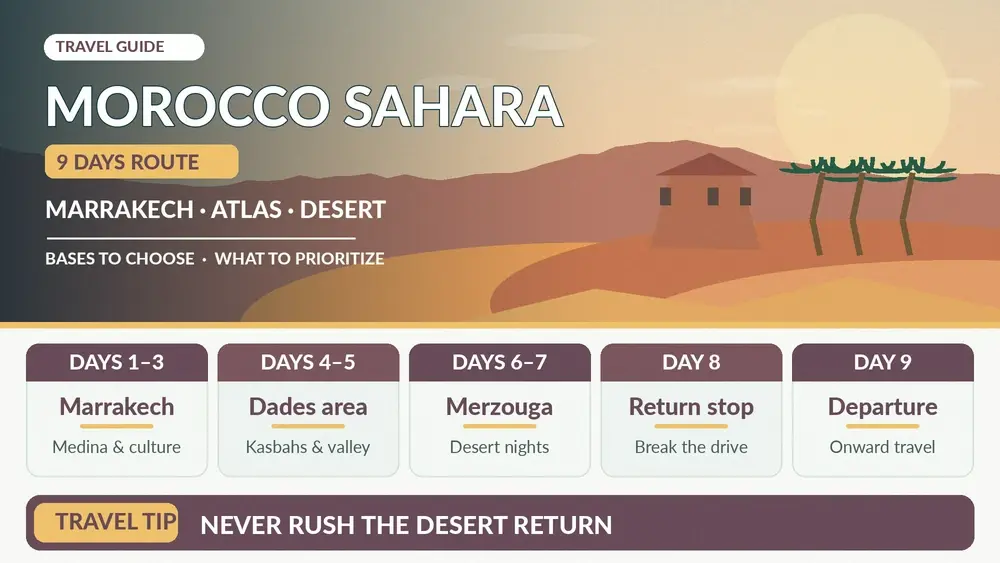
This route gives Marrakech three nights, two nights across the Ouarzazate/Dades corridor, two nights in Merzouga and a final overnight stop before returning or flying onward. The desert receives a full day instead of one sunset, sleep and sunrise before another eight-hour drive.
The Moroccan National Tourist Office presents Ouarzazate, the Dades valleys and Tinghir as a landscape region in its own right. Its suggested desert route gives roughly 194 km and about 3 hours 45 minutes from Marrakech to the Ouarzazate region, then about 303 km and 4 hours 20 minutes onward toward the Errachidia/Merzouga side—before scenic stops, mountain traffic and breaks are added.
Quick trip summary
- 3 nights Marrakech, 2 nights Ouarzazate/Dades corridor, 2 nights Merzouga, 1 return/transfer night, Day 9 departure.
- Use a reputable driver or tour for the desert road unless you are experienced with Moroccan mountain/desert driving.
- Sleep two nights in Merzouga.
- Do not treat Aït Ben Haddou and Dades as roadside photo stops only.
- Avoid a same-day Merzouga-to-international-flight connection.
Why this route works
Marrakech needs several nights before the road trip so the medina, gardens and food are not squeezed around transport.
The Ouarzazate/Dades section contains kasbahs, valleys and High Atlas approaches that deserve at least two nights.
Merzouga is one of Morocco’s Sahara gateways and becomes much more rewarding when you have a full day between arrival sunset and departure.
A realistic itinerary at a glance
| Days | Base | Main focus |
|---|---|---|
| 1–3 | Marrakech | Medina, food and acclimatisation |
| 4–5 | Ouarzazate / Dades | High Atlas crossing, Aït Ben Haddou, valleys and gorges |
| 6–7 | Merzouga | Erg Chebbi, desert camp and full desert day |
| 8 | Return corridor / Errachidia or Ouarzazate | Break the long return |
| 9 | Departure | Marrakech/Fes/Errachidia onward |
Day-by-day plan
Day 1: Marrakech arrival
Stay inside or near the medina depending on luggage tolerance and keep the first evening simple. Marrakech intensity plus a flight is enough for one day.
Day 2: Marrakech medina
Use a guided historic walk if helpful, then leave time for souks and a long lunch. Do not cram every palace and garden into one day.
Day 3: Marrakech flexible day
Choose gardens, food, hammam or another neighbourhood. This buffer means the desert departure tomorrow does not sit directly after a delayed international flight.
Day 4: Marrakech to Ouarzazate/Aït Ben Haddou
Cross the High Atlas with a reputable driver, stopping at Aït Ben Haddou and one mountain viewpoint. The official tourism estimate already approaches four hours before stops, so this is a full travel day.
Day 5: Ouarzazate to Dades/Tinghir corridor
Use Skoura, Dades Valley, Rose Valley or Todra direction according to the chosen overnight. The official tourism board treats this as a landscape region, not merely a road between Marrakech and the dunes.
Day 6: Continue to Merzouga
Drive toward Erg Chebbi, arriving with enough time to settle before a camel walk or 4×4 transfer to a desert camp. Do not schedule three additional gorges on the same day.
Day 7: Full Merzouga day
Use sunrise only if you want the early start, then return for rest. Spend the day with a village, oasis, guided desert walk, music/cultural experience or simply time among the dunes. A second sunset prevents the desert from becoming a sleepover.
Day 8: Break the return
Travel toward Errachidia/Midelt for a Fes direction or back toward Ouarzazate for Marrakech. This is intentionally a positioning night; forcing Merzouga to Marrakech in one push is exactly what the route is designed to avoid.
Day 9: Departure or onward city
Complete the return or fly from the most practical airport if schedules fit. Keep any international flight well separated from the long road segment.
Where to stay and how many hotel changes to make
In Marrakech, choose medina atmosphere versus vehicle access consciously; a riad deep in narrow lanes is beautiful but luggage transfers need planning.
In the desert, distinguish between a camp reached by dunes and a hotel/riad on the edge; bathroom, heating/cooling and electricity standards vary widely.
Hotel geography matters more than a small nightly-price difference. A room that removes a repeated transfer, long walk with luggage or difficult parking problem often adds more value than a prettier property in the wrong place.
Read recent guest reviews for practical details that promotional photos rarely show: stairs, lift size, road noise, parking, breakfast hours and how far you actually carry luggage from the station, ferry terminal or car park.
Transport: what is worth planning in advance
Private or small-group road transport is the easiest solution for a first Sahara route because the driver handles passes, fuel, stops and rural navigation.
Self-driving is possible for experienced travellers, but avoid night driving and confirm rental/insurance conditions for unpaved access.
Measure every move door to door rather than by the timetable headline. Checkout, waiting, luggage and the final transfer can turn a short train, road or ferry journey into half a day.
Save tickets, accommodation addresses and essential timetables offline. Rural roads, islands, mountains and national parks are exactly where mobile coverage or battery life can become least reliable.
Food and daily rhythm
Marrakech provides the broadest dining; road days rely more on set lunch stops, guesthouses and camp meals.
Communicate dietary needs before the desert because remote camps have less flexibility than city restaurants.
Use meals to control the rhythm of the day. A long regional lunch can be both an experience and a recovery period after museums, hiking, heat, driving or an early start.
Do not make every meal another attraction. Mix destination restaurants with markets, bakeries, cafés and simple local places so food improves the trip instead of controlling it.
Families, children and older travellers
The route can work with children if road days include real stops and the desert camp is selected for comfort, not only atmosphere.
Older travellers should ask about camel mounting, dune walking, camp toilets and 4×4 access; a camel ride is optional, not required to experience Erg Chebbi.
For multigenerational travel, the useful pace is the one at which the least mobile member still enjoys the day. That normally produces a better shared trip for everyone.
When accessibility matters, ask specific questions about steps, surfaces, boat boarding, lifts and vehicle access rather than relying on a generic accessibility label.
Budget: where the money really goes
Private drivers and high-comfort desert camps are the major expenses. A cheaper three-day group tour costs less but trades money for many more hours in the vehicle.
Paying for two desert nights can offer better value than an upgraded camp if the real goal is time in the landscape.
Compare total trip cost rather than headline room or ticket prices. Parking, taxis, transfers, luggage, park transport and time lost reaching remote accommodation can erase an apparent saving.
The best splurges usually remove friction: a central room, a direct transfer, a good guide where context matters, or one extra night that prevents an exhausting move.
Best time to go
Spring and autumn are easiest for desert travel; summer heat can be extreme and winter nights can be surprisingly cold.
High Atlas weather can differ sharply from Marrakech and Merzouga, so pack layers even on a desert-focused trip.
Shoulder season often balances weather, demand and prices well, but ferries, mountain services, wildlife excursions and rural attractions may run less frequently.
Heat, rain, snow, wind and daylight should change the order of a day. Use the most comfortable hours for exposed outdoor sights and keep easier alternatives available.
Comfort, accessibility and realistic pacing
No road day is followed immediately by another pre-dawn departure unless you choose it.
The full Merzouga day is the key difference between this route and a standard three-day transfer tour.
Travel fatigue compounds. One difficult transfer can reduce the quality of the following two days, which is why this itinerary avoids one-night bases unless geography genuinely requires them.
A free half-day is not wasted time. It is insurance for weather, transport disruption, a tired child or a place you discover only after arriving.
Small decisions that improve the trip
Give the road two nights before Merzouga
Aït Ben Haddou, valleys and gorges deserve real time.
Stay two nights in the desert region
One sunset is not enough if the Sahara is a trip priority.
Break the return
Long-road fatigue is avoidable.
Use the right camp for the group
Comfort and access matter more than social-media styling.
What I would leave out on this length of trip
Leave Chefchaouen, Atlantic Morocco and the northern cities for separate routes; the site already contains broader Morocco itineraries.
Skip the three-day Marrakech–Merzouga–Marrakech dash if you have a full nine days available.
Mistakes that make this trip harder than it needs to be
- Choosing a tour by the lowest price without checking driving hours.
- Assuming Marrakech-to-desert is a short transfer.
- Booking one Merzouga night.
- Forcing children or older travellers onto camels.
- Driving mountain roads after dark unnecessarily.
- Connecting the long desert return directly to an international flight.
How I would adapt the itinerary
With six days, use Marrakech plus Ouarzazate/Dades and choose a nearer desert experience instead of Merzouga, or accept one longer return day.
With twelve days, continue to Fes after Merzouga or add Skoura/Dades nights rather than more roadside stops.
Before booking
- Choose reputable driver/tour and inspect the real itinerary.
- Ask desert camp about bathroom and temperature comfort.
- Pack layers.
- Carry cash for rural stops.
- Protect the onward flight.
Practical questions
Is Merzouga worth the long drive?
Yes if the Sahara is a major priority and you stay long enough; not if you have only a very short Morocco trip.
Do I need to ride a camel?
No. 4×4 transfers and walking can provide the desert experience without camel riding.
How long is the Marrakech–Ouarzazate road?
The Moroccan tourism office gives roughly 194 km and around 3 hours 45 minutes, before stops and traffic.
Final thoughts
The Sahara should not feel like a distant attraction you endure a minibus to reach. The Atlas, kasbahs, valleys and dunes form one journey.
Nine days allow Marrakech, the southern road and Merzouga to become separate experiences instead of a three-day driving marathon.
How to keep this itinerary resilient
Mountain weather and roadworks can slow the Atlas crossing, so never schedule a fixed desert activity too close to the expected arrival time.
Keep the return night flexible enough to choose Marrakech, Errachidia or another logical hub according to your onward ticket.