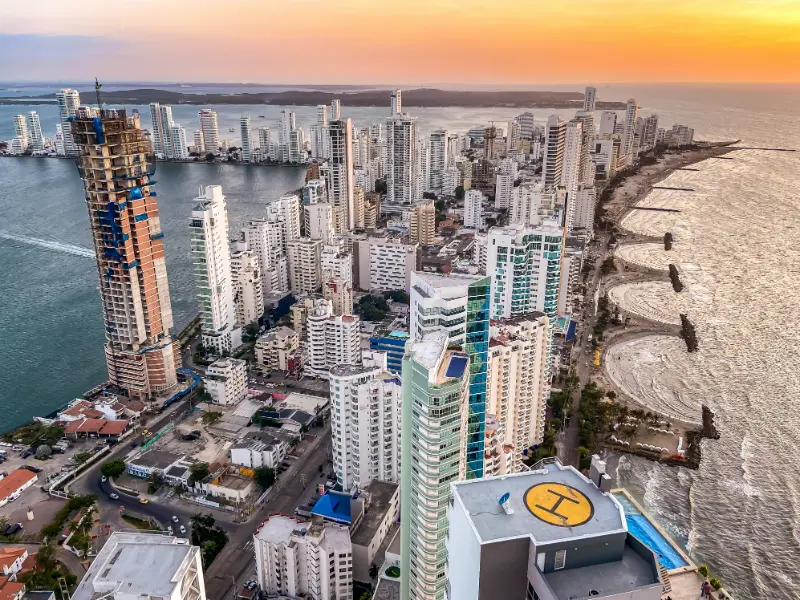
Colombia is large enough that a ten-day trip needs a clear transport strategy. Bogotá, Medellín and Cartagena form a classic first-time triangle because each feels different, and short domestic flights can save entire days compared with overland travel. The route only works, however, if you accept that airport time is part of the trip.
Bogotá brings altitude, museums and Andean weather; Medellín adds spring-like temperatures and a valley city shaped by public transport and neighbourhood change; Cartagena shifts the trip to Caribbean heat and colonial streets. Three bases are enough.
Travellers who want nature more than cities might prefer our Costa Rica itinerary or Peru itinerary. Colombia’s first-trip strength is the contrast between urban regions.
Quick trip summary
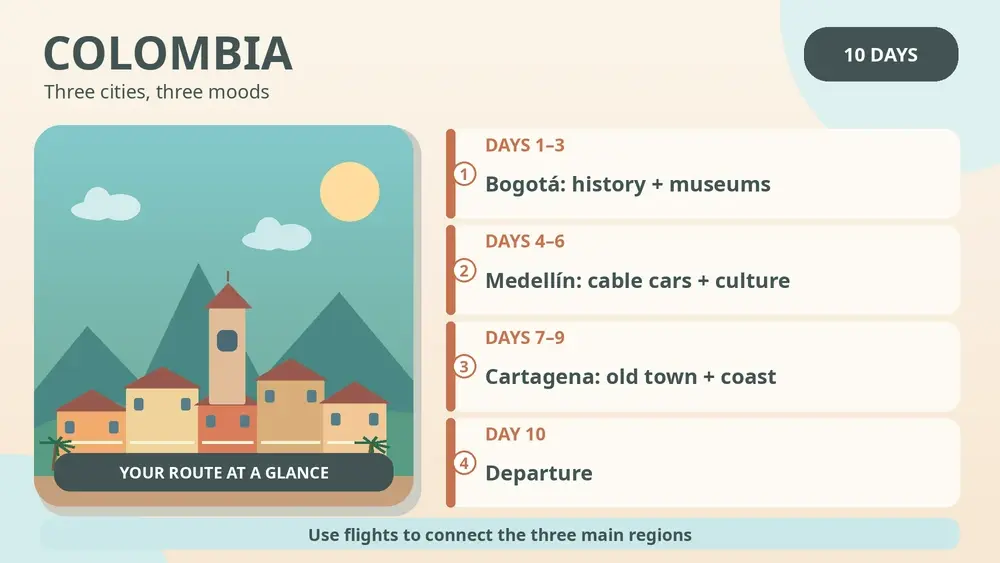
- Use 3 nights Bogotá, 3 nights Medellín and 3 nights Cartagena.
- Fly the long intercity legs; road journeys are much slower than map distance suggests.
- Give Bogotá an easy first day because of altitude.
- In Cartagena, plan around heat: early morning and evening outside, slower midday.
- Choose neighbourhoods carefully and use current local safety advice rather than relying on old reputations.
Why this city triangle is realistic
Each city offers a distinct climate and travel style, so the flights buy genuine variety rather than moving you between similar places. Bogotá and Medellín are separated by mountains; Cartagena sits on the Caribbean coast.
The route also gives you a natural energy curve: cooler Bogotá for culture, Medellín for mixed city/outdoor days, then Cartagena for a slower finish.
The official Colombia Travel site can help with current destination information. For neighbourhood-level safety and transport choices, use recent local guidance because conditions can change.
A realistic itinerary at a glance
| Days | Base | Main focus |
|---|---|---|
| 1–3 | Bogotá | La Candelaria, museums and one viewpoint/neighbourhood day |
| 4–6 | Medellín | City, cable cars and one regional excursion |
| 7–9 | Cartagena | Walled city, Getsemaní and optional islands |
| 10 | Departure | Fly home or connect onward |
Day-by-day plan
Day 1: Bogotá arrival
Bogotá sits at high elevation, so use arrival day for a short walk, an early meal and sleep. Staying in a neighbourhood with restaurants nearby reduces the need for late transport after a long flight.
Day 2: Historic Bogotá
Explore La Candelaria and choose one major museum such as the Gold Museum rather than trying to see every collection. Weather can shift quickly, so carry a light waterproof layer.
If you go to Monserrate, treat visibility as weather-dependent and avoid forcing the climb if altitude affects you.
Day 3: Bogotá beyond the historic core
Use the day for a food experience, Chapinero/Zona G, Usaquén or another neighbourhood according to your interests. This is also your buffer if Day 2 weather was poor.
Day 4: Fly to Medellín
A morning or midday flight works well. The airport is outside the central valley, so include the ground transfer in your planning.
After check-in, keep the first Medellín evening near your base.
Day 5: Medellín city day
Use the metro/cable-car system to understand the geography and visit one or two areas in depth. Guided context can be especially valuable in places where visitors are interested in the city’s social transformation.
Avoid “dark tourism” experiences that reduce complex communities to crime stories. Choose guides who centre residents and present-day life.
Day 6: Day trip or slower city day
Guatapé is a popular full day, but the drive and climb can be tiring. Choose it if colourful towns and reservoir views appeal to you; otherwise spend more time in Medellín’s museums, gardens and neighbourhoods.
Day 7: Fly to Cartagena
Arrive and adapt to the heat. Walk the walled city after the strongest sun has eased, then have dinner nearby.
Cartagena is compact but humid, and the climate changes how far you want to walk.
Day 8: Walled city and Getsemaní
Start early, return to the hotel or a shaded lunch at midday, then go out again in late afternoon. This split-day rhythm is more comfortable than pushing through the heat.
Take your time with streets, balconies, churches and plazas instead of turning the old city into a photo scavenger hunt.
Day 9: Islands or a slow Cartagena day
Choose a reputable boat trip if beaches are important. Sea conditions, transfer logistics and beach-club expectations vary, so understand exactly what the package includes.
If you are tired of transfers, stay in Cartagena. A slow final day can be more satisfying than another early pickup.
Day 10: Departure
Allow traffic and airport time. If connecting internationally on separate tickets, build more margin than the airline minimum.
Where to stay and how many hotel changes to make
In Bogotá, Chapinero/Zona G, Parque 93 and parts of La Candelaria offer very different evenings; choose based on your activities and current local advice.
In Medellín, El Poblado is convenient for first-timers but not the only option. Laureles offers a flatter, more residential feel.
In Cartagena, sleeping inside the walled city or Getsemaní makes evening walks easy, while Bocagrande offers modern hotels and a different atmosphere.
Transport: what is worth booking in advance
Domestic flights are worth using, but airport transfers are not trivial. Bogotá traffic and Medellín’s out-of-town airport can turn a “one-hour flight” into half a day.
Use app-based or authorised transport according to current local practice, especially at night and with luggage. If your itinerary adds protected natural areas later, verify rules through Colombia National Natural Parks rather than assuming city-tour advice applies nationwide.
Do not rent a car for this three-city route. It adds parking, security and navigation issues without improving the main transfers.
Food and daily rhythm
Each city has a different food scene. Bogotá is strong for contemporary Colombian cooking and markets; Medellín for Antioquian traditions and modern restaurants; Cartagena for Caribbean seafood and tropical flavours.
In Cartagena tourist zones, menu prices can vary widely. Check prices before ordering and be cautious with unsolicited beach services or add-ons.
Families, children and older travellers
Families should keep Bogotá’s first day light because altitude affects adults and children unpredictably. Medellín’s parks and cable cars can break up museum time.
Older travellers may prefer Laureles in Medellín for flatter streets and should use taxis strategically in Bogotá. Cartagena’s heat makes midday rest especially valuable.
A hotel pool in Cartagena is not a frivolous upgrade for a multigenerational group—it can be the difference between an enjoyable afternoon and heat fatigue.
Budget: where the money really goes
Domestic flights are often reasonably priced when booked ahead, but checked bags and seat fees can change the total. Compare the complete fare.
Cartagena is usually the most expensive stop for accommodation and tourism services. Bogotá and Medellín offer broader price ranges.
Budget for airport transfers in all three cities. They are part of the transport cost, not a minor extra.
Best time to go
Colombia’s seasons are driven more by altitude and rainfall than by a simple four-season pattern. Bogotá can be cool and wet while Cartagena is hot on the same day.
Pack for multiple climates: light layers and rain protection for Bogotá, warmer conditions in Medellín, breathable clothing and strong sun protection for Cartagena.
Holiday periods can raise domestic-flight prices and crowd coastal destinations.
Three cities, three different ways to plan a day
Bogotá works best when you group museums and historic streets, then use a separate day for northern neighbourhoods or a food experience. Medellín is more linear because the metro and cable-car network can shape the day, but hills still make short map distances deceptive. Cartagena is the opposite: distances are small, yet heat and humidity make the timing of those kilometres more important than the number.
That means the same daily schedule should not be copied across all three stops. In Bogotá, start a little later if you are still adapting to altitude. In Medellín, use the morning for a neighbourhood or excursion and the afternoon for a museum or garden. In Cartagena, start early, retreat during the strongest heat and return outside near sunset. Adapting the clock is one of the simplest ways to make the trip feel less tiring.
It is also worth deciding how much guided context you want. Bogotá and Medellín both have histories that are easy to misunderstand through headlines alone. A strong local guide can add value, but choose experiences that explain communities rather than turning poverty, conflict or crime into spectacle. The quality of the interpretation matters more than the number of stops on the tour.
Mistakes that make this trip harder than it needs to be
- Taking buses between all three cities to save money on a ten-day trip.
- Planning a heavy Bogotá day immediately after a long-haul flight.
- Choosing Medellín experiences that sensationalise violence rather than explain the city.
- Walking Cartagena through the hottest midday hours every day.
- Booking an island trip without checking what is included.
- Using neighbourhood advice from many years ago as if cities do not change.
How I would adapt the itinerary
With seven days, choose Bogotá plus Medellín or Medellín plus Cartagena. With fourteen, add the coffee region or a slower Caribbean stop rather than extending every city equally.
Travellers who dislike airports should focus on one region—Bogotá plus the coffee zone, or Cartagena plus nearby Caribbean destinations—rather than forcing the classic triangle.
Before booking the trip
- Check recent neighbourhood and transport guidance before departure.
- Compare domestic airfares including bags.
- Plan for three different climates.
- Use a midday-rest strategy in Cartagena.
- Protect separate-ticket international connections with extra time.
Ten days in Colombia can show remarkable variety, but only because flights replace very long road journeys. Once you accept the airport time and keep the city days geographically simple, the route feels far more spacious than it looks on paper.