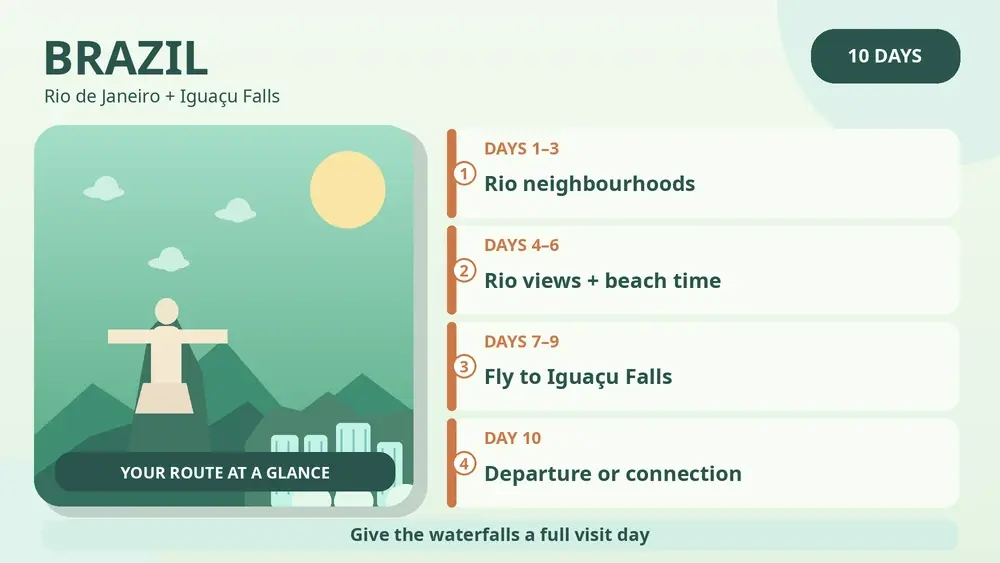
Brazil is continental in scale, which means a first ten-day trip improves dramatically when you stop trying to “see Brazil” and choose two strong regions instead. Rio de Janeiro, Iguaçu Falls, Salvador, the Amazon and São Paulo can all belong to great trips, but they do not belong to the same short itinerary unless airports become the main recurring experience.
This route gives most of the time to Rio and adds Iguaçu Falls as the nature contrast. Brazil’s official tourism material notes that the falls change character with the seasons: wetter summer months generally bring greater water volume, while drier periods can make individual cascades more defined. That makes Iguaçu worthwhile in different seasons, but the exact experience is never identical.
Quick trip summary
- Use Rio as the main base and add only Iguaçu as the second region.
- Choose a Rio neighbourhood based on evening comfort and transport, not just beach proximity.
- Reserve one clear-weather slot for Sugarloaf/Christ viewpoints instead of fixing both to the same day.
- Give Iguaçu two nights so domestic-flight delays do not erase the waterfall visit.
- If crossing to the Argentine side, check current border requirements for your nationality before travel.
Who this itinerary is for — and when to change it
This route is designed for a first or early visit with a moderate pace. It assumes that you want the destination’s defining experiences without turning every day into an early start, late arrival and luggage transfer. Couples, solo travellers, families and mixed-age groups can use the same geographic structure, but the number of activities inside each day should change with mobility, climate, jet lag and personal interests.
Before booking every attraction, identify the two experiences you would regret missing. Protect those first, then build the rest of the trip around them. Weather-dependent mountains, deserts, coastlines and wildlife experiences deserve flexible placement, while museums and neighbourhood days can often move more easily.
Where to stay: choose the base before the hotel
Accommodation is a transport decision as much as a comfort decision. Check how you will reach the first activity in the morning, how you will return after dinner, whether the property has lifts or parking, and what happens with luggage on transfer days. A cheaper room that creates two difficult journeys every day can cost more in taxis, time and energy than a slightly more expensive base in the right place.
| Base | Why it works — and the trade-off |
|---|---|
| Rio: Ipanema / Leblon | Strong beach access, restaurants and evening walkability; usually expensive. |
| Rio: Copacabana | Broad hotel choice and transport; exact block and street atmosphere vary significantly. |
| Rio: Botafogo / Flamengo | Useful for metro access and lower-key local feel; less direct beach-holiday atmosphere than Ipanema. |
| Foz do Iguaçu | Practical base for the Brazilian falls side, airport and onward border travel; resort options outside town can suit families. |
The four decisions that shape this trip most
| Decision | Best default | When to change it |
|---|---|---|
| Rio nights | 6–7 nights | Reduce only if another Brazilian region matters more than city and beach time. |
| Iguaçu | 2 nights minimum | Use 3 if you want both Brazilian and Argentine sides with weather flexibility. |
| Rio viewpoints | Weather-driven order | Move them when cloud hides the summit. |
| Additional city | Skip on 10 days | Add Salvador or São Paulo only by removing days from Rio/Iguaçu, not by stacking another flight. |
Make these decisions before filling the calendar with attractions. They determine how many hotel changes, early starts and long journeys the trip contains. Once the structure is right, individual sightseeing choices become much easier to adjust.
A realistic day-by-day route
Days 1–3: settle into Rio and understand the neighbourhoods
Keep arrival day around your hotel area. Walk the beachfront in daylight, learn transport options and avoid a long cross-city itinerary after a flight.
Use the first full clear-weather day for one major viewpoint such as Sugarloaf or Corcovado, then combine it with nearby neighbourhood time rather than another distant landmark.
Give another day to the historic centre, museums, Santa Teresa or a second beach area according to interests and current local conditions.
Days 4–6: Rio at a slower rhythm
Use one morning for the second iconic viewpoint if the weather is good; if not, move it and use an indoor alternative.
Spend a day that is genuinely beach-and-neighbourhood focused. Rio is not improved by turning every hour into transport between attractions.
Use the last Rio day for a botanical garden, Tijuca-related experience, food tour or another priority. Keep the evening near your accommodation before the domestic flight.
Days 7–9: fly to Foz do Iguaçu and give the falls real time
Fly to Foz and do not assume the arrival day will support a full park visit. Airport, hotel and transfer timing matter.
Use the full day for the Brazilian side or, if you have added a third night, choose the side according to weather and crowd patterns. The official Brazilian park information should determine current opening and ticket procedures.
If visiting the Argentine side, treat it as another full day with border time. Do not schedule a late return immediately before an inflexible flight.
Pace check: if this stage runs late, remove the lowest-priority activity rather than stealing time from meals, sleep or the next transfer. A resilient itinerary should become simpler when something changes, not more frantic.
Day 10: departure or connection
Fly onward with a healthy buffer, particularly if your international flight is on a separate ticket.
If returning to Rio/São Paulo for the international departure, consider an overnight near the hub rather than trusting a tight same-day domestic connection.
Keep the morning simple and close to the hotel or airport route.
Transport reality: plan door to door
Rio has metro, buses, ride-hailing and taxis, but the best combination depends on neighbourhood, time of day and current local advice. For Iguaçu, flights are usually the practical way to connect from Rio. The Brazilian national park can be reached from Foz by organised transfer, taxi/app transport or bus, while a visit to the Argentine side adds an international border crossing. Always check entry rules for your passport and carry the exact documents needed, even for a day trip.
Door-to-door time is the number that matters. Add hotel checkout, reaching the station, airport or pier, waiting, boarding, collecting luggage, local transport at the other end and the possibility that everyone needs food immediately after arrival. This is why a “two-hour flight” or “three-hour train” can consume most of a day. Our guide to building realistic 7-, 10- and 14-day itineraries explains how to treat transfer days honestly.
Food strategy: make meals part of the route
Rio can be a major food destination without requiring formal restaurants every night. Beach kiosks, bakeries, juice bars and simple lunch-by-weight restaurants can balance more expensive dinners. At Iguaçu, park days often run on attraction timing, so eat when it is practical rather than waiting until everyone is exhausted. In hot weather, hydration and shade breaks matter as much as restaurant choice.
One planned meal per day is usually enough. Keep another meal flexible so it can respond to where you actually are, not where an old itinerary expected you to be. With children, older travellers or very hot weather, eating before everyone becomes exhausted is often more important than reaching a restaurant that looked perfect months earlier.
When to go and how the season changes the plan
Rio is warm for much of the year, with summer bringing heat, humidity and more rain. Iguaçu’s water volume varies with rainfall and season; the official Brazilian tourism site notes stronger volume in wetter summer months and more defined falls in drier winter periods. Cloud can affect Rio viewpoints in any season, so flexible ordering is more valuable than obsessing over a single “best” month.
Instead of searching for one universal best month, decide which compromise you prefer: better weather, fewer visitors, lower prices, longer daylight, beach conditions or seasonal scenery. No month maximises everything. Recheck short-term weather and official access information shortly before each critical outdoor day.
Budget: where spending actually improves the trip
Domestic flights, Rio hotel location and premium attractions shape the budget. Staying one or two metro stops away from the most expensive beachfront blocks can save money if the evening area still suits you. At Iguaçu, compare a central hotel plus transfers with a resort package. Avoid adding another Brazilian region simply because the domestic airfare looks cheap; airport transfers and lost sightseeing time are also costs.
The most useful upgrades are often logistical rather than luxurious: a hotel that removes a daily transfer, a direct ride after a long flight, a flexible ticket, an additional night in a weather-dependent region or a guide where interpretation genuinely adds value. Cut low-value extras before cutting the pieces that keep the route reliable.
Common mistakes to avoid
- Trying to combine Rio, Iguaçu, Salvador and the Amazon in ten days.
- Booking both major Rio viewpoints on fixed cloudy days with no flexibility.
- Giving Iguaçu only one same-day flight window.
- Crossing to Argentina without checking passport and entry requirements.
- Choosing a Rio hotel solely by low price without understanding the exact block and transport context.
Most difficult trips are not ruined by one large mistake. They become tiring through a sequence of optimistic assumptions: a transfer that “should” be quick, a hotel that is “only” a kilometre away, a famous walk assumed to suit everyone and a dinner reservation across town after an already long day. Leave margin before you need it.
Families, older travellers and mixed-age groups
Rio and Iguaçu can work well for families when the schedule includes beach or pool recovery. Children may enjoy cable cars and waterfall walks more than a full day of museums. Older travellers should check walking distance and lift/escalator access at viewpoints and the national park. Heat can magnify fatigue, so start earlier and plan seated breaks rather than adding another attraction to fill every afternoon.
For mixed-age groups, agree which experiences everyone will share and which can be optional. Splitting for two hours is often healthier than forcing the entire group through one person’s priority. Build seating, toilets, shade, step-free access and realistic meal times into the plan with the same seriousness as headline attractions. Our guide to travelling with parents and older adults develops this approach in more detail.
If you have more or less time
With fourteen days, add Salvador, Paraty/Ilha Grande or another region rather than more Rio sightseeing. With seven days, stay in Rio and make Iguaçu optional unless the falls are one of your main reasons for visiting Brazil. The country’s scale means every extra region should earn its flight.
When shortening the trip, remove an entire base before cutting every destination to one night. When lengthening it, add depth before distance. An extra morning in a place you already understand often produces a better memory than another multi-hour transfer to a new pin on the map.
Useful official resources
Opening hours, transport timetables, road conditions, trail rules and visitor procedures can change. Use official sources for the details that affect your exact travel dates and recheck them shortly before departure.
Final planning checklist
- Confirm passport, visa, entry and transit requirements for your nationality and route.
- Book the genuinely scarce transport or accommodation segment before secondary attractions.
- Check the exact luggage journey between bases, including stairs, ferries, station exits and rental-car rules.
- Save offline copies of essential reservations, insurance details and each accommodation address.
- Recheck weather, road, park, trail or transport notices shortly before each critical day.
- Keep at least one flexible half-day that can absorb rain, fatigue, a delay or a cancellation.
- Choose clothing and footwear for the actual surfaces and climate, not only for photographs.
- Leave a generous buffer before international flights and other connections that are expensive to miss.
The purpose of a good itinerary is not to prove that you covered the maximum distance. It is to make the important experiences easier to enjoy and to leave enough energy for the unexpected parts that become the best memories. Use this route as a framework, then remove anything that does not fit your interests, mobility or travel rhythm.