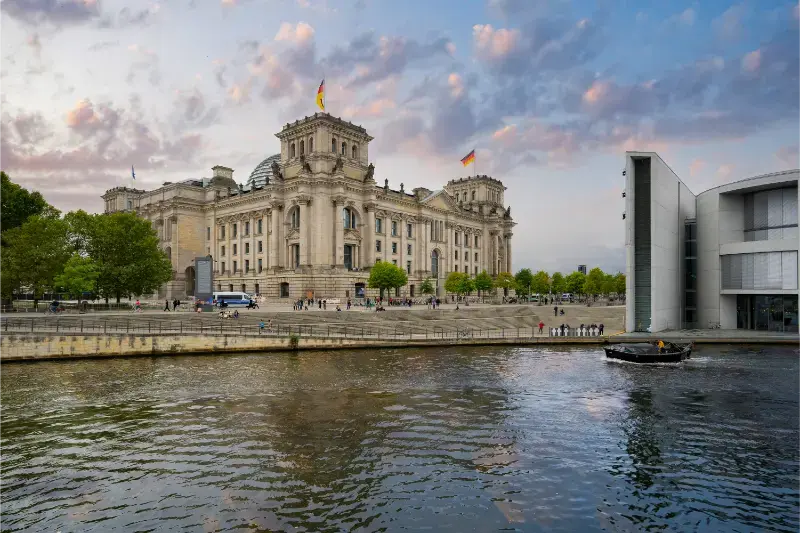
Germany rewards rail travel because the difficult part is not moving between major cities; it is deciding how much to include. A first ten-day route can easily become Berlin, Hamburg, Dresden, Nuremberg, Munich, Neuschwanstein and the Rhine, all connected by trains but not by enough hours in the day.
This itinerary chooses Berlin, Nuremberg and Munich. The cities are different enough to justify the journey, the rail connections are strong, and Nuremberg works as more than a transfer point. It breaks the long north-to-south route and gives you medieval urban fabric, twentieth-century history and Franconian food without another flight.
If you prefer alpine scenery to cities, compare this route with our Austria by train itinerary or Switzerland by train itinerary. Germany itself works best here as a city-and-history trip with one optional countryside day.
Quick trip summary
- Spend 4 nights in Berlin, 2 in Nuremberg and 3 in Munich.
- Use ICE trains for the long legs; no rental car is needed for the core route.
- Choose one large museum or memorial-heavy experience per half-day, not several.
- Keep Neuschwanstein optional rather than mandatory.
- Book train-specific saver fares only when your schedule is genuinely fixed.
Why Berlin, Nuremberg and Munich fit ten days better than a grand tour
Berlin needs time because its important places are spread out and because much of the value comes from context. A rushed two-night visit often reduces the city to Brandenburg Gate, the Reichstag exterior and Museum Island without understanding the neighbourhoods or the difficult history connecting them.
Nuremberg is compact enough to slow the route while still adding substance. Its old town, castle, market area and major documentation sites can fill two days without the transport overhead of another large city.
Munich then provides a different atmosphere, easier access to Bavaria and a logical departure point. Deutsche Bahn currently lists direct Berlin–Munich ICE journeys of roughly four hours on faster services, which is why rail can compete very effectively with flying once airport procedures are included. Deutsche Bahn should be your live timetable source.
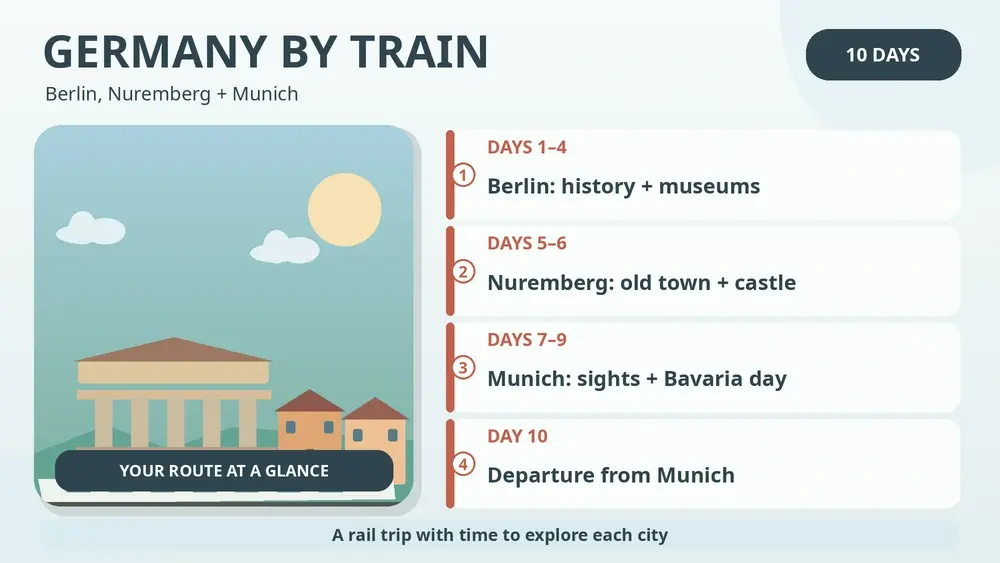
A realistic itinerary at a glance
| Days | Base | Main focus |
|---|---|---|
| 1–4 | Berlin | History, museums, neighbourhoods and one lighter day |
| 5–6 | Nuremberg | Old town, castle and twentieth-century history |
| 7–9 | Munich | Historic core, museums/parks and one optional Bavaria day |
| 10 | Munich / departure | Easy final morning and departure |
Day-by-day plan
Day 1: Arrive in Berlin and learn your immediate area
Berlin is large, so a good first evening is local. Walk the neighbourhood around your hotel, buy any transit ticket you need and have dinner without crossing the city. Mitte is convenient for first visits, but Prenzlauer Berg, Kreuzberg or Charlottenburg can offer better evenings depending on your interests.
Day 2: The central historical axis
Use the Reichstag/Brandenburg Gate area, Holocaust Memorial surroundings, Unter den Linden and one substantial museum or exhibition as the day’s structure. Do not schedule every memorial in a single morning. The subject matter can be emotionally heavy, and Berlin becomes more understandable when you allow time between sites.
Day 3: Museum or Cold War day plus a neighbourhood evening
Choose a clear theme. Museum Island can consume most of a day; alternatively focus on Cold War history and the Berlin Wall memorial areas. Finish somewhere that feels contemporary—Kreuzberg, Neukölln, Prenzlauer Berg or another district—so the city is not experienced only through its past.
Day 4: Buffer day in Berlin
Use this for a palace, a market, Tempelhof, a boat ride, a longer neighbourhood walk or the museum you could not fit earlier. Four nights are valuable because Berlin weather, closures and fatigue can otherwise break a rigid itinerary.
Day 5: Train to Nuremberg and old-town afternoon
Take a morning or midday ICE, check in and spend the afternoon around the old town and castle. The city centre is compact enough that you can arrive without needing a complicated transport plan. Keep the evening in Franconia rather than treating Nuremberg as only a bed between trains.
Day 6: Nuremberg in context
Dedicate part of the day to twentieth-century history, then deliberately change tone with the old town, river, market or a food stop. Heavy historical sites deserve enough time to read and reflect, not a rushed photo stop before the next attraction.
Day 7: Train to Munich and central orientation
Continue south, leave luggage and walk the old centre around Marienplatz and the pedestrian core. If the weather is good, finish in the English Garden rather than trying to enter another museum immediately after the train.
Day 8: Munich by interest
Choose between major art museums, Deutsches Museum, palace interiors, food markets or a more leisurely parks-and-neighbourhoods day. Munich is often reduced to beer halls and a day trip to a castle; give the city one day that reflects your actual interests.
Day 9: Optional Bavaria day
If Neuschwanstein is a genuine priority, make this the day and accept that it is a long excursion requiring timed logistics. Otherwise choose Dachau Memorial, a nearby lake, another Munich day or a simpler regional outing. The best choice depends on weather and energy, not a universal must-see list.
Day 10: Departure
Stay flexible. If flying from Munich, leave a comfortable airport margin. If continuing by train to Austria, Switzerland or elsewhere in Germany, check engineering works and platform information shortly before travel.
Where to stay and how many hotel changes to make
In Berlin, location near an S-Bahn/U-Bahn interchange is often more useful than being beside one famous landmark. Four nights justify a neighbourhood you enjoy returning to at night.
In Nuremberg, the old town or station-to-old-town corridor keeps everything easy for a two-night stop. If you arrive with luggage, a five-minute walk from the station can be worth more than a picturesque address on the opposite side of the walls.
In Munich, Altstadt is expensive and convenient; areas near Hauptbahnhof are practical for day trips but vary street by street; Maxvorstadt or Glockenbach can suit travellers who prefer museums or restaurants.
Transport: what is worth booking in advance
Long-distance trains should be checked on Deutsche Bahn for your exact date because engineering work can alter routes. Seat reservations can be a good idea on busy ICE services even when not mandatory.
Local transit in Berlin and Munich is excellent. Validate or activate tickets correctly and understand the fare zones rather than assuming every airport journey is covered by the same central ticket.
A rental car is unnecessary unless you are building a separate countryside route. For a single castle or lake day, rail plus bus or an organised excursion is often easier than collecting and parking a car in Munich.
Food and daily rhythm
Berlin is excellent for international food and casual eating; Nuremberg adds Franconian specialities; Munich is ideal for Bavarian classics but also far more diverse than stereotypes suggest. One traditional meal per city is enough to understand the regional differences without eating heavily every night.
Beer culture can be part of the trip without becoming the itinerary. Families and non-drinkers can enjoy beer gardens as social spaces, and many have food or non-alcoholic options.
Families, children and older travellers
Berlin works well for children when history-heavy sessions are alternated with parks, technology museums, boats or open spaces. Do not expect a young child to absorb several memorials in sequence.
Older travellers should note that large stations can require long platform changes. Use lifts when available, travel with manageable luggage and avoid minimum transfer times when a delay would create stress.
Nuremberg is particularly useful in a multigenerational route because its centre is compact. Munich then gives you the choice between a city day and a more scenic outing according to the group’s energy.
Budget: where the money really goes
Germany can be moderate to expensive depending on hotel dates. Berlin often offers more accommodation range than Munich, especially during major events.
Rail savings are real when booked in advance, but saver fares can tie you to a specific service. Compare flexibility before choosing the lowest headline price.
Museums and public transport are predictable costs. The biggest surprises are often hotel prices during fairs, Oktoberfest, football matches or major conventions.
Best time to go
Late spring and early autumn are excellent for this route. Summer brings long days and outdoor life but more demand; winter adds Christmas markets and indoor culture while shortening daylight.
Munich pricing and availability change dramatically around Oktoberfest. If the festival is not your goal, avoid those dates rather than paying the premium accidentally.
Rail disruptions from weather or engineering are possible year-round. A route with only two long transfer days is more resilient than one that changes city every night.
Small decisions that improve the trip
Decide whether Neuschwanstein is worth a full day
The castle is iconic, but it is not a casual two-hour add-on from Munich. Tickets, transfers and crowds can dominate the day. If architecture, landscapes or photography make it a priority, plan it properly; if not, Munich itself may be the better use of limited time.
Do not compress Berlin because the train is fast
Fast rail can create the illusion that four cities fit. The real cost is not the journey alone but checkout, station navigation, check-in and the loss of an unstructured evening. Berlin needs at least three full days on a first trip.
Use Nuremberg to change scale
The middle stop is valuable precisely because it is smaller. Walk more, schedule less and let one afternoon contain both history and ordinary city life. That change of tempo prevents the itinerary from feeling like Berlin followed immediately by another Berlin-sized programme.
Treat history with pacing, not as a checklist
Many important German sites deal with persecution, war and dictatorship. Reading enough to understand them takes time and emotional energy. Pairing a serious museum or memorial with an outdoor walk or simple meal is not wasted time; it is what keeps the day meaningful.
What I would leave out on this length of trip
I would skip Hamburg, Cologne and the Rhine on this version. They are excellent destinations, but adding them makes the route geographically scattered.
I would also avoid a one-night alpine stop unless the mountains are the central purpose. If Bavaria beyond Munich matters, extend the trip by at least two or three nights.
Mistakes that make this trip harder than it needs to be
- Adding a fourth major city because the ICE looks fast.
- Choosing a non-flexible saver ticket before the inbound flight is secure.
- Planning multiple emotionally heavy memorial sites in one day.
- Assuming Oktoberfest dates will have normal Munich hotel prices.
- Renting a car for the city portion.
- Treating Nuremberg as only a station change.
How I would adapt the itinerary
With seven days, choose Berlin and Munich with a direct train between them. With twelve to fourteen, keep Nuremberg and add either Dresden, Hamburg or a more substantial Bavaria stay—not all three.
Travellers focused on twentieth-century history can give Berlin five nights and reduce Munich. Families looking for parks and easier days may prefer the opposite.
Before booking the trip
- Check Deutsche Bahn for engineering works and live schedules.
- Compare flexible and train-specific fares before purchase.
- Reserve popular Reichstag or museum visits where required.
- Check Munich event dates before locking hotel prices.
- Decide on Neuschwanstein before choosing your Munich hotel and departure time.
Germany is easiest to appreciate when the rail network is used to simplify the trip, not to multiply destinations. Berlin, Nuremberg and Munich give you three scales of city and a strong north-to-south story without needing a car.