Austria is one of the easiest European countries to overcomplicate. The trains are good enough that visitors sometimes assume they should add a new city every day, while postcard places such as Hallstatt encourage people to build an itinerary around brief stops rather than actual experiences.
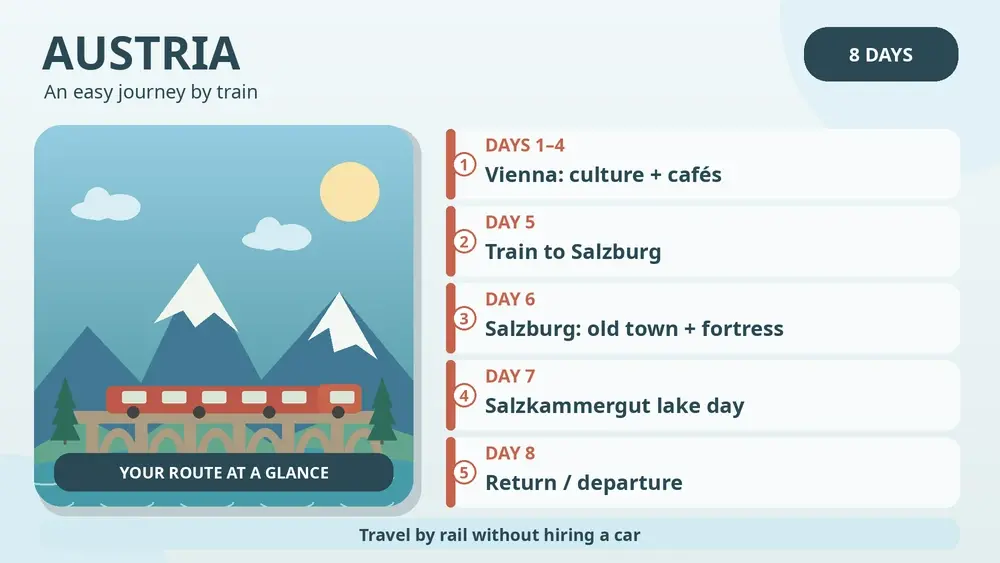
Eight days works very well with two main bases: Vienna and Salzburg. From Salzburg, you can choose one Salzkammergut day rather than sleeping in several lake villages. The result is a trip with imperial museums, cafés, music, mountain scenery and lakes without a car or constant luggage handling.
If you enjoyed our Switzerland by train itinerary, Austria offers a similar advantage: public transport lets the journey itself become simple enough that you can focus on what to do with each day.
Quick trip summary
- Use Vienna for 4 nights and Salzburg for 3, with the final day as departure or an extra lake-region day.
- Travel between Vienna and Salzburg by direct train.
- Choose one Salzkammergut focus—Hallstatt, Wolfgangsee or another lake area—rather than collecting several villages in one day.
- Reserve only the high-demand experiences that matter to you; leave café and neighbourhood time unstructured.
- A rental car is unnecessary for the core itinerary.
Why two bases are enough
Vienna is not a city you “finish” in two days. Museums are large, palaces sit outside the tight centre and the café culture only works if you allow time to stop. Four nights gives you choice rather than pressure.
Salzburg is smaller, but it works as both a destination and a transport base for the lakes. That avoids checking into Hallstatt for one night simply to photograph it early in the morning.
The Austrian National Tourist Office is useful for current regional information and seasonal ideas, while rail operators should be checked for live schedules before booking.
A realistic itinerary at a glance
| Days | Base | Main focus |
|---|---|---|
| 1–4 | Vienna | Historic centre, museums, palace or neighbourhood day |
| 5 | Train to Salzburg | Transfer and old-town orientation |
| 6 | Salzburg | Fortress, music heritage and river |
| 7 | Salzkammergut | One focused lake-region day trip |
| 8 | Salzburg / departure | Flexible final day |
Day-by-day plan
Day 1: Vienna arrival
Stay near a U-Bahn or tram connection, not necessarily inside the most expensive historic blocks. Vienna’s transport network makes a slightly wider radius practical.
Use the first evening for the Ring area, a café and dinner. Do not begin with a four-hour palace after a flight.
Day 2: Historic Vienna
Walk the central district, choose one major museum or historic interior and allow time for lunch or coffee. Vienna is dense with culture, and museum fatigue arrives quickly if you treat each collection as a box to tick.
An evening concert can be worthwhile, but compare programme, venue and seat quality rather than buying the first ticket marketed to tourists.
Day 3: Schönbrunn or Belvedere focus
Pick one major palace complex as the anchor of the day. Schönbrunn can consume most of a day when gardens and travel are included; Belvedere fits more easily with other central sights.
Families may prefer the outdoor space at Schönbrunn, while art-focused travellers may spend longer at Belvedere.
Day 4: Vienna with fewer monuments
Use markets, neighbourhoods, the Prater, Danube areas or a second museum according to your interests. The objective is to see how Vienna works beyond imperial interiors.
This flexible day also absorbs any attraction you could not book earlier.
Day 5: Train to Salzburg
A direct train turns this into an easy transfer. Arrive, leave bags and walk the old town rather than scheduling a formal excursion.
Salzburg’s scale is a relief after Vienna, so use the change in pace rather than filling it immediately.
Day 6: Salzburg
Combine the fortress area with the old town, river and one music-related sight. If you are a serious Mozart enthusiast, plan accordingly; everyone else should avoid making every hour Mozart-themed simply because the city is famous for him.
Walk to a viewpoint if weather is good, but do not force a steep climb when clouds erase the view.
Day 7: Salzkammergut
Choose one route. Hallstatt is famous but can be busy; Wolfgangsee or other lake areas may offer a calmer experience. Public transport is feasible, but connections need to be read as a chain rather than a single train.
Leave early, protect the final return connection and remember that mountain/lake weather can differ from Salzburg.
Day 8: Flexible finish
If your flight is later, use the morning for a final Salzburg walk or café. If departing from Vienna, calculate the rail transfer with a generous flight buffer rather than relying on the theoretical fastest connection.
Where to stay and how many hotel changes to make
In Vienna, a hotel near a useful U-Bahn line can be better value than one inside the Innere Stadt. Check air conditioning if travelling during a hot spell and check lift access in older buildings.
In Salzburg, staying near the old town or between the station and centre can simplify both the lake day and your onward journey.
Two hotels in eight days keeps the trip calm. A one-night Hallstatt stay is worthwhile only if being there after day-trippers leave is one of your main goals.
Transport: what is worth booking in advance
Book long-distance trains early if you want the best fares, but do not make every local segment rigid. Vienna’s urban network and Salzburg buses are easy to use day by day. For live intercity schedules and tickets, use ÖBB rather than relying on an old timetable in a travel article.
For the Salzkammergut, plan the exact route the night before because a journey may combine train, bus and boat. A missed connection can matter more late in the day.
A car becomes useful for remote lakes or multi-stop countryside routes, not for Vienna and Salzburg themselves.
Food and daily rhythm
Vienna’s cafés are part of the city’s social history, so build one into the day without treating it as a race for the most famous address. Salzburg also rewards simple Austrian meals, bakeries and beer halls beyond the tourist centre.
Reservations can help for popular restaurants, but lunch often gives more flexibility and better value than trying to reserve every dinner.
Families, children and older travellers
Children need fewer interiors than adults often plan. Alternate palaces and museums with parks, river walks, fortress funiculars or lakes.
Older travellers benefit from excellent public transport but should still check walking distances inside large complexes. A palace “visit” can involve far more steps than the map implies.
Rail-based travel reduces the stress of parking and navigation, which makes this route especially suitable for multigenerational groups.
Budget: where the money really goes
Austria is not a bargain destination, but transport and sightseeing can be controlled. Compare city passes only against attractions you genuinely plan to enter.
The biggest savings often come from booking trains and hotels early, using public transport and choosing one paid cultural highlight per day rather than several.
Lake-region excursions can become expensive if you combine multiple boats, mountain lifts and transfers. Decide what the main experience is before buying every add-on.
Best time to go
Spring and autumn are excellent for cities, while summer offers long daylight and lake activity but can be busy and hot. Winter changes the trip completely with Christmas markets, shorter days and possible snow.
Mountain weather is more variable than city weather. A clear Vienna forecast does not guarantee lake views two days later.
If Hallstatt is central to your plan, shoulder-season weekdays can be more comfortable than peak summer weekends.
Small Austria decisions that save more time than they cost
Vienna and Salzburg both reward choosing accommodation around how you will actually move. A hotel that is fifteen minutes farther from the postcard centre but two minutes from a useful U-Bahn or tram can save more energy across four days than a central room reached through crowded pedestrian streets with luggage. In Salzburg, station access matters more if your Salzkammergut day starts early.
It is also worth deciding in advance what kind of cultural traveller you are. If art museums are a priority, protect half-days for them. If music is the reason for the trip, spend on one performance you genuinely want rather than buying several generic concert packages. If cafés, parks and architecture matter most, do not let a city pass pressure you into paid interiors simply to “get value”.
For the lake day, build a Plan A and Plan B. Clear weather may justify a boat ride, panoramic lift or longer lakeside walk; rain may make a compact town, spa, museum or shorter route the better choice. Having two versions keeps the day enjoyable without feeling that poor visibility has ruined an expensive excursion.
Mistakes that make this trip harder than it needs to be
- Adding Innsbruck, Graz and Hallstatt overnights to an eight-day first trip.
- Renting a car for Vienna and Salzburg.
- Treating Hallstatt as mandatory even when weather and crowds make another lake more appealing.
- Scheduling two major Vienna museums back-to-back every day.
- Ignoring the last bus/train connection from a lake region.
- Booking an evening event without checking the programme and seat category.
How I would adapt the itinerary
With five days, stay only in Vienna or split 3/2 with Salzburg. With ten or twelve, add Innsbruck or a second lake-region base rather than turning the original eight days into a faster itinerary.
Travellers who prefer nature can reverse the balance—fewer Vienna nights, more Salzburg/lakes—but should still keep only two or three bases.
Before booking the trip
- Compare Vienna hotel location by transit line, not only distance from St Stephen’s Cathedral.
- Check direct-train fares before your dates fill.
- Plan one Salzkammergut route and confirm the final return connection.
- Reserve major palace or concert experiences only where necessary.
- Leave airport-transfer time that does not depend on a perfect train connection.
Austria by train works because you can remove an entire layer of logistics. With Vienna and Salzburg as stable bases, the trip gains enough structure to be easy and enough free time to feel like a holiday.