Category: North America

Practical travel guides for destinations in North America, focused on neighbourhood planning, transport, costs and first-time itineraries.

  • Vancouver Island in 9 Days: Victoria, Tofino and Cowichan Without Driving to the Far North

    Vancouver Island in 9 Days: Victoria, Tofino and Cowichan Without Driving to the Far North

    Vancouver Island is much larger than many first-time visitors expect. Victoria and Tofino look close on a provincial map, but mountain roads, ferry logistics and scenic stops turn the island into a real road trip rather than a city break.

    This nine-day route uses Victoria, Tofino/Ucluelet and one central/southeast island base such as Cowichan or Nanaimo. It deliberately leaves Campbell River and the far north for another trip.

    The planning principle is simple: do not arrive by ferry or long-haul flight and immediately drive across the island. Give Victoria real time, make the west-coast transfer its own day and keep Pacific weather flexible.

    Quick trip summary

    • 3 nights Victoria, 3 nights Tofino/Ucluelet, 2 nights Cowichan/Nanaimo, Day 9 departure.
    • Rent a car after Victoria unless arrival logistics require one.
    • Treat the drive to Tofino as a real travel day.
    • Keep one Pacific Rim day flexible.
    • Do not add the far north.

    Why this route works

    Victoria is a complete city destination and the easiest place to recover from ferry or flight travel.

    Tofino/Ucluelet is the dramatic Pacific section, but weather and road time make three nights a sensible minimum.

    A central/southeast final base breaks the return journey and removes the temptation to drive directly from Tofino to a flight.

    A realistic itinerary at a glance

    Days Base Main focus
    1–3 Victoria Harbour, museums and city/garden day
    4–6 Tofino / Ucluelet Pacific Rim, beaches, rainforest and wildlife
    7–8 Cowichan / Nanaimo Forest, food, coast and return positioning
    9 Departure Ferry or airport

    Day-by-day plan

    Day 1: Victoria arrival

    Stay near the harbour or a walkable district and keep the first day to orientation, dinner and waterfront time.

    Day 2: Victoria properly

    Use heritage, museums, harbour and neighbourhoods. Avoid using the city only as a sleeping place before Tofino.

    Day 3: Garden or local coast day

    Choose Butchart Gardens, a whale/wildlife trip with a reputable operator, or another peninsula outing.

    Day 4: Drive to Tofino/Ucluelet

    Make the west-coast crossing the main event. Stop for food and one forest/scenic break rather than filling every hour.

    Day 5: Pacific Rim day

    Use Long Beach and rainforest trails at a comfortable pace. Waterproof clothing matters more than chasing a perfect forecast.

    Day 6: Wildlife, surf or flexible nature day

    Choose a guided wildlife/boat outing, surf lesson, another trail or a slow day.

    Day 7: Tofino to Cowichan/Nanaimo

    Drive east and stop selectively. A central island night removes departure stress.

    Day 8: Cowichan/Nanaimo area

    Use forests, food/wine, cultural experiences or a slower waterfront day.

    Day 9: Departure

    Continue to the ferry or airport with enough margin for traffic and check-in.

    Where to stay and how many hotel changes to make

    Victoria’s Inner Harbour is useful for a car-light start; in Tofino/Ucluelet choose walkable town access or a beach resort deliberately; the last base should simplify departure.

    For Vancouver Island, location matters more than a small difference in nightly rate. A hotel that removes repeated transfers usually adds more value than a prettier property in the wrong part of the route.
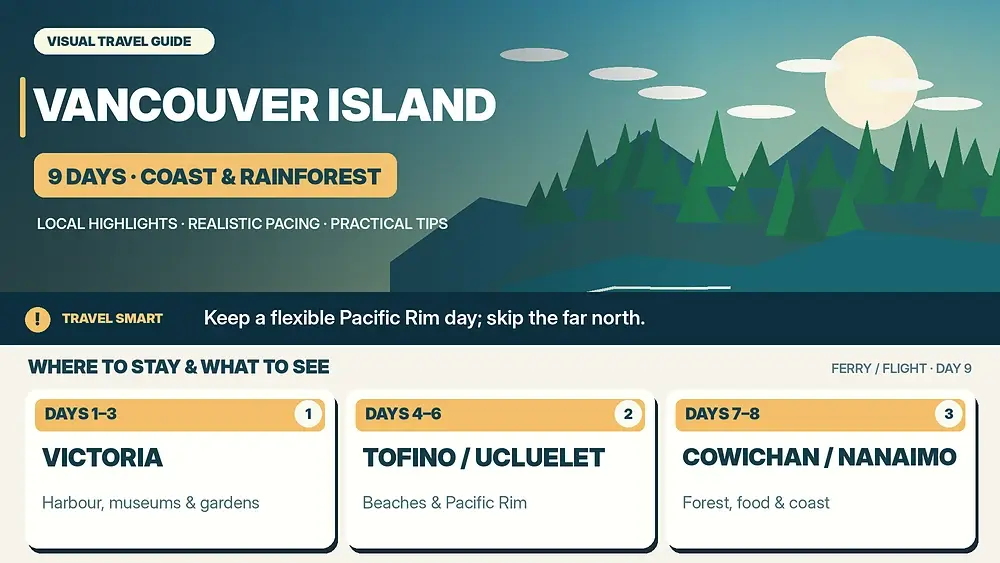
    Illustrated Vancouver Island route through Victoria, the Pacific Rim and Cowichan or Nanaimo

    Read recent guest reviews for practical details that booking photos rarely show: stairs, lift size, road noise, parking access, breakfast hours and the final walk from transport.

    Transport: what is worth planning in advance

    A rental car is highly useful outside Victoria, but the west-coast road is a real mountain/forest drive, not a casual city commute.

    Measure every move door to door rather than by the headline timetable. Checkout, terminal access, waiting, luggage and the final connection can turn a short journey into half a day.

    Use inflexible tickets only when the saving is meaningful and the day is genuinely fixed. Weather-sensitive coast, mountain, wildlife and boat plans benefit from flexibility.

    Food and daily rhythm

    Victoria has the broadest dining while Tofino/Ucluelet highlights seafood and seasonal west-coast food; book popular dinners early in peak season.

    Use meals to control the rhythm of the day. A long regional lunch can be an experience and a recovery period, especially after hiking, museums, wildlife outings or early starts.

    Do not make every meal another attraction. Mix local specialties with simple food so that the destination, not the restaurant schedule, remains the centre of the trip.

    Families, children and older travellers

    Beaches, forests, ferries and wildlife give children excellent variety. Older travellers should ask about boat boarding, trail surfaces and long drive tolerance.

    For multigenerational travel, the useful pace is the one at which the least mobile member still enjoys the day. That normally produces a better shared trip for everyone.

    When accessibility matters, ask specific questions about steps, trail surfaces, boat boarding, lift dimensions and vehicle access rather than relying on a generic label.

    Budget: where the money really goes

    Rental cars, peak-summer Tofino lodging and wildlife tours are the biggest variables.

    Compare total trip cost rather than headline prices. Parking, transfers, luggage, park transport, tours and time lost reaching a remote hotel can erase an apparent saving.

    Keep a contingency rather than allocating every day to the last euro or dollar. Weather, a changed ferry, a taxi or an extra night can appear even on a carefully planned journey.

    Best time to go

    Summer is easiest for daylight and broad services; spring and autumn bring lower crowds and more variable Pacific weather.

    Shoulder season often balances weather, demand and room prices well, but ferries, mountain services, wildlife excursions and rural restaurants may run less frequently.

    Heat, rain, snow, wind and daylight should change the order of your day. Use the most comfortable hours for exposed outdoor sights and keep lower-effort alternatives available.

    Comfort, accessibility and realistic pacing

    The west-coast transfer is isolated as its own day, and the final central-island stay reduces departure stress.

    Travel fatigue compounds. One difficult transfer can reduce the quality of the following two days, which is why this itinerary avoids one-night bases unless geography genuinely requires them.

    A free half-day is not wasted time. It is insurance for weather, laundry, a delayed service, a tired child or a place you discover only after arriving.

    Small decisions that improve the trip

    Give Victoria three nights

    It is worth a real city stay.

    Stay three nights on the west coast

    Weather and boat plans need space.

    Break the return journey

    A central island night makes the final day calmer.

    What I would leave out on this length of trip

    Leave Campbell River, Telegraph Cove and the far north for another trip.

    Skip changing between Tofino and Ucluelet hotels.

    Mistakes that make this trip harder than it needs to be

    • Driving to Tofino immediately after a long travel day.
    • Giving the west coast one night.
    • Booking every marine activity with no backup.
    • Underestimating driving distances.
    • Choosing a remote hotel without dinner planning.
    • Driving from Tofino directly to a tight ferry or flight.

    How I would adapt the itinerary

    With six days, use Victoria plus Tofino/Ucluelet only.

    With twelve days, add Campbell River or the north with proper multi-night time.

    Before booking

    • Reserve peak-season west-coast lodging.
    • Review ferry and road status.
    • Pack waterproof layers.
    • Choose reputable wildlife operators.
    • Protect the final departure connection.

    Practical questions

    Do I need a car?

    Not for central Victoria, but yes for a flexible west-coast road trip.

    Tofino or Ucluelet?

    Tofino has more visitor services; Ucluelet is quieter and also excellent.

    Is nine days enough?

    Yes for the south and west coast, not the whole island.

    Final thoughts

    Vancouver Island is best understood as a large island with several travel regions, not a quick extension of Vancouver city.

    Victoria, the Pacific Rim and one central return base create a nine-day journey with city, rainforest and ocean without a punishing loop.

    How to keep this itinerary resilient

    Keep Day 6 flexible so a cancelled boat or heavy rain can be absorbed without losing the west-coast experience.

    Check the live ferry and road situation before the final drive, especially on peak summer weekends.

    Who this route suits best

    This route is designed for travellers who prefer depth over collecting places. It keeps hotel changes low, protects flexible time and assumes that a good meal, an unexpectedly interesting neighbourhood or a slower morning can be as valuable as another attraction. That makes it particularly suitable for first-time visitors, couples, families and multigenerational groups.

    More energetic travellers can add a longer hike, an extra museum or a second excursion on the flexible days. Travellers who prefer an easier pace can remove those extras and still keep the core journey intact. Before booking, identify the two or three experiences that would genuinely disappoint you to miss; those are the ones to reserve or protect first.

    What to book early and what can wait

    Book the elements with genuinely limited capacity first: high-demand accommodation, protected-area access, popular trains or ferries, and any guided experience that is central to the trip. Leave ordinary meals, minor attractions and weather-dependent outdoor activities more flexible whenever possible. This prevents the itinerary from becoming a chain of reservations that forces you to ignore how the destination actually feels on the day.

    One week before departure, check the official transport or park information again. The evening before each major move, confirm departure points, opening status and the hotel address. That small routine catches most avoidable travel problems before they become expensive or tiring.

  • Banff in 5 Days: Town, Lake Louise and Mountain Trails Without Chasing Every Viewpoint

    Banff in 5 Days: Town, Lake Louise and Mountain Trails Without Chasing Every Viewpoint

    Banff Banff becomes less enjoyable when every sunrise is assigned to a different famous lake and every afternoon to another long drive. Five days is enough to combine Banff town, Lake Louise, Moraine Lake in season, a canyon or lake corridor and one flexible hiking day without turning the national park into a sequence of parking problems. The most important planning decisions are transport reservations, weather and choosing which landscapes matter most to you rather than trying to reproduce every photograph you have seen.

    If this destination is part of a wider trip, compare the pacing with Canadian Rockies in 7 Days: Banff, Icefields Parkway and Jasper at a Realistic Pace. The city guide adds local depth; the wider itinerary is better for deciding how this stop fits into the rest of the journey.

    Quick trip summary

    Ideal stay5 days for a first trip
    Best approachGroup each day by geography and keep one flexible block for weather or energy
    Transport strategyUse public transport or transfers for long moves, then explore each district locally
    Who it suitsFirst-time visitors, couples, solo travellers, families and slower-paced travellers
    Most common mistakeAdding another distant attraction because it looks close on a map

    How to plan the trip before booking

    Start by separating the itinerary into fixed reservations, weather-sensitive experiences and flexible neighbourhood time. Fixed reservations should be the things that can genuinely sell out or determine the rest of the day. Weather-sensitive blocks should stay movable until the forecast becomes useful. Everything else should be grouped geographically so that a late breakfast, a long museum visit or an unexpected queue does not break the schedule.

    A good multi-day trip does not look completely full on paper. Most days need one main anchor, one secondary experience and enough open time for a meal, rest, shopping, a viewpoint or something you discover after arrival. That unused space is not wasted time; it is what allows the itinerary to survive real travel.

    Where to stay: choose location before hotel style

    BaseWhy choose it
    Downtown BanffBest for first-time visitors who want restaurants, Roam Transit and evening walks without driving after every activity.
    Banff Avenue north / UptownStill convenient but often a little quieter, with straightforward access to shuttles and town services.
    Tunnel Mountain areaGood for cabins, views and a more residential feel, though some travellers will use transit or drive into the centre.
    CanmoreOutside Banff National Park but often better value and useful for longer stays; allow extra travel time for park days and check transit options.

    A beautiful room is not automatically a useful base. Map the first activity of the morning, the likely dinner area and the route you will use on departure day. If the hotel creates two unnecessary transfers every day, the hidden cost is time and energy as well as money. For a short trip, location usually matters more than a larger room several kilometres away.

    A realistic 5-day itinerary

    Day 1: Banff town, Bow River and a gentle first viewpoint

    Use the first day to understand the town and recover from the journey. Walk the Bow River, Bow Falls or easy nearby trails, then choose one viewpoint such as the gondola only if weather is clear and energy is good. Buy or confirm your park pass and learn the local transit stops. Do not drive to Lake Louise simply because you arrived before hotel check-in; save the most logistically constrained places for a planned day.

    Day 2: Lake Louise and Moraine Lake with reserved transport

    In the 2026 season, Parks Canada requires reservations for its Lake Louise and Moraine Lake shuttles, and Moraine Lake Road remains closed to personal vehicles. Use the official shuttle or another authorised transport option. Combining the two lakes in one planned day can reduce duplicate transfers. Choose a short walk at one lake rather than demanding major hikes at both. Carry layers because mountain weather can change quickly even when Banff town is warm.

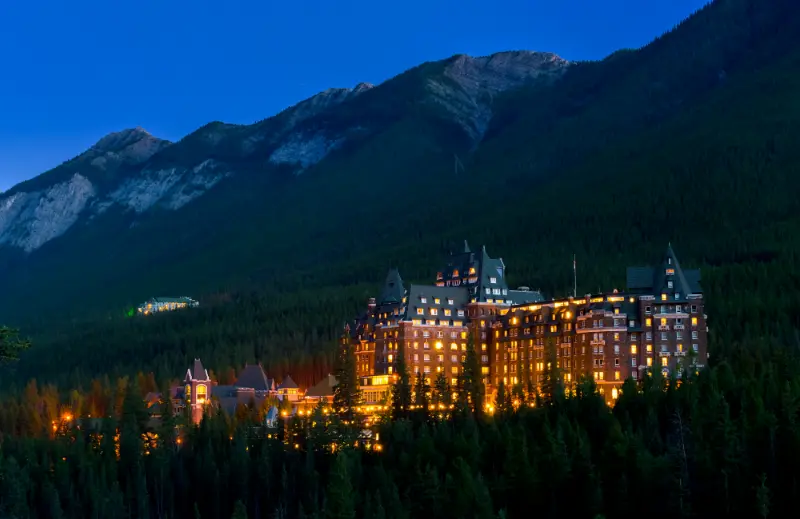
    Banff Springs Hotel Surrounded By Mountains

    Day 3: Johnston Canyon and Lake Minnewanka corridor

    Visit Johnston Canyon early or use current transit where available to reduce parking pressure. Decide in advance how far you want to hike; the lower and upper falls are enough for many visitors, while longer routes require more time and fitness. Pair the day with Lake Minnewanka, Two Jack Lake or a quieter town afternoon rather than driving to the Icefields Parkway as well. Geographic discipline is what keeps Banff from becoming a windshield holiday.

    Day 4: Your best hike, chosen for conditions and ability

    Choose one trail according to current closures, wildlife notices, weather and your actual fitness. Options range from gentle lakeside walks to demanding alpine hikes. Check Parks Canada trail information shortly before leaving and carry the equipment appropriate to the route. Start early for popular trailheads, but do not force a summit when smoke, storms, snow or fatigue make the day poor. A shorter safe hike is a successful mountain day.

    Day 5: weather buffer, hot springs or a final scenic day

    Keep the final full day deliberately flexible. Use it for the activity displaced by weather, a quieter lake, Banff Upper Hot Springs if operating, museums, shopping or a second modest walk. This buffer is valuable because mountain plans fail for reasons that cannot be solved months in advance. If you are driving onward, leave enough daylight and energy for the next road rather than treating departure morning as one more sunrise mission.

    Getting from the airport or station and handling arrival day

    Most international visitors reach Banff through Calgary and continue by shuttle, bus or rental car. A car adds flexibility for some corridors but is not required for every major sight, especially with Roam Transit and seasonal shuttles. If driving, remember that a national park pass is separate from transport reservations. In winter, road and vehicle requirements need additional attention. Build the arrival day around the transfer rather than a timed mountain attraction.

    Arrival day should carry less risk than the rest of the trip. Keep the first reservation easy to cancel, know how you will reach the hotel before landing and save the address offline. If a flight or train is delayed, skip a secondary sight instead of beginning the trip by rushing across an unfamiliar city with luggage.

    Getting around without wasting the day

    Banff now requires more transport planning than a simple rental-car itinerary suggests. Roam Transit serves many popular locations, and Parks Canada shuttles are central to Lake Louise and Moraine Lake access. For 2026, Moraine Lake Road is closed to personal vehicles year-round and regular Parks Canada shuttle reservations are required. Parking at Lake Louise is limited and not a dependable strategy. Reserve the constrained transport first, then build hiking and meals around it.

    When comparing two routes, include the walk to the stop, waiting time, transfers and the final approach. The route with fewer changes is often better for families, luggage, older travellers and anyone visiting in difficult weather. Use transport to remove unrewarding distance, then spend walking energy on the streets, viewpoints, markets and museums that actually define the destination.

    Best time to visit and how the season changes the itinerary

    Summer offers the broadest hiking access and lake colours, but it is also the busiest period. Shoulder seasons can be beautiful yet bring snow or trail closures at elevation. Winter turns Banff into a snow destination with very different road, clothing and daylight requirements. Wildfire smoke can affect summer visibility and air quality. Use current Parks Canada information shortly before each day because conditions can change far faster than hotel reservations.

    Season changes more than temperature. It affects daylight, hotel prices, operating hours, event calendars, sea or trail conditions and how tiring a normal sightseeing day feels. If your dates are fixed, adapt the daily rhythm rather than forcing an itinerary designed for another month.

    What to book first

    Book accommodation early in peak periods and treat Lake Louise/Moraine Lake transport as a priority. Parks Canada states that 2026 shuttle reservations open in advance, with additional seats released two days before departure. Reserve only the hikes, tours or gondola times that truly need fixed access. Too many timed bookings remove the flexibility that mountain weather demands.

    Banff Springs Hotel Lit At Night

    Recheck opening days, reservation procedures, transport notices and access rules shortly before departure. These operational details change faster than the basic geography of a good itinerary. When an official source conflicts with an old screenshot, saved social post or outdated blog, use the current official information.

    Food strategy: eat well without crossing the city for every meal

    Banff has a wide restaurant range, but popular dinner times can fill in peak season and prices reflect the resort setting. Buy trail snacks and breakfast supplies before early starts. For Lake Louise or shuttle days, carry enough food and water to avoid relying on one crowded café. If staying in Canmore, dinner there can reduce cost and add variety, but do not underestimate the energy needed to commute back after a long hiking day.

    For a multi-age group, a reliable breakfast and an easy lunch often matter more than one additional attraction. Use meals as genuine rest and part of the travel experience. A restaurant that is ten minutes from where you already are can be a better choice than a famous address that requires forty minutes of extra transport each way.

    Travelling with children

    Families should prioritise transport certainty and shorter trails with clear turnaround points. Lake Louise and Moraine Lake are easier when shuttle times are organised before the trip. Johnston Canyon can be appealing but becomes crowded, so early timing helps. Wildlife should always be observed from a safe distance; never approach animals for photographs. Build one low-effort afternoon into the trip because five consecutive mountain days can overwhelm younger travellers.

    With children, reduce transitions before reducing the highlights. Alternate one structured visit with something that allows movement, and always know the easiest route back to the hotel before starting a long afternoon. A flexible snack and rest stop can protect the whole day better than another timed ticket.

    Travelling at a slower pace or as a senior

    Transit and shuttles can reduce parking stress, but boarding, waiting and uneven trail surfaces still matter. Choose accommodation near a transit stop and select viewpoints that do not require steep hiking. Parks Canada provides accessible shuttle options for Lake Louise and Moraine Lake; check current procedures before travel. Mountain weather and altitude can increase fatigue, so one major outdoor block per day is often enough.

    Slower travel often improves a destination itinerary because it forces better geographic choices. Use lifts, public transport, taxis or door-to-door transfers to remove unrewarding distance, then spend walking energy where the surroundings are worth noticing. Keep a seated break in the middle of any day with significant climbing or heat.

    Budget planning

    Build the budget in layers: accommodation, arrival and departure transport, local movement, fixed attractions or excursions, food and a reserve for spontaneous changes. The cheapest hotel is not always the cheapest trip if it creates two extra rides every day. Likewise, a city or transport pass is worthwhile only when its zones and included attractions match the itinerary you will actually follow.

    Keep a separate allowance for weather-driven changes. A taxi during heavy rain, a last-minute indoor attraction, a shuttle or a different departure can protect a travel day without representing a planning failure. Saving money is useful; sacrificing the main experience to avoid a modest practical cost often is not.

    Weather backup plan

    The itinerary should be built around movable outdoor blocks. Thunderstorms, snow at elevation, smoke or low cloud can change the best trail within hours. Use the flexible fifth day to rescue a key lake or hike rather than forcing it in poor conditions. Carry layers and rain protection even in summer. If air-quality advisories are poor, reduce strenuous activity and follow official health guidance.

    Do not read only the temperature. Wind, visibility, rain intensity, humidity, sea state, snow and daylight can change the quality of an experience much more than a few degrees. The best itineraries have at least one outdoor block that can trade places with an indoor or neighbourhood day.

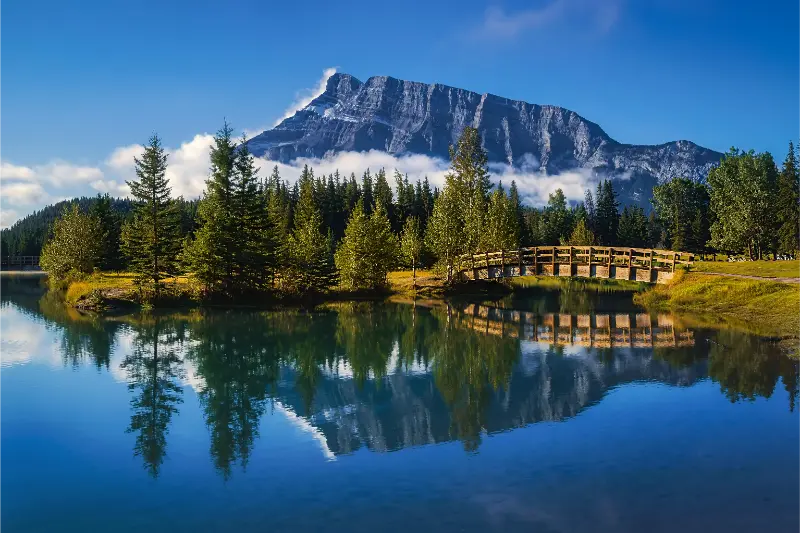
    Cascade Ponds And Mount Rundle Banff National Park Canada

    Connectivity, payments and small practical details

    Download an offline map before arrival, save the accommodation address and keep screenshots or offline copies of critical tickets. A local data plan or eSIM can simplify live transport information, but do not depend on a phone battery for every part of the day. Carry a small power bank on long excursion days if navigation and tickets are digital.

    Cards are widely accepted in many visitor areas, but payment habits differ by destination and smaller businesses may work differently from hotels. Keep a backup payment method and a modest amount of local currency when useful. Check whether transport uses contactless bank cards, a dedicated travel card, app tickets or paper validation rather than assuming the system matches another city.

    What to pack

    Comfortable walking shoes, a small day bag, sun protection and weather layers matter more than extra outfits. Add any medication you may need during the day and a refillable bottle where practical. For mountain, coast or desert days, pack for the conditions at the destination rather than the temperature outside your hotel. A light layer can be useful even in warm places because vehicles and indoor spaces may be strongly air-conditioned.

    Common mistakes to avoid

    • Planning to drive a private vehicle to Moraine Lake despite the year-round road restriction.
    • Assuming parking at Lake Louise will be available without a transport backup.
    • Scheduling a famous viewpoint for every sunrise and exhausting the group by day three.
    • Ignoring wildlife closures, bear-safety guidance or changing trail conditions.
    • Using the final travel day for a remote hike with no delay buffer.

    Responsible travel and local etiquette

    Treat residential streets, markets, places of worship, memorial sites and working neighbourhoods as real parts of a community rather than scenery. Follow local instructions, keep entrances and pavements passable, ask before photographing people in sensitive settings and spend with local businesses when it fits naturally. Clothing, photography and behaviour expectations can change between religious, cultural and recreational spaces.

    In natural settings, stay within marked routes and respect closures even when another visitor appears to ignore them. Access rules often protect both visitors and the place itself. Wildlife should never be approached for a photograph, and weather or safety closures are not an invitation to find an unofficial route around a barrier.

    If you have less or more time

    With three days, focus on Banff town, one Lake Louise/Moraine Lake day and one canyon or hiking day. Four days adds breathing room. With six or seven days, continue toward the Icefields Parkway or Jasper only if the wider road itinerary is realistic; otherwise spend the extra time on fewer hikes with better weather flexibility.

    Safety and decision-making on the day

    Use ordinary situational awareness: keep valuables controlled in crowded places, use clearly identified transport and follow current local advice about specific streets, weather or transport hubs. Safety conditions can differ by neighbourhood and time of day, so official notices and recent local guidance are more useful than blanket claims that an entire destination is either “safe” or “unsafe”.

    Set a practical turnaround time for excursions and departure days. Missing a secondary attraction is cheaper than missing a flight, travelling exhausted late at night or forcing a route after conditions have changed. When a plan stops making sense, simplify it rather than trying to recover every item on the original list.

    Useful official and planning resources

    Opening hours, fees, transport schedules and access rules change more often than the overall itinerary. Recheck the official source shortly before departure.

    Final planning checklist

    • Confirm passport, visa, transit and health requirements for your nationality.
    • Reserve the attraction, tour or transport that controls the rest of the itinerary.
    • Save your accommodation address and first-day route offline.
    • Recheck weather, closures and transport notices before each critical day.
    • Keep at least one half-day that can absorb a delay or become simple rest.
    • Leave a generous buffer before flights and other costly connections.

    A strong trip to Banff should feel as though you understood how the place fits together, not merely that you collected its famous names. Protect the reservations that matter, group the rest by geography and remove anything that creates more transit than experience.

  • Nevada in 8 Days: Las Vegas, Valley of Fire and Great Basin Beyond the Strip

    Nevada in 8 Days: Las Vegas, Valley of Fire and Great Basin Beyond the Strip

    Nevada is much larger and more varied than a Las Vegas weekend suggests. This route begins with three city nights, uses Valley of Fire as the transition into rural Nevada and then gives Great Basin National Park three nights. Reno and Lake Tahoe are left out because the north-south distances would make an eight-day trip mostly windshield time.

    This itinerary is designed for travellers who want useful decisions rather than a checklist. The route deliberately limits hotel changes, keeps the longest transfers separate from the hardest activity days and leaves room for weather, transport delays and ordinary travel fatigue.

    The day-by-day order is a framework, not a rule. Outdoor and marine days should move when conditions are poor, while museums, neighbourhoods and food-focused blocks make reliable alternatives.

    Quick trip summary

    • Las Vegas is the first base and the route uses only 3 main travel blocks.
    • Keep at least one weather- or transport-flexible day.
    • Book only the genuinely capacity-limited experiences early.
    • Avoid adding another distant destination simply because it fits on a map.
    • Protect the final airport or ferry connection with extra margin.

    Why this route works

    The route works because each base has a distinct purpose. You are not moving hotels merely to save a few kilometres; every relocation changes the type of experience and earns the packing time.

    It also avoids the common mistake of attaching a famous but distant place to an already full itinerary. On a short trip, removing one destination often improves every remaining day.

    A realistic itinerary at a glance

    DaysBaseMain focus
    1–3Las VegasMuseums, food, neighbourhoods and one nearby desert day
    4Valley of Fire / transitionRed rock and road transition
    5–7Baker / Great BasinCaves, bristlecones, high country and dark skies
    8DepartureLas Vegas or onward road trip

    Day-by-day plan

    Day 1: Arrival and orientation

    Arrive in Las Vegas and keep the first night simple rather than stacking shows after a flight.

    Day 2: Main experience

    Use one city-history or museum block, downtown or the Arts District, then choose one evening show or restaurant.

    Day 3: Second focused day

    Keep a flexible Las Vegas day for Red Rock Canyon, a pool, another museum or a slower neighbourhood.

    Day 4: Flexible day

    Collect the car and visit Valley of Fire in cooler hours, then position for the eastward drive.

    Day 5: Transfer day

    Drive to Baker/Great Basin in daylight, refuelling early and treating the road as the main activity.

    Day 6: Full destination day

    Use the scenic road when open and choose a bristlecone or high-country hike suited to altitude and snow.

    Day 7: Flexible or recovery day

    Reserve a cave tour if it matters, then keep the rest of the day for another walk or dark-sky time.

    Day 8: Departure planning

    Depart west or continue the road trip without attaching a strenuous hike to a long drive.

    Where to stay and how many hotel changes to make

    Las Vegas lodging should be compared on total cost including resort and parking fees. Around Great Basin, availability and park proximity matter more than hotel style.

    Choose accommodation for geography before decoration. A well-positioned room can save an hour every day and often matters more than a small difference in nightly rate.

    Read recent guest reviews for practical details that hotel pages rarely emphasise: stairs, parking, road noise, breakfast hours, room temperature and the real walk from a station, ferry terminal or car park.

    Transport: what is worth planning in advance

    Measure every move door to door rather than by the headline journey time. Luggage, waiting, parking, ferry check-in and the final transfer can turn a short trip into half a day.

    Save tickets, hotel addresses and maps offline. The places where navigation matters most are often exactly where mobile coverage becomes unreliable.

    Food and daily rhythm

    Las Vegas offers extraordinary variety, while eastern Nevada is much simpler. Buy trail food and breakfast supplies before the most remote section.

    Use meals to shape the rhythm of the day. A long regional lunch can be both an experience and a recovery period after hiking, museums, heat or an early start.

    Do not make every meal another reservation. Mix destination restaurants with markets, bakeries, cafés and simple local places so food improves the trip instead of controlling it.

    Families, children and older travellers

    Valley of Fire short walks, caves and scenic roads work for families. Older travellers can enjoy Great Basin through viewpoints and shorter trails while stronger hikers go higher.

    For multigenerational travel, the right pace is the one at which the least mobile member still enjoys the day. That usually creates a better shared trip for everyone.

    Las Vegas Nevada Skyline After Dark

    When accessibility matters, ask precise questions about steps, trail surfaces, boat boarding, lifts, toilets and vehicle access rather than relying on a generic accessibility label.

    Budget: where the money really goes

    The largest costs are usually accommodation, intercity transport and one or two signature experiences. Spend where logistics improve; save on ordinary meals and attractions that do not matter to you.

    Compare total trip cost rather than headline prices. Parking, transfers, fuel, luggage and guided excursions can erase an apparent saving.

    The best splurges usually remove friction: a central room, a direct transfer, a quality local guide or one extra night that prevents an exhausting move.

    Best time to go

    Southern Nevada is easiest in cooler months, while Great Basin high country is most accessible in summer. Spring and autumn can create the odd combination of desert heat and mountain snow.

    Shoulder season often balances weather, crowds and prices well, but rural attractions and mountain or marine services may run less frequently.

    Weather should change the order of the day. Keep lower-effort alternatives so wind, rain, heat or snow do not force you to waste the trip.

    Comfort, accessibility and realistic pacing

    This route assumes one main experience per day, one secondary activity and enough open time to recover. Travellers who prefer a slower pace can remove the secondary activity without damaging the itinerary.

    Travel fatigue compounds. One difficult transfer can weaken the following two days, which is why this itinerary avoids one-night bases unless geography genuinely requires them.

    A free half-day is not wasted time. It is insurance for weather, delays, a tired child or a place you discover only after arriving.

    Small decisions that improve the trip

    Use the bases as anchors

    Once you check in, explore that region rather than repeatedly crossing back through places you already saw. A base should simplify the next two or three days.

    Protect the hardest day

    Do not place the longest hike, boat trip or road excursion immediately before the longest transfer. Leaving one easier block on either side makes the whole trip more resilient.

    Book the scarce things first

    High-demand accommodation, ferries, cave tours, park access and limited-capacity guides deserve early attention. Ordinary meals and minor attractions usually do not.

    What I would leave out on this length of trip

    Leave Reno, Lake Tahoe and Death Valley for separate trips unless one replaces Great Basin. Nevada distances punish add-on thinking.

    If you have extra time, add nights before adding destinations. One additional night in the most interesting base usually produces more value than another one-night stop.

    Mistakes that make this trip harder than it needs to be

    • Assuming sparse cities mean short distances.
    • Driving remote roads with low fuel.
    • Walking Valley of Fire at peak summer midday.
    • Planning high trails without checking snow.
    • Ignoring Las Vegas resort fees.
    • Driving long remote sections after a hard hike.

    How I would adapt the itinerary

    With two or three fewer days, remove the most distant secondary base rather than shortening every stop. With two or three extra days, extend the strongest base and add one carefully chosen excursion.

    For families or travellers who prefer a gentler pace, keep mornings active and afternoons open. For more energetic travellers, flexible days can absorb a longer hike, another museum or an additional boat trip.

    Before booking

    • Check current entry, park, ferry or road requirements.
    • Reserve the accommodation or transport segment with the least capacity first.
    • Verify the final airport or ferry connection before booking the last hotel.
    • Download offline maps and save confirmations.
    • Keep travel insurance appropriate to the activities and season.

    Practical questions

    Is this itinerary too fast?

    For most first-time visitors it is moderate because hotel changes are limited. Remove one optional excursion if you want a genuinely slow holiday.

    Should I rent a car?

    A car is essential after Las Vegas. Rural Nevada requires fuel margin, water, offline maps and a realistic daylight driving plan. High-elevation access at Great Basin can be seasonal even when Las Vegas is warm.

    What should I book first?

    Start with the hardest-to-replace item: peak-season hotel, inter-island ferry, limited park access, domestic flight or specialist guide. Everything else can be arranged around it.

    Final thoughts

    The strongest version of this trip is not the one that includes the most names. It is the one where each base feels different, travel days remain manageable and the final days still have enough energy for spontaneous discoveries.

    Use this route as a decision framework: keep the core, remove anything that creates disproportionate travel and leave at least one block flexible enough to absorb the reality of the destination.

    How to keep the itinerary resilient

    Recheck weather and transport every evening, especially before ferries, remote roads, desert days, high-country hikes or domestic flights.

    If something moves, protect the final connection and the experiences you care about most. Optional attractions are easier to sacrifice than sleep, safety or an expensive ticket home.

  • Memphis in 4 Days: Music, Civil Rights History and Graceland Without Spending the Trip in the Car

    Memphis in 4 Days: Music, Civil Rights History and Graceland Without Spending the Trip in the Car

    If this stop is part of a wider journey, use Tennessee in 8 Days: Nashville, Chattanooga and Memphis for the broader planning decisions and this guide for the destination-level details.

    Quick trip summary

    • Ideal stay: 4 days for a first visit.
    • Best approach: one major experience per half-day, with at least one flexible block for weather, fatigue or transport changes.
    • Good for: first-time visitors, couples, families, senior travellers and independent travellers who prefer a realistic pace.
    • Main planning risk: treating map distance as if transfers, queues, terrain, heat and meals took no time.

    Is this the right trip for you?

    Memphis is one of the rare American cities where several globally important stories overlap within the same trip: blues, soul and rock ’n’ roll, the civil rights movement, Mississippi River commerce and a food culture with its own strong identity. The challenge is that the headline attractions are not all in one walkable district. Four days gives enough time to separate downtown history, music museums and Graceland instead of spending each afternoon zigzagging across the city.

    Memphis asks you to give some experiences your full attention. The National Civil Rights Museum and the city’s great music landmarks are not quick photo stops, and you will appreciate both more if you leave space to reflect and listen. Plan the four days around a few substantial visits, with neighbourhood time and good meals between them.

    Where to stay

    AreaWhy choose it
    DowntownBest for Beale Street, the National Civil Rights Museum, riverfront access and visitors who want to walk to evening entertainment.
    South MainHistoric character, galleries and easy access to the Civil Rights Museum, with a calmer feel than the busiest blocks of Beale Street.
    Midtown / Cooper-YoungGood for restaurants, local neighbourhood life and travellers with a car or ride-hailing budget.
    East MemphisQuieter, often easier for parking and families, but less convenient for first-time sightseeing without a car.

    Downtown or South Main works well if you want to walk to the riverfront and spend evenings near the music venues. Midtown may suit a quieter, neighbourhood-focused stay, but you will use transport more often. Compare parking costs, nighttime noise and the journey back after a show before choosing a hotel on room price alone.

    Look at the hotel’s position on the actual street grid, not just its distance from Beale Street. A short-looking walk can cross wide roads or leave the lively parts of downtown. If you are renting a car, ask about overnight parking; if not, check where a ride-hailing car can collect you after an evening out.

    Memphis Sun Studio Building

    How to get there

    Memphis International Airport is the main air gateway. Amtrak’s City of New Orleans route also serves the city, useful for travellers combining Memphis with Chicago or New Orleans. A car is helpful for some parts of the metro area, but ride-hailing can be simpler if your itinerary centres on downtown, Graceland and a few specific museums.

    After landing at Memphis International Airport or arriving by train, head to the hotel first and leave a proper buffer before any evening plans. You may be able to enjoy dinner or a little music downtown, but avoid making a timed tour your first commitment. Save your address and pickup point offline so arrival is straightforward.

    Getting around

    Downtown and South Main are walkable in sections, while Graceland, Stax, Midtown and other neighbourhoods require transport. Group attractions by area and avoid returning to the hotel between every stop. The historic trolley can be useful for some central routes, but it should supplement rather than define the entire plan.

    A Memphis day can disappear in car journeys if you keep switching between downtown, Midtown and the area around Graceland. Visit the National Civil Rights Museum while exploring South Main, and treat Graceland as a separate outing. For evening music, consider how you will return to the hotel, not only how you will get to the venue.

    A realistic itinerary

    Arrange the four days by neighbourhood rather than by a list of famous names. Give the first day to civil rights history and the riverfront, the second to downtown music, and another to Graceland. Keep Stax and Midtown flexible until you have checked tour times and museum opening days; the order can change without spoiling the plan.

    Day 1 – Civil rights history and South Main

    Begin at the National Civil Rights Museum and give it enough time; this is not an attraction to rush before lunch. Continue through South Main, then walk toward the riverfront for a lighter outdoor block. Keep the evening low-key or hear live music after a break.

    Day 2 – Sun Studio, downtown music and Beale Street

    Visit Sun Studio or another major music site early, then focus on the downtown cluster of music museums and Beale Street. Do not try to experience live music as a checklist of venues. Choose one or two places, listen properly and leave room for dinner.

    Day 3 – Graceland and South Memphis

    Make Graceland the anchor and allow for the time required by the ticket package you choose. Pair it with a stop that fits geographically rather than driving back and forth. If Stax Museum is a priority, check hours and consider visiting it on this day or the next depending on timing.

    Day 4 – Stax, Midtown and food-focused Memphis

    Use the last day for Stax, Cooper-Young, Overton Square, Crosstown or another neighbourhood that shows the living city beyond the major historic sites. Finish with a barbecue or soul-food meal chosen for quality rather than fame alone.

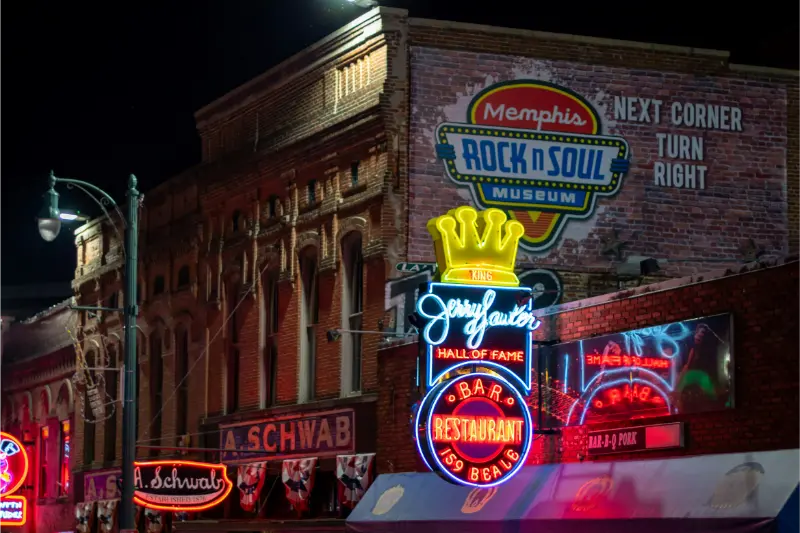
    Memphis Streetcar On Main Street

    On the final day, choose between more music history at Stax and a slower wander through Midtown, rather than trying to cover every neighbourhood mentioned in the guide. Leave enough time for a barbecue lunch and the trip back to the airport or station. Memphis is better enjoyed listening to something than watching the clock.

    How many days do you really need?

    If you have three days, I would keep the National Civil Rights Museum, a strong music-focused day and Graceland if Elvis’s story interests you. With five days, spend longer in Midtown or add another museum without squeezing it beside a big tour. There is no need to tick off every studio and stage to understand why Memphis matters.

    Four days work well because Memphis has two strong strands to explore: the history of civil rights and a remarkable musical heritage. Give each its own time, then use the remaining hours for the riverfront and local neighbourhoods. A rushed two-night visit can be enjoyable, but you will make tougher choices about what to leave out.

    Best time to visit

    Spring and autumn are popular for comfortable temperatures and events. Summer is hot and humid, so midday museum time becomes valuable. Winter is quieter and can be good for lower hotel rates, though some outdoor experiences feel less appealing in cold or wet weather.

    Summer heat and humidity make long riverfront walks more tiring than they look on paper. Spring and autumn often feel easier, though festivals and popular weekends can affect hotel availability. Before choosing dates, look at the performances or events you hope to attend; a live-music night may matter more to your trip than a small difference in temperature.

    What deserves advance booking?

    Graceland ticket packages, major music events and popular weekend hotels should be booked early. Timed tours such as Sun Studio can also sell out. Many museums are easier to fit around those fixed reservations, so anchor the itinerary with the attractions that have limited entry times.

    Graceland and timed studio tours deserve the first place in your booking plan, especially on a busy weekend. Once those times are set, fit museums and neighbourhood walks around them. Leave some room to change your evening music choice when you see what is actually playing; a full calendar of prepaid activities can make the city feel strangely rushed.

    Food and drink

    Memphis barbecue is famous, but the city’s food identity is broader than ribs. Try different styles across several meals rather than turning one heavily promoted restaurant into a pilgrimage. Soul food, modern Southern cooking and neighbourhood cafés deserve space too. Reservations help for higher-end weekend dining.

    A leisurely meal fits naturally between a museum and a night of live music. You might try barbecue one day, soul food another and a casual neighbourhood café when you want something lighter. Check kitchen hours before a late show, and tell the restaurant about allergies rather than assuming every sauce or side dish has an obvious ingredient list.

    Families, senior travellers and mixed-age groups

    Families can mix music, riverfront space and interactive museums, but long historical museums may require breaks for younger children. Senior travellers should choose a central hotel with easy parking or ride-hailing access and avoid scheduling Graceland plus multiple large museums on the same day.

    Children may enjoy the music and open spaces along the riverfront more than a full day of serious museum galleries. Plan a shorter museum visit with a break if you are travelling with younger family members. Older visitors may prefer to spread Graceland and the larger museums across separate days, with a ride rather than a long walk between stops.

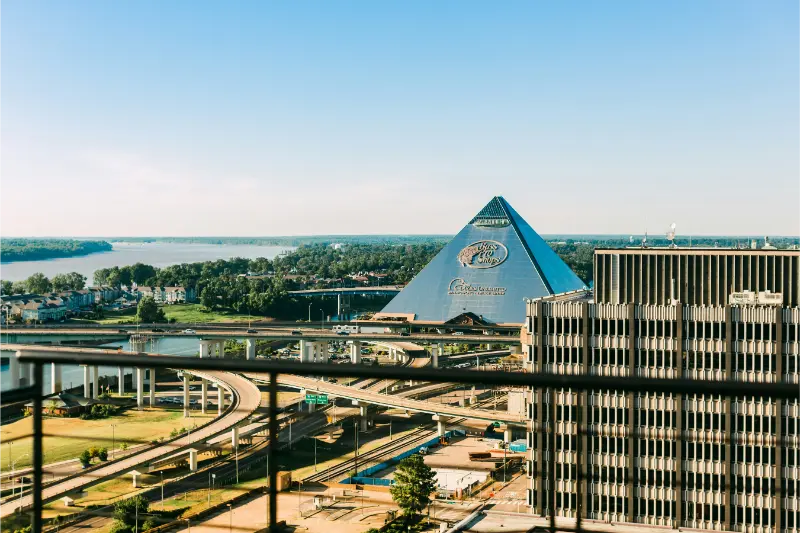
    Memphis Pyramid Arena At Sunset

    Accessibility

    Major Memphis museums provide visitor-access information, but do not assume every part of an older building or music venue is equally easy to navigate. Check entrances, seating and the availability of lifts or accessible facilities before buying a timed ticket. Downtown pavements and busy roads also deserve a look when planning a route for someone with limited mobility.

    Budget: where to spend and where to save

    Admission to several major attractions adds up quickly. A city pass or bundled ticket may help only if you genuinely want everything included. Spend on the essential music and civil-rights sites, then use the riverfront, neighbourhood walks and live-music planning to balance the budget.

    Tickets for Graceland, studios and museums can add up, so decide which stories you most want to follow before purchasing a bundle. A downtown hotel may cost more but reduce transport after evening performances. Free time by the Mississippi and a few carefully chosen music venues can balance a day with a larger admission charge.

    Safety and practical awareness

    Memphis has neighbourhood-by-neighbourhood differences, so ask your hotel about current local conditions and use normal urban precautions, especially late at night. Ride-hailing can be sensible after evening music. Do not judge the whole city by isolated warnings, but do not ignore local advice either.

    Keep a copy of your bookings and the address of your hotel on your phone. After a late set on Beale Street, choose a sensible route home or arrange a ride instead of wandering into unfamiliar streets. Check current local advice with your accommodation, particularly for evening plans, and keep usual precautions in mind without letting them overshadow the visit.

    One day trip or regional extension

    Many visitors continue to the Mississippi Delta, Oxford or another Tennessee destination rather than taking a formal day trip. If you only have four days, Memphis itself is the priority. Add an excursion only if you have already protected the city’s core history and music sites.

    The Mississippi Delta is tempting if the blues is what brings you here, but a trip out of the city takes more time than a quick glance at a map suggests. If you are already driving towards another destination, build it into that journey. Otherwise, use your four Memphis days to explore the music and civil rights history already close at hand.

    How to handle bad weather or extreme heat

    In the heat, make the riverfront walk an early or late activity and spend the hottest hours inside a museum. When rain rolls in, a music exhibit, studio visit or long lunch offers an easy alternative. Keep any outdoor riverside plan flexible; there is no reason to cross the city in poor weather simply because a schedule says you should.

    Solo travel

    Memphis can be rewarding on your own, especially if you love museums and live music. A central hotel makes it easier to return between daytime visits and a show, and a guided music tour can be a pleasant way to meet fellow travellers. For late evenings, know your ride-home plan before the last performance ends.

    Evenings and nightlife

    Give yourself a proper night on Beale Street rather than hopping from door to door just to say you have been everywhere. Listen to a whole set if the music grabs you, and check cover charges or age policies before going in. On another evening, a quieter restaurant or neighbourhood venue may suit you better than the crowds downtown.

    Memphis Pyramid And Downtown Aerial

    Photography without turning the trip into a photo shoot

    The riverfront looks especially striking in the softer light, while old storefronts and music signs give downtown its character. At the National Civil Rights Museum and other sites tied to painful history, follow the photography rules and read the interpretation before taking pictures. These places deserve more than a quick image for a travel feed.

    Shopping and souvenirs

    A record from a local music shop or a book about Memphis history will often mean more than a generic souvenir. Give independent stores a little time, and ask staff about local artists if you are curious. Protect vinyl and other fragile purchases on the flight home, and remember that a good live performance is also something worth taking away.

    What to pack

    Pack comfortable shoes for museum floors, South Main walks and evenings on your feet at music venues. In summer, light clothing and water are useful even when the day’s plan seems mostly urban; in cooler months, bring a layer for the riverfront after dark. Keep your day bag small enough to handle easily in busy rooms and shows.

    Common planning mistakes

    Do not schedule the National Civil Rights Museum as a rushed stop between Graceland and a studio tour. Each is worth more time, and they are not all next door to each other. Another easy mistake is treating an evening of music as a short final appointment; it is often the part of the day you most want to linger over.

    Leave one museum or neighbourhood as an optional extra rather than a promise. A tour can run longer than you expect, or you may find a live act you want to stay for. When that happens, you should be able to enjoy it without worrying about the next drive across Memphis or a dinner booking you can no longer make.

    Practical habits that make the trip easier

    • Save offline maps and the exact names of stations, terminals, hotel entrances and meeting points.
    • Carry a small amount of local cash even when cards are widely accepted.
    • Check the last practical return option before starting a day trip.
    • Download tickets and booking confirmations before leaving reliable Wi-Fi.
    • Separate one payment card from your main wallet and keep backup contact details offline.
    • Recheck weather, transport notices and opening hours on the morning of any fixed excursion.

    Official information to check before you go

    Opening days, transport, weather-sensitive access and event schedules can change. Recheck the details that control fixed reservations shortly before travel, especially during public holidays, major festivals or severe weather.

    Final planning checklist

    • Confirm passport, visa, entry and transit requirements for your nationality.
    • Choose accommodation by the journeys you will repeat, not by price alone.
    • Reserve only the attractions or excursions that genuinely control the day.
    • Save offline copies of tickets, hotel details, insurance information and essential addresses.
    • Check the exact airport, station, bus terminal, ferry pier or pickup point before arranging transfers.
    • Keep one flexible half-day for weather, fatigue or something discovered after arrival.
    • Recheck official opening information and local transport shortly before each fixed day.

    Final thoughts

    Memphis is most memorable when its history and music are given room to breathe. Spend time with the stories at the civil rights sites, listen closely in a music venue and sit down for a meal that belongs to the city. The best four-day visit is not a collection of famous names; it is one that helps you understand why they matter.

  • Florida Keys in 7 Days: Key Largo, Marathon and Key West Without Driving the Overseas Highway Twice a Day

    Florida Keys in 7 Days: Key Largo, Marathon and Key West Without Driving the Overseas Highway Twice a Day

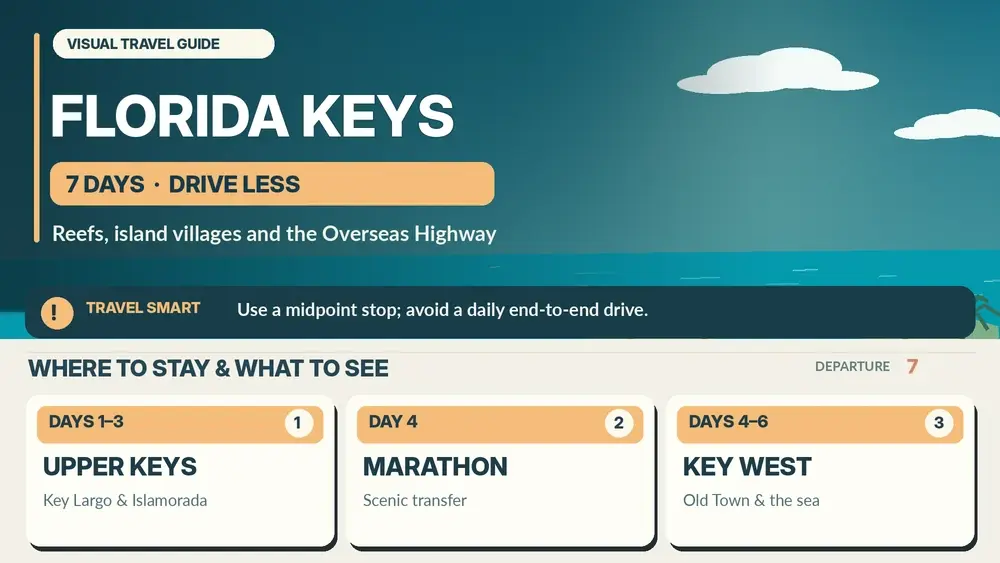
    The Florida Keys stretch for more than 100 miles below the mainland, and the Overseas Highway crosses 42 bridges. That makes the drive iconic, but it also means a Key West hotel is not a sensible base for daily reef trips in Key Largo or vice versa.

    This seven-day route uses two main bases: Key Largo or Islamorada for the Upper Keys and Key West for the Lower Keys, with Marathon as a deliberate stop or day rather than another compulsory hotel change.

    The official Florida Keys tourism site describes five distinct destination areas—Key Largo, Islamorada, Marathon, the Lower Keys and Key West—connected by the 113-mile Overseas Highway. The geography makes a one-way, two-base trip much more comfortable than constant backtracking.

    Quick trip summary

    • 3 nights Key Largo or Islamorada, 3 nights Key West, Day 7 departure.
    • Use Marathon and the Seven Mile Bridge area during the transfer rather than changing hotels again.
    • Book reef/snorkel trips with weather flexibility.
    • Avoid weekend/holiday drive assumptions based on empty-road map estimates.
    • Consider open-jaw flights or a final Miami buffer if the international flight is expensive to miss.

    Why this route works

    The Upper Keys provide the strongest reef/snorkelling/diving access and an easier first drive from Miami.

    Marathon naturally breaks the highway and offers wildlife/bridge/coast stops without requiring another checkout.

    Key West deserves several nights for history, walking, food and evenings when day visitors have left.

    A realistic itinerary at a glance

    Days Base Main focus
    1–3 Key Largo / Islamorada Reef, mangroves and Upper Keys
    4 Overseas Highway / Marathon Scenic transfer and Middle Keys stops
    4–6 Key West Old Town, history and flexible sea day
    7 Departure Key West flight or mainland return

    Day-by-day plan

    Day 1: Miami to Upper Keys

    Collect the car and drive south without turning every roadside attraction into a stop. Check in before dark and use a waterfront dinner as the first Keys experience.

    Day 2: Reef or marine day

    Choose snorkelling, diving, glass-bottom boat or eco-tour according to swimming ability. Weather and sea conditions should decide whether the trip goes ahead.

    Day 3: Islamorada/Upper Keys

    Use mangroves, paddling, fishing culture, galleries or a slower beach/water day. The official tourism site distinguishes Islamorada’s boating/fishing identity from Key Largo’s reef gateway role.

    Day 4: Drive to Key West via Marathon

    Stop in Marathon/Seven Mile Bridge area and perhaps one Lower Keys nature stop. The Overseas Highway is the day’s scenic spine; do not try to visit every key.

    Day 5: Key West history and walking

    Leave the car parked and use Old Town, Hemingway/Truman-style history, architecture and waterfront areas on foot or local transport.

    Day 6: Key West flexible day

    Choose a responsible boat/snorkel trip, Dry Tortugas planning if it is a true priority and booked, beaches or another historical/cultural day. Do not book the whole day around sunset.

    Illustrated Florida Keys route from the Upper Keys through Marathon to Key West

    Day 7: Departure

    Fly from Key West if the ticket works or drive north with a major buffer. A Key West–Miami airport drive is not a local transfer and traffic incidents can erase optimistic timing.

    Where to stay and how many hotel changes to make

    Key Largo is practical for reef access; Islamorada feels more spread out and relaxed.

    In Key West, paying for walkability can save parking and make evenings much easier.

    One Upper Keys base plus Key West is enough for a week; Marathon works naturally as a transfer stop.

    On a multi-base trip, location matters more than a small difference in nightly price. A room that removes repeated transfers can add more value than a prettier property that forces extra driving or taxis every day.

    Read recent guest reviews for practical details that booking photos rarely show: stairs, lift size, road noise, parking access, breakfast hours, room ventilation and the final walk from transport.

    Transport: what is worth planning in advance

    A car is useful for the Upper/Middle Keys and highway transfer, but mostly unnecessary once parked in central Key West.

    There is essentially one main road, so accidents and peak traffic can have disproportionate effects.

    If returning to Miami for a flight, consider a mainland final night when the ticket is costly or departure is early.

    Measure every move door to door rather than by the headline journey time. Checkout, reaching the station or airport, waiting, luggage and the final connection to the next hotel can turn a short transfer into half a day.

    Use inflexible tickets only when the saving is meaningful and the day is genuinely fixed. Weather-sensitive road, ferry and outdoor plans benefit from flexibility.

    Food and daily rhythm

    Seafood, Cuban influences and casual dockside meals fit the route naturally.

    A famous Key West dinner is more enjoyable when you are not hunting for parking at the same time.

    Use meals to control the rhythm of the day. A long regional lunch can be an experience and a recovery period, especially after hiking, museums, boat trips or an early start.

    Do not make every meal another attraction. Mix local specialties with simple food so that the destination, not the restaurant schedule, remains the centre of the trip.

    Families, children and older travellers

    Glass-bottom boats, aquariums/wildlife centres and shallow-water experiences can suit non-swimmers.

    Older travellers should ask about boat boarding and sun exposure.

    Key West walking days reduce the car-seat/parking cycle for families.

    For multigenerational travel, the useful pace is the one at which the least mobile member still enjoys the day. That usually produces a better experience for everyone.

    Children often respond better to a change of format than to another famous sight: a beach after a museum, a ferry after a city walk, or wildlife after a road day.

    Budget: where the money really goes

    Keys accommodation is often expensive; two bases reduce cleaning/parking/check-in costs.

    Marine activities are the main splurge, so choose one excellent reef day rather than paying for similar boat trips repeatedly.

    Compare total trip cost rather than headline prices. Parking, transfers, luggage, tours, resort fees and time lost reaching a remote hotel can erase an apparent saving.

    The best splurges usually remove friction: a central room, a safe private transfer, a direct train or ferry, a guide where context matters or one extra night that prevents an exhausting move.

    Best time to go

    Heat, thunderstorms, hurricane risk and winter cold fronts can all affect water plans.

    Sea conditions matter more than sunshine alone for snorkelling and boats.

    Shoulder season often balances weather, demand and prices well, but ferries, mountain services, rural restaurants and scenic roads may operate less frequently.

    Heat, rain, wind, snow and daylight should change the order of a day. Use comfortable hours for exposed outdoor sights and keep lower-effort alternatives available.

    Comfort, accessibility and realistic pacing

    Three nights in each main base make the highway a scenic transfer rather than a daily commute.

    Keep departure day conservative because one road connects much of the island chain.

    Travel fatigue compounds. One difficult transfer can reduce the quality of the following two days, which is why this route avoids one-night bases unless geography genuinely requires them.

    A free half-day is not wasted time. It is insurance for weather, laundry, a delayed transfer, a tired child or a place you discover only after arrival.

    Small decisions that improve the trip

    Use two bases

    Upper Keys and Key West are far enough apart to justify the split.

    Make Marathon the transfer day

    It breaks the road naturally without another hotel.

    Park in Key West

    Walking is part of the experience.

    Protect the Miami flight

    Highway 1 does not offer many alternatives.

    What I would leave out on this length of trip

    Leave a full Everglades road trip for another segment unless you add several days.

    Skip driving Key West–Key Largo–Key West for attractions on consecutive days.

    Mistakes that make this trip harder than it needs to be

    • Using Key West as the base for the whole chain.
    • Underestimating traffic on the one main highway.
    • Booking water trips with no weather backup.
    • Paying for a car that never moves in Old Town.
    • Treating Marathon as only a gas stop.
    • Driving directly to a tight Miami flight.

    How I would adapt the itinerary

    With four days, use Key West plus one Upper Keys night.

    With ten days, add a mainland Everglades section or more slow Keys time, not more hotel changes.

    Before booking

    • Book reef trips with cancellation policy.
    • Check hurricane-season insurance.
    • Plan Key West parking.
    • Keep road-trip fuel/water stocked.
    • Protect the final flight.

    Practical questions

    Key Largo or Islamorada?

    Key Largo is strongest for reef access; Islamorada is excellent for a laid-back boating/fishing atmosphere.

    Do I need a car in Key West?

    Not if you stay centrally; walking, bikes and local transport are often easier.

    How long does the Overseas Highway take?

    The pure drive is only part of the story. Traffic and scenic stops make it a real travel day.

    Final thoughts

    The Florida Keys are more enjoyable when the Overseas Highway is used as a journey once rather than a commute every day.

    An Upper Keys base and Key West give a week enough reef, road-trip scenery and old-town evenings without wasting hours backtracking.

  • Southern Arizona in 8 Days: Tucson, Saguaro and Bisbee Without Adding the Grand Canyon

    Southern Arizona in 8 Days: Tucson, Saguaro and Bisbee Without Adding the Grand Canyon

    Arizona travel does not have to revolve around the Grand Canyon. Southern Arizona offers a completely different desert, food culture and borderland history centred on Tucson, Saguaro National Park and the historic mining town of Bisbee.

    This eight-day route uses Tucson as the main base and Bisbee for the final block, with only one hotel change.

    The Visit Arizona Saguaro page notes that Saguaro National Park is split into east and west districts on opposite sides of Tucson. Treat them as separate days or half-days rather than trying to cross the city repeatedly.

    Quick trip summary

    • 5 nights Tucson, 2 nights Bisbee, Day 8 departure.
    • Use a rental car.
    • Treat Saguaro East and West as separate geographic areas.
    • Do desert walks early, especially in warm months.
    • Do not add the Grand Canyon or Sedona to this eight-day Southern Arizona trip.

    Why this route works

    Tucson deserves several nights for Sonoran Desert landscapes, UNESCO-recognised food culture, museums and nearby mountain environments.

    Five nights allow both Saguaro districts without daily cross-city driving.

    Bisbee provides a cooler, walkable historic finale and access to a different southeastern Arizona landscape.

    A realistic itinerary at a glance

    DaysBaseMain focus
    1–5TucsonSaguaro districts, food, museums and desert/mountain day
    6–7Bisbee / southeast ArizonaMining history, borderlands and smaller-town atmosphere
    8DepartureTucson/Phoenix onward

    Day-by-day plan

    Day 1: Tucson arrival

    Stay downtown, near the university or another area tied to your evening plans. Keep the first afternoon to food, streetcar districts or a short sunset stop.

    Day 2: Saguaro National Park West

    Use the Tucson Mountain District, Desert Museum direction and a short desert walk. Start early in hot weather and protect the middle of the day.

    Day 3: Tucson culture and food

    Use Mission San Xavier del Bac, museums, downtown or a food-focused experience. This lower-effort day breaks the desert exposure.

    Day 4: Saguaro National Park East

    Use the Rincon Mountain District scenic loop and one hike suited to conditions. The east side feels different enough to justify a separate day.

    Day 5: Mount Lemmon or flexible Tucson day

    Drive upward into cooler ecological zones, use an observatory/astronomy option or keep a slower city day depending on weather and energy.

    Day 6: Tucson to Bisbee

    Drive southeast, stop in Tombstone only if its history/interpretation genuinely interests you, then settle into Bisbee before evening.

    Day 7: Bisbee and borderlands

    Walk the steep historic town, use a mine/history tour or nearby nature. Avoid packing Tombstone, Bisbee and several border towns into one hurried day.

    Day 8: Departure

    Return toward Tucson or Phoenix with enough road time and no final long desert hike.

    Where to stay and how many hotel changes to make

    Tucson hotel location matters because the city is spread out; choose one side based on dining and the park district you expect to visit most.

    Bisbee is steep, so travellers with mobility limitations should check parking, stairs and the exact route to the room before booking.

    Choose accommodation for geography before décor. A well-positioned room can save an hour every day and often matters more than a small difference in nightly rate.

    Read recent guest reviews for practical details that hotel pages rarely emphasise: stairs, parking, road noise, breakfast hours, heating or air conditioning, and the real walk from transport.

    Transport: what is worth planning in advance

    A car is essential, and Saguaro’s two districts should be grouped with attractions on their respective sides of Tucson.

    Avoid long desert driving at dusk/night when wildlife and fatigue increase risk.

    Measure every move door to door rather than by headline distance. Parking, luggage, road conditions, ferry check-in and the final local transfer can turn a short-looking journey into half a day.

    Save hotel addresses, tickets and maps offline. The places where navigation matters most are often the places where mobile coverage becomes less reliable.

    Food and daily rhythm

    Tucson’s food culture is a major reason to stay several nights, with Sonoran, Mexican and Indigenous influences far beyond a single famous dish.

    Hydration matters more than restaurant ambition on hot hiking days.

    Use meals to shape the rhythm of the day. A long regional lunch can be both an experience and a recovery period after museums, hiking, heat or an early start.

    Do not make every meal another reservation. Mix destination restaurants with bakeries, markets, cafés and simple local places so food improves the trip instead of controlling it.

    Families, children and older travellers

    Desert museums, short park trails and astronomy can be excellent for families.

    Tucson Arizona Desert Highway And Mountains

    Older travellers can use scenic drives and visitor-centre trails; Bisbee’s steep streets require more planning.

    For multigenerational travel, the right pace is the one at which the least mobile member still enjoys the day. That usually creates a better shared trip for everyone.

    When accessibility matters, ask precise questions about steps, trail surfaces, boat boarding, lifts, toilets and vehicle access rather than relying on a generic accessibility label.

    Budget: where the money really goes

    Tucson lodging is often good value outside major events, while specialty astronomy, guided food or mine tours add optional costs.

    Five nights in one Tucson hotel reduce packing and parking uncertainty.

    Compare total trip cost rather than headline prices. Parking, transfers, fuel, tolls, ferries and guided activities can erase an apparent saving.

    The best splurges usually remove friction: a central room, a direct transfer, a good local guide or one extra night that prevents an exhausting move.

    Best time to go

    Late autumn through spring is easiest for desert walking; summer heat requires dawn starts and major midday indoor breaks.

    Higher elevations such as Mount Lemmon can be dramatically cooler and may have winter weather while Tucson is mild.

    Shoulder season often balances weather, crowds and prices well, but rural attractions, ferries, mountain services and seasonal restaurants may run reduced schedules.

    Weather should change the order of the day. Keep indoor or lower-effort alternatives so rain, heat, wind, smoke or cloud does not force you to waste the trip.

    Comfort, accessibility and realistic pacing

    One long Tucson base eliminates most logistics.

    The itinerary alternates exposed desert days with culture and high-elevation options.

    Travel fatigue compounds. One difficult relocation can weaken the following two days, which is why this itinerary avoids one-night bases unless geography genuinely requires them.

    A free half-day is not wasted time. It is insurance for weather, traffic, a tired child or a place you discover only after arriving.

    Small decisions that improve the trip

    Keep the trip southern

    Do not add the Grand Canyon.

    Separate Saguaro East and West

    Tucson sits between them.

    Use heat-aware timing

    The desert dictates the schedule.

    Sleep in Bisbee

    Its evening atmosphere is part of the experience.

    What I would leave out on this length of trip

    Leave Sedona, Grand Canyon and northern Arizona for another road trip.

    Skip long exposed hikes when temperatures are unsafe simply because the trail is famous.

    Mistakes that make this trip harder than it needs to be

    • Treating both Saguaro districts as one quick stop.
    • Hiking at midday in hot weather.
    • Underestimating Tucson’s spread.
    • Booking steep Bisbee lodging without checking access.
    • Adding Tombstone to every southeast-Arizona day.
    • Returning to Phoenix after a long hike with no buffer.

    How I would adapt the itinerary

    With five days, stay in Tucson and make Bisbee a long day only if you tolerate the driving.

    With ten days, add Chiricahua National Monument or another southeast-Arizona block with proper nights.

    Before booking

    • Check NPS weather/trail alerts.
    • Carry far more water than on a city day.
    • Use sun protection.
    • Choose Tucson hotel geography carefully.
    • Check Bisbee mobility/parking details.

    Practical questions

    Which Saguaro district is better?

    West is dense and dramatic around Tucson Mountain landscapes; East has a longer scenic road and Rincon Mountain setting. Both are worth time.

    Do I need to add the Grand Canyon?

    No. Southern Arizona can easily fill eight days.

    Is Bisbee worth two nights?

    Yes if you enjoy historic towns, architecture and slower evenings.

    Final thoughts

    Southern Arizona is a complete destination without borrowing the Grand Canyon’s fame.

    Tucson, two Saguaro districts and Bisbee create eight days of desert, food and history with only one hotel change.

    How to keep the itinerary resilient

    Keep the park districts interchangeable around heat, wind and storms.

    If temperatures spike, move desert walks to dawn and use museums or Mount Lemmon during the hottest hours.

    Who this route suits best

    This itinerary works best for travellers who prefer depth over collecting places. It keeps hotel changes low, protects flexible time and assumes that a good meal, a slower morning or an unexpectedly interesting local stop can be as valuable as another famous attraction. That approach works especially well for first-time visitors, couples, families and multigenerational groups.

    More energetic travellers can add a longer hike, another museum or a second excursion on flexible days. Travellers who prefer an easier pace can remove those extras and still keep the core journey intact. Before booking, identify the two or three experiences that would genuinely disappoint you to miss; those are the ones to reserve first.

  • Québec City in 4 Days: Old Québec, Petit-Champlain and St. Lawrence Views Without Rushing the Walls

    Québec City in 4 Days: Old Québec, Petit-Champlain and St. Lawrence Views Without Rushing the Walls

    Québec City is compact in geography but dense in atmosphere. Fortifications, steep staircases, stone streets, French Canadian food and views over the St. Lawrence can make the old city feel cinematic, yet the destination becomes much more interesting once you add local neighbourhoods and one outdoor extension. Four days gives that balance without compressing everything into a cruise-port schedule.

    If this stop is part of a wider journey, compare the pacing with Eastern Canada in 12 Days. Use that wider route for country- or region-level decisions and this guide for destination-level detail.

    Quick trip summary

    • Ideal stay: 4 days for a first visit.
    • Best approach: group each day by geography and keep one block flexible.
    • Good for: independent travellers, couples, families and slower-paced trips.
    • Main planning risk: adding too many fixed activities and underestimating local transfers, weather or walking conditions.

    Is this the right trip for you?

    Québec City is excellent for history, food, winter atmosphere, family travel and travellers who enjoy exploring on foot. The steep connection between Upper Town and Lower Town matters, especially in winter or for reduced mobility, but the funicular and taxis can make the core far more manageable.

    Where to stay

    AreaWhy choose it
    Old Québec – Upper TownBest for a first visit, evening walks, historic atmosphere and immediate access to the walls and major sights.
    Petit-Champlain / Lower TownRomantic streets and fast access to the river, but expect stairs or funicular rides to Upper Town.
    Saint-RochA more contemporary food and nightlife base with easy access to the old city.
    MontcalmQuieter residential feel near museums and the Plains of Abraham.

    For a first visit, staying in or near Old Québec makes the evenings especially pleasant. Check whether your hotel is in Upper Town or Lower Town before booking: a short-looking walk on the map may involve a steep climb. In winter, it’s also worth asking about luggage drop-off and how close a vehicle can get to the entrance.

    How to get there

    Québec City has an international airport and rail and coach connections with Montréal and other eastern Canadian cities. If you arrive by train, the station is conveniently placed near the lower edge of the historic centre. Winter conditions can add time to every transfer, so keep the first fixed reservation conservative.

    Save the accommodation name and address offline before travelling. Keep arrival day low-risk and leave extra time for baggage, traffic, platform changes and finding the correct entrance.

    Getting around

    Old Québec is best explored on foot, but hills and stairs are real. The funicular between Lower Town and Dufferin Terrace is useful for conserving energy. Local buses and taxis help for Montmorency Falls, outer neighbourhoods and bad-weather days.

    You can cover much of the old city on foot, but the height difference between Place Royale and Dufferin Terrace changes how far a walk feels. Use the funicular or a taxi when you’d rather save your energy for sightseeing. If you’re visiting in snow or ice, allow extra time even for familiar central routes.

    A realistic day-by-day itinerary

    Spend your first two days around the old town and the river, then look beyond the walls. That way you’re not travelling back and forth between the same streets. Keep the outdoor trip to Montmorency Falls on whichever day has the better conditions, rather than treating the schedule as something that can’t be changed.

    Day 1 – Old Québec, walls and Dufferin Terrace

    Start inside the fortified core with a slow walk around major squares, gates and viewpoints. Continue along Dufferin Terrace and around the Château Frontenac area without turning the hotel itself into the entire visit. Keep the evening in the old city so you can see the streets after day-trip crowds thin.

    Day 2 – Petit-Champlain, Place Royale and the river

    Descend to Lower Town for Petit-Champlain and Place Royale. Spend time along the St. Lawrence and Old Port rather than climbing immediately back uphill. This is also a good day for a museum or guided history walk if weather is poor.

    Chateau Frontenac Above Quebec City

    Day 3 – Plains of Abraham, museum time and local neighbourhoods

    Use the Plains of Abraham and nearby museum district to understand the city beyond the postcard streets. Continue into Montcalm or Saint-Jean-Baptiste for cafés and ordinary neighbourhood life. The day should feel more local and less monument-heavy.

    Day 4 – Montmorency Falls or a seasonal outdoor extension

    Visit Montmorency Falls if conditions suit, or choose another seasonal outdoor experience. In deep winter, keep the day flexible around weather; in summer and autumn, the river corridor and nearby nature are easier to combine with the city.

    On the day you leave the centre, check your return journey before setting off. Montmorency Falls deserves time for the views, not a hurried stop between two appointments. If the outing takes longer than expected, enjoy dinner back in town and leave any spare museum visit for another day.

    Best time to visit

    Québec City is genuinely year-round, but the experience changes dramatically. Summer offers festivals and long days; autumn adds colour; winter brings snow, ice and major events but requires proper clothing and slower walking; spring is quieter and more variable. Choose the season for the experience you actually want rather than searching for one universal best month.

    In Québec City, the season shapes the entire trip. Summer brings long evenings and busy terraces; winter offers a very different atmosphere, along with ice, cold and shorter daylight. Festival dates can affect room prices and availability, so choose the experience you want first and check the calendar before booking.

    Food and meal planning

    French Canadian classics, bakeries, maple products and contemporary Québec cooking are all easy to find. Reserve one important dinner if food is central to the trip, then keep the rest flexible so meals fit the neighbourhood you are already exploring.

    Petit-Champlain is a lovely place to stop for lunch while you’re exploring Lower Town. On the day you visit Montcalm or Saint-Jean-Baptiste, eat there rather than heading back to the tourist centre. Save one special restaurant for an evening when you can linger; a good meal shouldn’t require crossing town twice.

    One day trip or regional extension

    Montmorency Falls is the easiest high-value extension. If you have more time, Île d’Orléans or another regional outing adds countryside and food, but do not force multiple outer-area stops into one winter day.

    Montmorency Falls is the straightforward choice if you want a change of scenery from stone streets and museums. Île d’Orléans makes more sense when you have time for a leisurely food-and-countryside day, especially with suitable transport. Don’t try to combine both simply because they look close on a map.

    How many days do you really need?

    With four days you can explore Upper Town, spend a proper afternoon in Petit-Champlain and Place Royale, visit the Plains of Abraham and still get out toward the falls. If you only have two days, stay within the city. A fifth day is best spent taking things slower or exploring Île d’Orléans rather than revisiting the same viewpoints in a hurry.

    Give Lower Town most of a morning or afternoon. You’ll want time to look into shops, stop at Place Royale and wander towards the port without immediately facing the climb back uphill. The same goes for a museum day: one good visit, followed by a café or a neighbourhood stroll, often feels more satisfying than three short stops.

    Travelling with children

    For families, mix the old town’s streets and stories with places where children can move about freely. The Plains of Abraham can provide a welcome break after museums or guided visits. Remember that a steep staircase is much more demanding with a pushchair; the funicular may make the day easier, depending on your needs.

    Old Quebec City Skyline By River

    Carry snacks and water when you’re spending a long stretch in Lower Town, especially if travelling with younger children. Leave room for an unplanned stop by the river and avoid putting two fixed reservations close together. A little spare time matters when someone wants lunch earlier than expected or needs a rest halfway up the hill.

    Senior travellers and a slower pace

    A relaxed Québec City visit is absolutely possible without walking every staircase. Stay close to the area you expect to enjoy most and use the funicular or a taxi for the climb between Upper and Lower Town. Put the museum and the Plains of Abraham on the same day if that reduces unnecessary journeys.

    Old Québec has cobbles, slopes and stretches that can be slippery in winter. If you prefer shorter walks, choose a few viewpoints and squares rather than attempting every section of the fortifications. Check where you can sit, and be realistic about the walk back to the hotel after a full day out.

    Accessibility

    Don’t rely on an ‘accessible room’ label alone, especially in an older hotel. Ask about steps at the entrance, lifts, bathroom layout and the pavement outside. In Québec City a hotel may be close to everything on a map yet require a steep approach, so the exact address is important.

    Before buying tickets, check the access arrangements for the museum or attraction you want to visit. Some entrances are easier than others, and the practical route can change with snow or temporary works. If step-free access or seating is essential, contact the venue directly and plan the day around the confirmed information.

    Budget and booking strategy

    An extra amount spent on a conveniently located hotel can be worthwhile here, particularly in winter when repeated uphill walks become tiring. Decide which paid attractions really matter to you, then enjoy the city’s streets, squares and river views at your own pace. There’s no need to turn every afternoon into another ticket purchase.

    If you’re visiting during a major festival or a popular winter weekend, accommodation is the first thing to secure. Beyond that, keep at least one day flexible for weather. When comparing a trip to the falls or countryside, add the transport cost and time to the advertised ticket price before deciding what works for your budget.

    Money and payments

    You’ll be paying in Canadian dollars. Cards are useful across much of the city, but a little cash can still come in handy for smaller purchases. If you’re arriving from another country, check your bank’s foreign transaction fees and keep a spare payment card somewhere separate from your wallet.

    Safety and situational awareness

    Québec City is comfortable to explore with normal city precautions. Keep an eye on your belongings in crowded areas and take care on steep, icy streets in winter; a slip can be more likely than any dramatic travel mishap. If you’re out late, choose a well-lit route or a short taxi ride rather than a difficult shortcut.

    How to handle bad weather or extreme heat

    Winter weather can change a day’s plans quickly. Keep one indoor option, such as a museum or a leisurely meal, ready for icy or windy conditions. In summer, do your longer walks before the busiest part of the day and make time for the riverfront. Save Montmorency Falls for weather that lets you enjoy the views safely.

    Solo travel

    On your own, Québec City is easy to settle into. Spend a morning exploring the old streets, then join a history walk if you’d like local stories or company. For evenings, choosing accommodation near the areas you enjoy will make the walk home simple. Download a map before you go, especially if your phone plan doesn’t include Canadian data.

    Evenings and nightlife

    The old town is particularly attractive after sunset, when the stone buildings light up and the daytime visitors begin to leave. Have dinner nearby and walk along Dufferin Terrace if the weather allows. In winter, a warm café can be just as memorable; there is no need to force a late-night activity after a full day outdoors.

    Photography without turning the trip into a photo shoot

    For photographs, try the streets around Place Royale when they’re quieter, or look towards the St. Lawrence from Dufferin Terrace. Snow changes the whole scene, but watch your footing before stepping back for a wider shot. Be considerate in narrow streets and ask before photographing people at close range.

    Old Quebec City Historic Waterfront At Sunrise

    Shopping and souvenirs

    Take a little time to browse the small shops in Petit-Champlain or look for Québec-made food and crafts. Maple products make an easy gift, provided you can carry them on the rest of your journey. Check where an item was made rather than assuming every souvenir in the old town is local.

    What to pack

    Pack for the season, not just for a city break. In winter that means warm, grippy footwear, gloves and layers you can adjust when going indoors. Even in summer, comfortable shoes are important for cobbled streets and slopes. A compact bag leaves your hands free on stairways and makes museum visits easier.

    Common planning mistakes

    • Choosing accommodation by headline price without checking the repeated daily journey.
    • Booking a major attraction on arrival day with no margin for delays.
    • Crossing the destination several times because sights were listed by fame rather than geography.
    • Assuming a short map distance means an easy walk regardless of hills, heat, cobbles, weather or queues.
    • Keeping every day full and leaving no space for weather or fatigue.
    • Adding a day trip that duplicates a destination already scheduled later in the wider journey.

    Practical habits that make the trip easier

    • Save offline maps and the exact name of your hotel, station, terminal and meeting points.
    • Download tickets and confirmations before leaving reliable Wi-Fi.
    • Check the last practical return option before starting any excursion.
    • Carry a small amount of local cash even where cards are widely accepted.
    • Recheck opening hours and transport notices on the morning of any fixed reservation.
    • Keep one half-day flexible so a delay does not damage the rest of the trip.

    Final planning checklist

    • Confirm entry, transit and insurance requirements relevant to your nationality.
    • Choose accommodation by location, noise, access and transport as well as price.
    • Reserve only the attractions or excursions that genuinely control the day.
    • Keep offline copies of tickets, hotel details and important contact information.
    • Check the exact station, airport terminal, parking area or pickup point before travel.
    • Leave enough time for meals and unscheduled stops.
    • Recheck official information shortly before departure.

    Planning the days by geography

    Québec City becomes easier when the itinerary is built around neighbourhoods and transport corridors instead of a ranked attraction list. Put sights that share the same streets, transit line or landscape on the same day, then leave the final hours flexible. This reduces repeated transfers and makes it easier to stop for a meal, market, café or viewpoint that was not part of the original plan.

    Choose one thing you especially want from each day: the fortifications, the riverside streets, a museum or a trip to the falls. Everything else can fit around it. That simple choice makes it easier to enjoy an unexpected café or viewpoint without feeling that the whole itinerary has fallen behind.

    Arrival and departure day strategy

    Your arrival and departure days are best kept close to your hotel or transport connection. A gentle walk through Old Québec works well after checking in, but a trip to the falls doesn’t belong between checkout and an afternoon train. Leave time for luggage and for winter journeys that may take longer than planned.

    If your wider route continues elsewhere in Canada, confirm the exact station, terminal or pickup point the evening before. Similar place names, multiple stations and seasonal timetables are common sources of avoidable stress.

    Final thoughts

    Québec City is at its best when you give the streets time to work their charm. Walk through the old town, linger by the river and make room for a neighbourhood outside the walls. You don’t need to see every landmark in four days; you need enough time to enjoy the ones that brought you here.

    Official information to check before you go

    Opening days, transport, weather-sensitive access and event schedules can change. Recheck the details that control fixed reservations shortly before travel, especially during public holidays, festivals or severe weather.