Category: North America

Practical travel guides for destinations in North America, focused on neighbourhood planning, transport, costs and first-time itineraries.

  • Mexico in 10 Days: Mexico City and Oaxaca Without Trying to See the Whole Country

    Mexico in 10 Days: Mexico City and Oaxaca Without Trying to See the Whole Country

    Mexico is too large and too varied to treat as a single ten-day destination. The country rewards repeat trips, so a first itinerary becomes better when it accepts that limitation instead of trying to combine Mexico City, Oaxaca, the Yucatán, Pacific beaches and colonial towns in one exhausting loop.

    For ten days, Mexico City and Oaxaca make an unusually strong pair. One is a huge capital built in layers; the other is a smaller city where markets, food traditions, nearby archaeological sites and craft villages can fill several days without requiring constant hotel changes. The route also works well for travellers who want culture and food rather than a beach holiday.

    If your priority is cenotes and the Caribbean, use our Yucatán Peninsula itinerary instead. This article is deliberately about a different Mexico: neighbourhoods, museums, highland landscapes, markets and the slower pleasure of staying long enough to learn how each city moves.

    Quick trip summary

    • Spend 5 nights in Mexico City and 4 nights in Oaxaca, keeping the final night or departure buffer flexible.
    • Choose one Mexico City neighbourhood base and avoid crossing the metropolis repeatedly for meals.
    • Use a direct flight or a comfortable intercity bus between Mexico City and Oaxaca rather than adding several intermediate stops.
    • Reserve high-demand museums, restaurants or archaeological visits only where advance booking genuinely matters.
    • Build in altitude, heat and food-adjustment buffers instead of planning every hour.

    Why Mexico City and Oaxaca work so well together

    Mexico City gives you scale: major museums, pre-Hispanic history, architecture, neighbourhood life and one of the world’s great food scenes. Oaxaca gives you a contrasting rhythm. Its historic centre is walkable, excursions are compact enough for day trips, and evenings can be spent around the same plazas rather than in traffic.

    The pairing also limits logistical friction. Mexico City is a major international gateway, while Oaxaca is connected by air and long-distance bus. You can make the transfer once, settle again and then explore from a stable base. That is far more efficient than adding three or four destinations simply because they look close on a map.

    Altitude is another reason not to rush. Mexico City sits high enough that some visitors feel tired during the first day or two. A lighter arrival day, regular water and a gradual increase in walking can improve the whole trip.

    A realistic itinerary at a glance

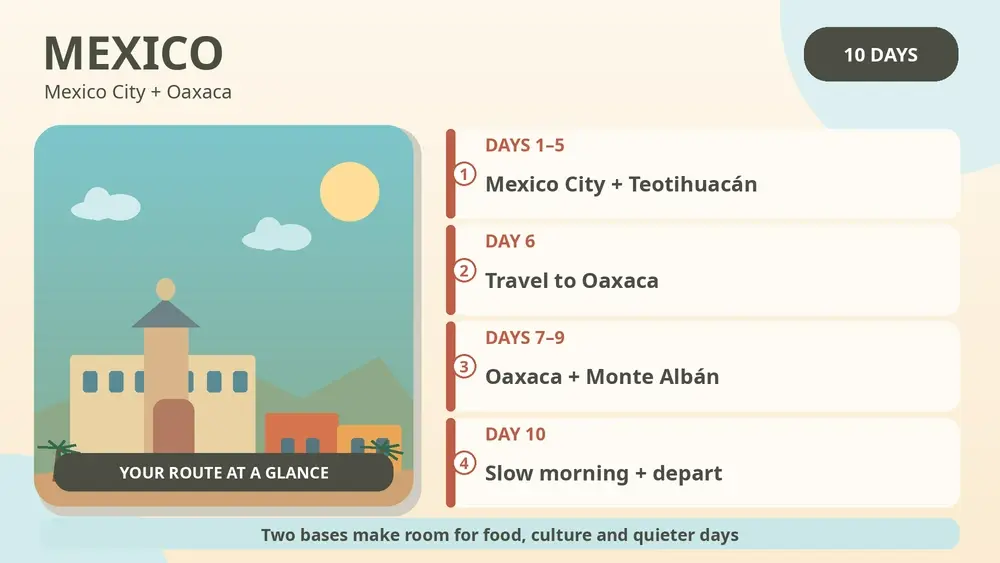
    Days Base Main focus
    1–5 Mexico City Historic centre, Chapultepec, neighbourhoods and Teotihuacán
    6 Transfer Mexico City to Oaxaca
    7–9 Oaxaca Historic centre, markets, Monte Albán and one focused excursion
    10 Oaxaca / departure Slow morning and onward journey

    Day-by-day plan

    Day 1: Arrive and stay local

    Choose a hotel in Roma Norte, Condesa, Juárez, Polanco or the historic centre according to what you value most. Do not spend the first afternoon crossing the city for a checklist attraction. Walk nearby, have an early meal and learn the rhythm of your immediate neighbourhood.

    Traffic and altitude make arrival days unpredictable. If you feel good, add a short walk; if not, protecting your energy is a better investment than forcing the first museum.

    Day 2: Historic Mexico City

    Spend the day around the Zócalo, cathedral area, Templo Mayor surroundings and streets of the Centro Histórico. The objective is not to enter every building but to understand the layers of the city before moving to other neighbourhoods.

    Start early, take breaks and be selective about museums. One substantial museum plus street-level exploration usually creates a better day than four rushed interiors.

    Day 3: Chapultepec and one major museum

    Give Chapultepec enough time to feel like a district rather than a single attraction. The National Museum of Anthropology can absorb several hours, and trying to combine it with multiple large museums often leaves visitors mentally exhausted.

    Finish in nearby Polanco or return toward Roma/Condesa for an easy evening. This is a good day to book one special dinner because the daytime route is geographically coherent.

    Day 4: Teotihuacán without overloading the evening

    Visit Teotihuacán early and treat it as the main event. Sun exposure, walking and the transfer make it more tiring than a normal city day. Check current access rules and opening information through Mexico’s National Institute of Anthropology and History before you go.

    When you return, keep the evening simple. A relaxed meal close to the hotel is more sensible than another cross-city attraction.

    Day 5: Neighbourhood day

    Use this day for Coyoacán, San Ángel, Roma, Condesa or a food-focused walk depending on your interests. Pick one or two areas rather than collecting neighbourhood names.

    This is also your weather and energy buffer. If an earlier museum was closed or you lost time to a delay, you can move it here without breaking the itinerary.

    Day 6: Travel to Oaxaca

    A flight saves time; a good intercity bus can be comfortable and lets you see the landscape. Compare the complete door-to-door time rather than the headline journey time. Airport transfers and check-in can erase part of the difference.

    After arrival, do little more than walk the historic centre, find the main market area and choose dinner close to your accommodation.

    Day 7: Oaxaca city properly

    Spend a full day in the centre: churches, markets, small museums, courtyards and food. Oaxaca is a place where stopping for chocolate, mezcal, mole or a market lunch is part of the experience, not wasted time.

    Avoid scheduling every tasting in advance. Leave room for recommendations you receive after arrival.

    Day 8: Monte Albán

    Visit Monte Albán early, then return to the city for a slower afternoon. The archaeological site is exposed and can be hot, so water, sun protection and sensible footwear matter.

    A half-day structure works well because it avoids combining Monte Albán with another long excursion merely to maximise the number of sights.

    Day 9: Choose one excursion

    Pick one direction: artisan villages, Hierve el Agua if access and road conditions suit you, or a mezcal-focused outing with a reputable operator. Do not try to stack all three into the same day.

    This choice is where the trip becomes personal. A family with young children may prefer shorter village stops; food-focused adults may value a producer visit; keen walkers may prefer a landscape day.

    Day 10: Leave space

    Keep the final morning for breakfast, a market revisit and packing. If you are connecting to an international flight from Mexico City, consider whether an overnight there is safer than a tight same-day connection.

    Mexico rewards unhurried repeat visits. Leave Puebla, the Pacific coast and other regions for a later trip rather than treating them as omissions.

    Where to stay and how many hotel changes to make

    In Mexico City, neighbourhood choice changes the trip more than a small difference in hotel quality. Roma Norte and Condesa are convenient for restaurants and evening walks; the historic centre puts monuments close but can feel quieter or more intense depending on the block; Polanco offers polished hotels and easy access to Chapultepec at a higher price.

    In Oaxaca, staying within comfortable walking distance of the historic centre is valuable because it lets you return to the hotel during the hottest or busiest part of the day. You do not need to sleep directly on the main square; being several blocks away can be quieter.

    For only ten days, two main hotels are enough. Every extra hotel change steals time through packing, check-out, luggage storage and orientation.

    Transport: what is worth booking in advance

    Mexico City traffic can make short map distances surprisingly slow. Use the Metro and Metrobús where practical, combine them with authorised taxi or ride-hailing options, and group each day geographically.

    Between the two cities, compare flight and bus schedules based on your hotel locations. A bus station may be easier to reach than an airport, while a flight can be useful if you find a well-timed fare.

    For Oaxaca excursions, a driver, small-group tour or organised transport can be easier than renting a car for a single day. If you do drive, understand local insurance, parking and road conditions rather than choosing a rental only because the base rate looks low.

    Food and daily rhythm

    Food is one of the strongest reasons to slow this route down. In Mexico City, mix markets, neighbourhood restaurants, bakeries and street food instead of reserving every meal. In Oaxaca, allow time for moles, tlayudas, chocolate, regional corn dishes and mezcal in contexts where you can actually understand what you are tasting.

    Use ordinary food-safety judgement: choose busy vendors with high turnover, drink safe water and give your stomach time to adapt. A packed tasting schedule on the first day is rarely necessary.

    Families, children and older travellers

    With children, reduce the number of museums and use parks, markets and short neighbourhood walks to break up the day. Chapultepec is especially useful because it provides space between indoor attractions.

    Older travellers may appreciate private transfers for Teotihuacán and Oaxaca excursions, elevators in hotels and rooms away from noisy streets. Historic paving and archaeological terrain can be uneven, so footwear and a slower pace matter.

    Multigenerational groups should not assume everyone must do the same activity. A morning excursion and a shared dinner often works better than keeping a large group together from breakfast to bedtime.

    Budget: where the money really goes

    The largest variables are accommodation level, restaurant choices and domestic transport. Mexico can feel good value compared with some North American and European cities, but premium hotels, tasting menus and private tours can quickly change the total.

    Budget for airport transfers, archaeological entrance fees, museum tickets, day trips and tips rather than comparing only room rates. Keep a separate contingency for schedule changes or a final-night airport hotel if your international connection requires it.

    If cost matters, spend on location before luxury. A well-located mid-range hotel can reduce daily transport and return-trip fatigue.

    Best time to go

    Highland Mexico does not have one universal “best” month. Mexico City and Oaxaca have distinct dry and rainy patterns, and temperatures change with elevation. Dry-season weather can be convenient, while rainy months may bring greener landscapes and afternoon showers rather than continuous rain.

    Major holidays, festivals and events can transform both price and atmosphere. If you want a specific celebration, plan around it deliberately; if not, avoiding peak dates can make rooms and transport easier.

    Check current local conditions shortly before departure rather than relying on a climate chart alone.

    Mistakes that make this trip harder than it needs to be

    • Trying to add the Yucatán or a Pacific beach to the same ten-day trip.
    • Booking a hotel far from the neighbourhoods you actually want to use every evening.
    • Treating Teotihuacán as a quick stop between several other major attractions.
    • Underestimating Mexico City traffic and altitude.
    • Scheduling multiple long Oaxaca excursions on consecutive days.
    • Connecting from Oaxaca to a long-haul international flight with no margin for disruption.

    How I would adapt the itinerary

    With seven days, stay only in Mexico City or divide the trip 4/3 and skip the Oaxaca day trip. With two weeks, add Puebla between the two cities or extend Oaxaca with a second focused excursion rather than immediately flying to another region.

    Travellers who mainly want beaches should not force this route to become something it is not. Pair the Yucatán guide with a future Mexico trip instead. Food-focused travellers can easily spend extra days in both cities without running out of meaningful experiences.

    Before booking the trip

    • Check passport and entry requirements for your nationality close to departure.
    • Review current archaeological-site opening information and any reservation rules.
    • Choose neighbourhoods before choosing hotels.
    • Leave a connection buffer if your international flight requires a domestic positioning flight.
    • Download offline maps and keep the hotel address available without internet.

    The most useful mindset for Mexico is to plan for depth, not coverage. Ten days in Mexico City and Oaxaca will show you only a fraction of the country, but that is precisely why it can feel like a real journey rather than a transfer schedule.

  • Miami and the Everglades in 6 Days: South Beach, Little Havana and Shark Valley Without a Rental Car Every Day

    Miami and the Everglades in 6 Days: South Beach, Little Havana and Shark Valley Without a Rental Car Every Day

    Miami is not simply South Beach, and the Everglades are not a quick roadside swamp stop. A six-day trip works best when urban Miami receives several full days and the national park is treated as a separate ecosystem day.

    This itinerary stays in Miami for the whole trip and rents a car or books a transfer only for the Everglades and any wider suburban/coastal excursion. That keeps parking from dominating the city portion.

    For current 2026 context, the National Park Service reported that Shark Valley reopened on August 24, 2026 after wildfire closures. NPS still advises checking current conditions because fire activity and access can change quickly in South Florida.

    Quick trip summary

    • One Miami hotel for all 6 days.
    • Use transit/rideshare for Miami Beach, Downtown/Brickell and Little Havana.
    • Rent a car or take a reputable tour for the Everglades day.
    • Check current NPS conditions before Shark Valley.
    • Do not combine the Florida Keys with this six-day itinerary.

    Why this route works

    Miami needs several days because Miami Beach, Little Havana, Wynwood/Design District and downtown waterfront areas have very different rhythms.

    Shark Valley or another Everglades gateway deserves most of a day, not a rushed hour between beach reservations.

    Keeping one hotel removes luggage and lets the Everglades day move if weather, fire or thunderstorms affect access.

    A realistic itinerary at a glance

    DaysBaseMain focus
    1–3MiamiSouth Beach, Little Havana, art/food neighbourhoods
    4EvergladesShark Valley or another park gateway
    5–6MiamiFlexible beach/culture day and departure

    Day-by-day plan

    Day 1: Miami Beach arrival

    Stay where you actually want evenings—South Beach, Mid-Beach, Downtown/Brickell or another area—and use the first day for Ocean Drive/Art Deco context and the beach.

    Day 2: Little Havana and urban Miami

    Use Calle Ocho with a food/history angle, then add one nearby neighbourhood or downtown block. Avoid reducing Little Havana to a single coffee/photo stop.

    Day 3: Art, design and coast

    Choose Wynwood/Design District, Vizcaya/Coconut Grove or another coherent direction. The best Miami day is usually one neighbourhood cluster plus beach time.

    Day 4: Everglades

    Check NPS current conditions first, then visit Shark Valley or another suitable entrance. As of August 24, 2026, Shark Valley had reopened after wildfire closures, but conditions remain something to verify close to travel.

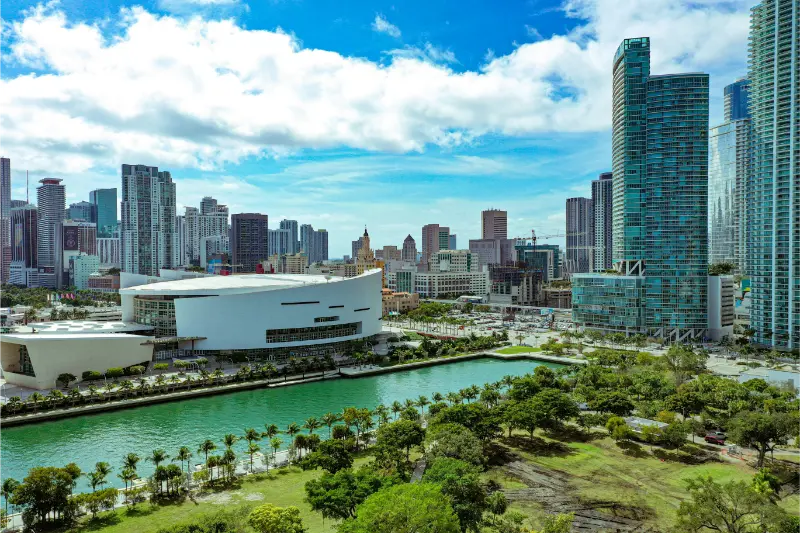
    Downtown Miami From Waterfront

    Day 5: Flexible Miami

    Use Key Biscayne, another beach, a museum or the neighbourhood you skipped. This is the weather/fire backup if the Everglades had to move.

    Day 6: Slow morning and departure

    Keep the final hours close to your airport route rather than adding a last long drive.

    Where to stay and how many hotel changes to make

    South Beach is best for beach-first travellers; Downtown/Brickell is stronger for transit and central urban access; Coconut Grove offers a quieter feel.

    Choose location by the evenings you want, because crossing Miami at dinner time can take longer than expected.

    Where you sleep should reduce friction rather than create another transfer. A well-connected room often adds more value than a cheaper property that forces repeated taxis, parking or long luggage walks.

    Read recent guest reviews for practical details that promotional photos rarely show: stairs, lift size, road noise, parking, breakfast hours and the final walk from a station, ferry or car park.

    Transport: what is worth planning in advance

    Do not rent a car for the whole stay unless your hotel includes practical parking and you expect suburban travel every day.

    For the Everglades, a one-day rental or quality small-group tour can be far more efficient.

    Measure every move door to door rather than by the headline timetable. Checkout, waiting, luggage and the final transfer can turn a short journey into half a day.

    Use inflexible tickets only when the saving is meaningful and the day is genuinely fixed. Weather-sensitive coast, mountain and marine plans benefit from flexibility.

    Food and daily rhythm

    Miami’s Cuban, Caribbean, Latin American and seafood scenes are central to the trip.

    Avoid scheduling every meal in South Beach; neighbourhood food is one of the strongest reasons to leave the barrier island.

    Use meals to control the rhythm of the day. A long regional lunch can be an experience and a recovery period after hiking, museums, heat or an early start.

    Do not make every meal another attraction. Mix destination restaurants with markets, bakeries, cafés and simple local places so food improves the trip instead of controlling it.

    Families, children and older travellers

    Beach time, wildlife and colourful neighbourhoods work well for families when heat is managed.

    Miami Waterfront Neighborhoods Aerial

    Older travellers should consider the exposed heat at Shark Valley and use tram/bike/walking options that match mobility and conditions.

    For multigenerational travel, the useful pace is the one at which the least mobile member still enjoys the day. That normally produces a better shared trip for everyone.

    When accessibility matters, ask specific questions about steps, trail surfaces, boat boarding, lifts and vehicle access rather than relying on a generic accessibility label.

    Budget: where the money really goes

    Miami parking and resort fees can materially change hotel value. Compare total nightly cost, not just room rate.

    Using a car only for one or two days can reduce parking and rental expense significantly.

    Compare total trip cost rather than headline prices. Parking, transfers, luggage and tours can erase an apparent saving.

    The most useful splurges usually remove friction: a central room, a direct transfer, a quality guide or one extra night that prevents an exhausting move.

    Best time to go

    Winter and early spring are popular for lower humidity, while summer brings intense heat, storms and higher mosquito activity.

    Everglades water levels, wildlife distribution and fire conditions change seasonally, so the park experience is not identical year-round.

    Shoulder season often balances weather, demand and prices well, but ferries, rural attractions and mountain services may run less frequently.

    Heat, rain, wind and daylight should change the order of the day. Keep lower-effort alternatives for conditions that do not suit the original plan.

    Comfort, accessibility and realistic pacing

    The Everglades day is surrounded by flexible Miami days so access changes do not break the itinerary.

    One hotel keeps the trip easy even if you switch urban neighbourhoods by rideshare/transit.

    Travel fatigue compounds. One difficult transfer can reduce the quality of the following two days, which is why this itinerary avoids one-night bases unless geography genuinely requires them.

    A free half-day is not wasted time. It is insurance for weather, transport disruption, a tired child or a place you discover only after arriving.

    Small decisions that improve the trip

    Keep one Miami base

    There is no reason to move hotels for the Everglades.

    Rent a car only when useful

    Parking should not become a daily attraction.

    Check NPS status close to travel

    The August 2026 fire closures are a reminder that conditions can change.

    Give Little Havana real time

    It deserves food, history and context.

    Miami Tropical Beach Promenade

    What I would leave out on this length of trip

    Leave the Florida Keys, Naples and Orlando for separate trips.

    Skip treating the Everglades as a photo stop on the way somewhere else.

    Mistakes that make this trip harder than it needs to be

    • Staying far from the neighbourhoods you actually want.
    • Renting a car for every city day.
    • Visiting the Everglades at peak heat with no water/sun plan.
    • Ignoring NPS fire/road conditions.
    • Eating only in tourist strips.
    • Driving to the Keys before a flight.

    How I would adapt the itinerary

    With four days, use three Miami days plus one Everglades day.

    With eight days, add the Upper Keys or Biscayne National Park with proper time rather than more city cramming.

    Before booking

    • Check Everglades current conditions.
    • Compare hotel resort/parking fees.
    • Plan sun/heat protection.
    • Choose Everglades transport before arrival.
    • Keep departure day geographically simple.

    Practical questions

    Do I need a car in Miami?

    Not for every day. Transit, rideshare and walking can cover much of a first city stay.

    Is Shark Valley open?

    NPS reported it reopened August 24, 2026 after wildfire closure; always verify current conditions before travel.

    Can I add the Keys?

    Not without making six days much more rushed.

    Final thoughts

    Miami and the Everglades work best as two complementary experiences rather than one giant driving itinerary.

    One hotel, several distinct Miami neighbourhood days and one serious national-park day produce a much stronger six-day trip.

    How to keep the itinerary resilient

    Keep the Everglades day movable around fire, storm and heat conditions.

    Use Day 5 as the backup so a closure never forces you to lose the park entirely.

    Who this route suits best

    This itinerary works best for travellers who value depth over collecting places. It keeps hotel changes low, protects flexible time and assumes that a good meal, an unexpectedly interesting neighbourhood or a slower morning can be as valuable as another attraction. That approach is particularly useful for first-time visitors, couples, families and multigenerational groups.

    More energetic travellers can add a longer hike, an extra museum or a second excursion on flexible days. Travellers who prefer an easier pace can remove those extras and still keep the core journey intact. Before booking, identify the two or three experiences that would genuinely disappoint you to miss; those are the ones to reserve first.

  • Honolulu in 5 Days: Waikīkī, Pearl Harbor and Oʻahu Views Without Renting a Car Every Day

    Honolulu in 5 Days: Waikīkī, Pearl Harbor and Oʻahu Views Without Renting a Car Every Day

    Honolulu is both a real Pacific capital and the gateway to Oʻahu, and those two roles are easy to blur. Visitors often rent a car for the entire stay, then pay to park it while spending several days in Waikīkī and central Honolulu. Five days works better when the urban core is explored without a car first and a vehicle is added only if a specific island day genuinely needs one.

    If this destination is part of a wider trip, compare the pacing with Hawaii in 10 Days. The city guide should add depth to that route rather than duplicate the same transfers.

    Quick trip summary

    Ideal stay5 days for a first trip
    Best approachGroup each day by geography and protect one flexible block
    Transport strategyWalk within districts; use public transport or taxis for cross-city moves
    Who it suitsFirst-time visitors, couples, solo travellers, families and slower-paced travellers
    Most common mistakeAdding too many distant attractions to the same day

    How to plan the trip before booking

    Start by fixing the parts of the itinerary that are difficult to replace: timed monuments, limited-capacity experiences, major performances or transport that controls the rest of the trip. Everything else should remain flexible enough to move when weather, queues or simple tiredness change the day.

    The most useful question is not “How many attractions can fit?” but “Which part of the city should this day belong to?” Grouping stops by geography usually saves more time than any transport trick. It also creates room for spontaneous meals, neighbourhood streets and the unexpected places that often become the strongest memories.

    Where to stay: choose location before hotel style

    BaseWhy choose it
    WaikīkīThe easiest first-time base for beach access, dining and tours, with the widest hotel choice.
    Ala MoanaConvenient between Waikīkī and central Honolulu with strong shopping and transit connections.
    Downtown HonoluluBetter for history, business and local urban access, but less convenient for travellers who want daily beach time.
    KāhalaQuieter and more resort-focused, best for travellers willing to trade walkability for space and calm.

    A beautiful room is not automatically a good base. Map the first activity of the morning, the likely dinner area and the departure route. If the hotel creates two unnecessary transfers every day, the hidden cost is time as well as money.

    A realistic 5-day itinerary

    Day 1: Waikīkī and an easy arrival day

    Use the first day to settle into Waikīkī, walk the beachfront and adjust to the time difference. Keep the schedule light even if the flight arrives early; jet lag, heat and strong sun are poor ingredients for an ambitious first afternoon.

    Honolulu Waikiki Shoreline Aerial

    Day 2: Honolulu history and culture

    Move beyond the resort zone for Downtown Honolulu, ʻIolani Palace area and one cultural institution. This day provides context that a beach-only itinerary misses and can be managed largely without a rental car.

    Day 3: Pearl Harbor with realistic reservation timing

    Give Pearl Harbor a dedicated block and reserve any limited-capacity experience that matters to you. Security, transport and site logistics can take longer than expected, so avoid attaching a long North Shore drive to the same day.

    Day 4: Lēʻahi (Diamond Head) and the south/east coast

    Start early for Diamond Head if you have the required reservation, then choose a small number of south- or east-coast stops. Heat and parking are better managed in the morning. Do not turn scenic viewpoints into a race around the island.

    Day 5: Flexible Oʻahu day or slower Honolulu

    Use the final day for a North Shore outing, Hanauma Bay if properly reserved and conditions fit, or simply more Honolulu and beach time. The best choice depends on weather, surf and how much driving you actually want before departure.

    Keep the second half of the day lighter than the first whenever possible. A useful itinerary leaves room for a delayed start, a longer meal, weather or the simple discovery that one neighbourhood deserves another hour.

    Getting from the airport and handling arrival day

    Daniel K. Inouye International Airport is close to central Honolulu in distance, but traffic can stretch transfer times. Taxis, ride-hailing, buses and selected rail/transit connections may suit different hotels. Confirm your exact route shortly before travel because the island’s transport network continues to evolve.

    Honolulu Waikiki Beach Panorama

    Arrival day should carry less risk than the other days. Keep the first reservation easy to cancel, buy water and any transport card you need, and learn the route back to the hotel before staying out late.

    Getting around without wasting the day

    Waikīkī and central Honolulu can be managed with walking, TheBus, taxis, ride-hailing and other local services. A car becomes more useful for parts of the island that are awkward by transit, but parking costs and traffic make a full-stay rental unnecessary for many visitors.

    When comparing two routes, include walking to the station, waiting, transfers and the final approach. A route with fewer changes is often better for families, luggage, older travellers and anyone visiting in difficult weather.

    Best time to visit and how season changes the itinerary

    Oʻahu works year-round, but surf, rainfall patterns and holiday demand change the character of different coasts. Winter can bring powerful North Shore waves; summer often has calmer conditions there. Always follow lifeguard advice and treat ocean conditions as a real planning factor rather than background scenery.

    Season also changes hotel prices, daylight, event calendars and how tiring outdoor sightseeing feels. If your dates are fixed, adapt the daily rhythm instead of forcing an itinerary designed for another month.

    What to book first

    Reserve only the experiences where availability genuinely matters. Timed museums, high-demand monuments, a special show, protected natural areas and limited tours deserve priority. Ordinary neighbourhood walks, markets and most meals are better left flexible unless there is one restaurant you care about deeply.

    Recheck opening days, transport works, reservation rules and local closures shortly before departure. These details change faster than the basic shape of a good itinerary, and a five-minute check on an official source can prevent a wasted cross-city journey.

    Food strategy: eat well without crossing the city for every meal

    Eat beyond resort dining at least a few times. Honolulu offers Native Hawaiian, Japanese, Filipino, Chinese, Korean and broader local influences. Markets, plate lunches, bakeries and neighbourhood restaurants can be as memorable as formal dinners. Respect that popular local places may have limited parking or queues.

    For a multi-age group, a reliable breakfast and an easy lunch often matter more than one additional attraction. Use meals as genuine rest rather than another item to complete quickly.

    Travelling with children

    Beaches and short cultural visits make Honolulu family-friendly, but strong sun, heat and water conditions require more conservative pacing. Alternate water time with shade and indoor breaks, and never assume a calm-looking beach is suitable for children without checking conditions.

    Honolulu Waikiki Beach And Hotels

    With children, reduce transitions before reducing the highlights. Alternate one structured indoor visit with something that allows movement: a park, waterfront, market, short ride or open square. Keep toilets, drinking water, snacks and an easy route back to the hotel in mind before starting a long afternoon.

    Travelling at a slower pace or as a senior

    Choose accommodation with easy lift access and nearby transport, especially if daily beach walks are part of the plan. For Pearl Harbor and major cultural sites, check walking distances and seating. A taxi for one awkward transfer can preserve energy for the place itself.

    Slower travel usually improves a city itinerary because it forces better geographic choices. Use transport to remove unrewarding distance, then spend walking energy on the streets, museums, viewpoints and markets that actually define the destination.

    Budget planning

    The largest differences in a short city budget usually come from hotel location, airport transfers, major admissions, restaurant choices and repeated taxi use. A slightly more expensive hotel can be better value if it removes two long transfers every day. Compare the total trip cost rather than the room rate alone.

    Keep a small daily reserve for an easier taxi, an unexpected admission, extra water, a spontaneous meal or a weather-driven change. A budget works better when it protects the trip from small problems instead of allocating every available amount in advance.

    Weather backup plan

    Keep at least one indoor or low-commitment block movable. The best backup fits the same part of the city, so a sudden shower, heat wave or poor visibility does not force a completely new transport plan. Outdoor viewpoints, beaches and long walks should be placed where they can move by half a day if necessary.

    Connectivity, payments and small practical details

    Save the hotel address, key tickets, passport or identity details, insurance information and the next important transfer outside your email app. Offline access matters when the network is weak or the battery is low. Carry a small power bank and keep a backup payment method separate from the main wallet.

    Do not assume every small business accepts the same payment methods as major hotels. Carrying a modest amount of local cash can be useful even in destinations where cards are common, while large amounts of cash create unnecessary risk.

    What to pack

    Comfortable shoes, weather protection and a small day bag matter more than extra outfits on a short city trip. Add any medication you may need during the day, a refillable bottle where practical and one layer for strong air-conditioning or cooler evenings. Pack for the conditions you will actually walk through, not only the climate average.

    Honolulu Waikiki Aerial Beach

    Common mistakes to avoid

    • Renting a car for five days when it is needed only once or twice.
    • Treating Honolulu as only a hotel base for driving around Oʻahu.
    • Ignoring reservation requirements for high-demand natural or historic sites.
    • Underestimating sun exposure on the first day after a long flight.
    • Planning a full North Shore circuit immediately after Pearl Harbor.

    Responsible travel and local etiquette

    Treat residential streets, places of worship, markets and memorial spaces as working parts of the destination rather than scenery. Follow staff instructions, keep entrances and pavements passable, ask before photographing people in sensitive settings and spend with local businesses when it fits naturally.

    In natural or wildlife settings, distance and local rules matter more than the photograph. Do not feed animals, cross barriers or pressure guides to break access rules for a closer view.

    If you have less or more time

    With three days, keep Waikīkī, Honolulu culture and Pearl Harbor. Four days adds Diamond Head and the south/east coast. With six or seven days, add a carefully paced North Shore day and more beach time rather than attempting every famous stop on Oʻahu.

    Safety and decision-making on the day

    Use ordinary urban awareness: keep phones and wallets controlled in crowded areas, use clearly identified transport and avoid walking while distracted at complicated crossings. The most useful safety advice is current and local, so follow official notices, hotel guidance and attraction staff when conditions change.

    Set a practical turnaround time for excursions and transfer days. A missed secondary sight is cheaper than a missed flight, an unsafe late journey or an exhausted final day.

    Useful official and planning resources

    Opening hours, transport schedules, fees, reservation procedures and access rules change more often than the basic geography. Recheck the official source shortly before departure.

    Final planning checklist

    • Confirm passport, visa, transit and health requirements for your nationality.
    • Reserve the attraction, tour or transport that controls the rest of the itinerary.
    • Save the accommodation address and first-day route offline.
    • Recheck weather, closures and transport notices before each critical day.
    • Keep at least one half-day that can absorb a delay or become simple rest.
    • Leave a generous buffer before flights and other costly connections.

    A successful city break should feel as though you understood how the place fits together, not merely that you collected its famous names. Protect the fixed reservations that matter, group the rest by geography and remove anything that creates more transit than experience.

  • New Jersey in 8 Days: Jersey City, Princeton and Cape May Beyond a New York Day Trip

    New Jersey in 8 Days: Jersey City, Princeton and Cape May Beyond a New York Day Trip

    New Jersey is commonly experienced through airports, turnpikes and quick New York-area visits, but the state changes dramatically from the Hudson waterfront to university towns, pine forests and Victorian Cape May.

    This eight-day route uses Jersey City or Hoboken first, Princeton in the middle and Cape May at the coast. It deliberately skips an exhausting attempt to cover every Jersey Shore town.

    The itinerary works because it travels south in one direction and keeps each block geographically coherent.

    Quick trip summary

    • 3 nights Jersey City/Hoboken, 2 nights Princeton/central New Jersey, 2 nights Cape May, Day 8 departure.
    • Do not keep a rental car during the Hudson-waterfront days unless necessary.
    • Use Princeton as a base for central history, gardens or Pinelands direction.
    • Choose Cape May as the coastal base rather than moving up and down the Shore.
    • Use an open-jaw or one-way car strategy if it saves backtracking.

    Why this route works

    Jersey City and Hoboken provide skyline views, food and rapid transit while remaining distinctly New Jersey.

    Princeton offers a walkable historic/university centre and a calmer middle block.

    Cape May is far enough south to justify two nights and gives the trip a real coastal finale.

    A realistic itinerary at a glance

    DaysBaseMain focus
    1–3Jersey City / HobokenHudson waterfront, local neighbourhoods and nearby urban culture
    4–5Princeton / central NJUniversity town, history and gardens/Pinelands
    6–7Cape MayVictorian streets, beaches and wildlife coast
    8DeparturePhiladelphia/Newark onward

    Day-by-day plan

    Day 1: Hudson waterfront arrival

    Stay near PATH or ferry connections and use the waterfront, Liberty State Park direction or Hoboken streets for a low-pressure first day.

    Day 2: Jersey City and Liberty Harbor area

    Use Liberty State Park, Empty Sky Memorial and local neighbourhoods. You can include Manhattan if it is a priority, but this article keeps the day focused on New Jersey.

    Jersey City Waterfront Skyline And Ferries New Jersey

    Day 3: North Jersey flexible day

    Choose Paterson history, Montclair, Newark arts/food or another local theme. Avoid turning the trip into a sequence of New York commuter runs.

    Day 4: Move to Princeton

    Collect the car if needed, travel south and spend the afternoon walking the university district and town centre.

    Day 5: Central New Jersey

    Use Grounds For Sculpture, a Revolutionary War site, a garden or a first Pinelands direction. One substantial theme is enough.

    Day 6: Princeton to Cape May

    Drive south with one meaningful stop, arrive in Cape May and use the Victorian centre or beach before dinner.

    Day 7: Cape May coast

    Use the lighthouse, birding/wetlands, beach, cycling or a whale/dolphin trip in season. Keep the day local.

    Day 8: Departure

    Use Philadelphia if it fits naturally; returning to Newark is possible but requires more road buffer.

    Where to stay and how many hotel changes to make

    On the Hudson, proximity to PATH/ferry is more useful than a skyline room alone. In Princeton, walkability is valuable for evenings.

    Cape May rewards a central inn/hotel if you want to park once and walk to dinner.

    Choose accommodation for geography before décor. A well-positioned room can save an hour every day and often matters more than a small difference in nightly price.

    Read recent guest reviews for practical details that hotel pages rarely emphasise: parking, stairs, road noise, breakfast hours, lift access and the real walk from the station, beach or attraction.

    Transport: what is worth planning in advance

    Delay the rental car until leaving the dense northeast if possible.

    The New Jersey Turnpike and Garden State Parkway are efficient but tolls and traffic should be part of the budget and timing.

    New York One World Trade Center Skyline From Jersey

    Measure every move door to door rather than by headline mileage. Parking, roadworks, luggage, ferry check-in and the final local transfer can turn a short-looking journey into half a day.

    Save hotel addresses, reservation confirmations and maps offline. Coverage is usually good in cities but becomes less dependable in rural parks, shorelines and mountain areas.

    Food and daily rhythm

    Northern New Jersey is extraordinarily diverse for food, while the coast shifts toward seafood, casual beach dining and seasonal restaurants.

    Leave space for local diners, bakeries and neighbourhood restaurants instead of chasing only social-media-famous places.

    Use meals to shape the rhythm of the day. A long regional lunch can be both an experience and a recovery period after museums, hiking, heat or an early start.

    Do not turn every meal into another reservation. Mix destination restaurants with bakeries, markets, diners, cafés and simple local places so food improves the itinerary instead of controlling it.

    Families, children and older travellers

    Liberty State Park, sculpture gardens, beaches and wildlife are easy to combine for families.

    Older travellers should choose Cape May accommodation close to the pedestrian core and check beach-boardwalk access.

    For multigenerational travel, the right pace is the one at which the least mobile member still enjoys the day. That usually creates a better trip for everyone.

    When accessibility matters, ask precise questions about steps, boardwalk surfaces, boat boarding, lifts, beach access and restroom availability rather than relying on a generic accessibility label.

    Budget: where the money really goes

    Hudson waterfront hotels can be expensive, especially when Manhattan rates rise.

    A car-free first three days can offset some lodging cost by avoiding parking and rental fees.

    Compare total trip cost rather than headline room prices. Parking, transfers, tolls, ferries, resort fees and guided activities can erase an apparent saving.

    The best splurges usually remove friction: a central room, a direct transfer, a good local guide or one extra night that prevents an exhausting relocation.

    Newark City Hall New Jersey Neoclassical Facade

    Best time to go

    Spring and autumn are excellent for towns and birding; summer is strongest for the coast but busiest and most expensive.

    Cape May remains interesting outside beach season because architecture, birding and food are not summer-only experiences.

    Shoulder season often balances weather, crowds and prices well, but beach services, ferries, heritage attractions and rural restaurants may run reduced schedules.

    Weather should change the order of the day. Keep indoor or lower-effort alternatives so rain, heat, wind or storms do not force you to waste the trip.

    Comfort, accessibility and realistic pacing

    The route moves steadily south, avoiding repeated Turnpike crossings.

    The coast comes last, creating a slower finish after the urban beginning.

    Travel fatigue compounds. One difficult relocation can weaken the following two days, which is why this itinerary avoids one-night bases unless geography genuinely requires them.

    A free half-day is not wasted time. It is insurance for weather, traffic, a tired child or a place you discover only after arriving.

    Small decisions that improve the trip

    Keep New York optional

    New Jersey should be the destination in this itinerary.

    Delay the car

    Urban parking is expensive and unnecessary.

    Use Princeton for the middle block

    It creates a natural transition.

    Finish in Cape May

    Do not commute to the coast from North Jersey.

    What I would leave out on this length of trip

    Leave Atlantic City, the entire Shore and northern mountain areas for future New Jersey trips.

    Skip trying to visit several beach towns on the same day.

    Mistakes that make this trip harder than it needs to be

    • Treating Jersey City only as cheaper Manhattan accommodation.
    • Renting a car before leaving the Hudson area.
    • Crossing north-south repeatedly.
    • Trying to see every Shore town.
    • Ignoring tolls and summer traffic.
    • Returning from Cape May to Newark under a tight flight.

    How I would adapt the itinerary

    With five days, use Jersey City plus Princeton and one Cape May night.

    Asbury Park Paramount Theatre And Convention Hall New Jersey

    With ten days, add the Pinelands or another Shore base with proper nights.

    Before booking

    • Choose PATH/ferry-friendly lodging.
    • Plan tolls and one-way car options.
    • Book summer Cape May early.
    • Check marine-tour conditions.
    • Choose departure airport by final geography.

    Practical questions

    Is New Jersey worth a standalone trip?

    Yes. The state is much more varied than the Turnpike corridor suggests.

    Do I need a car?

    Not for the first urban block, but yes for Princeton and Cape May.

    Cape May or Atlantic City?

    Cape May fits this slower heritage-and-coast itinerary much better.

    Final thoughts

    New Jersey makes more sense when the trip stops orbiting New York City and follows the state’s own geography.

    The Hudson waterfront, Princeton and Cape May create eight days of urban culture, history and coast without constant highway backtracking.

    How to keep the itinerary resilient

    Keep the Cape May boat/outdoor day flexible around wind and weather.

    If north-south traffic builds, shorten a transfer-day stop instead of arriving late and tired.

    Who this route suits best

    This itinerary works best for travellers who prefer depth over collecting places. It keeps hotel changes low, protects flexible time and assumes that a good meal, a slower morning or an unexpectedly interesting local stop can be as valuable as another famous attraction. That approach works especially well for first-time visitors, couples, families and multigenerational groups.

    More energetic travellers can add a longer hike, another museum or a second excursion on flexible days. Travellers who prefer an easier pace can remove those extras and still keep the core journey intact. Before booking, identify the two or three experiences that would genuinely disappoint you to miss; those are the ones to reserve first.

  • Seattle in 4 Days: Waterfront, Markets and Neighbourhoods Without Making Every Day a Mountain Trip

    Seattle in 4 Days: Waterfront, Markets and Neighbourhoods Without Making Every Day a Mountain Trip

    Seattle is often planned as a waiting room for Mount Rainier, Olympic National Park or an Alaska cruise, yet the city deserves several days of its own. Four days allows Pike Place Market, the waterfront, Seattle Center and neighbourhoods to fit without making each day depend on a car. The key choice is whether one regional excursion is truly a priority or whether the city and Puget Sound are enough for this trip.

    If this city is part of a longer trip, compare the pacing with Washington State in 10 Days. A city guide should complement the wider itinerary, not force a traveller to repeat the same transfer twice.

    Quick trip summary

    Ideal stay4 days for a first trip
    Best approachGroup each day by geography and protect one flexible block
    Transport strategyWalk within districts; use public transport or taxis for cross-city moves
    Who it suitsFirst-time visitors, couples, solo travellers, families and slower-paced travellers
    Most common mistakeAdding too many distant attractions to the same day

    How to plan the trip before booking

    A useful city itinerary is not the one with the highest number of saved pins. It is the one in which the difficult reservations are protected, the days make geographic sense and there is still enough margin for a long meal, weather, queues or simple fatigue. Treat travel time as part of the day rather than as an invisible gap between attractions.

    Where to stay: choose location before hotel style

    BaseWhy choose it
    Downtown / Pike Place edgeMaximum convenience for first-time sights and walking access to the waterfront.
    BelltownCentral, lively and practical between Pike Place and Seattle Center.
    Capitol HillRestaurants, nightlife and local character with light-rail access.
    Queen Anne / Seattle CenterGood for families and major attractions, somewhat quieter than the downtown core.

    A more attractive room is not automatically a better travel decision. Map the first activity of the morning, the likely dinner area and the departure route. If the hotel adds two unnecessary transfers every day, the hidden cost is time as well as money.

    A realistic 4-day itinerary

    Day 1: Pike Place Market and waterfront

    Visit Pike Place early enough to enjoy the working market, then move downhill to the waterfront. Choose one major waterfront attraction or ferry experience rather than trying to do everything before lunch.

    Seattle Waterfront Skyline Across Bay

    Day 2: Seattle Center and Queen Anne

    Use the second day for the Space Needle area and whichever museum or cultural attraction best fits your interests. Queen Anne or nearby viewpoints can finish the day without another long transfer.

    Day 3: Capitol Hill, parks and neighbourhood Seattle

    Spend a day beyond the postcard core. Combine Capitol Hill with a park, local food and a neighbourhood such as Fremont or Ballard only if the route is logical. This day is where Seattle feels like a city rather than a collection of attractions.

    Keep the second half of the day lighter than the first. A useful itinerary creates space for an unexpectedly good museum, a long meal, a delayed train, a child who needs a break or a neighbourhood that deserves another hour.

    Day 4: Ferry, islands or flexible regional day

    Take a ferry for the experience and views, or keep the day within Seattle for museums and neighbourhoods. A Mount Rainier trip is a major commitment and should replace this day, not be squeezed around evening plans.

    How to move around without wasting the day

    Light rail is useful for airport and city corridors, buses cover many neighbourhoods and walking works well in the central core, though hills are real. Ferries are both transport and experience. A rental car is unnecessary for most city days and becomes most useful only when the wider Washington itinerary begins.

    Seattle Waterfront Glass Towers

    Do not judge a journey only by kilometres. A short trip can include station corridors, road congestion, stairs, queues or a long final walk. Think in door-to-door time and keep a margin before anything expensive or difficult to replace.

    Arrival and departure strategy

    Seattle-Tacoma International Airport connects to the city by light rail and road transfers. If arriving for a cruise, confirm the exact terminal because different piers create different transfer logic. Keep luggage handling in mind when choosing between transit and a direct ride.

    Arrival day is rarely the right time for the most complicated attraction. On departure day, protect the connection first and use only nearby activities that can be abandoned without consequence.

    Best time to visit

    Late spring through early autumn generally offers the longest days and the best odds for mountain views, while wetter months are excellent for museums, food and neighbourhood travel. Clear conditions matter for skyline and mountain viewpoints, so keep those flexible rather than booking the whole trip around one forecast.

    What to book first

    Book the experiences that are difficult to replace: limited-capacity museums, timed monuments, a special performance or a day trip that controls the rest of the itinerary. Leave ordinary meals, neighbourhood walks and secondary sights flexible. Recheck entry rules, opening days and transport notices shortly before departure because these details change more often than the basic geography.

    Food strategy: eat well without crossing the city for every meal

    Seafood, coffee, bakeries and Asian cuisines are central to Seattle’s food identity. Pike Place is a useful introduction but should not be the only dining zone. Capitol Hill, the International District, Ballard and other neighbourhoods reward a more local evening.

    For a multi-age group, a reliable breakfast and an easy lunch often matter more than one additional attraction. Use meals as genuine rest rather than another item to complete quickly.

    Travelling with children

    Pike Place, ferries, Seattle Center and parks offer natural variety for families. Keep the hillier walking sections short and avoid adding a long mountain day immediately after a late arrival.

    Seattle Waterfront Ferries And Space Needle

    With children, reduce transitions before reducing the highlights. Alternate one structured indoor visit with something that allows movement: a park, waterfront, market, short ride or open square. Keep toilets, drinking water, snack options and an easy route back to the hotel in mind before starting a long afternoon.

    Travelling at a slower pace or as a senior

    For older travellers or anyone who prefers a slower pace, choose a base close to the transport line or district used most often. Use taxis or public transport to remove unrewarding distance, then spend walking energy on the streets, museums and viewpoints that actually define the destination. Check lifts, stairs and seating at major sights rather than assuming accessibility from the map.

    Budget planning

    The largest budget differences usually come from hotel location, airport transfers, major admissions and how often a taxi is used for cross-city journeys. A slightly more expensive central hotel can be better value if it removes two long transfers every day. Build a daily budget with a small reserve instead of planning to spend every available amount on advance bookings.

    Weather backup plan

    Keep one indoor or low-commitment block movable. A good weather fallback should fit the same part of the city and should not damage the following day. If one experience depends heavily on clear skies, comfortable heat or dry conditions, place it in a flexible slot and move it when the local forecast improves.

    Connectivity, cash and small practical details

    Save the hotel address, key tickets, passport or identity details, insurance information and the next important transfer outside your email app. Offline access matters when the network is weak or the battery is low. Carry a small power bank and keep a backup payment method separate from the main wallet.

    What to pack

    Comfortable walking shoes matter more than an extra outfit on a short city break. Add sun or rain protection, a refillable bottle where practical, any medication you may need during the day and one layer suitable for air-conditioned interiors or cooler evenings. The goal is to stay mobile without carrying the contents of the hotel room.

    Seattle Pike Place Waterfront Aerial

    Common mistakes to avoid

    • Treating Seattle only as the airport for national parks.
    • Renting a car for every city day and paying to store it.
    • Scheduling a mountain day and a packed city evening together.
    • Ignoring hills when estimating walking distance.
    • Assuming a cloudy forecast means the entire day is lost.

    Responsible travel and local etiquette

    Treat residential streets, places of worship and memorial spaces as real parts of a working city rather than scenery. Follow staff instructions, keep entrances and pavements passable, use bins, and spend with local businesses when it fits naturally. Small choices about timing and behaviour often improve the experience for visitors as well as residents.

    If you have less or more time

    With two days, keep Pike Place/waterfront and Seattle Center. Three days adds one strong neighbourhood day. With five days, add a ferry-focused day or one regional excursion, but preserve enough city time that Seattle does not become only a hotel base.

    Safety and decision-making on the day

    Use ordinary big-city awareness: keep phones and wallets controlled in crowded areas, choose clearly identified transport and avoid walking while distracted at complicated road crossings. The most useful safety advice is current and local, so follow official notices, attraction staff and transport operators when conditions change.

    Set a practical turnaround time for long walks, excursions and transfer days. A missed secondary sight is cheaper than a missed flight, unsafe walk or exhausted final day.

    Useful official and planning resources

    Opening hours, transport schedules, fees, reservation procedures and access rules change more often than the basic geography. Recheck the official source shortly before departure.

    Final planning checklist

    • Confirm passport, visa, transit and health requirements for your nationality.
    • Reserve the attraction, permit or train that controls the rest of the itinerary.
    • Save the accommodation address and first-day route offline.
    • Recheck weather, closures and transport notices before each critical day.
    • Keep at least one half-day that can absorb a delay or become simple rest.
    • Leave a generous buffer before flights and other costly connections.

    A good city break should feel as though you understood how the place fits together, not merely that you collected its famous names. Keep the fixed reservations that matter, group the rest by geography and remove anything that creates more transit than experience.

  • Baja California Sur in 10 Days: La Paz, Todos Santos and Los Cabos Without Driving the Peninsula

    Baja California Sur in 10 Days: La Paz, Todos Santos and Los Cabos Without Driving the Peninsula

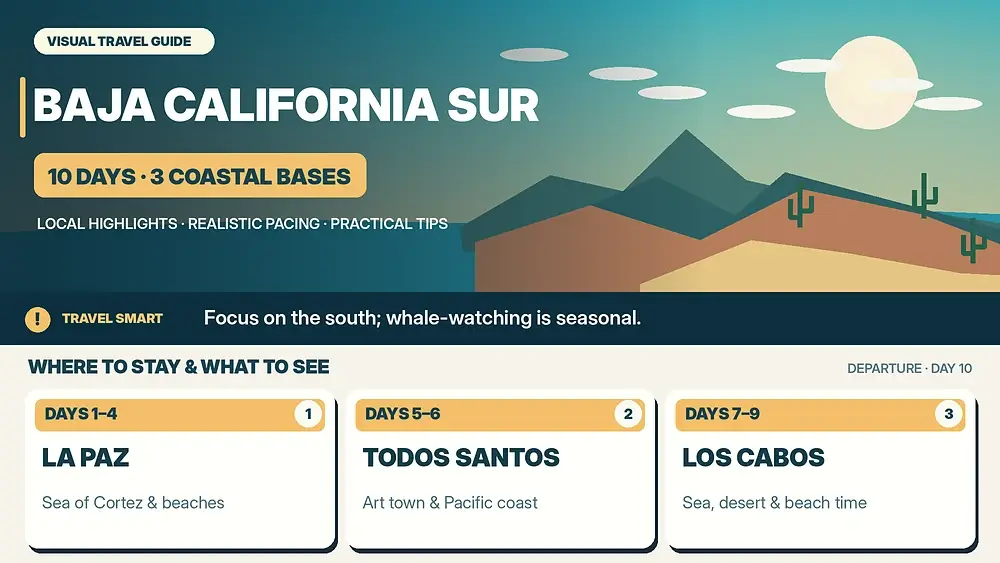
    Baja California Sur is a long peninsula state, and a ten-day trip should not try to drive from Los Cabos to Loreto and every whale lagoon simply because the highway exists. The southern triangle already contains several very different trips.

    This itinerary uses La Paz, Todos Santos and Los Cabos. La Paz provides Sea of Cortez wildlife and a real Mexican city; Todos Santos adds the Pacific; Los Cabos finishes with broad flight options and resort infrastructure.

    The official Visit Baja Sur La Paz guide highlights the city as a gateway to the Sea of Cortez, while its whale-watching guide distinguishes gray whales on Pacific lagoons, blue whales around Loreto and humpbacks around Los Cabos. Wildlife is seasonal and never guaranteed.

    Quick trip summary

    • 4 nights La Paz, 2 nights Todos Santos, 3 nights Los Cabos, Day 10 departure.
    • Keep the long peninsula north out of this trip.
    • Use La Paz for Sea of Cortez experiences.
    • Treat whale watching as seasonal.
    • Finish near Los Cabos airport.

    Why this route works

    La Paz deserves the longest stay because the Malecón, beaches and marine excursions are the route’s strongest nature component.

    Todos Santos is close enough to avoid a long transfer but different enough for two nights of Pacific atmosphere.

    Los Cabos provides a practical airport ending plus beaches and desert-meets-sea landscapes.

    A realistic itinerary at a glance

    DaysBaseMain focus
    1–4La PazMalecón, beaches and Sea of Cortez nature
    5–6Todos SantosPacific coast and art-town rhythm
    7–9Los CabosCoast, desert/sea outings and final beach time
    10DepartureLos Cabos International Airport

    Day-by-day plan

    Day 1: La Paz arrival

    Stay near the Malecón and keep the first evening to waterfront walking and dinner.

    Day 2: La Paz beaches

    Use Balandra/Tecolote-area beaches according to current access rules and crowd conditions.

    Day 3: Sea of Cortez day

    Choose a reputable marine operator for Espíritu Santo, sea lions or another seasonal experience.

    Disney California Adventure Pixar Pier Ferris Wheel At Sunset

    Day 4: Flexible La Paz day

    Use a second marine day, city/food, beach or a seasonal wildlife experience when operationally available.

    Day 5: La Paz to Todos Santos

    Drive south/west and use galleries, cafés and a Pacific sunset instead of immediately continuing.

    Day 6: Todos Santos/Pacific coast

    Choose beach, art, food or a nearby nature outing. Swimming suitability varies by beach and surf.

    Day 7: Todos Santos to Los Cabos

    Drive south and use the afternoon for San José del Cabo or your chosen beach/resort area.

    Day 8: Los Cabos coast day

    Choose a boat trip, coastal viewpoint or relaxed resort day. Wildlife outings should use permitted operators.

    Day 9: Flexible final day

    Use San José culture, beach, desert activity or genuine rest.

    Day 10: Departure

    Return the car and fly without a same-morning La Paz transfer.

    Where to stay and how many hotel changes to make

    La Paz Malecón access is ideal for evenings; Todos Santos is compact; in Los Cabos choose San José, Cabo San Lucas or the corridor according to the experience you want.

    For Baja California Sur, location matters more than a small difference in nightly rate. A hotel that removes repeated transfers usually adds more value than a prettier property in the wrong part of the route.

    Read recent guest reviews for practical details that booking photos rarely show: stairs, lift size, road noise, parking access, breakfast hours and the final walk from transport.

    Transport: what is worth planning in advance

    A car is useful for the southern route but not a reason to drive hundreds of extra kilometres north. Avoid unfamiliar desert-highway driving late at night.

    Measure every move door to door rather than by the headline timetable. Checkout, terminal access, waiting, luggage and the final connection can turn a short journey into half a day.

    Los Angeles Welcome To California Street Mural

    Use inflexible tickets only when the saving is meaningful and the day is genuinely fixed. Weather-sensitive coast, mountain, wildlife and boat plans benefit from flexibility.

    Food and daily rhythm

    La Paz has strong local seafood and city dining, while Todos Santos and San José add boutique and farm-to-table styles.

    Use meals to control the rhythm of the day. A long regional lunch can be an experience and a recovery period, especially after hiking, museums, wildlife outings or early starts.

    Do not make every meal another attraction. Mix local specialties with simple food so that the destination, not the restaurant schedule, remains the centre of the trip.

    Families, children and older travellers

    Marine life can be excellent for children, but boat length and swimming ability should guide excursion choice. Older travellers should ask about small-boat boarding and shade.

    For multigenerational travel, the useful pace is the one at which the least mobile member still enjoys the day. That normally produces a better shared trip for everyone.

    When accessibility matters, ask specific questions about steps, trail surfaces, boat boarding, lift dimensions and vehicle access rather than relying on a generic label.

    Budget: where the money really goes

    Marine tours, rental cars and resort nights are the biggest variables; Todos Santos boutique properties can be pricier than expected.

    Compare total trip cost rather than headline prices. Parking, transfers, luggage, park transport, tours and time lost reaching a remote hotel can erase an apparent saving.

    Keep a contingency rather than allocating every day to the last euro or dollar. Weather, a changed ferry, a taxi or an extra night can appear even on a carefully planned journey.

    Best time to go

    Whale species and marine experiences have different seasonal windows. Winter and spring are particularly popular for wildlife, while summer heat can be intense.

    Shoulder season often balances weather, demand and room prices well, but ferries, mountain services, wildlife excursions and rural restaurants may run less frequently.

    Oceanside California Beach At Dusk

    Heat, rain, snow, wind and daylight should change the order of your day. Use the most comfortable hours for exposed outdoor sights and keep lower-effort alternatives available.

    Comfort, accessibility and realistic pacing

    The route ends near the main airport and uses marine days early enough that one cancellation can be moved.

    Travel fatigue compounds. One difficult transfer can reduce the quality of the following two days, which is why this itinerary avoids one-night bases unless geography genuinely requires them.

    A free half-day is not wasted time. It is insurance for weather, laundry, a delayed service, a tired child or a place you discover only after arriving.

    Small decisions that improve the trip

    Keep the route south

    Loreto and gray-whale lagoons deserve another trip.

    Give La Paz four nights

    The Sea of Cortez is the heart of the route.

    Treat wildlife as seasonal

    No ethical operator can guarantee a wild-animal encounter.

    What I would leave out on this length of trip

    Leave Loreto, Mulegé and Magdalena Bay for a longer journey.

    Skip swimming at Pacific beaches where current or surf conditions make it unsafe.

    Mistakes that make this trip harder than it needs to be

    • Driving too far north in a short trip.
    • Booking wildlife outside the relevant season.
    • Choosing unlicensed operators.
    • Ignoring surf/current warnings.
    • Driving desert highways late at night.
    • Leaving La Paz for the airport on flight morning.

    How I would adapt the itinerary

    With six days, use La Paz plus Los Cabos.

    With two weeks, add Loreto by flight or a carefully planned road section.

    Before booking

    • Check seasonal wildlife regulations.
    • Use reputable marine operators.
    • Plan beach access rules.
    • Carry sun and water protection.
    • Finish near Los Cabos airport.

    Practical questions

    Do I need a car?

    A car adds useful flexibility, though private transfers can work.

    La Paz or Los Cabos for more time?

    La Paz for Sea of Cortez nature; Los Cabos for resorts and flight convenience.

    When can I see whales?

    It depends on species and location; check current official seasonal guidance.

    The Pacific Coast Highway California

    Final thoughts

    Baja California Sur is most rewarding when it is treated as a region of two seas rather than one endless highway.

    La Paz, Todos Santos and Los Cabos create a ten-day southern route with marine life, Pacific atmosphere and easy airport logistics.

    How to keep this itinerary resilient

    Leave Day 4 open so wind or a cancelled boat can be absorbed without losing your Sea of Cortez priority.

    Confirm marine regulations and beach access shortly before travel, especially if wildlife is a central reason for the trip.

    Who this route suits best

    This route is designed for travellers who prefer depth over collecting places. It keeps hotel changes low, protects flexible time and assumes that a good meal, an unexpectedly interesting neighbourhood or a slower morning can be as valuable as another attraction. That makes it particularly suitable for first-time visitors, couples, families and multigenerational groups.

    More energetic travellers can add a longer hike, an extra museum or a second excursion on the flexible days. Travellers who prefer an easier pace can remove those extras and still keep the core journey intact. Before booking, identify the two or three experiences that would genuinely disappoint you to miss; those are the ones to reserve or protect first.

    What to book early and what can wait

    Book the elements with genuinely limited capacity first: high-demand accommodation, protected-area access, popular trains or ferries, and any guided experience that is central to the trip. Leave ordinary meals, minor attractions and weather-dependent outdoor activities more flexible whenever possible. This prevents the itinerary from becoming a chain of reservations that forces you to ignore how the destination actually feels on the day.

    One week before departure, check the official transport or park information again. The evening before each major move, confirm departure points, opening status and the hotel address. That small routine catches most avoidable travel problems before they become expensive or tiring.

  • Boston in 4 Days: Freedom Trail, Back Bay and Cambridge Without Walking the Same Streets Twice

    Boston in 4 Days: Freedom Trail, Back Bay and Cambridge Without Walking the Same Streets Twice

    Boston looks compact, and much of the centre really is walkable, but the first-time mistake is to repeat the same downtown corridor while treating Cambridge, Back Bay and the waterfront as afterthoughts. Four days is enough to understand the city’s historical role and its contemporary neighbourhoods if each day follows one side of the Charles or one coherent section of the centre.

    If this city is part of a longer trip, compare the pacing with New England in 10 Days. A city guide should complement the wider itinerary, not force a traveller to repeat the same transfer twice.

    Quick trip summary

    Ideal stay4 days for a first trip
    Best approachGroup each day by geography and protect one flexible block
    Transport strategyWalk within districts; use public transport or taxis for cross-city moves
    Who it suitsFirst-time visitors, couples, solo travellers, families and slower-paced travellers
    Most common mistakeAdding too many distant attractions to the same day

    How to plan the trip before booking

    A useful city itinerary is not the one with the highest number of saved pins. It is the one in which the difficult reservations are protected, the days make geographic sense and there is still enough margin for a long meal, weather, queues or simple fatigue. Treat travel time as part of the day rather than as an invisible gap between attractions.

    Where to stay: choose location before hotel style

    BaseWhy choose it
    Downtown / Government CenterBest for Freedom Trail access and a short first visit focused on historic sights.
    Back BayAttractive streets, restaurants and good transport with an easy walk to several central areas.
    SeaportModern hotels and waterfront dining, convenient for some museums and airport access but less historic in atmosphere.
    Cambridge near Harvard or KendallA good repeat-visitor or university-focused base, with rapid transit into central Boston.

    A more attractive room is not automatically a better travel decision. Map the first activity of the morning, the likely dinner area and the departure route. If the hotel adds two unnecessary transfers every day, the hidden cost is time as well as money.

    Boston North End Restaurants And Cafes

    A realistic 4-day itinerary

    Day 1: Freedom Trail and North End

    Start early on the core historic route and decide in advance which interiors matter. Finish in the North End rather than rushing back across town. The goal is to understand the sequence of places, not merely photograph every marker.

    Day 2: Beacon Hill, Boston Common and Back Bay

    Use the second day for a slower urban walk through Beacon Hill, the Public Garden and Back Bay. Add one cultural stop or the library area and keep the evening local.

    Day 3: Waterfront and Seaport

    Walk part of the harbourfront, choose one museum or market area and continue into the Seaport only as far as interest and weather justify. A harbour cruise can replace, not automatically add to, another major activity.

    Day 4: Cambridge and the Charles

    Cross the river for Harvard Square, selected university museums or the MIT/Kendall area. Finish with a river walk or neighbourhood meal instead of returning downtown for a duplicate sightseeing circuit.

    Keep the second half of the day lighter than the first. A useful itinerary creates space for an unexpectedly good museum, a long meal, a delayed train, a child who needs a break or a neighbourhood that deserves another hour.

    How to move around without wasting the day

    Central Boston is highly walkable, while the MBTA subway and buses remove longer distances. Old street patterns can make map distances deceptive, and stations do not always connect as directly as expected. Use public transport to link districts, then explore within each one on foot.

    Do not judge a journey only by kilometres. A short trip can include station corridors, road congestion, stairs, queues or a long final walk. Think in door-to-door time and keep a margin before anything expensive or difficult to replace.

    Boston Historic North End Street

    Arrival and departure strategy

    Logan Airport is close to the centre by big-city standards, but the best transfer depends on the hotel, luggage and traffic. Water transport, rapid transit and road options all serve different travellers. Keep the first evening flexible, especially after a transatlantic flight.

    Arrival day is rarely the right time for the most complicated attraction. On departure day, protect the connection first and use only nearby activities that can be abandoned without consequence.

    Best time to visit

    Spring and autumn are popular for comfortable walking and seasonal colour, summer brings long days and activity, and winter can be cold with weather disruptions. In 2026, major historic commemorations can also affect crowd patterns, so recheck event calendars if visiting around high-profile dates.

    What to book first

    Book the experiences that are difficult to replace: limited-capacity museums, timed monuments, a special performance or a day trip that controls the rest of the itinerary. Leave ordinary meals, neighbourhood walks and secondary sights flexible. Recheck entry rules, opening days and transport notices shortly before departure because these details change more often than the basic geography.

    Food strategy: eat well without crossing the city for every meal

    Boston is more than lobster rolls and clam chowder, although both can be worthwhile. Use the North End, Chinatown, Back Bay, Cambridge and the Seaport as different food zones instead of eating every meal around one tourist market. Reserve one special dinner and keep the rest adaptable to the day.

    For a multi-age group, a reliable breakfast and an easy lunch often matter more than one additional attraction. Use meals as genuine rest rather than another item to complete quickly.

    Travelling with children

    Boston works especially well for families because history can be broken into short outdoor segments. The Public Garden, waterfront and science or children’s museums can balance the denser historical material.

    Boston Historic North End Street 2

    With children, reduce transitions before reducing the highlights. Alternate one structured indoor visit with something that allows movement: a park, waterfront, market, short ride or open square. Keep toilets, drinking water, snack options and an easy route back to the hotel in mind before starting a long afternoon.

    Travelling at a slower pace or as a senior

    For older travellers or anyone who prefers a slower pace, choose a base close to the transport line or district used most often. Use taxis or public transport to remove unrewarding distance, then spend walking energy on the streets, museums and viewpoints that actually define the destination. Check lifts, stairs and seating at major sights rather than assuming accessibility from the map.

    Budget planning

    The largest budget differences usually come from hotel location, airport transfers, major admissions and how often a taxi is used for cross-city journeys. A slightly more expensive central hotel can be better value if it removes two long transfers every day. Build a daily budget with a small reserve instead of planning to spend every available amount on advance bookings.

    Weather backup plan

    Keep one indoor or low-commitment block movable. A good weather fallback should fit the same part of the city and should not damage the following day. If one experience depends heavily on clear skies, comfortable heat or dry conditions, place it in a flexible slot and move it when the local forecast improves.

    Connectivity, cash and small practical details

    Save the hotel address, key tickets, passport or identity details, insurance information and the next important transfer outside your email app. Offline access matters when the network is weak or the battery is low. Carry a small power bank and keep a backup payment method separate from the main wallet.

    What to pack

    Comfortable walking shoes matter more than an extra outfit on a short city break. Add sun or rain protection, a refillable bottle where practical, any medication you may need during the day and one layer suitable for air-conditioned interiors or cooler evenings. The goal is to stay mobile without carrying the contents of the hotel room.

    Charles River And Boston Skyline

    Common mistakes to avoid

    • Walking the Freedom Trail and then repeating most of the route again the next day.
    • Ignoring Cambridge because it is technically a separate city.
    • Underestimating wind and temperature changes near the harbour.
    • Driving into the historic centre when the car adds more friction than value.
    • Trying to combine Salem or another regional day trip with a short first visit automatically.

    Responsible travel and local etiquette

    Treat residential streets, places of worship and memorial spaces as real parts of a working city rather than scenery. Follow staff instructions, keep entrances and pavements passable, use bins, and spend with local businesses when it fits naturally. Small choices about timing and behaviour often improve the experience for visitors as well as residents.

    If you have less or more time

    With two days, keep the historic core and Back Bay/Beacon Hill. Three days adds Cambridge. With five days, add deeper museums, a harbour experience or a regional excursion such as Salem only if the season and interests justify the travel time.

    Safety and decision-making on the day

    Use ordinary big-city awareness: keep phones and wallets controlled in crowded areas, choose clearly identified transport and avoid walking while distracted at complicated road crossings. The most useful safety advice is current and local, so follow official notices, attraction staff and transport operators when conditions change.

    Set a practical turnaround time for long walks, excursions and transfer days. A missed secondary sight is cheaper than a missed flight, unsafe walk or exhausted final day.

    Useful official and planning resources

    Opening hours, transport schedules, fees, reservation procedures and access rules change more often than the basic geography. Recheck the official source shortly before departure.

    Final planning checklist

    • Confirm passport, visa, transit and health requirements for your nationality.
    • Reserve the attraction, permit or train that controls the rest of the itinerary.
    • Save the accommodation address and first-day route offline.
    • Recheck weather, closures and transport notices before each critical day.
    • Keep at least one half-day that can absorb a delay or become simple rest.
    • Leave a generous buffer before flights and other costly connections.

    A good city break should feel as though you understood how the place fits together, not merely that you collected its famous names. Keep the fixed reservations that matter, group the rest by geography and remove anything that creates more transit than experience.

  • New York State in 10 Days: Hudson Valley, Finger Lakes and Adirondacks Beyond New York City

    New York State in 10 Days: Hudson Valley, Finger Lakes and Adirondacks Beyond New York City

    New York State is much larger than visitors who know only New York City often expect. A ten-day road trip should not attempt Niagara Falls, the Adirondacks, the Catskills and every Finger Lake in one sweep.

    This route starts in the Hudson Valley, moves west to the Finger Lakes and finishes in the Adirondacks. New York City is deliberately excluded because it already deserves its own trip.

    The official I LOVE NY tourism site is useful for current scenic-drive, event and regional planning. Individual parks, trailheads and seasonal boat services should still be checked close to travel.

    Quick trip summary

    • 3 nights Hudson Valley, 3 nights Finger Lakes, 3 nights Adirondacks, Day 10 departure.
    • Rent a car outside New York City.
    • Choose one Finger Lakes base instead of moving between lakes nightly.
    • Use one Adirondack town as the anchor.
    • Do not add Niagara Falls unless you extend the trip.

    Why this route works

    The Hudson Valley offers historic estates, art, river towns and easy arrival from the New York metropolitan area.

    The Finger Lakes bring wineries, waterfalls and lake landscapes without needing a different hotel for each lake.

    The Adirondacks provide a mountain finish that feels completely different and is worth several nights.

    A realistic itinerary at a glance

    DaysBaseMain focus
    1–3Hudson ValleyRiver towns, estates, art and walking
    4–6Finger LakesWaterfalls, wineries and lake towns
    7–9AdirondacksMountain town, lakes and hiking
    10DepartureAlbany/New York regional airports onward

    Day-by-day plan

    Day 1: Hudson Valley arrival

    Collect the car outside Manhattan if possible and stay around Beacon, Rhinebeck, Kingston or another town tied to your priorities. Keep the first afternoon local.

    Day 2: Art and river towns

    Use Dia Beacon, Storm King direction, historic estates or a river-town walking day. Choose one major cultural anchor rather than driving north and south repeatedly.

    Day 3: Hudson Valley flexible day

    Use a hike, another town, culinary/farm stop or historic site. This is the first weather buffer.

    Day 4: Hudson Valley to the Finger Lakes

    Drive west and settle around Ithaca, Geneva, Watkins Glen or another chosen lake base. The transfer is long enough without several detours.

    Day 5: Waterfalls and lake day

    Use Watkins Glen, Taughannock, Ithaca gorges or another focused waterfall area according to trail conditions. Do not attempt every gorge in one day.

    Day 6: Wine/food and lake towns

    Use a designated driver or organised tour for wineries, then combine only nearby towns on the same lake or corridor.

    Day 7: Finger Lakes to the Adirondacks

    Move northeast and settle around Lake Placid, Saranac Lake or another practical base. Treat the road as the main activity.

    Day 8: Adirondack main outdoor day

    Choose one hike, paddle, scenic drive or mountain attraction that matches fitness and weather. The Adirondacks are too large for a checklist.

    Day 9: Adirondack flexible day

    Use another lake, easy trail, Olympic history in Lake Placid or a lower-effort town day. Keep this as the weather recovery block.

    Day 10: Departure

    Use Albany or another airport that fits the final geography rather than automatically returning to New York City.

    Where to stay and how many hotel changes to make

    Hudson Valley town choice should match art versus historic-estate priorities. In the Finger Lakes, choose one lake corridor and resist daily hotel changes.

    Lake Placid has the broadest Adirondack visitor infrastructure; Saranac Lake can feel quieter and more local.

    Choose accommodation for geography before décor. A well-positioned room can save an hour every day and often matters more than a small difference in nightly rate.

    Read recent guest reviews for practical details that hotel pages rarely emphasise: stairs, parking, road noise, breakfast hours, heating or air conditioning, and the real walk from transport.

    Transport: what is worth planning in advance

    A car is essential for the three-region route, but collect it outside dense Manhattan if possible.

    One-way rentals can be excellent value when they prevent a long final return drive.

    Measure every move door to door rather than by headline distance. Parking, luggage, road conditions, ferry check-in and the final local transfer can turn a short-looking journey into half a day.

    Save hotel addresses, tickets and maps offline. The places where navigation matters most are often the places where mobile coverage becomes less reliable.

    Food and daily rhythm

    The Hudson Valley and Finger Lakes are strong for farm-driven food, cider, wine and breweries, while the Adirondacks shift toward mountain-town dining.

    Use a sober driver for tasting days and keep winery schedules lighter than a city museum itinerary.

    Use meals to shape the rhythm of the day. A long regional lunch can be both an experience and a recovery period after museums, hiking, heat or an early start.

    Albany Empire State Plaza Skyscrapers New York State

    Do not make every meal another reservation. Mix destination restaurants with bakeries, markets, cafés and simple local places so food improves the trip instead of controlling it.

    Families, children and older travellers

    Riverfront towns, waterfalls, lake activities and easier Adirondack trails offer excellent family variety.

    Older travellers can use scenic roads, boat options and short viewpoints rather than difficult peaks.

    For multigenerational travel, the right pace is the one at which the least mobile member still enjoys the day. That usually creates a better shared trip for everyone.

    When accessibility matters, ask precise questions about steps, trail surfaces, boat boarding, lifts, toilets and vehicle access rather than relying on a generic accessibility label.

    Budget: where the money really goes

    Car hire, Hudson Valley weekends and Lake Placid peak-season lodging are the main variables.

    A one-way rental may look more expensive but can save a hotel night and several hours of driving.

    Compare total trip cost rather than headline prices. Parking, transfers, fuel, tolls, ferries and guided activities can erase an apparent saving.

    The best splurges usually remove friction: a central room, a direct transfer, a good local guide or one extra night that prevents an exhausting move.

    Best time to go

    Late spring through autumn offers the broadest options; fall foliage can create exceptional demand and traffic.

    Winter transforms the Adirondacks into a snow-focused trip and changes trail/road assumptions.

    Shoulder season often balances weather, crowds and prices well, but rural attractions, ferries, mountain services and seasonal restaurants may run reduced schedules.

    Weather should change the order of the day. Keep indoor or lower-effort alternatives so rain, heat, wind, smoke or cloud does not force you to waste the trip.

    Comfort, accessibility and realistic pacing

    Three-night blocks keep a large state manageable.

    Every major relocation is followed by at least two nights in the new region.

    Travel fatigue compounds. One difficult relocation can weaken the following two days, which is why this itinerary avoids one-night bases unless geography genuinely requires them.

    A free half-day is not wasted time. It is insurance for weather, traffic, a tired child or a place you discover only after arriving.

    Small decisions that improve the trip

    Leave NYC out

    The state deserves its own trip.

    Choose one Finger Lakes corridor

    Do not lake-hop with luggage.

    Use one Adirondack base

    The region is enormous.

    Consider open-jaw flights

    Backtracking to Manhattan is not automatically smart.

    What I would leave out on this length of trip

    Leave Niagara Falls, Thousand Islands and western New York for a second state road trip.

    Skip changing Finger Lakes hotels simply to wake up beside a different lake.

    Mistakes that make this trip harder than it needs to be

    • Underestimating New York State distances.
    • Collecting wineries instead of enjoying them.
    • Hiking several gorges in one day.
    • Driving into Manhattan with a rental car unnecessarily.
    • Booking foliage weekends late.
    • Returning from the Adirondacks under a tight NYC flight.

    How I would adapt the itinerary

    With seven days, use Hudson Valley plus Finger Lakes or Finger Lakes plus Adirondacks.

    With two weeks, add Niagara/Thousand Islands as a separate western block.

    Before booking

    • Choose one base per region.
    • Reserve foliage-season lodging early.
    • Plan sober winery transport.
    • Check trail conditions.
    • Compare Albany and NYC-area departure airports.

    Practical questions

    Is ten days enough for New York State?

    Yes for three regions, not the entire state.

    Which Finger Lake should I base around?

    Ithaca/Cayuga for waterfalls and university-town life, or Geneva/Seneca for wineries and central access.

    Should I return to New York City to fly?

    Only if the fare outweighs the extra road time.

    Final thoughts

    New York State becomes much more interesting when New York City stops dominating the itinerary.

    The Hudson Valley, Finger Lakes and Adirondacks create ten days of river towns, food, waterfalls and mountains with enough time to enjoy each region.

    How to keep the itinerary resilient

    Keep one day in each outdoor region flexible around rain and trail conditions.

    If foliage traffic or weather slows a relocation, remove a minor stop rather than arriving after dark and exhausted.

    Who this route suits best

    This itinerary works best for travellers who prefer depth over collecting places. It keeps hotel changes low, protects flexible time and assumes that a good meal, a slower morning or an unexpectedly interesting local stop can be as valuable as another famous attraction. That approach works especially well for first-time visitors, couples, families and multigenerational groups.

    More energetic travellers can add a longer hike, another museum or a second excursion on flexible days. Travellers who prefer an easier pace can remove those extras and still keep the core journey intact. Before booking, identify the two or three experiences that would genuinely disappoint you to miss; those are the ones to reserve first.

  • Central Florida in 8 Days: Orlando, Winter Park and the Space Coast Without Theme-Park Burnout

    Central Florida in 8 Days: Orlando, Winter Park and the Space Coast Without Theme-Park Burnout

    Central Florida is often planned as a seven-day theme-park marathon, but Orlando’s neighbourhoods, Winter Park, natural springs and the Space Coast can make the region much more varied.

    This eight-day route uses Orlando/Winter Park as the first base and Cocoa Beach/Titusville as the second. It includes only one or two theme-park days rather than assuming every day must be spent in a queue.

    Kennedy Space Center Visitor Complex publishes date-specific 2026 opening hours on its official hours page. For much of late summer and autumn 2026 the site lists 9 AM–5 PM, but hours change by season, so always check your exact date.

    Quick trip summary

    • 5 nights Orlando/Winter Park, 2 nights Space Coast, Day 8 departure.
    • Choose one or two theme-park days, not all of them automatically.
    • Give Kennedy Space Center a full day.
    • Use Winter Park or another neighbourhood day as a recovery block.
    • Do not add Miami or the Florida Keys.

    Why this route works

    Orlando needs several nights because theme parks, neighbourhoods, springs and museums are spread out.

    Winter Park provides a lower-pressure day with food, museums and lakes close to Orlando.

    Sleeping on the Space Coast makes Kennedy Space Center and an Atlantic beach day much easier than repeated Orlando commuting.

    A realistic itinerary at a glance

    DaysBaseMain focus
    1–5Orlando / Winter ParkSelected parks, neighbourhoods, springs and recovery time
    6–7Space CoastKennedy Space Center and Atlantic coast
    8DepartureOrlando/Melbourne onward

    Day-by-day plan

    Day 1: Orlando arrival

    Choose a hotel based on your actual priorities: theme-park transport, walkable neighbourhood evenings or Winter Park access. Do not pay resort prices automatically if you have only one park day.

    Day 2: Theme-park day

    Choose the park that matters most and make it the only major commitment. Arrive early, use current reservation/queue systems and leave space for an evening rest.

    Orlando Big Thunder Mountain Railroad Ride

    Day 3: Winter Park and local Orlando

    Use the scenic boat tour, Morse Museum-style culture, Park Avenue, Mills 50 or another neighbourhood. This day changes the rhythm completely.

    Day 4: Springs or nature day

    Use Wekiwa Springs, Blue Spring direction or another current accessible natural area according to conditions and wildlife rules. State-park capacity can fill, so check before driving.

    Day 5: Second theme park or flexible Orlando day

    Use a second park only if the group wants it. Otherwise choose museums, shopping, food or a slow hotel/pool day.

    Day 6: Orlando to Space Coast

    Move to Cocoa Beach/Titusville, use the beach or Merritt Island-area nature and keep the evening simple.

    Day 7: Kennedy Space Center

    Arrive at opening and give the Visitor Complex a full day. The bus tour, Space Shuttle Atlantis and major exhibits take far longer than a quick half-day.

    Day 8: Departure

    Return toward Orlando or use Melbourne where practical; do not attach a rocket launch or beach excursion to a tight flight.

    Where to stay and how many hotel changes to make

    Theme-park resorts make sense when transport and early-access benefits outweigh the price. Winter Park/downtown areas suit travellers who want restaurants and local neighbourhoods.

    On the Space Coast, Titusville is practical for KSC while Cocoa Beach offers stronger beach atmosphere.

    Choose accommodation for geography before décor. A well-positioned room can save an hour every day and often matters more than a small difference in nightly price.

    Read recent guest reviews for practical details that hotel pages rarely emphasise: stairs, parking, road noise, breakfast hours, heating or air conditioning, and the real walk from transport.

    Transport: what is worth planning in advance

    A car is useful for this mixed itinerary, though resort shuttles and rideshare can reduce driving on park days.

    Orlando traffic is a real planning factor; two attractions that look close on a map can involve a tiring cross-city transfer.

    Orlando Walt Disney World Monorail At Epcot

    Measure every move door to door rather than by the headline distance. Luggage, waiting, parking, road conditions, ferries or the final local connection can turn a short-looking transfer into half a day.

    Save hotel addresses, reservation confirmations and maps offline. The places where navigation matters most are often exactly where mobile coverage becomes weakest.

    Food and daily rhythm

    Orlando’s broader food scene is strongest away from the theme-park corridors, especially in neighbourhoods such as Mills 50 and Winter Park.

    On full park days, prioritise hydration and easy meals rather than turning every dining reservation into another timed obligation.

    Use meals to shape the rhythm of the day. A long regional lunch can be both an experience and a recovery period after hiking, museums, heat or an early start.

    Do not make every meal another reservation. Mix destination restaurants with markets, bakeries, cafés and simple local places so food improves the itinerary instead of controlling it.

    Families, children and older travellers

    Families benefit most from alternating high-stimulation park days with low-pressure lake, spring or beach days.

    Older travellers should check walking distances, mobility rentals and shade/rest areas at large attractions before arrival.

    For multigenerational travel, the right pace is the one at which the least mobile member still enjoys the day. That usually creates a better shared trip for everyone.

    When accessibility matters, ask precise questions about steps, trail surfaces, beach access, boat boarding, lifts, toilets and vehicle access rather than relying on a generic accessibility label.

    Budget: where the money really goes

    Theme-park tickets and resort hotels dominate the budget, so selecting fewer parks can free money for better accommodation or a longer stay.

    Kennedy Space Center deserves its own budget line rather than being treated as a small roadside attraction.

    Compare total trip cost rather than headline room prices. Parking, transfers, fuel, tolls, ferries and guided activities can erase an apparent saving.

    Orlando Walt Disney And Mickey Partners Statue

    The best splurges usually remove friction: a central room, a direct transfer, a good local guide or one extra night that prevents an exhausting move.

    Best time to go

    Central Florida can be hot and stormy in summer, while winter and spring are generally easier for long outdoor days.

    Hurricane-season travel should use flexible bookings and daily weather awareness.

    Shoulder season often balances weather, crowds and prices well, but rural attractions, boats, ferries, mountain services and seasonal restaurants may run reduced schedules.

    Weather should change the order of the day. Keep indoor or lower-effort alternatives so rain, heat, wind, smoke, snow or cloud does not force you to waste the trip.

    Comfort, accessibility and realistic pacing

    The itinerary deliberately separates major theme-park days with recovery blocks.

    Two Space Coast nights remove the need for an early and late Orlando–KSC round trip.

    Travel fatigue compounds. One difficult relocation can weaken the following two days, which is why this itinerary avoids one-night bases unless geography genuinely requires them.

    A free half-day is not wasted time. It is insurance for weather, traffic, a tired child or a place you discover only after arriving.

    Small decisions that improve the trip

    Choose parks intentionally

    Not every traveller needs Disney, Universal and every new attraction.

    Sleep on the Space Coast

    Kennedy is better without a commute.

    Use one local Orlando day

    The city is more than resorts.

    Check hours and launch schedules late

    Space operations change.

    What I would leave out on this length of trip

    Leave Miami, Everglades and the Keys for the separate South Florida itineraries.

    Skip booking consecutive rope-drop-to-fireworks park days unless the whole group genuinely wants that intensity.

    Mistakes that make this trip harder than it needs to be

    • Planning every day inside a major park.
    • Booking dining/ride schedules with no recovery time.
    • Assuming Kennedy Space Center takes only a few hours.
    • Driving back to Orlando exhausted after KSC.
    • Ignoring summer thunderstorms.
    • Choosing a hotel by price without considering transport costs.

    How I would adapt the itinerary

    With five days, use Orlando plus one Space Coast night.

    Orlando Tall Palm Trees Under Blue Sky

    With ten days, add another nature/springs day or a slower beach block rather than another distant Florida region.

    Before booking

    • Check date-specific KSC hours.
    • Choose theme parks before hotel geography.
    • Use flexible storm-season rates.
    • Plan hydration and rest.
    • Protect the final airport drive.

    Practical questions

    How many theme parks should I do?

    One or two is enough for a mixed Central Florida trip.

    Is Kennedy Space Center worth a full day?

    Yes. The major exhibits and bus tour easily fill a day.

    Where should I stay for KSC?

    Titusville for practical access or Cocoa Beach for a beach-focused evening.

    Final thoughts

    Central Florida becomes much more enjoyable when theme parks are part of the itinerary rather than the entire identity of the trip.

    Orlando, Winter Park and the Space Coast create eight days of rides, local food, nature, space history and beach time without burnout.

    How to keep the itinerary resilient

    Keep the springs/beach days flexible around storms and capacity.

    If a launch or park schedule changes, protect Kennedy day and the final flight rather than squeezing another attraction into the margins.

    Who this route suits best

    This route works best for travellers who prefer depth over collecting places. It keeps hotel changes low, protects flexible time and assumes that a good meal, an unexpectedly interesting neighbourhood or a slower morning can be as valuable as another famous attraction. That approach works especially well for first-time visitors, couples, families and multigenerational groups.

    More energetic travellers can add a longer hike, another museum or a second excursion on flexible days. Travellers who prefer an easier pace can remove those extras and still keep the core journey intact. Before booking, identify the two or three experiences that would genuinely disappoint you to miss; those are the ones to reserve first.

  • Ontario in 9 Days: Toronto, Niagara and Prince Edward County Without Changing Hotels Constantly

    Ontario in 9 Days: Toronto, Niagara and Prince Edward County Without Changing Hotels Constantly

    Ontario is enormous, so a nine-day first trip should not try to combine Toronto, Niagara, Ottawa, Algonquin and the Great Lakes north shore. Southern Ontario already offers more than enough variety.

    This route uses Toronto first, Niagara next and Prince Edward County for a slower final block. Ottawa and Algonquin are saved for another itinerary.

    The Government of Ontario describes Niagara as a major multi-day tourism region centred on Niagara Falls and more than 100 vineyards. That scale is a good reason to stay overnight instead of treating the falls as a rushed Toronto day trip.

    Quick trip summary

    • 4 nights Toronto, 2 nights Niagara region, 2 nights Prince Edward County, Day 9 departure.
    • Keep Toronto car-free.
    • Stay in Niagara rather than day-tripping if wine or evening falls views matter.
    • Use a car for Prince Edward County.
    • Do not add Ottawa and Algonquin to the same nine days.

    Why this route works

    Toronto deserves several nights because neighbourhoods, museums, waterfront and food are spread across a large city.

    Niagara becomes much better after the day-trip buses leave and gives enough time for both falls and wine-country or historic-town experiences.

    Prince Edward County creates a slower lakeshore finale of beaches, farms and small towns before the return.

    A realistic itinerary at a glance

    DaysBaseMain focus
    1–4TorontoNeighbourhoods, museums and waterfront
    5–6NiagaraFalls, Niagara-on-the-Lake and vineyards
    7–8Prince Edward CountyLake Ontario, food and beaches
    9DepartureToronto onward

    Day-by-day plan

    Day 1: Toronto arrival

    Stay near rapid transit and keep the first day to the waterfront or one central neighbourhood.

    Day 2: Toronto core

    Use one major museum/gallery and a neighbourhood cluster rather than trying to cross the entire city.

    Day 3: Toronto neighbourhood day

    Choose Kensington/Chinatown, Queen West, Distillery District, islands or another coherent direction.

    CN Tower Toronto Waterfront Lake Ontario Canada

    Day 4: Flexible Toronto

    Use the Toronto Islands, food, another museum or a slower day. This prevents the city from feeling like a four-day checklist.

    Day 5: Toronto to Niagara

    Collect a car or use rail/transfer, check in and visit the falls later in the day when many day visitors have left.

    Day 6: Niagara region

    Use one falls experience plus Niagara-on-the-Lake and selected wineries with sober transport if tasting.

    Day 7: Niagara to Prince Edward County

    Drive east, making the transfer the main activity, then settle near Picton, Wellington or another practical base.

    Day 8: Prince Edward County

    Use Sandbanks/beaches, wineries/cider, farm shops and small towns selectively. Do not drive from producer to producer all day.

    Day 9: Departure

    Return toward Toronto airport with Highway 401 traffic built into the schedule.

    Where to stay and how many hotel changes to make

    In Toronto, choose subway/streetcar access rather than proximity to one attraction.

    In Niagara, Fallsview works for spectacle, Niagara-on-the-Lake for atmosphere; Prince Edward County works best when dinner is close enough to avoid repeated night driving.

    Choose accommodation for geography before decoration. A well-positioned room can save an hour every day and often matters more than a small difference in nightly rate.

    Read recent guest reviews for practical details that hotel pages rarely emphasise: stairs, parking, road noise, breakfast hours, room temperature and the real walk from a station, ferry terminal or car park.

    Transport: what is worth planning in advance

    Toronto is easier without a car; collect one only when leaving if practical.

    Southern Ontario distances look easy, but Toronto-area traffic can add significant time around rush periods.

    Measure every move door to door rather than by the headline journey time. Luggage, road conditions, parking, waiting and the final connection can turn a short move into half a day.

    Save important tickets, addresses and maps offline. The places where navigation matters most are often exactly where mobile coverage becomes unreliable.

    CN Tower Toronto Ontario Canada At Night

    Food and daily rhythm

    Toronto’s global food scene is a major part of the city experience, while Niagara and Prince Edward County add wine, cider, farm restaurants and regional produce.

    Use sober transport for serious tasting days.

    Use meals to shape the rhythm of the day. A long regional lunch can be both an experience and a recovery period after hiking, museums, heat or an early start.

    Do not make every meal another reservation. Mix destination restaurants with markets, bakeries, cafés and simple local places so food improves the trip instead of controlling it.

    Families, children and older travellers

    Toronto islands, museums and Niagara attractions work extremely well for families.

    Older travellers should use transit and elevators strategically in Toronto and choose falls viewpoints that minimise stairs.

    For multigenerational travel, the right pace is the one at which the least mobile member still enjoys the day. That usually creates a better shared trip for everyone.

    When accessibility matters, ask precise questions about steps, path surfaces, boat boarding, lifts, toilets and vehicle access rather than relying on a generic accessibility label.

    Budget: where the money really goes

    Toronto hotels and Niagara Fallsview rooms are the biggest accommodation costs.

    A Prince Edward County stay with kitchen or breakfast can reduce the cost of rural dining.

    Compare total trip cost rather than headline prices. Parking, transfers, fuel, luggage and guided excursions can erase an apparent saving.

    The best splurges usually remove friction: a central room, a direct transfer, a quality local guide or one extra night that prevents an exhausting move.

    Best time to go

    Late spring through early autumn offers the broadest outdoor options; fall is excellent for wine regions and foliage.

    Winter can be atmospheric at Niagara but creates a completely different county/beach itinerary.

    CN Tower Over Toronto Harbour Ontario Canada At Dusk

    Shoulder season often balances weather, crowds and prices well, but rural attractions and mountain or marine services may run less frequently.

    Weather should change the order of the day. Keep lower-effort alternatives so wind, rain, heat or snow do not force you to waste the trip.

    Comfort, accessibility and realistic pacing

    Four Toronto nights absorb jet lag before any driving begins.

    The final county block is deliberately slower than the city/falls section.

    Travel fatigue compounds. One difficult transfer can weaken the following two days, which is why this itinerary avoids one-night bases unless geography genuinely requires them.

    A free half-day is not wasted time. It is insurance for weather, delays, a tired child or a place you discover only after arriving.

    Small decisions that improve the trip

    Stay overnight in Niagara

    The region deserves more than a day trip.

    Keep Toronto car-free

    Traffic and parking add little value.

    Use one County base

    Rural roads are for short loops, not hotel hopping.

    Leave Ottawa for later

    Nine days are better spent deeply in the south.

    What I would leave out on this length of trip

    Leave Ottawa, Algonquin and Muskoka for another Ontario trip.

    Skip returning to Toronto every night from Niagara or Prince Edward County.

    Mistakes that make this trip harder than it needs to be

    • Renting a car for downtown Toronto days.
    • Seeing Niagara only at midday.
    • Driving after tastings.
    • Adding Ottawa as a one-night detour.
    • Underestimating Toronto traffic.
    • Leaving the County under a tight Pearson flight.

    How I would adapt the itinerary

    With six days, use Toronto plus Niagara.

    With twelve days, add Ottawa by train or Algonquin with a proper outdoor block.

    Before booking

    • Choose Toronto hotel by transit.
    • Plan wine transport.
    • Reserve peak Sandbanks/County stays early.
    • Check traffic before transfer days.
    • Protect Pearson airport time.

    Practical questions

    Is Niagara worth staying overnight?

    Yes, particularly if you want evening views, Niagara-on-the-Lake or wine country.

    Niagara Falls lit after dark

    Do I need a car?

    Not in Toronto; yes for the County and maximum Niagara flexibility.

    Why Prince Edward County?

    It provides a slower Lake Ontario food-and-beach finish without another flight.

    Final thoughts

    Ontario becomes much easier when you stop trying to use Toronto as a day-trip base for half the province.

    Toronto, Niagara and Prince Edward County create a nine-day route with city energy, world-famous scenery and a relaxed lakeshore finish.

    How to keep the itinerary resilient

    Keep one Toronto day and the County day flexible around weather.

    If traffic is unusually heavy before departure, leave the County early rather than adding another rural stop.

    Who this route suits best

    This itinerary works best for travellers who value depth over collecting places. It keeps hotel changes low, protects flexible time and assumes that a good meal, a slower morning or an unexpectedly interesting local stop can be as valuable as another famous attraction. That approach works especially well for first-time visitors, couples, families and multigenerational groups.

    More energetic travellers can add a longer hike, another museum or a second excursion on flexible days. Travellers who prefer an easier pace can remove those extras and still keep the core journey intact. Before booking, identify the two or three experiences that would genuinely disappoint you to miss; those are the ones to reserve first.

    What to book early and what can wait

    Book the elements with genuinely limited capacity first: high-demand accommodation, protected-area access, popular trains, ferries or flights, and any guided experience central to the trip. Leave ordinary meals, minor attractions and weather-dependent activities more flexible whenever possible.

    One week before departure, check official transport or park information again. The evening before each important move, confirm departure points, opening status and the hotel address. That small routine catches many avoidable travel problems before they become expensive or tiring.