Author: admin

  • How to Build a 7-, 10- or 14-Day Itinerary Without Turning Your Trip Into a Race

    How to Build a 7-, 10- or 14-Day Itinerary Without Turning Your Trip Into a Race

    An itinerary becomes exhausting when it is designed from a map rather than from a clock. Two cities may look close together, yet changing hotels can consume half a day. A famous attraction may need only two hours inside, but getting there, queuing, eating and returning can occupy most of the day.

    The purpose of this guide is to help you decide how many places fit into 7, 10 or 14 days without turning the holiday into a sequence of checkouts and transport. It works for cities, regions and road trips, and it can be adjusted for families, solo travellers and multi-generational groups.

    The itinerary rule that fixes most trips

    • Count nights first.
    • Treat arrival, departure and transfer days separately from full sightseeing days.
    • Use bases and day trips to reduce hotel changes.
    • Put only one or two fixed priorities into most days.
    • Keep at least one flexible block for weather, delays or discoveries.

    1. Count nights, not marketing-style days

    A “10-day trip” often means nine nights, and if the first day is an evening arrival and the final day is an early flight, you may have only eight meaningful days. Write every night in a column and attach a sleeping location. This immediately exposes itineraries with too many one-night stops.

    As a starting point, one-night stays should usually have a reason: a remote stop, a road-trip stage, a special event or transport connection. They are rarely efficient simply because another city looks close on the map.

    2. Calculate door-to-door transfer time

    A two-hour train does not equal a two-hour transfer. Add packing, checking out, reaching the station, arriving early, waiting, the journey itself, reaching the next hotel, checking in and settling. A nominal two-hour move can easily consume four or five hours.

    Flights magnify this effect. A one-hour flight between nearby cities may be slower door to door than a four-hour train once airport transfers and security are included.

    3. A realistic 7-day structure

    For seven nights, one or two bases are enough for many trips. Three bases can work when distances are short and the route is linear, but it leaves less space for weather or a tired day.

    PatternBest forExample rhythm
    One baseCity + day trips, beach, island, resortArrival + 5 full days + departure
    Two basesTwo major cities or city + countryside3 nights + 4 nights
    Three basesCompact rail route or road trip2 + 2 + 3 nights, with careful transfers

    If the first destination has far more to do than the second, do not force equal nights. Allocate time according to the experience, not symmetry.

    4. A realistic 10-day structure

    Ten nights open up more options because you can add a third base without making every stay short. A useful pattern is 4 + 3 + 3 nights, or 5 + 5 for a slower trip. If one destination is primarily a day-trip hub, give it enough nights to absorb weather changes.

    Ten days is also a good length for a small road-trip loop. Avoid driving every day. Alternate movement with stationary days so the trip includes places rather than only roads between places.

    5. A realistic 14-day structure

    Two weeks can support four or sometimes five bases, but the temptation is to add far more. A 4 + 3 + 4 + 3 pattern feels very different from seven consecutive two-night stays even though both cover four to seven destinations.

    Use the extra time to deepen the trip: a smaller town, a rest day, a scenic detour or two nights in the countryside. The value of a longer holiday is not only that you can see more; it is that you can see some things more slowly.

    6. Day trip or overnight stay? Use three questions

    1. Does the place feel meaningfully different after day-trippers leave?
    2. Is the return journey easy and frequent enough that you will not spend the day watching the clock?
    3. Would moving luggage and changing accommodation cost more effort than the extra return journey?

    If the answer to the first is yes and the destination has a strong evening or early-morning atmosphere, staying overnight may be worth it. If the journey is simple and accommodation is expensive or inconvenient, a day trip may be better.

    7. Put fixed events on the calendar first

    Concerts, sports matches, timed-entry attractions, ferries with limited schedules and special restaurants should be placed first. Build flexible sightseeing around them. This prevents the common problem of booking three non-refundable activities that compete with one another after transport times are added.

    8. Use geography to remove backtracking

    A good itinerary often looks like a line, loop or compact cluster. Constantly returning across the same region uses time without adding experience. Open-jaw flights, one-way car rentals or arriving by train and leaving by air can sometimes make a route cleaner; compare total cost and conditions.

    Illustrated Map Of United States With Famous Landmarks

    9. Alternate high-energy and low-energy days

    A long hike, all-day theme park, major museum marathon and late-night show should not automatically sit on four consecutive days. Follow a demanding day with a lighter one. This is particularly valuable for families and multigenerational groups, but adults travelling alone benefit too.

    Think of the itinerary as an energy budget. You can spend a lot on a priority experience when the surrounding days are affordable.

    10. Make outdoor plans movable

    Do not put every outdoor experience on one irreplaceable day. If a viewpoint, boat trip or hike matters, leave another day where it can move. In cities, pair outdoor and indoor options by neighbourhood so you can switch without crossing town.

    11. Not everything needs a reservation

    Reserve what genuinely sells out and leave ordinary attractions flexible. Too many timed entries create a domino effect when lunch takes longer, a train is delayed or someone wants to stay somewhere you like.

    A practical day might have one fixed morning ticket, one planned lunch area and an optional afternoon. That still provides structure without making the trip feel like work.

    12. Make the first day easy to win

    On arrival day, plan only what still works if you are two hours late. A short walk, casual dinner, riverfront, nearby viewpoint or local market can be enough. Save the high-value ticket for the next morning.

    If arriving after a long-haul flight, protect recovery. The long-haul flight guide explains why arrival timing can matter as much as the flight itself.

    13. Do not waste the last day by pretending it is full

    If the flight leaves at 3 p.m., the day is mostly transport. Plan breakfast and one nearby walk rather than a major museum across the city. If departure is late, arrange luggage storage and keep the final activity close to a transport route.

    Sample itinerary frameworks

    LengthComfortable number of basesGood use of extra time
    7 nights1–2 (sometimes 3)One day trip or one flexible half-day
    10 nights2–3Two day trips, slower mornings or a small third stop
    14 nights3–4 (sometimes 5)Rest day, rural stop, weather buffer, deeper exploration

    These are not rules. A high-speed rail trip can support more bases; a beach holiday may need only one. The table is useful because it forces you to justify every accommodation change.

    14. How to cut an itinerary without feeling you lost

    When a trip is too full, do not remove random attractions. Remove a base. Keeping four days in one region usually feels richer than splitting those days between two distant places. Save the removed destination for a future trip and let it become the reason to return.

    15. The final itinerary test

    • How many times do you unpack and repack?
    • How many mornings begin with a deadline?
    • How many days still work if weather changes?
    • Is there a day after the hardest physical activity that is easier?
    • Can you explain each transfer in door-to-door time?
    • Does everyone in the group have at least one priority experience?
    • Is there at least one block with nothing booked?

    If the plan survives those questions, it is probably ready. The most memorable trips often contain fewer places than the first draft and more time inside each place.

    Practical notes that make the plan work in real life

    Before departure, write the critical information in one place: booking references, the first accommodation address, transport details, insurance contact if applicable, and the phone numbers you would need if your device stopped working. Keep a secure offline copy as well as the online version. This is a small task, but it prevents several common travel problems from becoming larger than they need to be. Build margins around the parts of the trip that are difficult to replace. A local café can move to another hour; an international flight cannot. A free neighbourhood walk can be shortened; a prepaid tour may have a fixed departure. Giving the least flexible items more time is a better strategy than trying to make every minute efficient. Finally, review the plan from the perspective of the least experienced or least mobile traveller in the group. Check the distance from platform to hotel, how luggage will be handled, where meals can happen and what the alternative is if the day becomes too hot, wet or tiring. A plan that still works on an imperfect day is usually a strong plan.


  • Driving Abroad for the First Time: Licences, Rental Cars, Tolls and Road Rules

    Driving Abroad for the First Time: Licences, Rental Cars, Tolls and Road Rules

    A rental car can open the door to mountain villages, quiet beaches and scenic routes that are difficult to reach by bus. But driving on unfamiliar roads also means confronting different traffic rules, confusing toll systems, insurance exclusions and the possibility of expensive damage claims. The decision should begin with whether a car improves the trip, not with an assumption that every scenic region requires one.

    At a glance

    An international road-trip preparation guide covering legal driving documents, rental conditions, local traffic and insurance surprises.

    What to check before booking
    DecisionWhat matters
    DocumentsLicence, IDP and rental eligibility
    CostsInsurance excess, holds, tolls and fuel
    Road conditionsLocal laws and realistic daily distances

    This guide provides a framework for international travelers, not country-specific legal advice. Requirements depend on the nationality and licence of the driver, the destination, the vehicle and the rental supplier. The US Department of State’s driving-abroad guidance is a helpful official starting point for US motorists, while drivers from other countries should consult their own licensing authority and the destination’s regulations.

    Decide whether you actually need to drive

    Compare the planned stops with train, bus, ferry and organized-excursion options. A car may be excellent for remote villages but frustrating in compact historic centers with restricted traffic zones, expensive parking and narrow streets. Calculate time spent collecting and returning the car, driving to accommodation and finding overnight parking, not only the scenic time between attractions.

    Vehicles on a road through dry Australian terrain

    An itinerary with two cities and one rural excursion may work better with trains plus a short local rental. This avoids paying for a vehicle that sits unused in a garage. Our car-free travel planning guide offers the alternative. If you do rent, plan rest days and enjoy the route instead of assigning six hours of driving to every day.

    Verify your licence and international permit requirements

    Check whether your domestic licence is valid at the destination, whether an International Driving Permit is required and which issuing bodies are authorized in your home country. An IDP is generally a translation or companion document, not a replacement for a valid national driving licence. Carry originals and confirm the permitted vehicle category.

    Rules vary with residency, age, licence age and the country’s international agreements. The rental company may impose conditions stricter than the legal minimum. Beware of websites selling unofficial permits with impressive graphics. Contact your national automobile association or government licensing authority to identify an authorized issuer. Verify validity dates before paying for non-refundable accommodation in an isolated region.

    Compare rental contracts beyond the headline price

    A small daily rate can become much higher after airport surcharges, additional drivers, child seats, one-way fees, winter equipment, fuel charges and security deposits. Compare the full payable total for the same collection and return locations and times. Rental classes are often described as “or similar,” meaning the displayed model may not be guaranteed.

    Boston Highway Interchange Aerial

    Read minimum driver age rules, debit or credit card requirements and the size of the preauthorization hold. Some agencies require the lead driver’s name to match the payment card. Confirm which identification and permits must be physically presented. Reserve an automatic transmission if unfamiliar with manual gears; availability can be more limited in certain regions. For broader cost planning, our realistic travel budget guide helps avoid focusing only on the base price.

    Understand insurance, excess and exclusions

    The words “full insurance” are often used loosely. Check what liability, collision damage waiver, theft cover and excess or deductible actually mean in the contract. Tyres, glass, underbody damage, lost keys, interior damage, unsealed roads and towing can be subject to separate exclusions. If relying on a credit-card benefit or third-party excess policy, verify eligibility and the claim procedure before pickup.

    Some schemes reimburse you only after the rental company charges you, so you still need a card with sufficient available funds. Report incidents according to the rental agreement, including requirements for police records or immediate notification. Never assume a holiday medical policy covers vehicle damage. Our travel insurance explainer helps distinguish different types of protection.

    Learn the road rules before sitting behind the wheel

    Confirm which side of the road is used, speed-limit units, road-sign conventions, priority rules and enforcement practices. Research restrictions on right turns, roundabouts, pedestrian crossings, motorway lanes and mobile-phone use. Some places require safety equipment or winter tyres at certain times; others restrict vehicle access to low-emission zones or historic centers.

    A navigation app may show a road that is legally restricted to residents or unsuitable for a small rental car. Use official road signs as the authority and plan routes with current local transport information. If changing driving side makes you anxious, arrange a calm first day’s route with limited complex intersections. Do not start a long mountain drive after an overnight flight when fatigue could compromise judgment.

    Expect differences in tolls and restricted zones

    Tolls may use staffed plazas, electronic transponders, number-plate recognition or prepaid digital vignettes. Research each country’s system and the rental firm’s administrative charges. A missed payment may result in a fine, collection fees or delayed charges after the holiday. Never assume a motorway is free simply because no barrier appears.

    In many cities, restricted traffic zones operate at specific times and camera systems enforce them automatically. Hotels may be allowed to register a guest vehicle, but this must be confirmed rather than assumed. Check whether your route crosses borders or enters another region with different equipment rules. A one-way trip across a border can require prior rental-company permission and an additional fee.

    Inspect and document the vehicle carefully

    At pickup, photograph or video the exterior, interior, wheels, windows and visible existing damage, following local rules about photography. Note the fuel level, mileage and warning lights. Have an employee record discrepancies on the condition form before departure. Verify the spare wheel or repair kit instructions, emergency equipment and the location of rental contact details.

    Atlanta Interstate Highway And Skyline

    Before returning the vehicle, refill according to the fuel policy, keep the receipt and document its condition. Allow plenty of time for inspection rather than dropping the keys minutes before a flight. If an after-hours drop-off is permitted, record where you parked and how you returned keys. Maintain a copy of the final invoice and rental agreement until any deposit hold is resolved.

    Build rest stops and human needs into the route

    The distance between towns tells you little about mountain curves, ferry queues, traffic, weather or the number of photo stops. Limit the day’s driving to what the least comfortable traveler can reasonably manage. Children need toilet and play breaks, and older adults may prefer accessible services and shorter stretches. Include a proper meal rather than depending entirely on roadside snacks.

    Never drive when sleepy, impaired or unwell. If a route requires extreme concentration, split it across days or choose a train. For young families, confirm appropriate child restraint laws and seat availability at the rental company well before arrival. For travelers using mobility equipment, verify that the luggage compartment and vehicle controls accommodate individual needs.

    Prepare for parking, breakdowns and emergencies

    Research the parking rules at your accommodation and destinations. Understand paid zones, ticket validation, disabled parking eligibility and local towing enforcement. Leave valuables out of sight and never display passports or expensive electronics unnecessarily. Download offline maps and keep a paper or written address for the hotel if your phone loses signal.

    Save the rental company’s emergency number and the local emergency-service number. Ask what to do after a collision, puncture or breakdown, whether roadside assistance is included, and which roads are excluded from cover. Do not accept unauthorized repairs without checking your contract. In remote areas, note the last reliable fuel stop and plan around seasonal closures.

    Consider whether another driver or transport mode would help

    Sharing permitted driving duties can improve a trip, but additional drivers must be named under the rental contract. Everyone who will drive should meet licence and age requirements. If someone prefers not to drive on unfamiliar roads, do not pressure them to take a shift; use public transport, a local driver or a guided day trip instead.

    The best road trip balances independence with realistic limitations. A short coastal loop with two restful bases can be more rewarding than a high-mileage checklist. Start with one manageable region, learn the local system and leave room to stop when an unexpected town or viewpoint deserves more time. Driving should serve the experience, not become the main source of holiday stress.

    Frequently asked questions

    Is an International Driving Permit valid without my national licence?

    Usually no. An IDP generally accompanies a valid original licence. Check the destination’s exact rules and whether the issuing body is recognized.

    Does my credit card automatically provide rental insurance?

    Not necessarily. Eligibility, vehicle categories, countries, exclusions and claim procedures vary. Read the benefit documents and rental contract; do not assume “covered” means zero out-of-pocket costs.

    Can I drive my rental car across a national border?

    Only if the rental agreement and destination rules allow it. Ask in advance about additional fees, insurance validity and required documentation or equipment.

    Are electronic road tolls always paid by the rental company?

    No. The car may use a rental-managed transponder, a separate pay-by-plate system or a required vignette. Verify payment instructions and administrative fees before using toll roads.

  • Baja California Sur in 10 Days: La Paz, Todos Santos and Los Cabos Without Driving the Peninsula

    Baja California Sur in 10 Days: La Paz, Todos Santos and Los Cabos Without Driving the Peninsula

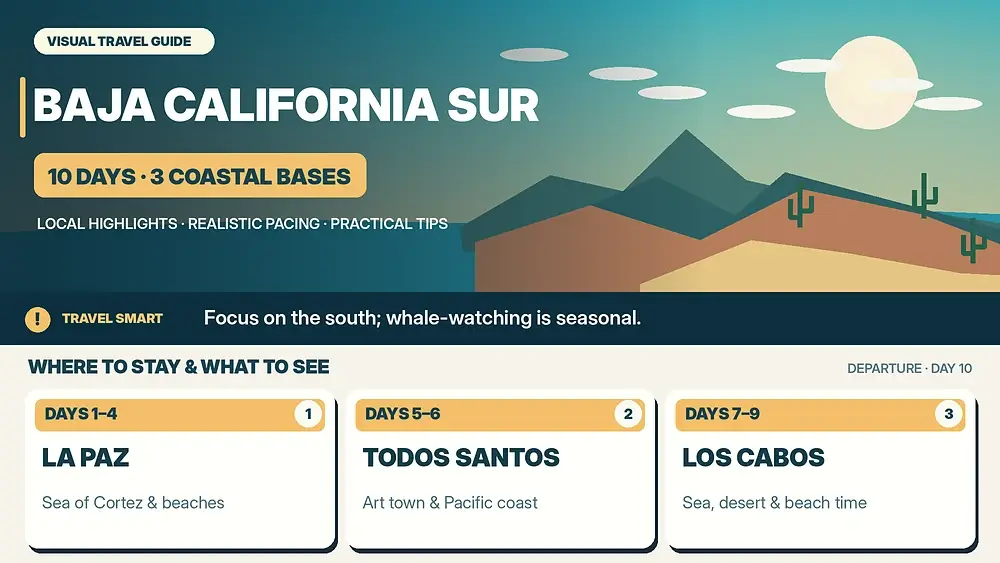
    Baja California Sur is a long peninsula state, and a ten-day trip should not try to drive from Los Cabos to Loreto and every whale lagoon simply because the highway exists. The southern triangle already contains several very different trips.

    This itinerary uses La Paz, Todos Santos and Los Cabos. La Paz provides Sea of Cortez wildlife and a real Mexican city; Todos Santos adds the Pacific; Los Cabos finishes with broad flight options and resort infrastructure.

    The official Visit Baja Sur La Paz guide highlights the city as a gateway to the Sea of Cortez, while its whale-watching guide distinguishes gray whales on Pacific lagoons, blue whales around Loreto and humpbacks around Los Cabos. Wildlife is seasonal and never guaranteed.

    Quick trip summary

    • 4 nights La Paz, 2 nights Todos Santos, 3 nights Los Cabos, Day 10 departure.
    • Keep the long peninsula north out of this trip.
    • Use La Paz for Sea of Cortez experiences.
    • Treat whale watching as seasonal.
    • Finish near Los Cabos airport.

    Why this route works

    La Paz deserves the longest stay because the Malecón, beaches and marine excursions are the route’s strongest nature component.

    Todos Santos is close enough to avoid a long transfer but different enough for two nights of Pacific atmosphere.

    Los Cabos provides a practical airport ending plus beaches and desert-meets-sea landscapes.

    A realistic itinerary at a glance

    DaysBaseMain focus
    1–4La PazMalecón, beaches and Sea of Cortez nature
    5–6Todos SantosPacific coast and art-town rhythm
    7–9Los CabosCoast, desert/sea outings and final beach time
    10DepartureLos Cabos International Airport

    Day-by-day plan

    Day 1: La Paz arrival

    Stay near the Malecón and keep the first evening to waterfront walking and dinner.

    Day 2: La Paz beaches

    Use Balandra/Tecolote-area beaches according to current access rules and crowd conditions.

    Day 3: Sea of Cortez day

    Choose a reputable marine operator for Espíritu Santo, sea lions or another seasonal experience.

    Disney California Adventure Pixar Pier Ferris Wheel At Sunset

    Day 4: Flexible La Paz day

    Use a second marine day, city/food, beach or a seasonal wildlife experience when operationally available.

    Day 5: La Paz to Todos Santos

    Drive south/west and use galleries, cafés and a Pacific sunset instead of immediately continuing.

    Day 6: Todos Santos/Pacific coast

    Choose beach, art, food or a nearby nature outing. Swimming suitability varies by beach and surf.

    Day 7: Todos Santos to Los Cabos

    Drive south and use the afternoon for San José del Cabo or your chosen beach/resort area.

    Day 8: Los Cabos coast day

    Choose a boat trip, coastal viewpoint or relaxed resort day. Wildlife outings should use permitted operators.

    Day 9: Flexible final day

    Use San José culture, beach, desert activity or genuine rest.

    Day 10: Departure

    Return the car and fly without a same-morning La Paz transfer.

    Where to stay and how many hotel changes to make

    La Paz Malecón access is ideal for evenings; Todos Santos is compact; in Los Cabos choose San José, Cabo San Lucas or the corridor according to the experience you want.

    For Baja California Sur, location matters more than a small difference in nightly rate. A hotel that removes repeated transfers usually adds more value than a prettier property in the wrong part of the route.

    Read recent guest reviews for practical details that booking photos rarely show: stairs, lift size, road noise, parking access, breakfast hours and the final walk from transport.

    Transport: what is worth planning in advance

    A car is useful for the southern route but not a reason to drive hundreds of extra kilometres north. Avoid unfamiliar desert-highway driving late at night.

    Measure every move door to door rather than by the headline timetable. Checkout, terminal access, waiting, luggage and the final connection can turn a short journey into half a day.

    Los Angeles Welcome To California Street Mural

    Use inflexible tickets only when the saving is meaningful and the day is genuinely fixed. Weather-sensitive coast, mountain, wildlife and boat plans benefit from flexibility.

    Food and daily rhythm

    La Paz has strong local seafood and city dining, while Todos Santos and San José add boutique and farm-to-table styles.

    Use meals to control the rhythm of the day. A long regional lunch can be an experience and a recovery period, especially after hiking, museums, wildlife outings or early starts.

    Do not make every meal another attraction. Mix local specialties with simple food so that the destination, not the restaurant schedule, remains the centre of the trip.

    Families, children and older travellers

    Marine life can be excellent for children, but boat length and swimming ability should guide excursion choice. Older travellers should ask about small-boat boarding and shade.

    For multigenerational travel, the useful pace is the one at which the least mobile member still enjoys the day. That normally produces a better shared trip for everyone.

    When accessibility matters, ask specific questions about steps, trail surfaces, boat boarding, lift dimensions and vehicle access rather than relying on a generic label.

    Budget: where the money really goes

    Marine tours, rental cars and resort nights are the biggest variables; Todos Santos boutique properties can be pricier than expected.

    Compare total trip cost rather than headline prices. Parking, transfers, luggage, park transport, tours and time lost reaching a remote hotel can erase an apparent saving.

    Keep a contingency rather than allocating every day to the last euro or dollar. Weather, a changed ferry, a taxi or an extra night can appear even on a carefully planned journey.

    Best time to go

    Whale species and marine experiences have different seasonal windows. Winter and spring are particularly popular for wildlife, while summer heat can be intense.

    Shoulder season often balances weather, demand and room prices well, but ferries, mountain services, wildlife excursions and rural restaurants may run less frequently.

    Oceanside California Beach At Dusk

    Heat, rain, snow, wind and daylight should change the order of your day. Use the most comfortable hours for exposed outdoor sights and keep lower-effort alternatives available.

    Comfort, accessibility and realistic pacing

    The route ends near the main airport and uses marine days early enough that one cancellation can be moved.

    Travel fatigue compounds. One difficult transfer can reduce the quality of the following two days, which is why this itinerary avoids one-night bases unless geography genuinely requires them.

    A free half-day is not wasted time. It is insurance for weather, laundry, a delayed service, a tired child or a place you discover only after arriving.

    Small decisions that improve the trip

    Keep the route south

    Loreto and gray-whale lagoons deserve another trip.

    Give La Paz four nights

    The Sea of Cortez is the heart of the route.

    Treat wildlife as seasonal

    No ethical operator can guarantee a wild-animal encounter.

    What I would leave out on this length of trip

    Leave Loreto, Mulegé and Magdalena Bay for a longer journey.

    Skip swimming at Pacific beaches where current or surf conditions make it unsafe.

    Mistakes that make this trip harder than it needs to be

    • Driving too far north in a short trip.
    • Booking wildlife outside the relevant season.
    • Choosing unlicensed operators.
    • Ignoring surf/current warnings.
    • Driving desert highways late at night.
    • Leaving La Paz for the airport on flight morning.

    How I would adapt the itinerary

    With six days, use La Paz plus Los Cabos.

    With two weeks, add Loreto by flight or a carefully planned road section.

    Before booking

    • Check seasonal wildlife regulations.
    • Use reputable marine operators.
    • Plan beach access rules.
    • Carry sun and water protection.
    • Finish near Los Cabos airport.

    Practical questions

    Do I need a car?

    A car adds useful flexibility, though private transfers can work.

    La Paz or Los Cabos for more time?

    La Paz for Sea of Cortez nature; Los Cabos for resorts and flight convenience.

    When can I see whales?

    It depends on species and location; check current official seasonal guidance.

    The Pacific Coast Highway California

    Final thoughts

    Baja California Sur is most rewarding when it is treated as a region of two seas rather than one endless highway.

    La Paz, Todos Santos and Los Cabos create a ten-day southern route with marine life, Pacific atmosphere and easy airport logistics.

    How to keep this itinerary resilient

    Leave Day 4 open so wind or a cancelled boat can be absorbed without losing your Sea of Cortez priority.

    Confirm marine regulations and beach access shortly before travel, especially if wildlife is a central reason for the trip.

    Who this route suits best

    This route is designed for travellers who prefer depth over collecting places. It keeps hotel changes low, protects flexible time and assumes that a good meal, an unexpectedly interesting neighbourhood or a slower morning can be as valuable as another attraction. That makes it particularly suitable for first-time visitors, couples, families and multigenerational groups.

    More energetic travellers can add a longer hike, an extra museum or a second excursion on the flexible days. Travellers who prefer an easier pace can remove those extras and still keep the core journey intact. Before booking, identify the two or three experiences that would genuinely disappoint you to miss; those are the ones to reserve or protect first.

    What to book early and what can wait

    Book the elements with genuinely limited capacity first: high-demand accommodation, protected-area access, popular trains or ferries, and any guided experience that is central to the trip. Leave ordinary meals, minor attractions and weather-dependent outdoor activities more flexible whenever possible. This prevents the itinerary from becoming a chain of reservations that forces you to ignore how the destination actually feels on the day.

    One week before departure, check the official transport or park information again. The evening before each major move, confirm departure points, opening status and the hotel address. That small routine catches most avoidable travel problems before they become expensive or tiring.

  • How to Create a Realistic Travel Budget: The Costs Most People Forget

    How to Create a Realistic Travel Budget: The Costs Most People Forget

    A travel budget usually fails in the small spaces between the big bookings. Flights and accommodation are easy to remember because they appear as large charges. What quietly pushes the total upward are baggage, airport transport, breakfasts, city taxes, parking, tolls, phone data, laundry, tips, snacks, seat selection and the expensive taxi taken when everyone is too tired for the bus.

    A useful budget therefore needs to describe the trip as it will actually happen. This guide gives you a framework that can be used for a weekend, a family holiday, a road trip or a long international journey.

    Budget in six buckets

    • 1. Getting there
    • 2. Accommodation
    • 3. Moving around
    • 4. Food and drink
    • 5. Experiences
    • 6. Friction and contingency

    1. Budget transport door to door

    Do not write only the airfare. Add the cost of reaching the departure airport, parking or train tickets, baggage, seat fees you intend to buy, airport food, and the transfer at the destination. If the return flight lands after public transport stops, include the taxi now rather than pretending you will solve it later.

    For road trips, add fuel or charging, tolls, parking, one-way rental fees, child seats and possible cross-border fees. For rail trips, include seat reservations where required and transport to stations.

    2. Use the real accommodation total

    Take the final price after mandatory taxes and fees, not the advertised nightly rate. Apartments may include cleaning fees; resorts may have mandatory charges; some destinations collect local taxes separately. Parking and breakfast can also materially change the comparison.

    Then ask whether the accommodation saves money elsewhere. A central hotel may reduce taxis. An apartment with a kitchen may lower breakfast costs. A resort with included activities may replace separate entertainment spending. Budget categories interact.

    3. Budget food by meal type

    A single daily food number is hard to estimate. Break it into breakfast, lunch, dinner, snacks and drinks. Decide which meals are experiences and which are functional. You may happily spend on three special dinners and save on simple lunches.

    Families should include the reality of snacks and drinks between meals. Travellers with dietary needs may need a higher food budget in places where suitable options are limited.

    Meal Budget question Easy way to control cost
    Breakfast Included, apartment or café? Choose accommodation with a useful breakfast or buy simple local groceries
    Lunch Sit-down or quick? Use markets, bakeries and lunch specials where appropriate
    Dinner How many special meals? Choose the splurge nights in advance
    Snacks/drinks Hot climate, children, long drives? Carry water and one snack rather than buying at every stop

    4. Separate must-do experiences from optional ones

    List ticketed attractions in two groups: non-negotiable and optional. Add the known cost of the first group to the baseline budget. Put the second group in a flexible allowance. This prevents the trip from being financially committed before you know your energy and weather.

    Also remember that free attractions can create transport and food costs. A free viewpoint 40 kilometres away is not necessarily a free day.

    5. Compare passes with actual journeys

    Transport passes feel convenient, but they are only good value when they match how you move. Estimate the number of rides and compare individual fares. In walkable cities, a multi-day pass may cost more than several single trips. In large cities, it may be excellent value.

    For groups, taxis can sometimes compete with public transport on short trips once four individual fares are added, but traffic and luggage capacity matter. Budget a mix rather than assuming one mode for the entire holiday.

    6. Create a line called fees and friction

    This category is where realistic budgets distinguish themselves. It covers charges that are neither memorable nor avoidable enough to fit neatly elsewhere.

    • Baggage and seat selection
    • Tourist or city taxes
    • Resort or cleaning fees
    • Airport transfers
    • Parking and tolls
    • ATM or card charges depending on your bank
    • Mobile data or eSIM
    • Laundry
    • Luggage storage
    • Tips where customary
    • Small booking or reservation fees

    You may not pay every item, but scanning the list prevents surprises.

    7. Plan payment methods, not just currency

    Carry more than one way to pay. A second card stored separately can rescue a trip if the first is lost, blocked or retained by an ATM. Cash needs vary widely by destination; research current local practice close to departure rather than assuming everywhere is cashless or cash-only.

    Check your bank’s foreign transaction and ATM fees. Decline dynamic currency conversion when your card issuer offers a better conversion and you understand the choice; when unsure, review your bank’s guidance before travel.

    8. Insurance belongs in the trip cost

    If you decide travel insurance is appropriate, add it from the beginning instead of buying it after the budget is “finished.” Compare what is covered, not only the premium, especially for medical care, cancellation, pre-existing conditions and planned activities.

    9. Add a contingency that you are allowed not to spend

    A practical personal rule is to keep an extra buffer — often around 10 to 15 percent for trips with many moving parts, less for highly prepaid simple trips and more for uncertain road trips or long journeys. This is not a universal financial rule; it is a planning tool.

    The contingency is for the taxi after a cancelled train, an unexpected meal, a replacement charger or a change of plan. It is not a target. If you come home with it untouched, the budget worked.

    10. Family budgets behave differently

    Families multiply some costs but share others. One hotel room may cover everyone, while attraction tickets and meals multiply by person. Car transfers can become more competitive, but larger rental cars cost more. Add the real number of travellers to each category rather than using an adult couple budget and scaling it roughly.

    Do not forget child-specific costs such as car seats, strollers or extra baggage, and check age-based attraction pricing.

    11. Longer trips can be cheaper per day — until they are not

    Weekly accommodation discounts, laundry and cooking can reduce the daily cost of a longer stay. But more days also create more meals, local transport and opportunities to spend. Calculate both the fixed costs and the daily burn rate.

    12. Build a daily spending number after fixed costs

    Once flights, accommodation and major transport are booked, calculate what remains for food, local transport and optional activities. Divide the flexible budget by the number of destination days. This daily number is not a strict allowance; it is an early-warning system.

    If you spend heavily on a special day, balance it with a lighter one rather than discovering at the end of the trip that the remaining budget is unrealistic.

    A simple example structure

    Category Planned amount Notes
    Main transport Fixed Flights/trains + bags + airport transfers
    Accommodation Fixed Final price including mandatory fees
    Local transport Estimated Transit, taxis, rental, parking
    Food Daily estimate Separate special meals if useful
    Activities Mixed Pre-booked must-dos + optional allowance
    Connectivity/insurance Fixed eSIM/roaming + policy
    Friction Estimated Laundry, storage, tips, small fees
    Contingency Reserved For genuine surprises

    13. Where to save without making the trip worse

    • Stay one neighbourhood farther out only if transport remains easy.
    • Use lunch for a special restaurant if the menu is better value than dinner.
    • Alternate paid attractions with parks, viewpoints, markets and neighbourhood walks.
    • Pack light when baggage savings are meaningful and practical.
    • Use a refillable bottle where tap water is safe and local rules allow.
    • Choose fewer destinations to reduce transport and hotel-change costs.

    The last point is the most powerful. Simplifying the itinerary can save transport, baggage, check-in time and stress at the same time.

    14. The pre-departure budget check

    • Have I included every airport transfer?
    • Have I used final accommodation prices?
    • What costs are per person rather than per room?
    • Are baggage and seat choices included?
    • How many paid attractions are genuinely priorities?
    • Will I need cash, and how will I obtain it?
    • Is insurance included if I am buying it?
    • Do I have a contingency that is separate from planned spending?

    A realistic budget is not the smallest number you can make fit in a spreadsheet. It is the amount that lets you enjoy the plan you actually intend to follow without being surprised by predictable costs.

    Illustration of a traveler checking plans on a laptop beside a map

    Practical notes that make the plan work in real life

    Before departure, write the critical information in one place: booking references, the first accommodation address, transport details, insurance contact if applicable, and the phone numbers you would need if your device stopped working. Keep a secure offline copy as well as the online version. This is a small task, but it prevents several common travel problems from becoming larger than they need to be. Build margins around the parts of the trip that are difficult to replace. A local café can move to another hour; an international flight cannot. A free neighbourhood walk can be shortened; a prepaid tour may have a fixed departure. Giving the least flexible items more time is a better strategy than trying to make every minute efficient. Finally, review the plan from the perspective of the least experienced or least mobile traveller in the group. Check the distance from platform to hotel, how luggage will be handled, where meals can happen and what the alternative is if the day becomes too hot, wet or tiring. A plan that still works on an imperfect day is usually a strong plan.
  • Boston in 4 Days: Freedom Trail, Back Bay and Cambridge Without Walking the Same Streets Twice

    Boston in 4 Days: Freedom Trail, Back Bay and Cambridge Without Walking the Same Streets Twice

    Boston looks compact, and much of the centre really is walkable, but the first-time mistake is to repeat the same downtown corridor while treating Cambridge, Back Bay and the waterfront as afterthoughts. Four days is enough to understand the city’s historical role and its contemporary neighbourhoods if each day follows one side of the Charles or one coherent section of the centre.

    If this city is part of a longer trip, compare the pacing with New England in 10 Days. A city guide should complement the wider itinerary, not force a traveller to repeat the same transfer twice.

    Quick trip summary

    Ideal stay4 days for a first trip
    Best approachGroup each day by geography and protect one flexible block
    Transport strategyWalk within districts; use public transport or taxis for cross-city moves
    Who it suitsFirst-time visitors, couples, solo travellers, families and slower-paced travellers
    Most common mistakeAdding too many distant attractions to the same day

    How to plan the trip before booking

    A useful city itinerary is not the one with the highest number of saved pins. It is the one in which the difficult reservations are protected, the days make geographic sense and there is still enough margin for a long meal, weather, queues or simple fatigue. Treat travel time as part of the day rather than as an invisible gap between attractions.

    Where to stay: choose location before hotel style

    BaseWhy choose it
    Downtown / Government CenterBest for Freedom Trail access and a short first visit focused on historic sights.
    Back BayAttractive streets, restaurants and good transport with an easy walk to several central areas.
    SeaportModern hotels and waterfront dining, convenient for some museums and airport access but less historic in atmosphere.
    Cambridge near Harvard or KendallA good repeat-visitor or university-focused base, with rapid transit into central Boston.

    A more attractive room is not automatically a better travel decision. Map the first activity of the morning, the likely dinner area and the departure route. If the hotel adds two unnecessary transfers every day, the hidden cost is time as well as money.

    Boston North End Restaurants And Cafes

    A realistic 4-day itinerary

    Day 1: Freedom Trail and North End

    Start early on the core historic route and decide in advance which interiors matter. Finish in the North End rather than rushing back across town. The goal is to understand the sequence of places, not merely photograph every marker.

    Day 2: Beacon Hill, Boston Common and Back Bay

    Use the second day for a slower urban walk through Beacon Hill, the Public Garden and Back Bay. Add one cultural stop or the library area and keep the evening local.

    Day 3: Waterfront and Seaport

    Walk part of the harbourfront, choose one museum or market area and continue into the Seaport only as far as interest and weather justify. A harbour cruise can replace, not automatically add to, another major activity.

    Day 4: Cambridge and the Charles

    Cross the river for Harvard Square, selected university museums or the MIT/Kendall area. Finish with a river walk or neighbourhood meal instead of returning downtown for a duplicate sightseeing circuit.

    Keep the second half of the day lighter than the first. A useful itinerary creates space for an unexpectedly good museum, a long meal, a delayed train, a child who needs a break or a neighbourhood that deserves another hour.

    How to move around without wasting the day

    Central Boston is highly walkable, while the MBTA subway and buses remove longer distances. Old street patterns can make map distances deceptive, and stations do not always connect as directly as expected. Use public transport to link districts, then explore within each one on foot.

    Do not judge a journey only by kilometres. A short trip can include station corridors, road congestion, stairs, queues or a long final walk. Think in door-to-door time and keep a margin before anything expensive or difficult to replace.

    Boston Historic North End Street

    Arrival and departure strategy

    Logan Airport is close to the centre by big-city standards, but the best transfer depends on the hotel, luggage and traffic. Water transport, rapid transit and road options all serve different travellers. Keep the first evening flexible, especially after a transatlantic flight.

    Arrival day is rarely the right time for the most complicated attraction. On departure day, protect the connection first and use only nearby activities that can be abandoned without consequence.

    Best time to visit

    Spring and autumn are popular for comfortable walking and seasonal colour, summer brings long days and activity, and winter can be cold with weather disruptions. In 2026, major historic commemorations can also affect crowd patterns, so recheck event calendars if visiting around high-profile dates.

    What to book first

    Book the experiences that are difficult to replace: limited-capacity museums, timed monuments, a special performance or a day trip that controls the rest of the itinerary. Leave ordinary meals, neighbourhood walks and secondary sights flexible. Recheck entry rules, opening days and transport notices shortly before departure because these details change more often than the basic geography.

    Food strategy: eat well without crossing the city for every meal

    Boston is more than lobster rolls and clam chowder, although both can be worthwhile. Use the North End, Chinatown, Back Bay, Cambridge and the Seaport as different food zones instead of eating every meal around one tourist market. Reserve one special dinner and keep the rest adaptable to the day.

    For a multi-age group, a reliable breakfast and an easy lunch often matter more than one additional attraction. Use meals as genuine rest rather than another item to complete quickly.

    Travelling with children

    Boston works especially well for families because history can be broken into short outdoor segments. The Public Garden, waterfront and science or children’s museums can balance the denser historical material.

    Boston Historic North End Street 2

    With children, reduce transitions before reducing the highlights. Alternate one structured indoor visit with something that allows movement: a park, waterfront, market, short ride or open square. Keep toilets, drinking water, snack options and an easy route back to the hotel in mind before starting a long afternoon.

    Travelling at a slower pace or as a senior

    For older travellers or anyone who prefers a slower pace, choose a base close to the transport line or district used most often. Use taxis or public transport to remove unrewarding distance, then spend walking energy on the streets, museums and viewpoints that actually define the destination. Check lifts, stairs and seating at major sights rather than assuming accessibility from the map.

    Budget planning

    The largest budget differences usually come from hotel location, airport transfers, major admissions and how often a taxi is used for cross-city journeys. A slightly more expensive central hotel can be better value if it removes two long transfers every day. Build a daily budget with a small reserve instead of planning to spend every available amount on advance bookings.

    Weather backup plan

    Keep one indoor or low-commitment block movable. A good weather fallback should fit the same part of the city and should not damage the following day. If one experience depends heavily on clear skies, comfortable heat or dry conditions, place it in a flexible slot and move it when the local forecast improves.

    Connectivity, cash and small practical details

    Save the hotel address, key tickets, passport or identity details, insurance information and the next important transfer outside your email app. Offline access matters when the network is weak or the battery is low. Carry a small power bank and keep a backup payment method separate from the main wallet.

    What to pack

    Comfortable walking shoes matter more than an extra outfit on a short city break. Add sun or rain protection, a refillable bottle where practical, any medication you may need during the day and one layer suitable for air-conditioned interiors or cooler evenings. The goal is to stay mobile without carrying the contents of the hotel room.

    Charles River And Boston Skyline

    Common mistakes to avoid

    • Walking the Freedom Trail and then repeating most of the route again the next day.
    • Ignoring Cambridge because it is technically a separate city.
    • Underestimating wind and temperature changes near the harbour.
    • Driving into the historic centre when the car adds more friction than value.
    • Trying to combine Salem or another regional day trip with a short first visit automatically.

    Responsible travel and local etiquette

    Treat residential streets, places of worship and memorial spaces as real parts of a working city rather than scenery. Follow staff instructions, keep entrances and pavements passable, use bins, and spend with local businesses when it fits naturally. Small choices about timing and behaviour often improve the experience for visitors as well as residents.

    If you have less or more time

    With two days, keep the historic core and Back Bay/Beacon Hill. Three days adds Cambridge. With five days, add deeper museums, a harbour experience or a regional excursion such as Salem only if the season and interests justify the travel time.

    Safety and decision-making on the day

    Use ordinary big-city awareness: keep phones and wallets controlled in crowded areas, choose clearly identified transport and avoid walking while distracted at complicated road crossings. The most useful safety advice is current and local, so follow official notices, attraction staff and transport operators when conditions change.

    Set a practical turnaround time for long walks, excursions and transfer days. A missed secondary sight is cheaper than a missed flight, unsafe walk or exhausted final day.

    Useful official and planning resources

    Opening hours, transport schedules, fees, reservation procedures and access rules change more often than the basic geography. Recheck the official source shortly before departure.

    Final planning checklist

    • Confirm passport, visa, transit and health requirements for your nationality.
    • Reserve the attraction, permit or train that controls the rest of the itinerary.
    • Save the accommodation address and first-day route offline.
    • Recheck weather, closures and transport notices before each critical day.
    • Keep at least one half-day that can absorb a delay or become simple rest.
    • Leave a generous buffer before flights and other costly connections.

    A good city break should feel as though you understood how the place fits together, not merely that you collected its famous names. Keep the fixed reservations that matter, group the rest by geography and remove anything that creates more transit than experience.

  • New York State in 10 Days: Hudson Valley, Finger Lakes and Adirondacks Beyond New York City

    New York State in 10 Days: Hudson Valley, Finger Lakes and Adirondacks Beyond New York City

    New York State is much larger than visitors who know only New York City often expect. A ten-day road trip should not attempt Niagara Falls, the Adirondacks, the Catskills and every Finger Lake in one sweep.

    This route starts in the Hudson Valley, moves west to the Finger Lakes and finishes in the Adirondacks. New York City is deliberately excluded because it already deserves its own trip.

    The official I LOVE NY tourism site is useful for current scenic-drive, event and regional planning. Individual parks, trailheads and seasonal boat services should still be checked close to travel.

    Quick trip summary

    • 3 nights Hudson Valley, 3 nights Finger Lakes, 3 nights Adirondacks, Day 10 departure.
    • Rent a car outside New York City.
    • Choose one Finger Lakes base instead of moving between lakes nightly.
    • Use one Adirondack town as the anchor.
    • Do not add Niagara Falls unless you extend the trip.

    Why this route works

    The Hudson Valley offers historic estates, art, river towns and easy arrival from the New York metropolitan area.

    The Finger Lakes bring wineries, waterfalls and lake landscapes without needing a different hotel for each lake.

    The Adirondacks provide a mountain finish that feels completely different and is worth several nights.

    A realistic itinerary at a glance

    DaysBaseMain focus
    1–3Hudson ValleyRiver towns, estates, art and walking
    4–6Finger LakesWaterfalls, wineries and lake towns
    7–9AdirondacksMountain town, lakes and hiking
    10DepartureAlbany/New York regional airports onward

    Day-by-day plan

    Day 1: Hudson Valley arrival

    Collect the car outside Manhattan if possible and stay around Beacon, Rhinebeck, Kingston or another town tied to your priorities. Keep the first afternoon local.

    Day 2: Art and river towns

    Use Dia Beacon, Storm King direction, historic estates or a river-town walking day. Choose one major cultural anchor rather than driving north and south repeatedly.

    Day 3: Hudson Valley flexible day

    Use a hike, another town, culinary/farm stop or historic site. This is the first weather buffer.

    Day 4: Hudson Valley to the Finger Lakes

    Drive west and settle around Ithaca, Geneva, Watkins Glen or another chosen lake base. The transfer is long enough without several detours.

    Day 5: Waterfalls and lake day

    Use Watkins Glen, Taughannock, Ithaca gorges or another focused waterfall area according to trail conditions. Do not attempt every gorge in one day.

    Day 6: Wine/food and lake towns

    Use a designated driver or organised tour for wineries, then combine only nearby towns on the same lake or corridor.

    Day 7: Finger Lakes to the Adirondacks

    Move northeast and settle around Lake Placid, Saranac Lake or another practical base. Treat the road as the main activity.

    Day 8: Adirondack main outdoor day

    Choose one hike, paddle, scenic drive or mountain attraction that matches fitness and weather. The Adirondacks are too large for a checklist.

    Day 9: Adirondack flexible day

    Use another lake, easy trail, Olympic history in Lake Placid or a lower-effort town day. Keep this as the weather recovery block.

    Day 10: Departure

    Use Albany or another airport that fits the final geography rather than automatically returning to New York City.

    Where to stay and how many hotel changes to make

    Hudson Valley town choice should match art versus historic-estate priorities. In the Finger Lakes, choose one lake corridor and resist daily hotel changes.

    Lake Placid has the broadest Adirondack visitor infrastructure; Saranac Lake can feel quieter and more local.

    Choose accommodation for geography before décor. A well-positioned room can save an hour every day and often matters more than a small difference in nightly rate.

    Read recent guest reviews for practical details that hotel pages rarely emphasise: stairs, parking, road noise, breakfast hours, heating or air conditioning, and the real walk from transport.

    Transport: what is worth planning in advance

    A car is essential for the three-region route, but collect it outside dense Manhattan if possible.

    One-way rentals can be excellent value when they prevent a long final return drive.

    Measure every move door to door rather than by headline distance. Parking, luggage, road conditions, ferry check-in and the final local transfer can turn a short-looking journey into half a day.

    Save hotel addresses, tickets and maps offline. The places where navigation matters most are often the places where mobile coverage becomes less reliable.

    Food and daily rhythm

    The Hudson Valley and Finger Lakes are strong for farm-driven food, cider, wine and breweries, while the Adirondacks shift toward mountain-town dining.

    Use a sober driver for tasting days and keep winery schedules lighter than a city museum itinerary.

    Use meals to shape the rhythm of the day. A long regional lunch can be both an experience and a recovery period after museums, hiking, heat or an early start.

    Albany Empire State Plaza Skyscrapers New York State

    Do not make every meal another reservation. Mix destination restaurants with bakeries, markets, cafés and simple local places so food improves the trip instead of controlling it.

    Families, children and older travellers

    Riverfront towns, waterfalls, lake activities and easier Adirondack trails offer excellent family variety.

    Older travellers can use scenic roads, boat options and short viewpoints rather than difficult peaks.

    For multigenerational travel, the right pace is the one at which the least mobile member still enjoys the day. That usually creates a better shared trip for everyone.

    When accessibility matters, ask precise questions about steps, trail surfaces, boat boarding, lifts, toilets and vehicle access rather than relying on a generic accessibility label.

    Budget: where the money really goes

    Car hire, Hudson Valley weekends and Lake Placid peak-season lodging are the main variables.

    A one-way rental may look more expensive but can save a hotel night and several hours of driving.

    Compare total trip cost rather than headline prices. Parking, transfers, fuel, tolls, ferries and guided activities can erase an apparent saving.

    The best splurges usually remove friction: a central room, a direct transfer, a good local guide or one extra night that prevents an exhausting move.

    Best time to go

    Late spring through autumn offers the broadest options; fall foliage can create exceptional demand and traffic.

    Winter transforms the Adirondacks into a snow-focused trip and changes trail/road assumptions.

    Shoulder season often balances weather, crowds and prices well, but rural attractions, ferries, mountain services and seasonal restaurants may run reduced schedules.

    Weather should change the order of the day. Keep indoor or lower-effort alternatives so rain, heat, wind, smoke or cloud does not force you to waste the trip.

    Comfort, accessibility and realistic pacing

    Three-night blocks keep a large state manageable.

    Every major relocation is followed by at least two nights in the new region.

    Travel fatigue compounds. One difficult relocation can weaken the following two days, which is why this itinerary avoids one-night bases unless geography genuinely requires them.

    A free half-day is not wasted time. It is insurance for weather, traffic, a tired child or a place you discover only after arriving.

    Small decisions that improve the trip

    Leave NYC out

    The state deserves its own trip.

    Choose one Finger Lakes corridor

    Do not lake-hop with luggage.

    Use one Adirondack base

    The region is enormous.

    Consider open-jaw flights

    Backtracking to Manhattan is not automatically smart.

    What I would leave out on this length of trip

    Leave Niagara Falls, Thousand Islands and western New York for a second state road trip.

    Skip changing Finger Lakes hotels simply to wake up beside a different lake.

    Mistakes that make this trip harder than it needs to be

    • Underestimating New York State distances.
    • Collecting wineries instead of enjoying them.
    • Hiking several gorges in one day.
    • Driving into Manhattan with a rental car unnecessarily.
    • Booking foliage weekends late.
    • Returning from the Adirondacks under a tight NYC flight.

    How I would adapt the itinerary

    With seven days, use Hudson Valley plus Finger Lakes or Finger Lakes plus Adirondacks.

    With two weeks, add Niagara/Thousand Islands as a separate western block.

    Before booking

    • Choose one base per region.
    • Reserve foliage-season lodging early.
    • Plan sober winery transport.
    • Check trail conditions.
    • Compare Albany and NYC-area departure airports.

    Practical questions

    Is ten days enough for New York State?

    Yes for three regions, not the entire state.

    Which Finger Lake should I base around?

    Ithaca/Cayuga for waterfalls and university-town life, or Geneva/Seneca for wineries and central access.

    Should I return to New York City to fly?

    Only if the fare outweighs the extra road time.

    Final thoughts

    New York State becomes much more interesting when New York City stops dominating the itinerary.

    The Hudson Valley, Finger Lakes and Adirondacks create ten days of river towns, food, waterfalls and mountains with enough time to enjoy each region.

    How to keep the itinerary resilient

    Keep one day in each outdoor region flexible around rain and trail conditions.

    If foliage traffic or weather slows a relocation, remove a minor stop rather than arriving after dark and exhausted.

    Who this route suits best

    This itinerary works best for travellers who prefer depth over collecting places. It keeps hotel changes low, protects flexible time and assumes that a good meal, a slower morning or an unexpectedly interesting local stop can be as valuable as another famous attraction. That approach works especially well for first-time visitors, couples, families and multigenerational groups.

    More energetic travellers can add a longer hike, another museum or a second excursion on flexible days. Travellers who prefer an easier pace can remove those extras and still keep the core journey intact. Before booking, identify the two or three experiences that would genuinely disappoint you to miss; those are the ones to reserve first.

  • Central Florida in 8 Days: Orlando, Winter Park and the Space Coast Without Theme-Park Burnout

    Central Florida in 8 Days: Orlando, Winter Park and the Space Coast Without Theme-Park Burnout

    Central Florida is often planned as a seven-day theme-park marathon, but Orlando’s neighbourhoods, Winter Park, natural springs and the Space Coast can make the region much more varied.

    This eight-day route uses Orlando/Winter Park as the first base and Cocoa Beach/Titusville as the second. It includes only one or two theme-park days rather than assuming every day must be spent in a queue.

    Kennedy Space Center Visitor Complex publishes date-specific 2026 opening hours on its official hours page. For much of late summer and autumn 2026 the site lists 9 AM–5 PM, but hours change by season, so always check your exact date.

    Quick trip summary

    • 5 nights Orlando/Winter Park, 2 nights Space Coast, Day 8 departure.
    • Choose one or two theme-park days, not all of them automatically.
    • Give Kennedy Space Center a full day.
    • Use Winter Park or another neighbourhood day as a recovery block.
    • Do not add Miami or the Florida Keys.

    Why this route works

    Orlando needs several nights because theme parks, neighbourhoods, springs and museums are spread out.

    Winter Park provides a lower-pressure day with food, museums and lakes close to Orlando.

    Sleeping on the Space Coast makes Kennedy Space Center and an Atlantic beach day much easier than repeated Orlando commuting.

    A realistic itinerary at a glance

    DaysBaseMain focus
    1–5Orlando / Winter ParkSelected parks, neighbourhoods, springs and recovery time
    6–7Space CoastKennedy Space Center and Atlantic coast
    8DepartureOrlando/Melbourne onward

    Day-by-day plan

    Day 1: Orlando arrival

    Choose a hotel based on your actual priorities: theme-park transport, walkable neighbourhood evenings or Winter Park access. Do not pay resort prices automatically if you have only one park day.

    Day 2: Theme-park day

    Choose the park that matters most and make it the only major commitment. Arrive early, use current reservation/queue systems and leave space for an evening rest.

    Orlando Big Thunder Mountain Railroad Ride

    Day 3: Winter Park and local Orlando

    Use the scenic boat tour, Morse Museum-style culture, Park Avenue, Mills 50 or another neighbourhood. This day changes the rhythm completely.

    Day 4: Springs or nature day

    Use Wekiwa Springs, Blue Spring direction or another current accessible natural area according to conditions and wildlife rules. State-park capacity can fill, so check before driving.

    Day 5: Second theme park or flexible Orlando day

    Use a second park only if the group wants it. Otherwise choose museums, shopping, food or a slow hotel/pool day.

    Day 6: Orlando to Space Coast

    Move to Cocoa Beach/Titusville, use the beach or Merritt Island-area nature and keep the evening simple.

    Day 7: Kennedy Space Center

    Arrive at opening and give the Visitor Complex a full day. The bus tour, Space Shuttle Atlantis and major exhibits take far longer than a quick half-day.

    Day 8: Departure

    Return toward Orlando or use Melbourne where practical; do not attach a rocket launch or beach excursion to a tight flight.

    Where to stay and how many hotel changes to make

    Theme-park resorts make sense when transport and early-access benefits outweigh the price. Winter Park/downtown areas suit travellers who want restaurants and local neighbourhoods.

    On the Space Coast, Titusville is practical for KSC while Cocoa Beach offers stronger beach atmosphere.

    Choose accommodation for geography before décor. A well-positioned room can save an hour every day and often matters more than a small difference in nightly price.

    Read recent guest reviews for practical details that hotel pages rarely emphasise: stairs, parking, road noise, breakfast hours, heating or air conditioning, and the real walk from transport.

    Transport: what is worth planning in advance

    A car is useful for this mixed itinerary, though resort shuttles and rideshare can reduce driving on park days.

    Orlando traffic is a real planning factor; two attractions that look close on a map can involve a tiring cross-city transfer.

    Orlando Walt Disney World Monorail At Epcot

    Measure every move door to door rather than by the headline distance. Luggage, waiting, parking, road conditions, ferries or the final local connection can turn a short-looking transfer into half a day.

    Save hotel addresses, reservation confirmations and maps offline. The places where navigation matters most are often exactly where mobile coverage becomes weakest.

    Food and daily rhythm

    Orlando’s broader food scene is strongest away from the theme-park corridors, especially in neighbourhoods such as Mills 50 and Winter Park.

    On full park days, prioritise hydration and easy meals rather than turning every dining reservation into another timed obligation.

    Use meals to shape the rhythm of the day. A long regional lunch can be both an experience and a recovery period after hiking, museums, heat or an early start.

    Do not make every meal another reservation. Mix destination restaurants with markets, bakeries, cafés and simple local places so food improves the itinerary instead of controlling it.

    Families, children and older travellers

    Families benefit most from alternating high-stimulation park days with low-pressure lake, spring or beach days.

    Older travellers should check walking distances, mobility rentals and shade/rest areas at large attractions before arrival.

    For multigenerational travel, the right pace is the one at which the least mobile member still enjoys the day. That usually creates a better shared trip for everyone.

    When accessibility matters, ask precise questions about steps, trail surfaces, beach access, boat boarding, lifts, toilets and vehicle access rather than relying on a generic accessibility label.

    Budget: where the money really goes

    Theme-park tickets and resort hotels dominate the budget, so selecting fewer parks can free money for better accommodation or a longer stay.

    Kennedy Space Center deserves its own budget line rather than being treated as a small roadside attraction.

    Compare total trip cost rather than headline room prices. Parking, transfers, fuel, tolls, ferries and guided activities can erase an apparent saving.

    Orlando Walt Disney And Mickey Partners Statue

    The best splurges usually remove friction: a central room, a direct transfer, a good local guide or one extra night that prevents an exhausting move.

    Best time to go

    Central Florida can be hot and stormy in summer, while winter and spring are generally easier for long outdoor days.

    Hurricane-season travel should use flexible bookings and daily weather awareness.

    Shoulder season often balances weather, crowds and prices well, but rural attractions, boats, ferries, mountain services and seasonal restaurants may run reduced schedules.

    Weather should change the order of the day. Keep indoor or lower-effort alternatives so rain, heat, wind, smoke, snow or cloud does not force you to waste the trip.

    Comfort, accessibility and realistic pacing

    The itinerary deliberately separates major theme-park days with recovery blocks.

    Two Space Coast nights remove the need for an early and late Orlando–KSC round trip.

    Travel fatigue compounds. One difficult relocation can weaken the following two days, which is why this itinerary avoids one-night bases unless geography genuinely requires them.

    A free half-day is not wasted time. It is insurance for weather, traffic, a tired child or a place you discover only after arriving.

    Small decisions that improve the trip

    Choose parks intentionally

    Not every traveller needs Disney, Universal and every new attraction.

    Sleep on the Space Coast

    Kennedy is better without a commute.

    Use one local Orlando day

    The city is more than resorts.

    Check hours and launch schedules late

    Space operations change.

    What I would leave out on this length of trip

    Leave Miami, Everglades and the Keys for the separate South Florida itineraries.

    Skip booking consecutive rope-drop-to-fireworks park days unless the whole group genuinely wants that intensity.

    Mistakes that make this trip harder than it needs to be

    • Planning every day inside a major park.
    • Booking dining/ride schedules with no recovery time.
    • Assuming Kennedy Space Center takes only a few hours.
    • Driving back to Orlando exhausted after KSC.
    • Ignoring summer thunderstorms.
    • Choosing a hotel by price without considering transport costs.

    How I would adapt the itinerary

    With five days, use Orlando plus one Space Coast night.

    Orlando Tall Palm Trees Under Blue Sky

    With ten days, add another nature/springs day or a slower beach block rather than another distant Florida region.

    Before booking

    • Check date-specific KSC hours.
    • Choose theme parks before hotel geography.
    • Use flexible storm-season rates.
    • Plan hydration and rest.
    • Protect the final airport drive.

    Practical questions

    How many theme parks should I do?

    One or two is enough for a mixed Central Florida trip.

    Is Kennedy Space Center worth a full day?

    Yes. The major exhibits and bus tour easily fill a day.

    Where should I stay for KSC?

    Titusville for practical access or Cocoa Beach for a beach-focused evening.

    Final thoughts

    Central Florida becomes much more enjoyable when theme parks are part of the itinerary rather than the entire identity of the trip.

    Orlando, Winter Park and the Space Coast create eight days of rides, local food, nature, space history and beach time without burnout.

    How to keep the itinerary resilient

    Keep the springs/beach days flexible around storms and capacity.

    If a launch or park schedule changes, protect Kennedy day and the final flight rather than squeezing another attraction into the margins.

    Who this route suits best

    This route works best for travellers who prefer depth over collecting places. It keeps hotel changes low, protects flexible time and assumes that a good meal, an unexpectedly interesting neighbourhood or a slower morning can be as valuable as another famous attraction. That approach works especially well for first-time visitors, couples, families and multigenerational groups.

    More energetic travellers can add a longer hike, another museum or a second excursion on flexible days. Travellers who prefer an easier pace can remove those extras and still keep the core journey intact. Before booking, identify the two or three experiences that would genuinely disappoint you to miss; those are the ones to reserve first.

  • Vienna in 4 Days: Imperial Sights, Museums and Neighbourhoods Without Spending the Trip in Palaces

    Vienna in 4 Days: Imperial Sights, Museums and Neighbourhoods Without Spending the Trip in Palaces

    Vienna deserves a trip built around geography and real travel time rather than a checklist. Vienna can easily become a parade of grand interiors: palace, museum, church, another palace. Four days works better when you alternate imperial history with neighbourhood walks, parks, cafés and one evening performance or river-side area. The public transport system makes it easy to reduce walking without reducing what you see.

    If this destination is part of a longer journey, compare the pacing with Austria in 8 Days by Train: Vienna, Salzburg and the Salzkammergut Without a Rental Car. The useful question is not how many famous names fit on the map, but how much usable holiday time remains after transfers, check-in, meals, weather and rest.

    Quick trip summary

    • Recommended time: 4 days.
    • Best planning principle: group each day by geography and protect only the reservations that control access.
    • Best for: independent travellers, couples, families and slower-paced visitors who prefer a realistic rhythm.
    • Keep flexible: at least one half-day or one major activity that can move with weather, traffic or energy.
    • Book first: the accommodation location, scarce transport and any permit, timed entry or signature experience that shapes the rest of the trip.

    Is Vienna the right trip for you?

    Vienna suits travellers who enjoy art, architecture, classical music, cafés and orderly public transport, but it also works for families because parks, the Prater and interactive museums break up formal sightseeing. Older travellers can control the pace well with trams and U-Bahn. The key is accepting that you do not need to enter every famous building to understand the city.

    The practical test is simple: decide what would make you disappointed if you missed it, then build the trip around that one or two priorities. Everything else should earn its place by fitting the same area of the day. This is especially important when travelling with children, older relatives or anyone who enjoys a slower pace.

    Where to stay: choose location before hotel style

    Base Why choose it
    Innere Stadt edge Best for a first visit and evening walks, though prices can be high and some streets are busy.
    Neubau / Mariahilf Best for cafés, independent shops and access to the MuseumsQuartier while remaining close to the centre.
    Wieden / Landstraße Best for a calmer residential base with strong tram or U-Bahn connections and easy station access depending on the exact location.

    A more attractive room is not always a better travel decision. Before booking, map the first activity of the morning, the likely dinner area and the departure route. If the hotel adds two unnecessary transfers every day, the hidden cost is time as well as money.

    A realistic 4-day itinerary

    Day 1: Ringstrasse and historic centre

    Walk a compact loop through the old centre, choosing one major interior such as the cathedral, Hofburg section or art collection. Use the Ring tram or public transport to shorten the less interesting stretches and save energy for the evening.

    Day 2: Schönbrunn without adding another palace

    Give Schönbrunn a proper half-day, including the gardens if weather is good. Return to a different district for lunch or a slow afternoon rather than immediately entering the Belvedere. Families can use the zoo or park spaces as their main second activity.

    Day 3: art, coffee and Neubau

    Choose one major museum or the Belvedere complex, then move into the MuseumsQuartier and Neubau area. The point is to balance concentrated art viewing with normal city time. A coffeehouse stop is useful when it is a rest, not another famous address you have to queue for.

    Day 4: Prater, Danube or one final cultural priority

    Use the final day for the Prater, Danube areas, Zentralfriedhof or a museum you deliberately left out. If you have an evening concert, keep the afternoon light so the performance is enjoyable rather than the fifth major activity of the day.

    How to move around without wasting the day

    Vienna’s U-Bahn, trams and buses cover the visitor areas extremely well. Most travellers do not need a car. Buy the transport product that matches your actual number of days and journeys, and compare the official Vienna City Card with ordinary transit plus separate admissions rather than assuming the card is automatically cheaper. Airport transport has several options, so compare time, fare and your hotel location.

    Do not judge a journey only by kilometres. A short distance can include traffic, security, parking, boat boarding, luggage handling or a long final walk. For every important transfer, think in door-to-door time and keep a margin before anything expensive or difficult to replace.

    Best time to visit

    Spring and early autumn are excellent for walking and gardens, summer brings outdoor events and heat, and December is atmospheric but crowded around Christmas markets. Winter works well for museums and cafés, though outdoor palace gardens are less central to the experience. Shoulder seasons reward a flexible order so Schönbrunn or the Danube gets the better-weather day.

    Seasonal advice should guide the style of the trip, not become a promise. Climate averages cannot tell you the exact conditions on your dates. Check the local forecast and any official closure, transport or safety notice again shortly before each weather-sensitive day.

    What to book first

    Reserve high-demand palace time slots, major performances and restaurants where a specific evening matters. Many museums can be visited more flexibly, especially if you arrive early. Do not book two major collections and a concert back to back; museum fatigue in Vienna is real because the collections are large.

    After those anchors are secure, leave ordinary meals, short walks and secondary sights open. A timetable with every hour reserved is fragile: one delay turns the rest of the day into a sequence of apologies and missed slots.

    Food strategy: eat well without scheduling every meal

    Vienna’s coffeehouse culture is part of the city, but one historic café is enough if you dislike queues. Mix traditional dishes with markets, bakeries and modern neighbourhood restaurants. Naschmarkt can be useful for variety, while residential districts often provide calmer dinners than the historic centre.

    For a multi-age group, a reliable breakfast and an easy lunch often matter more than one additional attraction. Keep water accessible, avoid waiting until everyone is exhausted to look for food and use meal stops as genuine rest rather than another item to complete quickly.

    Travelling with children

    Schönbrunn grounds, the zoo, Prater, trams and selected interactive museums give children strong alternatives to formal palace rooms. Build one child-led block into each day rather than promising a reward after hours of adult sightseeing. Public transport reduces fatigue and makes hotel breaks realistic.

    Children do not need a simplified version of every adult attraction. They usually need a different rhythm: movement, shade, snacks, toilets and periods when nobody is asking them to pay attention. Protect those needs and the whole group usually sees more, not less.

    Travelling at a slower pace or as a senior

    Vienna is easy to slow down because trams often run directly along the sightseeing corridors. Use lifts and accessible entrances where available, and do not assume a palace garden is a short walk simply because the building is close. Choose fewer interiors and allow time to sit in parks or cafés without feeling behind schedule.

    When mobility or stamina is limited, reduce transitions before reducing experiences. One well-located base, a direct transfer and a shorter route often preserve the most memorable parts of a trip far better than trying to keep the original schedule with longer rest stops.

    Budget: where the money really goes

    Accommodation and ticketed culture are the largest expenses. Transport is usually manageable with a period pass, while concert pricing varies widely. Decide whether you value a formal evening performance before buying premium seats; excellent music can also be found in smaller venues without building the whole day around dress and timing.

    Track the total cost of each planning choice. A lower hotel rate can be false economy after taxis, parking or long transfers, while a more expensive excursion may be reasonable if it replaces a rental car, guide and separate admission fees. Compare complete days rather than isolated prices.

    Weather fallback plan

    On rain days, move museums and coffeehouse time forward and keep parks for later. Heat can make palace gardens tiring, so visit earlier and use shaded or indoor afternoons. In winter, remember that heated museums and cafés make heavy layers inconvenient; dress in removable layers.

    The useful fallback is not a list of random indoor attractions. It is one realistic substitute that fits the same area or preserves the next day. Keep at least one activity movable so a poor forecast does not force you to choose between losing money and doing something unsafe.

    Connectivity, cash and small practical details

    Download the official city information or transport tools you prefer, and save booking confirmations offline. Many places accept cards, but small cash is still useful. Check museum closing days because Vienna’s cultural institutions do not all follow the same weekly pattern.

    Save hotel addresses, tickets, permits, insurance details and the next transfer outside your email app. Offline access matters most precisely when the network is weak, your battery is low or you are trying to solve a delay.

    What to pack

    Comfortable shoes and layers are the essentials. Bring a compact umbrella or rain shell, and slightly smarter clothing only if your chosen performance or restaurant requires it. Do not overpack formal wear for a city where most sightseeing is casual and walking-based.

    A small day bag should hold water, medication, sun or rain protection and the layer you are most likely to need. The goal is not to carry everything; it is to avoid having the useful items locked in a suitcase or parked car when conditions change.

    Common mistakes to avoid

    • Entering too many palaces and museums because they are famous rather than because you are interested.
    • Walking the entire Ringstrasse when a tram would save energy for the sights themselves.
    • Buying a city card without comparing it with a normal transport pass and your planned admissions.
    • Booking a major concert after an overloaded museum day.
    • Assuming every historic coffeehouse experience is improved by waiting in a long queue.

    Responsible travel and local etiquette

    Use public transport, respect quiet residential courtyards and follow photography rules inside museums and churches. In busy historic streets, step aside before stopping for maps or group photos. Vienna’s parks and public spaces are best enjoyed as shared city spaces rather than stages for rushed sightseeing.

    The best rule is to treat the destination as a real place rather than a stage built for visitors. Follow staff and ranger instructions, respect residential space and protected environments, and spend with businesses that add genuine local value instead of rewarding the most aggressive sales pitch.

    If you have less or more time

    Two days is enough for the old centre and Schönbrunn if you keep museums limited. Three days adds a serious art collection. Five or six days allows day trips such as Bratislava or Wachau, but Vienna itself also rewards a slower neighbourhood and park day.

    Extra days are most useful when they reduce pressure. Before adding another distant stop, ask whether the trip improves more by sleeping in the same place, repeating a favourite beach or neighbourhood, waiting for better weather or enjoying a late breakfast without watching the clock.

    How to choose between similar experiences

    Choose Schönbrunn for imperial scale and gardens, Belvedere for art and a more compact visit, and Hofburg for central history. You do not need all three as full interior tours. If classical music matters, prioritize one performance over adding another palace simply because it appears on every checklist.

    When two options offer a similar experience, choose the one that fits the geography and energy of the day. The extra hour of transfer rarely creates an extra hour of enjoyment, especially in heat, traffic, rough water or at altitude.

    Safety and decision-making on the day

    Vienna is generally easy to navigate. Use standard awareness in crowded transport and tourist areas, keep an eye on belongings, and take normal care around tram tracks and bicycle lanes. The practical risk is usually fatigue from long museum days rather than anything unique to the city.

    Local warnings, ranger instructions and transport operators have more value than an itinerary written months earlier. Set a practical turnaround time for hikes, drives and water days, and change the plan when conditions deteriorate rather than trying to complete the original checklist.

    Useful official and planning resources

    Opening hours, protected-area rules, transport schedules, fees and visitor procedures change more often than the landscape. Recheck the source below shortly before departure.

    Final planning checklist

    • Confirm passport, visa, transit and health requirements for your nationality.
    • Reserve the transport, permit or timed entry that controls the rest of the itinerary.
    • Check how luggage moves between airport, road transfer, ferry, train or accommodation.
    • Download offline maps and save key tickets outside your email app.
    • Recheck weather, sea, road, trail or park notices before each critical day.
    • Keep at least one half-day that can absorb a delay or become simple rest.
    • Leave a generous buffer before international flights and other costly connections.

    A good trip to Vienna should feel like you understood the place, not merely that you passed through it. Keep the transport anchors fixed, leave room for conditions to change, and remove anything that does not fit your interests, mobility or energy. The result is usually more enjoyable than the most ambitious version of the same route.

  • Rio de Janeiro in 5 Days: Beaches, Sugarloaf and Christ the Redeemer Without Living in Traffic

    Rio de Janeiro in 5 Days: Beaches, Sugarloaf and Christ the Redeemer Without Living in Traffic

    Rio de Janeiro deserves a trip built around geography and real travel time rather than a checklist. Rio is spectacular because mountains, beaches, dense neighbourhoods and city landmarks occupy the same landscape, but that geography also creates traffic bottlenecks and long cross-city journeys. Five days is enough for Corcovado, Sugarloaf, two different beach areas and one cultural or historic day if you group the city into zones and let weather decide the best viewpoint day.

    If this destination is part of a longer journey, compare the pacing with Brazil in 10 Days: Rio de Janeiro and Iguaçu Falls Without Spending Half the Trip in Airports. The useful question is not how many famous names fit on the map, but how much usable holiday time remains after transfers, check-in, meals, weather and rest.

    Quick trip summary

    • Recommended time: 5 days.
    • Best planning principle: group each day by geography and protect only the reservations that control access.
    • Best for: independent travellers, couples, families and slower-paced visitors who prefer a realistic rhythm.
    • Keep flexible: at least one half-day or one major activity that can move with weather, traffic or energy.
    • Book first: the accommodation location, scarce transport and any permit, timed entry or signature experience that shapes the rest of the trip.

    Is Rio de Janeiro the right trip for you?

    Rio suits travellers who want outdoor scenery with a major-city atmosphere. Beach-focused visitors, hikers, photographers, families and nightlife travellers can all enjoy it, but the daily plan needs more situational awareness than a compact resort. The best first trip uses reliable transport between districts and avoids assuming every attractive viewpoint can be added spontaneously after another full day.

    The practical test is simple: decide what would make you disappointed if you missed it, then build the trip around that one or two priorities. Everything else should earn its place by fitting the same area of the day. This is especially important when travelling with children, older relatives or anyone who enjoys a slower pace.

    Where to stay: choose location before hotel style

    Base Why choose it
    Copacabana Best for a first trip, broad hotel choice, beach access and practical transport; busy and very tourist-oriented.
    Ipanema / Leblon Best for beach atmosphere, restaurants and a more polished evening base, often at a higher price.
    Botafogo Best for metro access, Sugarloaf proximity and good value relative to the beachfront, with strong connections to several districts.

    A more attractive room is not always a better travel decision. Before booking, map the first activity of the morning, the likely dinner area and the departure route. If the hotel adds two unnecessary transfers every day, the hidden cost is time as well as money.

    A realistic 5-day itinerary

    Day 1: beach district and orientation

    Keep arrival day around your base. Walk Copacabana or Ipanema in active hours, understand the neighbourhood and watch sunset from a safe, busy location. Do not rush directly to a distant viewpoint if clouds or flight delays make the timing poor.

    Day 2: Christ the Redeemer and nearby green Rio

    Use a clear-weather window for Corcovado and combine it with one nearby garden, forest or neighbourhood stop rather than crossing to Sugarloaf immediately. Timed transport and crowds make the landmark a substantial half-day.

    Day 3: Sugarloaf and Urca / Botafogo

    Give Sugarloaf its own scenic block and spend time around Urca or Botafogo. Sunset is popular, but the best time depends on cloud, heat and ticket availability. Keep the rest of the day local.

    Day 4: historic centre, Santa Teresa or museums

    Choose a daytime cultural route through central Rio, museums, Lapa or Santa Teresa with current local guidance. Use reliable transport between areas rather than walking long unfamiliar connections solely because they look close on a map.

    Day 5: beach, Tijuca or one flexible experience

    Use the final day for another beach zone, a guided nature experience or anything weather displaced earlier. Leaving one flexible day protects the trip if Corcovado or Sugarloaf was hidden by cloud on your original date.

    How to move around without wasting the day

    Metro is useful along key corridors, while ride-hailing and taxis are practical for many point-to-point journeys. Traffic can be significant, so group days geographically and add a time buffer before airports, tours and sunset reservations. Walking is excellent along busy beachfront promenades and selected neighbourhoods, but route decisions should reflect current local context, not just map distance.

    Do not judge a journey only by kilometres. A short distance can include traffic, security, parking, boat boarding, luggage handling or a long final walk. For every important transfer, think in door-to-door time and keep a margin before anything expensive or difficult to replace.

    Best time to visit

    Rio can be visited year-round, but summer is hot, humid and storm-prone, while winter is milder and often comfortable for city walking. Visibility on Corcovado and Sugarloaf matters more than a generic seasonal ranking. Keep at least one viewpoint movable and check the live forecast before committing.

    Seasonal advice should guide the style of the trip, not become a promise. Climate averages cannot tell you the exact conditions on your dates. Check the local forecast and any official closure, transport or safety notice again shortly before each weather-sensitive day.

    What to book first

    Reserve timed landmark access when needed, plus any special guided hike, football match or high-demand event. Do not book both major viewpoints tightly on the same day; weather and transport can undermine the plan. Airport transfers deserve generous buffers because traffic conditions vary by time and route.

    After those anchors are secure, leave ordinary meals, short walks and secondary sights open. A timetable with every hour reserved is fragile: one delay turns the rest of the day into a sequence of apologies and missed slots.

    Food strategy: eat well without scheduling every meal

    Beach kiosks, bakeries, juice bars, traditional restaurants and modern dining all fit a Rio trip. On long sightseeing days, eat close to the district you are already in instead of crossing the city for one famous restaurant. Keep water and a simple snack available before viewpoints where queues can lengthen the day.

    For a multi-age group, a reliable breakfast and an easy lunch often matter more than one additional attraction. Keep water accessible, avoid waiting until everyone is exhausted to look for food and use meal stops as genuine rest rather than another item to complete quickly.

    Travelling with children

    Families can combine beaches, cable-car scenery, gardens and shorter museum visits. Shade and hydration are critical in hot weather. At beaches, keep children close and follow local advice on currents and swimming areas. A long central-city cultural day should include a clear rest or food break.

    Children do not need a simplified version of every adult attraction. They usually need a different rhythm: movement, shade, snacks, toilets and periods when nobody is asking them to pay attention. Protect those needs and the whole group usually sees more, not less.

    Travelling at a slower pace or as a senior

    Stay near metro access in Copacabana, Ipanema or Botafogo and use taxis for uphill or awkward final connections. Major viewpoints involve queues, slopes and standing, so plan fewer activities around them. Choose one beach section rather than walking kilometres of promenade simply to say you covered the whole coast.

    When mobility or stamina is limited, reduce transitions before reducing experiences. One well-located base, a direct transfer and a shorter route often preserve the most memorable parts of a trip far better than trying to keep the original schedule with longer rest stops.

    Budget: where the money really goes

    Accommodation varies by beachfront location and event dates. Ride-hailing is convenient but repeated cross-city use becomes expensive, which is another reason to group neighbourhoods. Paid viewpoints and organized tours should be chosen selectively; beaches, promenades and many views are free.

    Track the total cost of each planning choice. A lower hotel rate can be false economy after taxis, parking or long transfers, while a more expensive excursion may be reasonable if it replaces a rental car, guide and separate admission fees. Compare complete days rather than isolated prices.

    Weather fallback plan

    Cloud is the major planning issue for iconic viewpoints. If Corcovado is covered, move to museums, food, a lower neighbourhood or beach time and try again later. Summer downpours can be intense. Avoid exposed hikes or water activities when local warnings indicate unsafe conditions.

    The useful fallback is not a list of random indoor attractions. It is one realistic substitute that fits the same area or preserves the next day. Keep at least one activity movable so a poor forecast does not force you to choose between losing money and doing something unsafe.

    Connectivity, cash and small practical details

    Keep your phone secure rather than holding it loosely near traffic or in crowded areas, and save hotel details offline. Use reliable transport apps or official taxis. Carry only what you need to the beach, where leaving valuables unattended while swimming creates unnecessary risk.

    Save hotel addresses, tickets, permits, insurance details and the next transfer outside your email app. Offline access matters most precisely when the network is weak, your battery is low or you are trying to solve a delay.

    What to pack

    Light clothing, sun protection, water, a compact rain layer and comfortable sandals or shoes are useful. For hikes, bring proper footwear and more water than for a normal city walk. Leave expensive jewellery and unnecessary valuables at the hotel rather than managing them on beach days.

    A small day bag should hold water, medication, sun or rain protection and the layer you are most likely to need. The goal is not to carry everything; it is to avoid having the useful items locked in a suitcase or parked car when conditions change.

    Common mistakes to avoid

    • Booking Christ the Redeemer and Sugarloaf back to back without a weather buffer.
    • Crossing the city several times a day because attractions look close on a map.
    • Taking unnecessary valuables to the beach.
    • Walking unfamiliar routes after dark instead of using reliable transport.
    • Underestimating heat, humidity and the time spent in queues at major viewpoints.

    Responsible travel and local etiquette

    Use marked trails and established operators in natural areas, respect beach and park rules and avoid wildlife interaction for photographs. In neighbourhoods, choose tours that provide cultural context rather than treating communities as spectacles. Dispose of waste properly on beaches and use refill options when practical.

    The best rule is to treat the destination as a real place rather than a stage built for visitors. Follow staff and ranger instructions, respect residential space and protected environments, and spend with businesses that add genuine local value instead of rewarding the most aggressive sales pitch.

    If you have less or more time

    Three days can cover one major viewpoint, one beach day and a cultural district. Four days adds the second viewpoint. A week allows Tijuca, Niterói or more beach time while keeping weather flexibility and avoiding the feeling that every day must begin before sunrise.

    Extra days are most useful when they reduce pressure. Before adding another distant stop, ask whether the trip improves more by sleeping in the same place, repeating a favourite beach or neighbourhood, waiting for better weather or enjoying a late breakfast without watching the clock.

    How to choose between similar experiences

    Christ the Redeemer gives the iconic statue and a broad city panorama; Sugarloaf offers a different angle over bays and the coastline. If clouds are heavy, neither is worth forcing. Choose the clearer day rather than ranking the viewpoints in advance as if weather did not matter.

    When two options offer a similar experience, choose the one that fits the geography and energy of the day. The extra hour of transfer rarely creates an extra hour of enjoyment, especially in heat, traffic, rough water or at altitude.

    Safety and decision-making on the day

    Current local advice matters in Rio. Use reliable transport between unfamiliar districts, keep valuables discreet and be deliberate about routes after dark. On beaches and trails, waves, heat and changing weather are practical risks. A sensible plan is confident but not casual about context.

    Local warnings, ranger instructions and transport operators have more value than an itinerary written months earlier. Set a practical turnaround time for hikes, drives and water days, and change the plan when conditions deteriorate rather than trying to complete the original checklist.

    Useful official and planning resources

    Opening hours, protected-area rules, transport schedules, fees and visitor procedures change more often than the landscape. Recheck the source below shortly before departure.

    Final planning checklist

    • Confirm passport, visa, transit and health requirements for your nationality.
    • Reserve the transport, permit or timed entry that controls the rest of the itinerary.
    • Check how luggage moves between airport, road transfer, ferry, train or accommodation.
    • Download offline maps and save key tickets outside your email app.
    • Recheck weather, sea, road, trail or park notices before each critical day.
    • Keep at least one half-day that can absorb a delay or become simple rest.
    • Leave a generous buffer before international flights and other costly connections.

    A good trip to Rio de Janeiro should feel like you understood the place, not merely that you passed through it. Keep the transport anchors fixed, leave room for conditions to change, and remove anything that does not fit your interests, mobility or energy. The result is usually more enjoyable than the most ambitious version of the same route.

  • Kobe in 4 Days: Harbour, Kitano and Arima Onsen Without Treating It as an Osaka Side Trip

    Kobe in 4 Days: Harbour, Kitano and Arima Onsen Without Treating It as an Osaka Side Trip

    Kobe works best when it is treated as a destination rather than a box to tick inside a larger route. Kobe sits close enough to Osaka that many travellers reduce it to lunch and a harbour walk. Four days reveal a more complete city: international-port history, hillside neighbourhoods, sake brewing, mountain views, waterfront redevelopment and one of Japan’s classic hot-spring towns within the same municipal area.

    If Kobe is part of a wider trip, compare this city-level plan with Japan Beyond Tokyo in 10 Days: Kyoto, Nara, Hiroshima and Osaka Without Constant Packing. The broader itinerary helps with regional pacing; this guide focuses on the decisions that matter once you actually stay in Kobe.

    Quick trip summary

    • Ideal stay: 4 days for a first visit.
    • Best planning rule: group each day geographically and protect one flexible half-day.
    • Best for: first-time visitors, couples, solo travellers, families, older travellers and mixed-age groups.
    • Main risk: treating the city as a lunch stop from Osaka.

    Why 4 days works

    Kobe has enough range to reward several days, but it does not need an exhausting schedule. The key is to separate the large, time-consuming experiences from neighbourhood time. A good first visit should include headline sights, one or two deeper cultural blocks, ordinary meals and enough unstructured walking to understand how the city fits together.

    The itinerary below deliberately avoids putting a major attraction in every available slot. Queues, transit, weather, meal breaks and simple fatigue are part of travel. A plan that looks slightly under-filled at home often feels exactly right on the ground, especially when the destination includes museums, hills, large parks or a full-day excursion.

    The mountain and onsen parts of Kobe are not simply extensions of the flat waterfront. Check last transport, ropeway conditions and bathing rules before you commit to a late return.

    Where to stay in Kobe

    AreaWho it suits
    Sannomiya / MotomachiThe most practical first-time base for rail connections, restaurants, Chinatown and access to both the harbour and hills.
    Harborland / Meriken ParkBest for waterfront views and families who like modern promenades, though evenings can feel quieter than Sannomiya.
    Kitano / Shin-KobeUseful for travellers who prefer historic hillside streets and easy access to the ropeway and Shinkansen station.

    For a first visit, choose the district that shortens your most frequent journeys. A larger or cheaper room far from the places you care about can be a false saving once repeated transfers are included. Open the route from the hotel to your first morning stop, your likely dinner area and your departure station before booking.

    If noise matters, do not assume “central” means one thing. A room facing a nightlife street can feel completely different from a hotel two blocks away. Families and older travellers should also check lifts, steps, station exits and the final walk from public transport rather than relying only on the property’s distance from the centre.

    Getting there and getting around

    Kobe is served by JR, Hankyu, Hanshin, subway and local bus networks. Shin-Kobe is the Shinkansen station, while Sannomiya is the everyday urban transport hub. The city is compact east-to-west but climbs quickly toward the mountains, so a route that looks short can involve significant elevation. Arima Onsen and Mount Rokko need deliberate transport planning.

    For a wider Asian itinerary, compare high-speed rail, domestic flights and airport-transfer time door to door; the fastest segment on paper is not always the easiest overall journey.

    Plan journeys door to door. Add the walk to the station, security or ticket checks, platform changes and the final connection. A route shown as twenty minutes in a transport app can easily become forty once the whole movement is counted. The most efficient itinerary usually has fewer transfers, not the highest number of attractions.

    Kobe day-by-day itinerary

    Day 1: harbour, Chinatown and Motomachi

    Start around Meriken Park and Harborland, then walk toward Nankinmachi Chinatown and Motomachi. The route explains Kobe’s port-city identity without demanding much transport. Finish around Sannomiya, where there is a wider choice of restaurants than on the waterfront.

    Kobe Port Tower Against Stormy Night Sky

    Day 2: Kitano, Nunobiki and hillside Kobe

    Explore the Kitano district in the morning, then use the ropeway or walking routes around Nunobiki if weather is suitable. The contrast between foreign residences, greenery and the dense city below is central to Kobe’s character. Keep the afternoon light because hills add more effort than map distance suggests.

    Day 3: Nada sake district and Mount Rokko option

    Visit part of the Nada sake-producing area, choosing a few museums or breweries rather than trying to collect every tasting stamp. In the afternoon, use clear weather for Mount Rokko or Maya views. Travellers who do not drink can still enjoy the industrial and cultural history of the district.

    Day 4: Arima Onsen

    Make Arima Onsen the deliberate final day. Choose a public bath, day-use onsen or ryokan experience according to comfort and budget, and leave time for the compact town itself. Returning to Kobe in the evening is easy enough, but an overnight stay can be worthwhile if the wider Japan itinerary allows it.

    What to book in advance

    Reserve the few elements that can genuinely control the day: limited-capacity museums, timed heritage sites, a priority guided tour or an event you would be disappointed to miss. Leave ordinary meals and flexible neighbourhood walks unbooked. A city break becomes brittle when breakfast, lunch, dinner and every attraction all have fixed times.

    Before paying for a city pass, list the attractions you would actually enter and the transport you would actually use. Passes can be excellent value for a museum-heavy day but poor value when most of the itinerary is walking, markets and neighbourhoods. Check the current inclusions on the official website rather than relying on an old comparison table.

    Food and drink

    Kobe beef is the obvious splurge, but the city’s food identity is broader: Chinese-influenced dishes, bakeries, sweets, sake and casual local restaurants all matter. If Kobe beef is a priority, book a reputable restaurant and choose the meal that fits your budget rather than assuming the most expensive course is automatically better.

    Build meals into the geography of the day. Crossing the city twice for a restaurant seen on social media can cost more sightseeing time than the meal is worth. One destination restaurant is fine; the rest of the trip is often better when lunch and dinner happen naturally near the neighbourhood already being explored.

    For mixed-age groups, alternate quick meals with at least one comfortable seated meal each day. Carry water and a small snack so a delayed lunch does not force everyone into the first tourist trap. If anyone has allergies, dietary restrictions or religious requirements, prepare translated wording before travel instead of explaining it under pressure.

    Best time to visit Kobe

    Spring and autumn are excellent for combining hills, harbour and city walks. Summer is hot and humid; winter can be clear and crisp, especially for views. Mountain and ropeway conditions can change with weather, so keep the hillside day movable.

    Shoulder seasons often balance weather, room prices and crowds, but there is no universally best month. The right period depends on whether your priorities are outdoor time, museums, festivals, food, swimming, mountain views or lower costs. Check public holidays and major local events because one weekend can behave very differently from the week before it.

    Families, older travellers and accessibility

    For families, shorten museum blocks and alternate structured sightseeing with parks, food stops or open space. Older travellers often benefit from the same rhythm. A midday pause is not lost time if it prevents the final two hours of the day from becoming uncomfortable. Mixed-age groups should agree that splitting for one specialist attraction is perfectly reasonable.

    Accessibility varies not only by city but by individual attraction. Historic paving, stairs, steep streets, long metro corridors and crowded entrances can matter more than a distance shown on a map. Check the official accessibility information for any essential site and contact the venue directly if step-free access, wheelchair space or a specific lift is critical.

    Kobe Harbor Tower And Waterfront At Night

    A useful rule for multigenerational travel is to protect the first half of the day and simplify the second. Put the priority attraction in the morning, eat before everyone becomes tired, and keep the late afternoon optional. That structure makes it easier to recover from heat, rain, queues or a poor night’s sleep.

    A realistic budget

    Accommodation location usually matters more than a small difference in room price. A cheaper hotel that adds two long transfers every day can cost more in transport and, more importantly, consume the best sightseeing hours. Build the budget around a useful base, local transport, one or two paid priorities each day, food and a contingency margin.

    Keep a small daily buffer for ordinary friction: lockers, local taxes, luggage storage, an occasional taxi, extra drinks, a replacement transit ticket or a café stop during bad weather. These costs are normal. The budget becomes stressful only when every day has been planned with no margin at all.

    Weather backup plan

    Keep one indoor-heavy half-day movable. Museums, covered markets, cafés and long lunches are part of a resilient itinerary, not consolation prizes. Use the clearest weather for viewpoints, gardens and long outdoor walks, and move indoor culture to the weaker forecast instead of forcing the original order.

    For any exposed viewpoint, mountain, waterfront or long outdoor day, check conditions again on the morning itself. Visibility and comfort can change quickly. When the weather is poor, choosing a strong indoor alternative usually produces a better trip than forcing the original plan simply because it was written weeks earlier.

    Common mistakes to avoid

    • Visiting only for a Kobe beef lunch from Osaka.
    • Underestimating the steep walk from Sannomiya toward Kitano.
    • Trying to combine Arima Onsen, Mount Rokko and the harbour in one rushed day.
    • Booking a waterfront hotel without checking the evening atmosphere you actually want.
    • Treating Nada sake visits as a drinking challenge rather than a cultural experience.

    Most problems come from the same source: trying to extract maximum quantity from limited time. The best version of Kobe is not the itinerary with the most pins. It is the one that keeps travel distances sensible, gives major places enough attention and leaves enough energy to enjoy the city in the evening.

    Safety and practical habits

    Use ordinary big-city precautions: keep valuables secure in crowded transport and markets, use official or well-reviewed transport, and save the hotel address offline. Keep a backup payment method separate from the main wallet. Entry rules, health advice and local regulations can change, so check official government sources for your nationality before departure.

    Save essential addresses and tickets offline, keep a charging option for the phone and know which station or terminal you are actually using. If a day includes a long excursion, check the last realistic return connection before leaving in the morning. Small logistical checks prevent the kind of avoidable problems that consume an entire evening.

    Official information to check before you go

    For current visitor information, events, transport changes and attraction updates, use Visit Kobe. For the dates of your visit, verify opening hours, ticket arrangements and local transport rules before committing to reservations.

    Final planning checklist

    • Confirm passport, visa, entry and transit rules for your nationality.
    • Choose accommodation for location and transport convenience before room size.
    • Reserve only the attractions or events that genuinely control the day.
    • Save offline copies of tickets, hotel details and essential addresses.
    • Check the exact airport, railway station or terminal before booking transfers.
    • Keep one flexible half-day for weather, fatigue or something discovered after arrival.
    • Recheck official opening information and local transport shortly before each fixed day.

    Final thoughts

    Kobe becomes much more rewarding when the itinerary has enough structure to remove friction but not so much structure that every delay feels like a failure. 4 days give a first-time visitor room for the essential places, food, neighbourhoods and one or two deeper experiences without racing across the city. Keep the geography sensible, protect the experiences that matter most and let the rest of the trip breathe.