Author: admin

  • Your First International Trip: A Calm Step-by-Step Guide From Booking to Coming Home

    Your First International Trip: A Calm Step-by-Step Guide From Booking to Coming Home

    The first international trip can feel more complicated than it is because dozens of small unknowns arrive at once: passport rules, airport security, immigration, money, mobile data, local transport and the fear of forgetting something important. Most of those questions become manageable when they are handled in the right order.

    This guide follows the journey from the moment you choose a destination until you return home. It is intentionally practical and works for solo travellers, couples and families. Rules vary by nationality and country, so use it as a planning structure and verify legal, entry and health requirements with official sources.

    First international trip: the essential sequence

    • Check passport, visa, transit and health requirements.
    • Book the route and accommodation with sensible flexibility.
    • Prepare two payment methods and a mobile data plan.
    • Keep documents and essentials in your personal item.
    • Know how you will travel from the arrival airport to the first accommodation.
    • Keep the first day simple.

    1. Check the passport before shopping for flights

    A valid passport is not always enough. Some countries require a minimum remaining validity period or blank pages; requirements can differ based on nationality and destination. Check the exact rule before buying a non-refundable ticket.

    For international document requirements, the IATA Travel Centre is a useful starting point because it gathers passport, visa and health information. Confirm the final requirements with official government or embassy sources for the destination and any transit countries.

    2. Check visas and transit countries separately

    A connection is still part of the trip. Depending on your nationality, airport and ticket, you may need transit authorization or may need to pass immigration to collect baggage. This is particularly important with self-transfers or airport changes.

    If two flights are on separate tickets, allow much more time than you would for a normal protected connection. The second airline may have no responsibility if the first flight is late.

    3. Review health needs early

    Destination health advice can depend on season, activities, length of stay and the traveller. The World Health Organization travel and health page recommends researching health risks before departure and highlights additional considerations for young children, pregnancy, older people, disabilities and underlying conditions.

    If you take prescription medication, confirm that it is legal to bring into the destination and carry appropriate documentation where required. Do not leave essential medication in checked luggage.

    4. Book in a sensible order

    1. Confirm documents and feasibility.
    2. Choose dates and route.
    3. Book the main transport when the fare and conditions are acceptable.
    4. Book accommodation in the right area.
    5. Reserve scarce attractions or transport.
    6. Leave ordinary sightseeing flexible.

    The full international trip planning guide explains how to avoid locking the entire itinerary too early.

    5. Prepare at least two ways to pay

    Take a primary card and a backup stored separately. Research whether the destination still uses cash widely and how your bank handles foreign transactions and ATM withdrawals. Do not carry the entire travel budget in cash.

    When an ATM or card terminal offers to convert the amount into your home currency, understand the exchange option before accepting. Your bank or card issuer can explain its foreign-currency fees and conversion process.

    6. Decide how your phone will work abroad

    Check roaming prices before leaving. Depending on the destination and phone, an eSIM, local SIM or travel roaming plan may be more practical. Make sure your device is compatible and unlocked where necessary.

    Keep access to the phone number used for banking authentication if your bank may send SMS codes. Download offline maps and save the address of your first accommodation before the flight.

    7. Keep the first 24 hours with you

    Your personal item should contain passport, wallet, phone, chargers, medication, glasses, essential toiletries and one basic change of clothes. If a checked suitcase is delayed, you can still reach the hotel and function.

    Check cabin baggage and liquid rules for your specific airlines and airports. Our carry-on packing system gives a practical 7- to 10-day example.

    8. What happens at the departure airport

    The exact sequence varies, but an international departure typically includes check-in or bag drop, security screening and then the gate. Some routes also include exit immigration. Arrive according to the airline and airport recommendation for your flight, and add time if you are unfamiliar with the airport, travelling with children or checking special baggage.

    Illustration of a traveler checking a passport and flight documents at an airport window

    Keep your passport and boarding pass accessible rather than buried in the suitcase. Follow the rules posted at the airport for liquids and electronics, because screening technology and procedures can differ.

    9. At the gate and during boarding

    Check the gate screens even if the app has not changed; gates can move. Boarding closes before the departure time, so do not treat the scheduled takeoff as the time to arrive at the gate.

    If your cabin bag contains medication or valuables, remove them before surrendering the bag if staff need to gate-check it due to limited overhead space.

    10. What happens after landing

    International arrivals can involve immigration or passport control, baggage claim, customs and then the arrivals hall. If you have a connection, follow transfer signs instead; do not automatically follow passengers toward baggage claim.

    At border control, answer questions clearly and have the address of your accommodation and onward travel details accessible if requested. Requirements vary by country.

    11. Know the airport-to-hotel route before you land

    The first transfer is where many first-time travellers feel most vulnerable because they are tired, carrying luggage and dealing with a new language or currency. Save the official airport transport options, approximate travel time and the name of the stop you need.

    If arriving late, check the last train or bus. A taxi or pre-arranged transfer can be sensible when public transport is limited, but use official systems and understand the payment method.

    12. Check-in can have local requirements

    Hotels and other accommodation may ask for passports or identification and may collect local taxes or deposits. Apartments can use self-check-in instructions sent shortly before arrival. Read messages from the property before travelling and save them offline.

    13. Use ordinary risk management, not fear

    International travel does not require constant anxiety. Use the same practical habits you would at home plus a few travel-specific ones: keep valuables out of easy reach in crowded places, do not display large amounts of cash, use reputable transport, know the local emergency number and keep copies of key documents separate from originals.

    Check official travel advice for your destination close to departure. Conditions can change, and government advisories are more useful than viral social posts for concrete entry or security information.

    14. Food, water and health

    Food and water risk varies by destination. Use current official health advice rather than a universal rule. If you become seriously unwell, seek medical care and contact your insurer as required by the policy.

    15. Jet lag: make the first day easy

    If crossing several time zones, try to move toward local meal and sleep times after arrival. The CDC Yellow Book jet lag guidance explains the role of circadian timing and light exposure. Avoid scheduling an expensive, non-refundable highlight immediately after a long-haul arrival.

    16. If a flight is disrupted

    Take screenshots of notices, keep receipts and ask the airline what assistance applies. Passenger rights depend on the route and jurisdiction. For journeys covered by EU rules, the official Your Europe air passenger rights page explains rules for delays, cancellations and denied boarding.

    17. Coming home is part of the trip

    Keep enough money or card access for the return transfer to the airport. Check whether you need to complete any departure formalities, tax refund procedures or customs declarations. Do not pack prohibited or restricted goods without checking import rules for your home country.

    After returning, review what you actually used, what you spent and which part of the itinerary felt rushed. Those notes are more valuable than a generic packing list when planning the second international trip.

    First international trip checklist

    • Passport validity checked
    • Visa/authorization and transit requirements checked
    • Travel and health advice reviewed
    • Flights and accommodation confirmed
    • Insurance decision made
    • Two payment methods prepared
    • Phone connectivity planned
    • Airport transfer saved offline
    • Medication and essential documents in hand luggage
    • Copies of important documents stored securely
    • First day intentionally easy
    • Return-airport plan checked

    The first international trip stops feeling mysterious after you complete it once. What seems like a long list is really a small number of systems — documents, transport, money, communication and health — repeated from country to country. Learn those systems and the world becomes much easier to navigate.

    Practical notes that make the plan work in real life

    Before departure, write the critical information in one place: booking references, the first accommodation address, transport details, insurance contact if applicable, and the phone numbers you would need if your device stopped working. Keep a secure offline copy as well as the online version. This is a small task, but it prevents several common travel problems from becoming larger than they need to be. Build margins around the parts of the trip that are difficult to replace. A local café can move to another hour; an international flight cannot. A free neighbourhood walk can be shortened; a prepaid tour may have a fixed departure. Giving the least flexible items more time is a better strategy than trying to make every minute efficient. Finally, review the plan from the perspective of the least experienced or least mobile traveller in the group. Check the distance from platform to hotel, how luggage will be handled, where meals can happen and what the alternative is if the day becomes too hot, wet or tiring. A plan that still works on an imperfect day is usually a strong plan.


  • Loreto, Baja California Sur: Islands, Marine Wildlife and a Historic Town

    Loreto, Baja California Sur: Islands, Marine Wildlife and a Historic Town

    Loreto feels a long way from the busiest resort corridors of Mexico’s Baja California peninsula. Mountains rise behind a historic town while the Gulf of California opens toward islands, marine wildlife, and striking desert seascapes. The destination is appealing to families, couples, independent travelers, and visitors who prefer a small-town base over nightlife, but it requires choices. Island excursions are weather-dependent, the water is a protected environment, and driving times across Baja can be longer than expected. This guide focuses on Loreto’s history, beaches, responsible wildlife viewing, where to stay, and how to organize a trip that does not become a string of expensive boat tours.

    At a glance

    DestinationLoreto, Baja California Sur, Mexico
    Suggested stay3–4 days
    Especially good forMarine wildlife, desert landscapes and a calm historic town

    In this guide

    Get oriented between the town, mountains, and islands

    Loreto sits on the Gulf of California side of Baja California Sur, with the Sierra de la Giganta behind it. The town’s compact central streets, mission history, and waterfront are close together, while many of the best marine experiences require a boat. This geography should guide your accommodation choice. A hotel in the historic center makes it easy to walk to meals and stroll in the evening; an outlying beachfront resort may offer a spacious setting but requires transport for markets, cafés, and local life. Boats reach different islands and bays depending on operator and conditions. Do not assume the scenery visible across the water can be accessed independently by driving to a nearby beach.

    Visit the mission and understand its historical context

    The Misión de Nuestra Señora de Loreto is closely connected to the early Jesuit mission system in the Californias. Its architecture and museum setting are key historic landmarks, but the story should be told with an understanding of the Indigenous communities who lived on the peninsula before and during colonization. Mission history includes cultural changes, disease, displacement, and unequal power, not only stone buildings and old routes. Read interpretation critically and look for material on Cochimí and other local histories. Access to the mission church or museum may vary with religious services and opening hours. Visitors should dress and behave respectfully and avoid assuming that every historic building is a public photography venue.

    Walk the historic center and waterfront

    Loreto is easy to enjoy without a packed agenda. Walk the central streets, look for a shaded place to drink something cold, visit small shops, and head toward the malecón for views across the bay. The waterfront is pleasant in cooler parts of the day, although wind and sun can be intense. Choose locally made goods where available and ask sellers about materials rather than assuming every object is a regional craft. If you are traveling with children, short walks followed by a meal work better than insisting on hours of sightseeing under the midday sun. Keep the town’s ordinary rhythm in mind: shops and restaurants do not all run on resort timetables, and closing hours may change seasonally.

    Loreto Bay National Marine Park: what protection means

    The surrounding marine park is the reason many travelers come, but protected status means there are rules designed to safeguard habitats and wildlife. Boat operators should know where landing, snorkeling, fishing, and wildlife approaches are permitted. Ask whether required park fees or permits are included, how waste is handled, and what happens if sea conditions change. A good tour does not promise that animals will appear on command or guarantee an up-close encounter. The Gulf of California supports a remarkable marine ecosystem, and visitor decisions affect it. Avoid touching coral or animals, do not collect shells from protected areas where prohibited, and use reef-conscious behavior in the water.

    Choosing an island day trip

    Different excursions emphasize scenic beaches, snorkeling, wildlife observation, or a mix of short landings. The right choice depends on the season, sea conditions, swimming ability, and how long your group can spend in a boat. Before paying, ask for the expected travel time, number of stops, shade on board, bathroom availability, life jackets in appropriate sizes, and cancellation policy. Families with young children may prefer a shorter route with fewer transfers. People prone to motion sickness should plan ahead and check the forecast, not only the advertised departure time. Choose a licensed operator who can explain park restrictions and does not encourage passengers to chase animals or land on beaches marked as off-limits.

    Whale watching with realistic expectations

    Whales can be part of the region’s seasonal appeal, and the Baja California Sur tourism authorities highlight marine mammal viewing as one of Loreto’s experiences. Species, sightings, and trip availability depend on time of year and nature. Avoid selecting dates based on a promise of guaranteed blue whales or other species. Wildlife excursions should maintain appropriate distance and follow Mexican regulations and protected-area guidance. Bring binoculars, patience, and a secure strap for a camera rather than seeking a boat that advertises the closest possible approach. Some people discover that watching the open sea and learning from a knowledgeable guide is satisfying even on a day with few sightings. Responsible travel leaves wildlife to behave naturally.

    Beaches, snorkeling, and swimming safety

    Not every beach near Loreto has the same entry conditions. Some stretches are rocky, some require a boat, and others are easier for families to access. Water temperature, clarity, and wind change throughout the year. If snorkeling, choose an area recommended for your ability, wear a properly fitted flotation aid if needed, and avoid touching the seabed or marine life. Children require direct supervision, even where the bay looks calm. Ask locals about currents and boat traffic before entering the water. Good sun protection matters on land and at sea; shade is often scarce. A beach day can also mean reading by the water and enjoying the scenery without swimming.

    San Javier and the mountain backdrop

    A trip toward the historic Misión de San Javier introduces a very different side of the region: dramatic desert mountains, rugged landscapes, and a mission settlement away from the bay. Road conditions and travel times vary, so do not treat it as a short walk or spontaneous late-afternoon detour. If you are self-driving, check the route, vehicle suitability, fuel, and weather; avoid remote driving after dark. A guided excursion can simplify logistics and provide context on landscape, settlement, and mission history. Take water and allow time for an unhurried return. Adding this day helps balance a Loreto itinerary centered on marine tours, particularly for travelers who prefer cultural stops to snorkeling.

    Arriving in Loreto and getting around

    Loreto has an airport serving selected routes, but flight availability and connections change with season and airline schedules. Some travelers arrive by car along the Baja California peninsula. The driving route is scenic but remote in places, and realistic planning requires fuel stops, daylight travel, and awareness of road conditions. Do not assume a major city elsewhere in Baja is close just because it is on the same peninsula. Once in central Loreto, walking is useful for restaurants and waterfront stops. A car becomes more valuable for outlying beaches or the mountain excursion. Agree on taxi fares or transfer details before departure and confirm whether your hotel offers airport pickup.

    Where to stay: downtown, waterfront, or outside town

    A downtown hotel gives flexibility: coffee and dinner without driving, easy browsing, and short walks to tour meeting points. A beachfront hotel may offer more space and a quieter setting but can be isolated if you do not have a rental car. Check whether the advertised ‘beach access’ means safe, swimmable water or simply a view of the shore. Families should ask about connecting rooms, shade, pool fencing, and whether a child-sized life jacket is provided on boat tours booked through the property. Senior travelers and wheelchair users should confirm step-free room access, bathrooms, and transport rather than depending on general resort descriptions. Small hotels can be welcoming without offering the same facilities as larger chains.

    A three-day itinerary with one sea excursion

    On day one, settle into Loreto, explore the mission and old center, and walk along the waterfront near sunset. Day two is for a carefully chosen marine-park excursion, weather permitting, with a quiet dinner afterward. On day three, visit San Javier with suitable transport or enjoy a relaxed beach and town day. This balance keeps the trip from depending entirely on boat conditions. If wind cancels the excursion, swap the days without losing the holiday. Travelers who want multiple islands or specialized wildlife trips should add nights rather than squeezing activities into a single packed afternoon. Leave room to enjoy a café or conversation instead of paying for every available tour.

    Families, seniors, and travelers who do not swim

    Loreto can suit mixed-age groups because it offers history, food, scenery, and marine experiences at different intensity levels. Non-swimmers can enjoy some boat tours if the operator provides a safe seated experience and proper life jackets, though rough seas may still be uncomfortable. Ask in detail before booking. Parents should verify minimum ages, supervision expectations, and shade for young children. Older travelers may prefer gentle town walks and shorter boat routes rather than long sun-exposed outings. Those with mobility limitations need specific information about boarding boats, climbing docks, and beach landings. Access to the historic center may be simpler than access to remote natural sites, so choose a trip that matches the group’s practical needs.

    Food, budgeting, and supporting local businesses

    Seafood is prominent in the region, alongside tacos, soups, and other Mexican staples. Choose food establishments based on current menus and hygiene practices, and confirm allergy concerns rather than expecting every kitchen to offer substitutions. Boat trips are likely to be a substantial part of the budget; compare what is included, not only the headline price. Park fees, food, equipment, and transport can differ between operators. Carry some Mexican pesos for smaller purchases, while checking card acceptance beforehand. Independent restaurants, local guides, and regional producers provide ways to spend money beyond large tour companies. A relaxed day of walking and dining can be memorable without an expensive excursion.

    Weather, seasons, and flexible booking

    The desert environment has hot periods, cooler evenings in some seasons, and marine conditions that can change unexpectedly. Outdoor comfort depends on both temperature and wind. Wildlife watching is seasonal, so confirm the specific experience you want before deciding when to travel. If you are planning around whale activity, consult reputable local operators and official seasonal guidance; sightings are never guaranteed. Summer sun can make the middle of the day uncomfortable, while winter boat rides may call for warmer layers. Leave a weather buffer when possible, particularly if marine tours are the main reason for your visit. Travel insurance should be reviewed for water activities and any restrictions applicable to your bookings.

    Safety, conservation, and thoughtful travel

    Follow current official travel advice for Baja California Sur, use reputable transport, and avoid isolated driving at night. Carry water and a communication plan for mountain outings. On the sea, insist on a working life jacket and cancel if safety conditions do not meet expectations. Do not encourage feeding, handling, or pursuing wildlife. Respect the communities and cultural history of the peninsula, including Indigenous perspectives often overlooked in simple mission narratives. Use designated waste facilities and minimize plastics on boat trips. Loreto is at its best when visitors appreciate how the desert, historic town, and protected sea interact rather than treating each island as a place to conquer in one day.

    Frequently asked questions

    Can I enjoy Loreto without swimming? Yes. The mission, waterfront, local restaurants, mountain scenery, and some sightseeing boat trips offer alternatives. Confirm sea conditions and boarding requirements.

    Do I need a rental car? Not for central Loreto, but it helps with San Javier and outlying beaches. Guided transfers are another option.

    Are whale sightings guaranteed? No. They depend on species, season, weather, and animal behavior. Choose responsible operators.

    How long should I stay? Three or four nights allow one marine excursion, town time, and flexibility if the wind disrupts plans.

    More travel ideas on Travel is Wonderful

    Continue planning with these related guides, already published on Travel is Wonderful.

    Official visitor information and map

    Confirm schedules, access rules, and travel conditions with these official sources before departure. Opening hours, permits, and services can change.

    Explore Loreto, Baja California Sur, Mexico on Google Maps ↗

  • Traveling With Children Ages 5–12: Adventures Without Family Burnout

    Traveling With Children Ages 5–12: Adventures Without Family Burnout

    Traveling with children aged roughly five to twelve can be one of the most enjoyable stages of family holidays. Children are often curious enough to ask detailed questions, energetic enough for short adventures and increasingly able to remember a place long after returning home. Yet they still need rest, routine and chances to play. A successful trip is not an adult itinerary with a children’s ticket added. It mixes exploration, genuine child involvement and enough unstructured time for everyone to enjoy the destination.

    Start with interests, not just age labels

    Two eight-year-olds may want entirely different holidays. One loves castles and local history; another wants to swim, climb and spot animals. Ask children which experiences excite them before choosing a destination. Show three or four possibilities instead of inviting them to scroll endlessly through hotels. A child can help choose a museum, park or ferry ride without being responsible for every detail of the trip.

    Ages matter for practical considerations such as walking distance, child fare eligibility and attraction height restrictions, but they are not personality tests. Research individual venue rules and your child’s current abilities. A five-year-old who walks comfortably at home might manage a gentle city stroll but struggle on hot uphill streets. A twelve-year-old may enjoy a busy city as long as there is some independence, sport or downtime in the schedule.

    Give each day a simple, recognizable shape

    A reliable structure is one main activity in the morning, a break for lunch and a flexible afternoon. That main activity might be a castle, a science museum, a nature reserve or a short guided walk. Avoid booking three timed attractions just because they’re close together on a map. Children need transitions, snacks and opportunities to be curious without a guide asking everyone to move on.

    For younger school-age children, a familiar rhythm can reduce friction: breakfast, one exploration, lunch, free play and an easy evening. Older children may enjoy a longer outing or a separate interest with one parent. Keep at least one day during a week-long holiday mostly unscheduled. Some of the happiest memories come from playgrounds, street musicians or an unexpected bakery, not the attraction you planned months ahead.

    Choose destinations that reward short journeys

    A walkable city with reliable buses or trains can be ideal because every hour is not spent in a car. Neighborhoods with parks, public toilets and informal places to eat offer useful flexibility. Nature destinations work well too when paths are safe and hikes can be shortened without spoiling the day. A beach holiday can mix water time, cycling and occasional local visits, provided you verify safe swimming conditions and age-appropriate supervision.

    Think carefully before planning a road trip with daily hotel changes. Children may tolerate long drives, but packing and unpacking repeatedly takes time from everyone. Two or three nights per base can create a sense of familiarity. Research the time required to reach activities, not only the distance. A famous attraction reached after a difficult transfer may be less rewarding than a smaller experience five minutes from your hotel.

    Turn sightseeing into discovery

    Children often respond more deeply when they have a small mission. Before a museum, choose three things to find: a strange animal, an old map and an object from daily life. In a historic center, spot different doorways, fountains or local signs. In nature, record colors, tracks or bird calls without disturbing wildlife. A notebook or simple sketchbook gives the child something to bring home besides souvenirs.

    Use short stories tied to the place instead of lengthy lectures. Tell a child why a bridge mattered or how people once lived in a castle, then ask what they notice. Older children may enjoy learning a few phrases in the local language or helping interpret a public transport map. Learning works better as part of enjoyable exploration than as a compulsory homework assignment during a holiday.

    Make museums and attractions work for families

    Before booking, look for family trails, interactive exhibitions, age recommendations, noise levels and the realistic duration of a visit. A world-famous museum can be worthwhile for forty-five focused minutes rather than a three-hour marathon. Check whether there are lockers, baby-changing facilities, accessible toilets and an easy place to rest. Many institutions offer timed entry, but that time slot may leave little flexibility after a delayed train.

    A good way to choose is to ask what the child will actually do inside. An enormous art gallery with no breaks may be challenging, whereas a smaller museum with tactile demonstrations can feel exciting. Let children choose one exhibit to explain to the adults afterward. If a venue offers child-friendly tours, verify the language and age range. Tickets marketed as family passes may not always be the cheapest for your particular group.

    Budget realistically for a child’s travel style

    Adult-centered budgets often underestimate snacks, weather-related indoor activities and small transport needs. A child may need an additional drink, a quick meal or a rest stop when an adult would happily walk onward. Set aside a flexible daily allowance for these unglamorous but important expenses. Save money with picnic lunches, public parks and free museum areas, but avoid treating every request for a break as an unnecessary purchase.

    Teach older children simple budgeting by giving them a small agreed souvenir amount. This helps distinguish between a meaningful keepsake and an impulsive purchase at every stall. For expensive theme parks or excursions, compare full costs including queue-skipping products, lockers, transport and meals. A less famous local attraction can provide more enjoyment per hour than an exhausting major theme park day.

    Sleep, food and a comfortable base

    A family room described as ‘sleeps four’ may include a sofa bed, a narrow extra mattress or two double beds. Confirm the actual layout and any privacy needs before paying. Consider sound insulation, access to drinking water and the ability to prepare a simple meal. A hotel close to a park or public transport station can be more valuable than a picturesque property far from everything.

    Be realistic about late dinners. Children sometimes adapt beautifully to local evening routines, but others become tired well before restaurants open. Identify an early meal option, a supermarket and an easy takeaway near the accommodation. Allow enough sleep after big days; a holiday should not become a week of chronic fatigue. For children with sensory needs or dietary restrictions, communicate requirements in advance and keep familiar backup foods when legally permitted.

    Design outdoor activities around safety and curiosity

    Easy hikes, bike rides, boat trips and wildlife viewing can create lasting family memories. Choose routes that match the least experienced participant and have a clear turning point. Check weather, water availability, trail conditions, barriers and local emergency advice. If an activity requires helmets, life jackets or specialist equipment, confirm appropriate child sizes and qualified supervision. Do not assume that a tour is suitable merely because the website says ‘family-friendly’.

    Wildlife excursions should reward observation, not touching or feeding animals. Teach children to respect distances and follow rangers’ instructions. For beach days, research lifeguard coverage, local currents and safe swimming conditions. Always supervise children near water according to their abilities and local safety guidance. A short, enjoyable outdoor adventure often builds more confidence than forcing everyone through a long route they did not enjoy.

    Flights and long transport days

    Explain the journey in advance: security, boarding, a possible wait, then collecting luggage and traveling to the hotel. Children who know the sequence may be less frustrated by unavoidable pauses. Pack entertainment that works offline, a small notebook, suitable snacks, a water bottle and a spare layer. Give older children small jobs such as locating the gate on the screen, but keep passports, valuables and major decisions with the adults.

    When traveling by rail, reserve adjacent seats where possible and check whether seats are assigned. With car travel, use the legally required suitable child restraint and build in rest stops. Avoid unrealistic daily distances just to include another destination. A journey that leaves the child exhausted on arrival costs you valuable holiday time even if the transport ticket was cheap.

    Include children with different ages and needs

    If siblings are several years apart, their preferred activities may not overlap. Plan a shared highlight each day and allow occasional parallel choices if another responsible adult is available. A younger child may need a playground while an older sibling explores a science exhibition more deeply. Avoid telling one child that the entire holiday has been ruined because they need a rest or cannot join a particular activity.

    For children with disabilities, mobility needs, sensory differences or health conditions, contact providers about the specific service rather than assuming generic accessibility claims cover everything. Ask whether quiet spaces, step-free routes or special assistance are available. Involve the child in planning and respect their preferences. A comfortable family holiday is one where everyone has something enjoyable to anticipate, not just where the most active person gets their preferred schedule.

    Give older children a growing sense of independence

    A ten- or twelve-year-old may enjoy navigating a short section of a route, choosing a restaurant from a shortlist or planning a half-day activity. Set clear boundaries appropriate to the destination and the child’s maturity. Independence is not the same as leaving children unsupervised in an unfamiliar city. Discuss what to do if separated, who counts as a safe person to ask for help and how to contact parents.

    If a child has a device, agree on battery management and privacy rules. Avoid posting their location and images publicly without considering consent and safety. A shared family photo album can be more thoughtful than immediate social-media publication. Encourage the child to record favorite moments in their own words; it may reveal that a train ride mattered more than the expensive attraction.

    Sample four-day family rhythm

    Day Main experience Flexible time
    Arrival Explore local neighborhood Playground and familiar dinner
    Day 2 Science or history museum Park and quiet afternoon
    Day 3 Easy nature outing or boat ride Café or indoor backup
    Day 4 Child-chosen activity Pack without rushing

    This framework can fit many destinations because it concentrates on energy and variety rather than a fixed list of cities. Add a rest day for longer holidays or after demanding travel. If your children love a particular attraction, it may be better to return there than to push them toward one more famous place they do not care about.

    Frequently asked questions

    How many attractions should we book per day?

    Often one main activity plus a flexible extra works well for children aged five to twelve. Adjust for energy, weather, travel times and the child’s interests.

    Are guided tours suitable for school-age children?

    They can be excellent when the guide adapts language, length and activities to children. Check the actual age range and whether families can leave early if needed.

    Should children help plan the holiday?

    Yes, with appropriate choices. Invite them to choose experiences from realistic options while adults handle safety, budget and legal arrangements.

    Further reading

    You can combine these ideas with traveling with toddlers, traveling with teenagers, family holidays across generations and traveling without a car.

  • San Francisco in 4 Days: Waterfront, Neighbourhoods and Views Without Driving Everywhere

    San Francisco in 4 Days: Waterfront, Neighbourhoods and Views Without Driving Everywhere

    San Francisco deserves a trip built around geography and real travel time rather than a checklist. San Francisco is one of the easiest major US cities to enjoy without a car, yet many visitors still lose time parking, crossing hills and driving short distances that transit handles better. Four days gives the waterfront, Golden Gate Park, neighbourhoods and one flexible bay or coastal block enough room without turning every viewpoint into a separate journey.

    If this destination is part of a longer journey, compare the pacing with California Road Trip in 10 Days: San Francisco, Yosemite and the Central Coast Without Driving Every Day. The useful question is not how many famous names fit on the map, but how much usable holiday time remains after transfers, check-in, meals, weather and rest.

    Quick trip summary

    • Recommended time: 4 days.
    • Best planning principle: group each day by geography and protect only the reservations that control access.
    • Best for: independent travellers, couples, families and slower-paced visitors who prefer a realistic rhythm.
    • Keep flexible: at least one half-day or one major activity that can move with weather, traffic or energy.
    • Book first: the accommodation location, scarce transport and any permit, timed entry or signature experience that shapes the rest of the trip.

    Is San Francisco the right trip for you?

    San Francisco is especially good for travellers who enjoy neighbourhoods, public transport, food, museums and dramatic urban scenery. Families can mix parks, cable cars and waterfront stops, while slower-paced visitors should plan around hills rather than against them. Weather changes quickly between districts, so flexibility matters.

    The practical test is simple: decide what would make you disappointed if you missed it, then build the trip around that one or two priorities. Everything else should earn its place by fitting the same area of the day. This is especially important when travelling with children, older relatives or anyone who enjoys a slower pace.

    Where to stay: choose location before hotel style

    BaseWhy choose it
    Union Square / downtown edgeBest for transit connections and first-time convenience, though street atmosphere varies block by block.
    Fisherman’s Wharf / Marina edgeBest for waterfront access and families, with a more tourist-focused feel.
    Nob Hill / Russian Hill edgeBest for classic atmosphere and central position, but check the steepness of the exact hotel approach.

    A more attractive room is not always a better travel decision. Before booking, map the first activity of the morning, the likely dinner area and the departure route. If the hotel adds two unnecessary transfers every day, the hidden cost is time as well as money.

    San Francisco Bay Skyline At Night

    A realistic 4-day itinerary

    Day 1: Embarcadero, waterfront and North Beach

    Start around the Ferry Building and Embarcadero, continue toward the waterfront and North Beach, and choose only the attractions that genuinely interest you. Finish with a neighbourhood meal rather than staying entirely in the busiest tourist strip.

    Day 2: Golden Gate Bridge, Presidio and Marina

    Build the day around the Presidio and bridge area, using buses or rides to reduce hill fatigue. Add Crissy Field, a viewpoint or a short walk, then keep the evening on the northern side of the city.

    Day 3: Golden Gate Park and western neighbourhoods

    Give the park enough time for one major museum, gardens or a longer walk, then explore the Inner Sunset or another nearby neighbourhood. Do not pair the park with several distant downtown sights.

    Day 4: Mission, Castro or one bay experience

    Choose neighbourhood depth in the Mission and Castro, Alcatraz if prebooked and important, or a simple ferry experience. Keep departure logistics in mind if this is also the final day of a California road trip.

    How to move around without wasting the day

    Muni buses, light rail, streetcars and cable cars can cover most visitor needs, while rideshare is useful for awkward cross-town trips or late returns. A rental car is usually more burden than benefit inside the city because parking and break-in risk complicate ordinary sightseeing.

    Do not judge a journey only by kilometres. A short distance can include traffic, security, parking, boat boarding, luggage handling or a long final walk. For every important transfer, think in door-to-door time and keep a margin before anything expensive or difficult to replace.

    Best time to visit

    San Francisco has mild temperatures but highly variable wind, fog and neighbourhood microclimates. Late summer and early autumn can be especially pleasant, yet no season guarantees clear bridge views. Carry layers and keep viewpoint days flexible.

    Seasonal advice should guide the style of the trip, not become a promise. Climate averages cannot tell you the exact conditions on your dates. Check the local forecast and any official closure, transport or safety notice again shortly before each weather-sensitive day.

    What to book first

    Reserve accommodation first and Alcatraz well ahead if it is a priority. Popular restaurants or special museum experiences may also need planning. Ordinary neighbourhood days, bridge viewpoints and transit should remain flexible around weather.

    San Francisco Bay Bridge Night Skyline

    After those anchors are secure, leave ordinary meals, short walks and secondary sights open. A timetable with every hour reserved is fragile: one delay turns the rest of the day into a sequence of apologies and missed slots.

    Food strategy: eat well without scheduling every meal

    The city is easier to enjoy when meals follow neighbourhoods: North Beach, Mission, Chinatown and other districts each support a full block without crossing town for one famous restaurant. Keep one special meal and let the rest fit the route.

    For a multi-age group, a reliable breakfast and an easy lunch often matter more than one additional attraction. Keep water accessible, avoid waiting until everyone is exhausted to look for food and use meal stops as genuine rest rather than another item to complete quickly.

    Travelling with children

    Cable cars, ferries, parks, museums and waterfront areas can work very well for children. Hills are the main energy drain, so use buses uphill and walk down when practical. Keep snacks and layers accessible because weather can change within an hour.

    Children do not need a simplified version of every adult attraction. They usually need a different rhythm: movement, shade, snacks, toilets and periods when nobody is asking them to pay attention. Protect those needs and the whole group usually sees more, not less.

    Travelling at a slower pace or as a senior

    Choose a hotel near reliable transit and avoid routes that require repeated steep climbs. Use Muni and rides strategically, and do not assume a short distance is an easy walk. Golden Gate Park and the Embarcadero provide long flatter stretches when hills become tiring.

    When mobility or stamina is limited, reduce transitions before reducing experiences. One well-located base, a direct transfer and a shorter route often preserve the most memorable parts of a trip far better than trying to keep the original schedule with longer rest stops.

    Budget: where the money really goes

    Hotels are the largest expense, followed by dining and major attractions. Public transport can reduce both parking and rideshare costs. A slightly more expensive hotel near transit can be better value than a cheaper room that forces repeated car trips.

    Track the total cost of each planning choice. A lower hotel rate can be false economy after taxis, parking or long transfers, while a more expensive excursion may be reasonable if it replaces a rental car, guide and separate admission fees. Compare complete days rather than isolated prices.

    San Francisco Bay Bridge At Night From Shore

    Weather fallback plan

    Fog and wind can hide bridge views while another district is sunny. Move viewpoints to the clearest period and use museums, food halls or neighbourhoods when the coast is cold. Always carry a layer even if the morning begins warm.

    The useful fallback is not a list of random indoor attractions. It is one realistic substitute that fits the same area or preserves the next day. Keep at least one activity movable so a poor forecast does not force you to choose between losing money and doing something unsafe.

    Connectivity, cash and small practical details

    Do not leave anything visible in a parked car, even briefly. Save transit maps and hotel details, keep phones secure on busy streets and know that some downtown blocks can feel very different from adjacent ones. Choose routes based on current conditions and comfort.

    Save hotel addresses, tickets, permits, insurance details and the next transfer outside your email app. Offline access matters most precisely when the network is weak, your battery is low or you are trying to solve a delay.

    What to pack

    Layers are essential: a light jacket, comfortable walking shoes and sun protection cover most days. A compact day bag works better than carrying valuables in a vehicle during sightseeing.

    A small day bag should hold water, medication, sun or rain protection and the layer you are most likely to need. The goal is not to carry everything; it is to avoid having the useful items locked in a suitcase or parked car when conditions change.

    Common mistakes to avoid

    • Renting a car for the city portion of the trip by default.
    • Leaving luggage or visible belongings in a parked vehicle.
    • Walking every hill because the distance looks short.
    • Scheduling the Golden Gate Bridge for one fixed hour regardless of fog.
    • Eating only around Fisherman’s Wharf and missing neighbourhood food scenes.

    Responsible travel and local etiquette

    Use public transport, respect residential streets and parks, and avoid treating people experiencing homelessness as attractions or photo subjects. Keep waterfront and park spaces clean and follow local trail or wildlife rules.

    The best rule is to treat the destination as a real place rather than a stage built for visitors. Follow staff and ranger instructions, respect residential space and protected environments, and spend with businesses that add genuine local value instead of rewarding the most aggressive sales pitch.

    San Francisco Golden Gate Bridge From Marin

    If you have less or more time

    With two days, focus on waterfront, bridge/Presidio and one neighbourhood. Three days adds Golden Gate Park. With five days, add Alcatraz or a ferry day plus deeper neighbourhood exploration.

    Extra days are most useful when they reduce pressure. Before adding another distant stop, ask whether the trip improves more by sleeping in the same place, repeating a favourite beach or neighbourhood, waiting for better weather or enjoying a late breakfast without watching the clock.

    How to choose between similar experiences

    Choose Alcatraz for a structured historic experience, Sausalito for a ferry-based change of scenery, and the Mission for neighbourhood food and street life without leaving the city. Weather and advance availability should guide the choice.

    When two options offer a similar experience, choose the one that fits the geography and energy of the day. The extra hour of transfer rarely creates an extra hour of enjoyment, especially in heat, traffic, rough water or at altitude.

    Safety and decision-making on the day

    The most useful precautions involve vehicle break-ins, situational awareness and choosing comfortable routes after dark. Keep car interiors empty, use normal big-city awareness and do not let dramatic online anecdotes replace current local information.

    Local warnings, ranger instructions and transport operators have more value than an itinerary written months earlier. Set a practical turnaround time for hikes, drives and water days, and change the plan when conditions deteriorate rather than trying to complete the original checklist.

    Useful official and planning resources

    Opening hours, protected-area rules, transport schedules, fees and visitor procedures change more often than the landscape. Recheck the source below shortly before departure.

    Final planning checklist

    • Confirm passport, visa, transit and health requirements for your nationality.
    • Reserve the transport, permit or timed entry that controls the rest of the itinerary.
    • Check how luggage moves between airport, road transfer, ferry, train or accommodation.
    • Download offline maps and save key tickets outside your email app.
    • Recheck weather, sea, road, trail or park notices before each critical day.
    • Keep at least one half-day that can absorb a delay or become simple rest.
    • Leave a generous buffer before international flights and other costly connections.

    A good trip to San Francisco should feel like you understood the place, not merely that you passed through it. Keep the transport anchors fixed, leave room for conditions to change, and remove anything that does not fit your interests, mobility or energy. The result is usually more enjoyable than the most ambitious version of the same route.

  • Las Vegas in 4 Days: The Strip, Downtown and Red Rock Without Walking Miles Between Casinos

    Las Vegas in 4 Days: The Strip, Downtown and Red Rock Without Walking Miles Between Casinos

    Las Vegas looks compact from above and enormous at pavement level. Casino resorts that seem next door can require long indoor walks, bridges and repeated escalators before you reach the entrance you actually need. Four days works best when the Strip is divided into sections, Downtown gets its own evening and one desert experience provides a complete change of scale.

    If this destination is part of a wider trip, compare the pacing with Nevada in 8 Days. The city guide should add depth to that route rather than duplicate the same transfers.

    Quick trip summary

    Ideal stay4 days for a first trip
    Best approachGroup each day by geography and protect one flexible block
    Transport strategyWalk within districts; use public transport or taxis for cross-city moves
    Who it suitsFirst-time visitors, couples, solo travellers, families and slower-paced travellers
    Most common mistakeAdding too many distant attractions to the same day

    How to plan the trip before booking

    Start by fixing the parts of the itinerary that are difficult to replace: timed monuments, limited-capacity experiences, major performances or transport that controls the rest of the trip. Everything else should remain flexible enough to move when weather, queues or simple tiredness change the day.

    The most useful question is not “How many attractions can fit?” but “Which part of the city should this day belong to?” Grouping stops by geography usually saves more time than any transport trick. It also creates room for spontaneous meals, neighbourhood streets and the unexpected places that often become the strongest memories.

    Where to stay: choose location before hotel style

    BaseWhy choose it
    Central StripBest for first-time visitors who want to reduce taxi use and walk to several major resorts.
    South StripOften useful for convention access or specific resorts, but expect more transport for central attractions.
    North StripCan suit newer resort stays and selected shows, though some classic Strip sights are farther away.
    DowntownBetter for Fremont Street, lower-key casino hopping and a different Las Vegas atmosphere, but not the best base if most plans are on the Strip.

    A beautiful room is not automatically a good base. Map the first activity of the morning, the likely dinner area and the departure route. If the hotel creates two unnecessary transfers every day, the hidden cost is time as well as money.

    Las Vegas Strip Street Lights At Night

    A realistic 4-day itinerary

    Day 1: Central Strip without trying to walk all of it

    Pick one manageable Strip section and explore it slowly. Resort interiors, public art, gardens and people-watching can consume far more time than expected. Schedule only one fixed evening event so a delayed dinner or long resort walk does not cause a rush.

    Day 2: South or north Strip plus a show

    Choose the opposite Strip section and use transit or a taxi for the first long move. Keep the afternoon lighter if you have a ticketed show. A good Las Vegas day usually has one major daytime focus and one evening focus, not six casinos plus a performance.

    Day 3: Red Rock or another desert contrast

    Use the day for Red Rock Canyon or another well-planned outdoor experience appropriate to weather and road conditions. Start early in hot periods, carry more water than you think you need and treat timed-entry or access rules as something to verify before departure.

    Day 4: Downtown, Arts District and final evening

    Move beyond the Strip for Downtown and, if it fits your interests, the Arts District. Return to your preferred part of the city for the final evening rather than criss-crossing between Downtown and the Strip several times.

    Keep the second half of the day lighter than the first whenever possible. A useful itinerary leaves room for a delayed start, a longer meal, weather or the simple discovery that one neighbourhood deserves another hour.

    Getting from the airport and handling arrival day

    Harry Reid International Airport is close to the resort corridor in kilometres but traffic and terminal logistics still matter. For most short stays, taxi or ride-hailing is simpler than collecting a rental car immediately. Check the pickup location for your terminal before landing.

    Arrival day should carry less risk than the other days. Keep the first reservation easy to cancel, buy water and any transport card you need, and learn the route back to the hotel before staying out late.

    Las Vegas Strip Panorama At Dusk

    Getting around without wasting the day

    Walking is useful only within a chosen Strip section. For longer moves use buses, taxis, ride-hailing or the monorail where its stations match your plan. Do not assume the monorail serves the airport. A rental car becomes useful mainly when you add desert excursions, and even then it may be better to rent only for that day.

    When comparing two routes, include walking to the station, waiting, transfers and the final approach. A route with fewer changes is often better for families, luggage, older travellers and anyone visiting in difficult weather.

    Best time to visit and how season changes the itinerary

    Heat is the major planning variable. In hotter months, outdoor walking belongs early or late, with indoor attractions during the middle of the day. Cooler months make desert excursions easier but evenings can still feel cold. Wind and road conditions can also change outdoor plans quickly.

    Season also changes hotel prices, daylight, event calendars and how tiring outdoor sightseeing feels. If your dates are fixed, adapt the daily rhythm instead of forcing an itinerary designed for another month.

    What to book first

    Reserve only the experiences where availability genuinely matters. Timed museums, high-demand monuments, a special show, protected natural areas and limited tours deserve priority. Ordinary neighbourhood walks, markets and most meals are better left flexible unless there is one restaurant you care about deeply.

    Recheck opening days, transport works, reservation rules and local closures shortly before departure. These details change faster than the basic shape of a good itinerary, and a five-minute check on an official source can prevent a wasted cross-city journey.

    Food strategy: eat well without crossing the city for every meal

    Las Vegas supports everything from food halls and casual counters to destination restaurants. Decide which meals are truly important and reserve those; keep the rest flexible near the area you are already visiting. Crossing the Strip for every famous restaurant quickly becomes its own transport itinerary.

    For a multi-age group, a reliable breakfast and an easy lunch often matter more than one additional attraction. Use meals as genuine rest rather than another item to complete quickly.

    Travelling with children

    Families should treat resort attractions selectively, plan swimming or indoor breaks around heat and check age restrictions before assuming an evening venue works for everyone. Distances inside resorts can be tiring for children even when the outdoor map looks short.

    Las Vegas Strip Hotels At Twilight

    With children, reduce transitions before reducing the highlights. Alternate one structured indoor visit with something that allows movement: a park, waterfront, market, short ride or open square. Keep toilets, drinking water, snacks and an easy route back to the hotel in mind before starting a long afternoon.

    Travelling at a slower pace or as a senior

    For slower-paced travellers, the most important choice is a well-located hotel and disciplined transport use. Save walking energy for the resort or attraction itself rather than the long approach. Ask about accessible entrances because pedestrian bridges and casino layouts can create unnecessary detours.

    Slower travel usually improves a city itinerary because it forces better geographic choices. Use transport to remove unrewarding distance, then spend walking energy on the streets, museums, viewpoints and markets that actually define the destination.

    Budget planning

    The largest differences in a short city budget usually come from hotel location, airport transfers, major admissions, restaurant choices and repeated taxi use. A slightly more expensive hotel can be better value if it removes two long transfers every day. Compare the total trip cost rather than the room rate alone.

    Keep a small daily reserve for an easier taxi, an unexpected admission, extra water, a spontaneous meal or a weather-driven change. A budget works better when it protects the trip from small problems instead of allocating every available amount in advance.

    Weather backup plan

    Keep at least one indoor or low-commitment block movable. The best backup fits the same part of the city, so a sudden shower, heat wave or poor visibility does not force a completely new transport plan. Outdoor viewpoints, beaches and long walks should be placed where they can move by half a day if necessary.

    Connectivity, payments and small practical details

    Save the hotel address, key tickets, passport or identity details, insurance information and the next important transfer outside your email app. Offline access matters when the network is weak or the battery is low. Carry a small power bank and keep a backup payment method separate from the main wallet.

    Do not assume every small business accepts the same payment methods as major hotels. Carrying a modest amount of local cash can be useful even in destinations where cards are common, while large amounts of cash create unnecessary risk.

    What to pack

    Comfortable shoes, weather protection and a small day bag matter more than extra outfits on a short city trip. Add any medication you may need during the day, a refillable bottle where practical and one layer for strong air-conditioning or cooler evenings. Pack for the conditions you will actually walk through, not only the climate average.

    Las Vegas Strip Hotels And Palms

    Common mistakes to avoid

    • Believing adjacent Strip resorts are a five-minute walk apart.
    • Renting a car for every day when it will mostly remain in a paid garage.
    • Scheduling an outdoor desert visit at the hottest part of the day.
    • Booking back-to-back shows or dinners in different resort zones.
    • Treating Downtown as a quick add-on between two Strip reservations.

    Responsible travel and local etiquette

    Treat residential streets, places of worship, markets and memorial spaces as working parts of the destination rather than scenery. Follow staff instructions, keep entrances and pavements passable, ask before photographing people in sensitive settings and spend with local businesses when it fits naturally.

    In natural or wildlife settings, distance and local rules matter more than the photograph. Do not feed animals, cross barriers or pressure guides to break access rules for a closer view.

    If you have less or more time

    With two days, divide the Strip into two sections and choose one evening show. Three days adds Downtown. With five days, add one desert excursion and a slower pool, spa or museum block rather than another day of casino hopping.

    Safety and decision-making on the day

    Use ordinary urban awareness: keep phones and wallets controlled in crowded areas, use clearly identified transport and avoid walking while distracted at complicated crossings. The most useful safety advice is current and local, so follow official notices, hotel guidance and attraction staff when conditions change.

    Set a practical turnaround time for excursions and transfer days. A missed secondary sight is cheaper than a missed flight, an unsafe late journey or an exhausted final day.

    Useful official and planning resources

    Opening hours, transport schedules, fees, reservation procedures and access rules change more often than the basic geography. Recheck the official source shortly before departure.

    Final planning checklist

    • Confirm passport, visa, transit and health requirements for your nationality.
    • Reserve the attraction, tour or transport that controls the rest of the itinerary.
    • Save the accommodation address and first-day route offline.
    • Recheck weather, closures and transport notices before each critical day.
    • Keep at least one half-day that can absorb a delay or become simple rest.
    • Leave a generous buffer before flights and other costly connections.

    A successful city break should feel as though you understood how the place fits together, not merely that you collected its famous names. Protect the fixed reservations that matter, group the rest by geography and remove anything that creates more transit than experience.

  • Mexico in 10 Days: Mexico City and Oaxaca Without Trying to See the Whole Country

    Mexico in 10 Days: Mexico City and Oaxaca Without Trying to See the Whole Country

    Mexico is too large and too varied to treat as a single ten-day destination. The country rewards repeat trips, so a first itinerary becomes better when it accepts that limitation instead of trying to combine Mexico City, Oaxaca, the Yucatán, Pacific beaches and colonial towns in one exhausting loop.

    For ten days, Mexico City and Oaxaca make an unusually strong pair. One is a huge capital built in layers; the other is a smaller city where markets, food traditions, nearby archaeological sites and craft villages can fill several days without requiring constant hotel changes. The route also works well for travellers who want culture and food rather than a beach holiday.

    If your priority is cenotes and the Caribbean, use our Yucatán Peninsula itinerary instead. This article is deliberately about a different Mexico: neighbourhoods, museums, highland landscapes, markets and the slower pleasure of staying long enough to learn how each city moves.

    Quick trip summary

    • Spend 5 nights in Mexico City and 4 nights in Oaxaca, keeping the final night or departure buffer flexible.
    • Choose one Mexico City neighbourhood base and avoid crossing the metropolis repeatedly for meals.
    • Use a direct flight or a comfortable intercity bus between Mexico City and Oaxaca rather than adding several intermediate stops.
    • Reserve high-demand museums, restaurants or archaeological visits only where advance booking genuinely matters.
    • Build in altitude, heat and food-adjustment buffers instead of planning every hour.

    Why Mexico City and Oaxaca work so well together

    Mexico City gives you scale: major museums, pre-Hispanic history, architecture, neighbourhood life and one of the world’s great food scenes. Oaxaca gives you a contrasting rhythm. Its historic centre is walkable, excursions are compact enough for day trips, and evenings can be spent around the same plazas rather than in traffic.

    The pairing also limits logistical friction. Mexico City is a major international gateway, while Oaxaca is connected by air and long-distance bus. You can make the transfer once, settle again and then explore from a stable base. That is far more efficient than adding three or four destinations simply because they look close on a map.

    Altitude is another reason not to rush. Mexico City sits high enough that some visitors feel tired during the first day or two. A lighter arrival day, regular water and a gradual increase in walking can improve the whole trip.

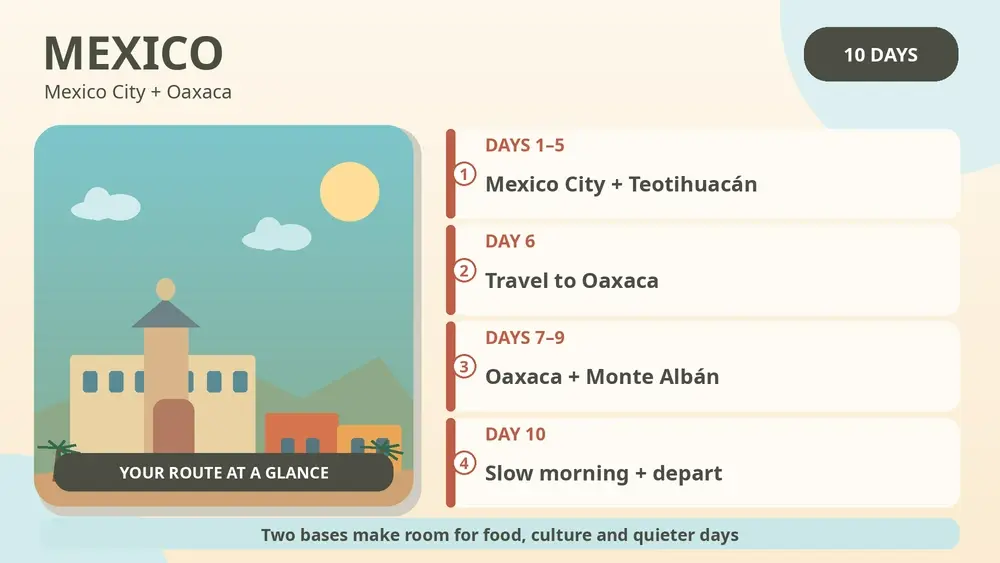
    A realistic itinerary at a glance

    Days Base Main focus
    1–5 Mexico City Historic centre, Chapultepec, neighbourhoods and Teotihuacán
    6 Transfer Mexico City to Oaxaca
    7–9 Oaxaca Historic centre, markets, Monte Albán and one focused excursion
    10 Oaxaca / departure Slow morning and onward journey

    Day-by-day plan

    Day 1: Arrive and stay local

    Choose a hotel in Roma Norte, Condesa, Juárez, Polanco or the historic centre according to what you value most. Do not spend the first afternoon crossing the city for a checklist attraction. Walk nearby, have an early meal and learn the rhythm of your immediate neighbourhood.

    Traffic and altitude make arrival days unpredictable. If you feel good, add a short walk; if not, protecting your energy is a better investment than forcing the first museum.

    Day 2: Historic Mexico City

    Spend the day around the Zócalo, cathedral area, Templo Mayor surroundings and streets of the Centro Histórico. The objective is not to enter every building but to understand the layers of the city before moving to other neighbourhoods.

    Start early, take breaks and be selective about museums. One substantial museum plus street-level exploration usually creates a better day than four rushed interiors.

    Day 3: Chapultepec and one major museum

    Give Chapultepec enough time to feel like a district rather than a single attraction. The National Museum of Anthropology can absorb several hours, and trying to combine it with multiple large museums often leaves visitors mentally exhausted.

    Finish in nearby Polanco or return toward Roma/Condesa for an easy evening. This is a good day to book one special dinner because the daytime route is geographically coherent.

    Day 4: Teotihuacán without overloading the evening

    Visit Teotihuacán early and treat it as the main event. Sun exposure, walking and the transfer make it more tiring than a normal city day. Check current access rules and opening information through Mexico’s National Institute of Anthropology and History before you go.

    When you return, keep the evening simple. A relaxed meal close to the hotel is more sensible than another cross-city attraction.

    Day 5: Neighbourhood day

    Use this day for Coyoacán, San Ángel, Roma, Condesa or a food-focused walk depending on your interests. Pick one or two areas rather than collecting neighbourhood names.

    This is also your weather and energy buffer. If an earlier museum was closed or you lost time to a delay, you can move it here without breaking the itinerary.

    Day 6: Travel to Oaxaca

    A flight saves time; a good intercity bus can be comfortable and lets you see the landscape. Compare the complete door-to-door time rather than the headline journey time. Airport transfers and check-in can erase part of the difference.

    After arrival, do little more than walk the historic centre, find the main market area and choose dinner close to your accommodation.

    Day 7: Oaxaca city properly

    Spend a full day in the centre: churches, markets, small museums, courtyards and food. Oaxaca is a place where stopping for chocolate, mezcal, mole or a market lunch is part of the experience, not wasted time.

    Avoid scheduling every tasting in advance. Leave room for recommendations you receive after arrival.

    Day 8: Monte Albán

    Visit Monte Albán early, then return to the city for a slower afternoon. The archaeological site is exposed and can be hot, so water, sun protection and sensible footwear matter.

    A half-day structure works well because it avoids combining Monte Albán with another long excursion merely to maximise the number of sights.

    Day 9: Choose one excursion

    Pick one direction: artisan villages, Hierve el Agua if access and road conditions suit you, or a mezcal-focused outing with a reputable operator. Do not try to stack all three into the same day.

    This choice is where the trip becomes personal. A family with young children may prefer shorter village stops; food-focused adults may value a producer visit; keen walkers may prefer a landscape day.

    Day 10: Leave space

    Keep the final morning for breakfast, a market revisit and packing. If you are connecting to an international flight from Mexico City, consider whether an overnight there is safer than a tight same-day connection.

    Mexico rewards unhurried repeat visits. Leave Puebla, the Pacific coast and other regions for a later trip rather than treating them as omissions.

    Where to stay and how many hotel changes to make

    In Mexico City, neighbourhood choice changes the trip more than a small difference in hotel quality. Roma Norte and Condesa are convenient for restaurants and evening walks; the historic centre puts monuments close but can feel quieter or more intense depending on the block; Polanco offers polished hotels and easy access to Chapultepec at a higher price.

    In Oaxaca, staying within comfortable walking distance of the historic centre is valuable because it lets you return to the hotel during the hottest or busiest part of the day. You do not need to sleep directly on the main square; being several blocks away can be quieter.

    For only ten days, two main hotels are enough. Every extra hotel change steals time through packing, check-out, luggage storage and orientation.

    Transport: what is worth booking in advance

    Mexico City traffic can make short map distances surprisingly slow. Use the Metro and Metrobús where practical, combine them with authorised taxi or ride-hailing options, and group each day geographically.

    Between the two cities, compare flight and bus schedules based on your hotel locations. A bus station may be easier to reach than an airport, while a flight can be useful if you find a well-timed fare.

    For Oaxaca excursions, a driver, small-group tour or organised transport can be easier than renting a car for a single day. If you do drive, understand local insurance, parking and road conditions rather than choosing a rental only because the base rate looks low.

    Food and daily rhythm

    Food is one of the strongest reasons to slow this route down. In Mexico City, mix markets, neighbourhood restaurants, bakeries and street food instead of reserving every meal. In Oaxaca, allow time for moles, tlayudas, chocolate, regional corn dishes and mezcal in contexts where you can actually understand what you are tasting.

    Use ordinary food-safety judgement: choose busy vendors with high turnover, drink safe water and give your stomach time to adapt. A packed tasting schedule on the first day is rarely necessary.

    Families, children and older travellers

    With children, reduce the number of museums and use parks, markets and short neighbourhood walks to break up the day. Chapultepec is especially useful because it provides space between indoor attractions.

    Older travellers may appreciate private transfers for Teotihuacán and Oaxaca excursions, elevators in hotels and rooms away from noisy streets. Historic paving and archaeological terrain can be uneven, so footwear and a slower pace matter.

    Multigenerational groups should not assume everyone must do the same activity. A morning excursion and a shared dinner often works better than keeping a large group together from breakfast to bedtime.

    Budget: where the money really goes

    The largest variables are accommodation level, restaurant choices and domestic transport. Mexico can feel good value compared with some North American and European cities, but premium hotels, tasting menus and private tours can quickly change the total.

    Budget for airport transfers, archaeological entrance fees, museum tickets, day trips and tips rather than comparing only room rates. Keep a separate contingency for schedule changes or a final-night airport hotel if your international connection requires it.

    If cost matters, spend on location before luxury. A well-located mid-range hotel can reduce daily transport and return-trip fatigue.

    Best time to go

    Highland Mexico does not have one universal “best” month. Mexico City and Oaxaca have distinct dry and rainy patterns, and temperatures change with elevation. Dry-season weather can be convenient, while rainy months may bring greener landscapes and afternoon showers rather than continuous rain.

    Major holidays, festivals and events can transform both price and atmosphere. If you want a specific celebration, plan around it deliberately; if not, avoiding peak dates can make rooms and transport easier.

    Check current local conditions shortly before departure rather than relying on a climate chart alone.

    Mistakes that make this trip harder than it needs to be

    • Trying to add the Yucatán or a Pacific beach to the same ten-day trip.
    • Booking a hotel far from the neighbourhoods you actually want to use every evening.
    • Treating Teotihuacán as a quick stop between several other major attractions.
    • Underestimating Mexico City traffic and altitude.
    • Scheduling multiple long Oaxaca excursions on consecutive days.
    • Connecting from Oaxaca to a long-haul international flight with no margin for disruption.

    How I would adapt the itinerary

    With seven days, stay only in Mexico City or divide the trip 4/3 and skip the Oaxaca day trip. With two weeks, add Puebla between the two cities or extend Oaxaca with a second focused excursion rather than immediately flying to another region.

    Travellers who mainly want beaches should not force this route to become something it is not. Pair the Yucatán guide with a future Mexico trip instead. Food-focused travellers can easily spend extra days in both cities without running out of meaningful experiences.

    Before booking the trip

    • Check passport and entry requirements for your nationality close to departure.
    • Review current archaeological-site opening information and any reservation rules.
    • Choose neighbourhoods before choosing hotels.
    • Leave a connection buffer if your international flight requires a domestic positioning flight.
    • Download offline maps and keep the hotel address available without internet.

    The most useful mindset for Mexico is to plan for depth, not coverage. Ten days in Mexico City and Oaxaca will show you only a fraction of the country, but that is precisely why it can feel like a real journey rather than a transfer schedule.

  • Hotel, Apartment, Hostel or Resort? How to Choose the Right Place to Stay

    Hotel, Apartment, Hostel or Resort? How to Choose the Right Place to Stay

    The best type of accommodation is not a universal category. A hotel can be perfect for a two-night city break and frustrating for a ten-night family holiday. An apartment can feel like excellent value until cleaning fees, luggage storage and a late self-check-in are added. A hostel can be sociable and central, while a resort can simplify a difficult family trip by putting food, pools and activities in one place.

    The useful question is not “Which is best?” but “Which problems do I want the accommodation to solve on this trip?”

    Choose by need, not label

    • Short stays usually reward convenience and easy check-in.
    • Longer stays increase the value of laundry, kitchens and living space.
    • Location often matters more than room size on sightseeing-heavy trips.
    • Families should compare sleeping layout, not just maximum occupancy.
    • Older travellers and anyone with mobility needs should verify access from street to room.

    1. Compare the total stay cost

    Do not compare a nightly hotel price with an apartment’s base rate. Add cleaning fees, resort or destination fees, local taxes, breakfast, parking and any mandatory charges. Then divide by the number of nights. Some fee structures make apartments poor value for one or two nights but very competitive for a week.

    Also price the services you will actually use. Free breakfast has value only if it suits your schedule and diet. A kitchen saves money only if you plan to cook or need it for children. Daily housekeeping may matter a lot on a short luxury break and very little on a long trip where you prefer privacy.

    2. Location can be worth more than a larger room

    Map the property against the places you will visit, not against the geometric centre of the city. A hotel beside the main station can be ideal for day trips but noisy at night. An apartment in a residential area can feel authentic but add 40 minutes of transport every day.

    • Walking time to useful transport
    • Evening food options
    • Airport or station access
    • Noise from nightlife or traffic
    • Gradient and stairs on the surrounding streets
    • Availability of supermarkets, pharmacies and laundry
    • How safe and comfortable the route feels late in the evening

    3. When a hotel is the easiest choice

    Hotels work especially well for short stays, late arrivals and trips with frequent city changes. Reception can solve problems, hold luggage and provide a predictable check-in process. Daily housekeeping and on-site breakfast can reduce planning when the trip itself is busy.

    Hotels can be less comfortable for families if everyone shares one room, and restaurant meals for every breakfast and dinner can become expensive. Room size also varies enormously between destinations, so square metres are more informative than photographs taken with a wide-angle lens.

    4. When an apartment wins

    Apartments become particularly useful when the trip lasts several nights and daily life matters: breakfast at your own pace, storing snacks, doing laundry, putting a child to sleep in a separate room or simply sitting somewhere that is not a bed.

    Red Brick Apartment Buildings With Fire Escapes New York

    The trade-off is usually service. Self-check-in can be convenient until a code does not work at midnight. Luggage storage before check-in or after checkout may not exist. If the property is in a residential building, lifts can be small or absent. Read access instructions and recent reviews carefully.

    5. Hostels are not only for 20-year-old backpackers

    Modern hostels range from basic dormitories to private rooms with hotel-style bathrooms. They can be useful for solo travellers who want social spaces, central locations and access to shared kitchens. Private rooms may suit couples or older travellers comfortable with a lively environment.

    Check whether the room is private or dormitory, whether the bathroom is ensuite, whether towels are included, quiet hours, lift access and the age profile of the property. “Hostel” describes a format, not a guaranteed atmosphere.

    6. When a resort makes sense

    Resorts can be good value when you intend to use the facilities. Pools, beach access, children’s clubs, entertainment and several restaurants reduce the need for daily logistics. This can be particularly valuable on family trips where adults want some downtime.

    A resort can be poor value when your plan is to leave early every morning and return after dinner. In that case, you may be paying for facilities you never use and a location far from the places you actually want to see.

    A resort pool reflecting palms and the evening sky in Tenerife

    7. Family accommodation: look at sleeping zones

    A listing that sleeps four may mean one double bed and one sofa bed in the same room. For a family with a young child who sleeps at 8 p.m., that arrangement can effectively end the adults’ evening. A one-bedroom apartment or connecting hotel rooms may cost more but transform the trip.

    Check cot availability, high chairs, laundry, kitchen equipment, pool fencing where relevant and whether balconies are suitable for your family. Never assume a property marketed as family-friendly has the specific safety features you need.

    8. Solo travellers: security and social needs are different choices

    A central hotel with 24-hour reception may feel reassuring for a first solo trip. A hostel can make meeting people easier. An apartment offers privacy but may feel isolated if the entrance is on a quiet street and there is no staff onsite. Choose based on how you want the trip to feel, not only on price.

    9. Older travellers and accessibility

    Verify details rather than relying on the word “accessible.” Ask about steps from street to reception, lift dimensions, bathroom layout, shower access and distance from transport. A property on a steep hill can be difficult even if the room itself is perfect.

    If luggage handling is a concern, a staffed hotel may be easier than a walk-up apartment. The best accommodation is the one that reduces effort throughout the stay.

    10. Read reviews for patterns, not individual drama

    Recent reviews are most useful when several people mention the same practical issue: street noise, weak air conditioning, poor cleanliness, tiny lifts, difficult check-in or unreliable Wi-Fi. One unusually angry review may tell you little; ten similar comments tell you much more.

    Filter by traveller type where the platform allows it. A couple on a weekend can have a different experience from a family staying ten nights.

    New York Apartment Buildings And Neighborhood Street

    11. Read accommodation photos like a floor plan

    Look for the things photographers do not emphasize: storage, sockets near the bed, curtains, the distance between beds, shower access, kitchen workspace and windows. If a listing shows 40 photographs of the lobby and only one of the bathroom, pay attention.

    12. Flexible booking can be worth a premium

    Early in the planning process, a flexible rate keeps the itinerary adjustable. You may later find a better flight, decide to add a night elsewhere or discover that a different neighbourhood fits the trip better. Compare the price difference with the value of being able to change your mind.

    13. Arrival and departure logistics matter

    A property may be excellent during the stay but awkward at the edges. If you arrive at 8 a.m., can it store luggage? If the flight leaves at 10 p.m., is there somewhere to wait? Does a late arrival incur a fee? Is reception open? These questions matter more on short trips because a few inconvenient hours represent a large part of the holiday.

    A simple accommodation decision table

    If your priority is…Start by looking at…Then verify…
    Easy two-night city breakHotelLocation, noise, breakfast, luggage storage
    Week with young childrenApartment or family hotelSleeping zones, kitchen, laundry, lift
    Social solo tripHostel/private hostel roomAtmosphere, bathroom, lockers, quiet hours
    Relaxing beach holidayResortBeach quality, meal plan, transfers, what is included
    Mobility comfortStaffed hotel or verified accessible propertyStreet access, lifts, bathroom and transport distance
    Long stayApartment/aparthotelLaundry, kitchen, workspace, local services

    Accommodation is the base that either supports or complicates the rest of the trip. Choose it after you understand the daily route, not before. A room you enjoy returning to is useful; a room that saves an hour of unnecessary travel every day is even more useful.

    Practical notes that make the plan work in real life

    Before departure, write the critical information in one place: booking references, the first accommodation address, transport details, insurance contact if applicable, and the phone numbers you would need if your device stopped working. Keep a secure offline copy as well as the online version. This is a small task, but it prevents several common travel problems from becoming larger than they need to be. Build margins around the parts of the trip that are difficult to replace. A local café can move to another hour; an international flight cannot. A free neighbourhood walk can be shortened; a prepaid tour may have a fixed departure. Giving the least flexible items more time is a better strategy than trying to make every minute efficient. Finally, review the plan from the perspective of the least experienced or least mobile traveller in the group. Check the distance from platform to hotel, how luggage will be handled, where meals can happen and what the alternative is if the day becomes too hot, wet or tiring. A plan that still works on an imperfect day is usually a strong plan.

  • Canary Islands in 10 Days: Tenerife and Gran Canaria Without Trying to Visit Every Island

    Canary Islands in 10 Days: Tenerife and Gran Canaria Without Trying to Visit Every Island

    The Canary Islands are often marketed as one destination, but each island is large and distinct enough to support a full holiday. Trying to include Tenerife, Gran Canaria, Lanzarote and Fuerteventura in ten days creates an airport-and-ferry itinerary rather than an island trip. A better first visit pairs two islands with direct transport and gives each enough time for both landscape and rest.

    This route uses Tenerife and Gran Canaria because they offer a broad mix: volcanic terrain, historic towns, beaches, mountain roads and urban life. It is intentionally not a “best islands” ranking. Travellers seeking mainly lava landscapes may prefer Lanzarote, while beach-first travellers may choose Fuerteventura. The planning principle is the same: two islands are enough for ten days.

    Quick trip summary

    • Split ten days roughly 5/5 between Tenerife and Gran Canaria.
    • Rent a car for selected days rather than automatically for the entire stay if you choose a walkable resort or city base.
    • Treat mountain roads as sightseeing time; short distances can take much longer than expected.
    • Choose one major volcanic or mountain day on each island and keep a weather fallback.
    • Use the inter-island transfer as a half-day, not as a free sightseeing day.

    Who this itinerary is for — and when to change it

    This route is designed for a first or early visit with a moderate pace. It assumes that you want the destination’s defining experiences without turning every day into an early start, late arrival and luggage transfer. Couples, solo travellers, families and mixed-age groups can use the same geographic structure, but the number of activities inside each day should change with mobility, climate, jet lag and personal interests.

    Before booking every attraction, identify the two experiences you would regret missing. Protect those first, then build the rest of the trip around them. Weather-dependent mountains, deserts, coastlines and wildlife experiences deserve flexible placement, while museums and neighbourhood days can often move more easily.

    Where to stay: choose the base before the hotel

    Accommodation is a transport decision as much as a comfort decision. Check how you will reach the first activity in the morning, how you will return after dinner, whether the property has lifts or parking, and what happens with luggage on transfer days. A cheaper room that creates two difficult journeys every day can cost more in taxis, time and energy than a slightly more expensive base in the right place.

    BaseWhy it works — and the trade-off
    Tenerife: La Laguna / Santa CruzGood for culture, food and the greener north; longer drive to some southern beaches.
    Tenerife: Costa Adeje / Los CristianosBest for resort convenience, family facilities and southern weather; farther from northern towns.
    Gran Canaria: Las PalmasStrong for city life, Las Canteras beach and restaurants; mountain day trips remain possible.
    Gran Canaria: Maspalomas / MelonerasBest for resort pools, dunes and winter sun; less central for the island’s northern cultural sights.

    The four decisions that shape this trip most

    DecisionBest defaultWhen to change it
    Number of islandsTwoUse one island for a slower trip; add a third only with 14+ days.
    Rental car3–4 days per island if neededSkip on city/resort days when buses, taxis and walking are easier.
    Teide / mountain dayWeather-dependent priorityKeep another day flexible because wind/cloud can change visibility and access.
    Beach baseChoose north/city or south/resort consciouslyDo not assume one coast provides the best compromise for every activity.

    Make these decisions before filling the calendar with attractions. They determine how many hotel changes, early starts and long journeys the trip contains. Once the structure is right, individual sightseeing choices become much easier to adjust.

    Gran Canaria Seaside Village

    A realistic day-by-day route

    Days 1–2: settle into Tenerife and choose your island personality

    Use arrival day around the hotel area. If you are in the south, make it a beach/pool afternoon; in the north, choose a town walk.

    Use the first full day for the opposite side of Tenerife’s character: La Laguna and northern landscapes from a southern base, or a warmer coastal day from a northern base.

    Avoid collecting scenic viewpoints by car. Choose a few and leave time to stop safely, eat and walk.

    Days 3–5: Teide, one coast and a flexible weather day

    Use the clearest suitable day for Teide National Park and surrounding volcanic landscapes. Check current official access and cable-car/permit requirements for any specific summit activity.

    Give another day to a coast that contrasts with your base—whale-watching, a beach, Anaga or a north-coast town depending on interests and conditions.

    Keep the final Tenerife day intentionally flexible. It can absorb cloud on the mountain, wind at sea or simply become a slow pool day before the island transfer.

    A road and palm trees below Mount Teide in Tenerife

    Day 6: transfer to Gran Canaria

    Fly or take the ferry according to your bases and total door-to-door time. Do not compare only the scheduled journey duration.

    Pick up a car only if you need it immediately; city parking in Las Palmas may make a delayed rental smarter.

    Spend the evening within walking distance of your new base.

    Pace check: if this stage runs late, remove the lowest-priority activity rather than stealing time from meals, sleep or the next transfer. A resilient itinerary should become simpler when something changes, not more frantic.

    Days 7–9: Gran Canaria’s city, mountains and coast

    Use one day for Las Palmas and Las Canteras if you are staying south, or as an easy home day if you are based in the city.

    Use one full day for the interior, choosing a realistic mountain loop with villages and viewpoints. Winding roads make a short kilometre total feel much longer.

    Use the remaining day for Maspalomas, a beach, a family attraction or a quieter coastal area. Do not force another mountain drive if the group wants rest.

    Day 10: departure without crossing the island twice

    Keep the last morning near your base or airport route.

    Return the car with time for fuel and inspection, especially in busy holiday periods.

    If your international flight departs from a different island, strongly consider transferring the previous day rather than relying on a same-day inter-island connection.

    Tenerife Volcanic Coastline And Blue Bay

    Transport reality: plan door to door

    Both Tenerife and Gran Canaria have extensive bus networks and airports, while ferries connect the islands. A rental car is valuable for mountain roads and dispersed viewpoints, but it can be unnecessary on resort days or in Las Palmas. Evaluate each island separately. Road distance is deceptive because volcanic topography creates curves, elevation and slow scenic sections. Check official island tourism and transport sources for current road, trail and cable-car access, especially when mountain weather is involved.

    Door-to-door time is the number that matters. Add hotel checkout, reaching the station, airport or pier, waiting, boarding, collecting luggage, local transport at the other end and the possibility that everyone needs food immediately after arrival. This is why a “two-hour flight” or “three-hour train” can consume most of a day. Our guide to building realistic 7-, 10- and 14-day itineraries explains how to treat transfer days honestly.

    Food strategy: make meals part of the route

    The islands are easy for mixed preferences because resort areas, cities and small towns provide very different dining styles. Plan at least one meal around Canarian dishes rather than eating only in international resort strips. On mountain days, carry water and snacks because opening hours in small villages may not match your driving schedule. If you stay in an apartment, a simple supermarket breakfast can make early scenic starts much easier.

    One planned meal per day is usually enough. Keep another meal flexible so it can respond to where you actually are, not where an old itinerary expected you to be. With children, older travellers or very hot weather, eating before everyone becomes exhausted is often more important than reaching a restaurant that looked perfect months earlier.

    When to go and how the season changes the plan

    The Canaries are popular for mild winter weather, but “eternal spring” does not mean identical conditions across each island. Northern slopes, mountains and trade-wind zones can be cool or cloudy while southern resorts are sunny. Higher elevations can be dramatically colder than the coast. Pack a warm layer for Teide or mountain viewpoints even if beach temperatures feel summery.

    Instead of searching for one universal best month, decide which compromise you prefer: better weather, fewer visitors, lower prices, longer daylight, beach conditions or seasonal scenery. No month maximises everything. Recheck short-term weather and official access information shortly before each critical outdoor day.

    Budget: where spending actually improves the trip

    Accommodation varies enormously between resort zones, city hotels and apartments. The biggest avoidable expense is renting a car for days when it remains parked, especially where hotel parking costs extra. Inter-island transport also adds baggage and transfer costs, which is another reason to limit the trip to two islands. Families can often save by choosing an apartment for part of the stay and using restaurants selectively.

    The most useful upgrades are often logistical rather than luxurious: a hotel that removes a daily transfer, a direct ride after a long flight, a flexible ticket, an additional night in a weather-dependent region or a guide where interpretation genuinely adds value. Cut low-value extras before cutting the pieces that keep the route reliable.

    Tenerife Tropical Resort Gardens

    Common mistakes to avoid

    • Trying to visit three or four islands in ten days.
    • Assuming coastal sunshine guarantees clear mountain conditions.
    • Underestimating driving time on winding interior roads.
    • Renting a car for an entire city-based stay without checking parking.
    • Planning a same-day island transfer immediately before an expensive international flight.

    Most difficult trips are not ruined by one large mistake. They become tiring through a sequence of optimistic assumptions: a transfer that “should” be quick, a hotel that is “only” a kilometre away, a famous walk assumed to suit everyone and a dinner reservation across town after an already long day. Leave margin before you need it.

    Families, older travellers and mixed-age groups

    Tenerife and Gran Canaria are both strong family destinations because beaches, pools, walks, towns and attractions can be mixed without a rigid schedule. Small children may prefer one longer resort base and fewer car days. Older travellers should pay attention to hotel gradients and the steepness of historic centres or mountain viewpoints. Scenic driving is enjoyable only if the driver is comfortable with curves and elevation; otherwise, organised excursions can be a better choice.

    For mixed-age groups, agree which experiences everyone will share and which can be optional. Splitting for two hours is often healthier than forcing the entire group through one person’s priority. Build seating, toilets, shade, step-free access and realistic meal times into the plan with the same seriousness as headline attractions. Our guide to travelling with parents and older adults develops this approach in more detail.

    If you have more or less time

    With fourteen days, add Lanzarote or Fuerteventura, or simply give a full week to each island. With seven days, choose one island and explore it properly. A single-island week usually feels richer than a two-island sprint because weather can move activities without forcing a transport change.

    When shortening the trip, remove an entire base before cutting every destination to one night. When lengthening it, add depth before distance. An extra morning in a place you already understand often produces a better memory than another multi-hour transfer to a new pin on the map.

    Useful official resources

    Opening hours, transport timetables, road conditions, trail rules and visitor procedures can change. Use official sources for the details that affect your exact travel dates and recheck them shortly before departure.

    Final planning checklist

    • Confirm passport, visa, entry and transit requirements for your nationality and route.
    • Book the genuinely scarce transport or accommodation segment before secondary attractions.
    • Check the exact luggage journey between bases, including stairs, ferries, station exits and rental-car rules.
    • Save offline copies of essential reservations, insurance details and each accommodation address.
    • Recheck weather, road, park, trail or transport notices shortly before each critical day.
    • Keep at least one flexible half-day that can absorb rain, fatigue, a delay or a cancellation.
    • Choose clothing and footwear for the actual surfaces and climate, not only for photographs.
    • Leave a generous buffer before international flights and other connections that are expensive to miss.

    The purpose of a good itinerary is not to prove that you covered the maximum distance. It is to make the important experiences easier to enjoy and to leave enough energy for the unexpected parts that become the best memories. Use this route as a framework, then remove anything that does not fit your interests, mobility or travel rhythm.

  • Traveling Without a Car: How to Plan a Holiday by Train, Bus and Ferry

    Traveling Without a Car: How to Plan a Holiday by Train, Bus and Ferry

    Traveling without a car can make a destination feel more connected, not less. You arrive in the center of towns, notice everyday neighborhoods and leave the driving to someone else. It can also become frustrating if a beautiful village has only two buses a day or a ferry connection does not line up with your flight. The difference lies in designing the route for the transport that actually exists, not removing a rental car from an itinerary built for driving.

    At a glance

    Plan a rewarding car-free trip with rail, coaches, ferries, local transport, sensible luggage and itineraries that work beyond big cities.

    • Rail: Train frequency and station-to-hotel access
    • Regional bus: Operating days and last return service
    • Ferry: Weather, terminal, boarding and buffer day

    This guide offers a framework for car-free holidays in Europe and beyond. It covers choosing bases, finding reliable connections, managing luggage, planning rural excursions and knowing when a taxi, guided transfer or different destination is the sensible solution. If you are comparing longer multi-stop trips, see our route-planning guide and our complete travel budget approach.

    Choose destinations that reward arriving without a car

    Start with places where the attractions you value are reachable by walking, frequent transport or a small number of straightforward excursions. Large cities with transit networks are obvious candidates, but regional towns on railway lines, walkable islands with reliable buses and lake districts with boats can be equally rewarding.

    The key is not whether a destination has a train station; it is the distance from the station to the accommodation and what happens after you arrive. A town with a busy railway hub but attractions spread across remote valleys may still require complicated transfers. A village served by a single ferry can work if you are happy to stay in one base and enjoy a slower pace.

    Ask three questions: Can I arrive conveniently? Can I enjoy several days without hiring a vehicle? Can I leave without depending on a single fragile connection? A destination that passes all three is a promising candidate for a first car-free trip.

    Build the route around transport frequency

    Look at the actual timetable, not just map distance. A 40-kilometer bus journey might take an hour with frequent service or almost a day when connections are limited. Compare weekday, weekend, holiday and seasonal schedules; a summer ferry or mountain bus may not operate in autumn. Timetable aggregators are useful for discovery, but confirm critical journeys through the operating company.

    For every travel day, identify the departure, arrival, station or pier location, transfer time, luggage constraints and last available service. When a route includes separate tickets, understand who is responsible if one leg is late. In Europe, rail passenger rights exist, but the protection available depends on the tickets, operators and circumstances. The European Commission’s rail passenger-rights information is a helpful starting point for applicable routes.

    Add a realistic buffer for finding a platform, walking to the ferry terminal or navigating with luggage. A departure listed as ten minutes after train arrival may be technically possible for some travelers but fragile for a group or someone using a mobility aid.

    Choose accommodation near useful transport, not only famous sights

    For accommodation trade-offs, our accommodation guide is a useful companion. A hotel a few minutes from a central station can be more valuable than a scenic property at the end of an infrequent bus route. But central stations can be noisy, so compare quieter side streets and how they connect to local transport. Where the bus network matters most, consider a base near the main bus interchange rather than the railway terminus.

    A New York City subway train on elevated tracks

    Map the route from the stop to the actual door. Look for steep streets, long staircases, dark underpasses and whether the final portion is realistic with your luggage. An apartment above a pedestrian-only hill may be charming after a day out but tiring at arrival. If you expect evening meals, make sure you can return safely once local buses become less frequent.

    For families, older travelers and people with mobility needs, the same geography matters even more. Check step-free access at stations and lodging separately; “near transit” does not necessarily mean accessible. A comfortable base reduces the need for emergency taxis and saves valuable holiday hours.

    Pack for movement rather than maximum storage

    Car-free travel rewards luggage you can manage independently through a station, a flight of stairs or a crowded bus. A compact suitcase or backpack can work; choose based on the terrain and your ability to lift it. Check baggage policies for coaches and ferries, including whether large bags go into a hold and whether you must handle them yourself.

    Reduce repeated unpacking by using simple clothing systems and staying longer in each base. A small day bag should contain valuables, medicine, rain protection, water, snacks and essential documents. Keep transport tickets available offline when possible and protect your phone battery with a compatible power bank.

    Do not assume all trains have easy large-luggage storage. Some regional services are busy and have narrow entrances. Booking reserved seats or luggage spaces may be useful on certain operators, but rules vary. Pack so one person can move their bag safely without blocking doors or aisles.

    Make one rail corridor the backbone of the trip

    An effective route follows a logical corridor rather than zigzagging between famous places. For example, a trip through connected European towns can work with two or three overnight bases and short train day trips. In Japan, a few cities on a reliable railway network may be easier than adding remote countryside stays. In parts of North America or Australia, train and bus coverage varies widely; a car-free itinerary may work best around selected cities or regional corridors.

    Search from the overnight bases outward. Identify two or three realistic day trips before adding more accommodation changes. If a destination requires a three-hour journey in each direction, ask whether it deserves an overnight stay or should be removed. Staying longer often saves money because you spend fewer days paying for transfers and moving bags.

    Rail passes can be convenient but are not automatically cheaper than point-to-point tickets. Compare reservation fees, train eligibility, route flexibility and the actual journeys you plan to take. A pass is a tool, not a reason to add more miles.

    Use buses and coaches with good backup logic

    Regional buses can open landscapes and towns that trains miss, but they require careful reading. Some routes operate only on school days, demand reservations or have different stops in each direction. A stop marked with a town name may be several kilometers from the historic center. Check the operator’s current timetable and, when useful, ask your accommodation about local practices.

    Arrive early at unfamiliar bus terminals, especially where platforms change. Save the route number, destination sign and approximate stop names. In rural areas, confirm the final return service before leaving. If a journey is dependent on the last bus, know whether a taxi company can provide a realistic fallback—and what that would cost.

    Coaches may offer excellent intercity value, but compare total journey time, seat comfort, baggage limits and the arrival location. A cheap overnight coach can save a hotel night while leaving you too tired to enjoy the next day; count the cost of fatigue as well as the fare.

    Treat ferries as transport with weather, not guaranteed sightseeing

    Ferry schedules are influenced by weather, season, tides, maintenance and operational changes. Reserve ahead where required, especially for islands with limited services, and avoid relying on the final possible ferry before a flight home. Check whether the ticket is flexible and how cancellations are handled.

    Research the real departure terminal, not merely the island or port name. A city may have multiple ferry piers far apart. Find out how early boarding begins, whether luggage must be checked and what transport is available at the destination port. A ferry arriving after local buses stop can create an expensive last-mile problem.

    The safest island itinerary usually includes a buffer before important onward travel. That might mean returning to the mainland a day early or choosing a flexible connection. The best route is one that remains enjoyable even when the sea does not cooperate.

    Check access, language and local payment details

    Transport accessibility varies by operator and equipment. If step-free boarding, wheelchair spaces, assistance or accessible toilets are essential, verify them for the particular service and station. For some European journeys, Your Europe’s assistance information explains general rights and advance arrangements. Elsewhere, use local operator guidance.

    Understand how tickets are purchased. Some systems require a transit card; others use contactless payment, cash, a mobile app or advance online purchase. Check whether you must validate a paper ticket. Keep small cash reserves where useful, but do not assume cash is accepted everywhere. In places with limited mobile reception, downloadable timetables and offline maps are especially valuable.

    With children, plan bathroom and snack breaks rather than relying on facilities at small stations. With multiple generations, favor fewer changes and longer connection times over marginal fare savings.

    A sample seven-day car-free holiday structure

    Day one: arrive in a main transport hub and settle into a central base. Day two: explore the city on foot and use local transit only when needed. Day three: make a short day trip along a frequent rail or bus route, returning well before the final service.

    Day four: transfer to a second base with one manageable connection. Day five: take a scenic ferry, mountain train or regional bus excursion if the weather and operating timetable permit. Day six: enjoy a slower local day without a long transport leg. Day seven: return to the airport or homeward station with a generous buffer.

    This framework works better than a seven-day list of seven cities. You gain time to notice local life and the flexibility to change plans without abandoning a sequence of prepaid transfers.

    Frequently asked questions

    Is traveling without a car always cheaper?

    Not necessarily. Trains can be expensive at busy times, and remote transfers can add up. Compare the full cost of tickets, luggage, taxis and accommodation location against a rental car, parking and fuel.

    How do I visit rural places with limited public transport?

    Stay near the main transport link, check seasonal buses and consider a guided day excursion or a prebooked local transfer. If access is too fragile, choose a different destination rather than spending the whole trip chasing connections.

    Should I buy a rail pass?

    Only after mapping your intended journeys. Compare pass conditions, reservations and the cost of separate tickets. The best-value option depends on country, time of booking and travel frequency.

    What is the biggest planning mistake on a car-free trip?

    Assuming that short distances mean short or frequent journeys. Timetables, last services and the final walk to the accommodation matter more than kilometers on a map.

    Traveling without a car encourages a different kind of curiosity: the station cafe, a neighborhood you pass on foot, a boat ride that becomes part of the holiday. Plan the essential connections well, and allow the ordinary journey to be part of the pleasure.

  • Rail Pass or Individual Tickets? How to Plan a Smarter Train Holiday

    Rail Pass or Individual Tickets? How to Plan a Smarter Train Holiday

    A rail pass can make a multi-country journey feel wonderfully simple: one travel document and an invitation to explore. But a pass is not automatically the cheapest ticket or a guarantee of a seat. The best choice depends on route, age, booking flexibility, reservation fees and the number of journeys you plan to take. This guide explains how to compare passes with individual tickets without confusing convenience, access and total cost. The examples focus on European rail travel, where pass systems are well established, but the decision method works elsewhere too.

    Begin with your actual train itinerary

    Before looking at pass prices, write down the trains you expect to use: origin, destination, travel date and approximate departure time. Separate long intercity trips from short urban journeys. A pass may cover certain national and cross-border services but not metros, local buses or some private tourist railways. Do not treat every line on a map as included. For each train, check the carrier and whether reservations or supplements are required.

    An effective itinerary usually has fewer long travel days than people first imagine. If you are spending four nights in each of three cities, you may need only two major train tickets. If you plan to cross several countries with many flexible stops, a pass could be valuable. Count travel days accurately: some passes charge by active day rather than by each individual train. The definition of a travel day and overnight-train treatment can affect value significantly.

    Compare the true total, not the headline pass price

    Calculate the full cost of a pass plus mandatory reservation fees, booking charges and any services not covered. Compare that with point-to-point fares for your actual dates, including flexible or refundable ticket versions when those features matter. An advance purchase can be inexpensive on certain routes, but restrictions may be strict. A pass may save time and flexibility even when the fare difference is modest.

    Use a simple spreadsheet or notes table rather than relying on a single ‘cheaper than train tickets’ claim. Include transfer risk: if the cheapest ticket locks you into a specific departure, consider the consequence of a late incoming train on separate bookings. For families, apply child and youth policies correctly and check whether particular national promotions are available only to residents or certain age groups.

    Understand mandatory seat reservations

    The pass often gives travel rights but not automatically an assigned seat. Many high-speed, international and night trains require separate reservations, while regional trains frequently do not. The Eurail reservation guidance explains that operators and train types determine when advance reservations are required. Rules and capacities change, so verify your specific service.

    A popular cross-border train can sell out of passholder reservations even when other ticket products appear available. Do not buy a nonrefundable hotel several hundred miles away until you know the train plan is feasible. In some countries it may be practical to use slower regional trains without reservations, but a route that looks elegant on a network map may involve extra changes and hours of travel. Time is part of the cost.

    Houston Downtown Light Rail Train

    Learn the difference between flexible and fixed passes

    A continuous pass is designed for travel throughout a defined period, while a flexible pass may offer a number of travel days within a longer window. The right one depends on how many days are actually spent on trains, not how long the holiday lasts. You should also check class, validity territory, required activation steps and any age restrictions. The meaning of ‘global’ or ‘one country’ in a product name does not guarantee access to every service inside those borders.

    For a trip with long stays in two major cities, individual tickets may be simpler. For a route with spontaneous stopovers, a pass can be convenient. But spontaneous does not mean reservation-free. Before buying, simulate booking the three hardest journeys. If those reservations are expensive or hard to obtain, consider redesigning the route instead of forcing the pass to fit.

    Book the expensive bottlenecks before anything else

    Identify the trains with the least flexibility: popular high-speed services, overnight sleepers, mountain panoramas, international crossings and peak-weekend departures. Look up the actual passholder reservation availability and the latest booking window. Depending on the route, you may book directly with the operator, through the pass platform or at a station. Avoid using an unofficial reseller just because a social-media post recommends it.

    Once critical trains are secured, add accommodation near stations and flexible local experiences. If reservations cannot be obtained, search for alternative departure times or conventional tickets. Do not assume an ordinary full-fare ticket is always more expensive; limited promotional fares occasionally change the calculation. The point is to secure a coherent trip, not to prove that the pass you already purchased was a bargain.

    Night trains require another calculation

    An overnight train can replace a hotel night and create a memorable journey, but sleeper berths and couchettes usually involve extra reservation charges. Some routes may have only seated accommodation left, and a night in a seat is not equivalent to sleeping in a bed. Consider arrival time, personal comfort and the impact of fatigue on the following day. Look into compartment arrangements, private options and requirements for traveling with children.

    For a family or older traveler, paying more for a sleeper may be worthwhile, but the trip might still be less comfortable than a daytime train and a hotel. Check luggage security and the station arrival hour. Where overnight trains cross calendar days, confirm exactly how travel days are counted under your pass conditions before planning the rest of the itinerary.

    What changes when you travel with children

    A rail holiday can be excellent for school-age children: city centers are easy to access, views change constantly and movement is less restricted than on an aircraft. But a rushed platform change with several suitcases is stressful. Prefer fewer bases, reserve seats together where possible and verify stroller storage, changing facilities and station elevators. Child discounts on individual tickets and pass products vary, sometimes substantially.

    Carry snacks, water and a compact activity bag rather than trying to entertain children with uninterrupted screen time. A child who likes maps can follow stations and count countries crossed. For toddlers, schedule a daily playground stop near the hotel. Remember that train punctuality and onboard services differ between countries; do not rely on a dining car being open to provide every meal.

    Accessibility and mobility planning

    A pass does not guarantee that every station or train is step-free. Check the specific operator’s accessibility information, assistance request deadlines, boarding equipment and changes needed during transfers. Wheelchair spaces may require reservations even on services where ordinary seating is unreserved. A traveler with limited mobility should not be left at an inaccessible platform because the route looked fine in a general planning app.

    Philadelphia Regional Rail Train

    Build extra transfer time and prefer direct services when feasible. For travelers with visual or hearing disabilities, ask about announcements, staff assistance and real-time service alerts. Keep the contact details of relevant rail operators, not just the pass provider, because help during a disruption may depend on who operates the train. Accessibility is a route-level question, not just a ticket category.

    Compare trip styles with a numerical example

    Imagine a seven-day trip linking three cities, with two long intercity journeys and several short local rides. The correct comparison is two advance or flexible tickets versus the cheapest suitable pass plus any mandatory reservations. Local buses, metros and many airport transfers may remain separate either way. If you add two distant day trips, re-run the calculation. A pass could move from poor value to worthwhile—or not—depending on the trains.

    Now imagine a ten-day journey across four countries with six intercity travel days. A pass may become appealing because it simplifies some ticketing, but cross-border reservations can add up. Create two columns labeled ‘pass scenario’ and ‘individual ticket scenario’ and enter real bookable prices on the same day. The outcome will be more reliable than any generic claim that one method is always cheaper.

    When individual tickets usually make sense

    Individual tickets are often convenient for fixed routes with only a few long journeys, especially when booking windows are open and lower advance fares remain. They can also be preferable when a particular premium train has limited passholder space. Compare whether a ticket includes a reserved seat, refund terms and a connection guarantee. One ticket for a protected connection can be more reassuring than several separate bookings.

    Do not overlook regional day tickets, domestic discount cards or group products. These options can be excellent value for travelers staying mostly inside one country. However, many regional promotions have eligibility rules, time restrictions and purchase conditions; check official sources for the date you travel. A practical rail plan uses the right mix of products rather than forcing every journey onto a single pass.

    A comparison table you can use

    Question Rail pass Individual tickets
    Many flexible travel days? Potential advantage Multiple bookings
    Few fixed journeys? May be unnecessary Often straightforward
    High-speed reservation required? Possible extra fee Often included in fare
    Peak-weekend sellout risk? Must check passholder quota Must check ticket availability
    Children and seniors? Product-specific policies Operator-specific discounts
    Local buses and metros? Often excluded Usually separate

    Booking and travel-day checklist

    Make a route chart showing expected travel days and accommodation nights. Confirm pass eligibility and which carriers participate. Price two or three point-to-point alternatives and check whether reservations are compulsory. Secure any difficult high-speed or sleeper services before buying nonrefundable hotels. Download or print essential tickets, keep device batteries charged and know how digital pass activation works offline. Confirm luggage limits for specialty trains and bus replacements.

    On travel days, arrive at the station with enough time to find the platform, especially when accessibility assistance is required. Keep the ticket, ID and seat reservation accessible for inspection. If your plans change, check whether the operator requires a new reservation or cancellation. A pass creates options, but each option still has operating rules.

    Frequently asked questions

    Does a rail pass guarantee a seat?

    No. Some trains need separate seat reservations, and a pass may not cover all services. Check the operating company’s requirements for each train.

    Is a pass always cheaper for students or retirees?

    No. Age-based discounts vary by product and operator. Compare actual travel dates, reservation fees and special domestic fares.

    Can I decide all my trains on the day?

    Some regional services allow it, but popular high-speed and sleeper trains may require advance reservations. Flexibility depends on the route and season.

    Further reading

    Review overnight trains for beginners, traveling without a car, budgeting your holiday and connecting journeys. For pass conditions, consult the official Eurail website.