Author: admin

  • Croatia in 10 Days: Split, One Island and Dubrovnik Without Too Many Ferries

    Croatia in 10 Days: Split, One Island and Dubrovnik Without Too Many Ferries

    Croatia’s coastline makes island-hopping look effortless. In reality, ferry timetables, port transfers, luggage and hotel check-in turn every island change into a meaningful piece of the day. A ten-day first trip is usually better with Split, one island and Dubrovnik than with four islands visited for one night each.

    This itinerary deliberately leaves the island choice flexible. Hvar is convenient and lively, Brač can offer easier beach-focused options, while Korčula works well for travellers who value a smaller historic town and wine-country feel. The important decision is not which island wins; it is whether the island matches the rest of your route and ferry dates.

    Quick trip summary

    • Use Split and Dubrovnik as city anchors and choose one island for three nights.
    • Check ferry timetables for your exact travel date before booking non-refundable hotels.
    • Stay near—but not necessarily inside—the busiest old-town lanes if stairs and luggage matter.
    • Plan one strong historic walking block per city, then add beach or neighbourhood time.
    • Do not assume summer road and ferry transfers will run at the speed suggested by a simple map.

    Who this itinerary is for — and who should change it

    This route is designed for a first visit with a moderate pace: enough structure to avoid wasting days on poor logistics, but enough freedom to respond to weather, energy and unexpected discoveries. It suits couples, solo travellers, families and mixed-age groups who would rather remember several places clearly than remember a blur of transfers.

    If your priority is nightlife, serious hiking, luxury resorts or a single specialist interest, use the route as a geographic framework and replace the lower-priority days. A useful itinerary is not a test of how many attractions you can complete. It should make the important parts easier while leaving room to stop when something is better than expected.

    Where to stay: location decisions that change the trip

    Accommodation has more impact than the room itself. Check the first journey each morning, the last journey at night, luggage access, hills or stairs, nearby food and whether you can return for a break. A cheaper property that creates two difficult transfers every day can cost more in time, taxis and energy than a slightly more expensive base in the right place.

    Base Best use and trade-off
    Split old town / Varoš edge Excellent for walking to Diocletian’s Palace and the waterfront. Some lanes involve stairs and vehicle restrictions.
    Split Bačvice / Firule Useful for travellers who want beach access while remaining walkable to the centre.
    Island port town Most convenient without a car because ferries, restaurants and buses cluster nearby; can be busy in peak season.
    Dubrovnik outside the walls Areas such as Ploče, Lapad or Gruž can offer easier road access and more space. Choose according to whether you prioritize old-town walking, beaches or the port.

    A realistic day-by-day route

    Days 1–2: Split with the palace as a living neighbourhood

    Use arrival day for the Riva and an unstructured walk through the palace lanes. The old core is compact, but stone surfaces and crowds can make it tiring.

    On the full day, explore Diocletian’s Palace area, markets and a viewpoint or nearby beach rather than adding a long excursion immediately.

    Evening is a good time to revisit the centre after day-trip crowds thin.

    Day 3: one deliberate day trip or a slower Split day

    Choose Trogir, a beach day, Klis or another nearby interest—not all of them.

    This buffer is valuable if your ferry schedule changes or weather makes the sea less appealing.

    Families may prefer a half-day excursion plus swimming over a full bus itinerary.
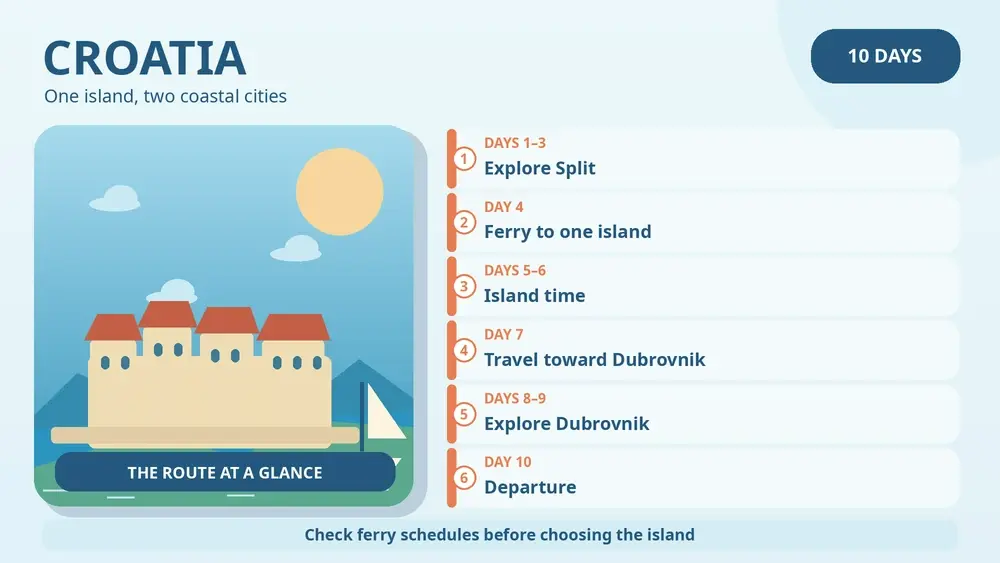
    Illustrated Croatia route from Split to Dubrovnik via one island stay

    Day 4: ferry to your chosen island

    Keep the morning simple and reach the correct port early enough to find the departure point. Ferry companies and terminals vary.

    After arrival, orient yourself around the port town and check local bus or taxi options before committing to a distant beach.

    Do not rent a vehicle purely because the island looks large; decide based on what you actually plan to visit.

    Days 5–6: give the island enough time to feel different

    Use one day for beaches or a boat-based experience and another for inland villages, walking or a quieter coast.

    If staying on Hvar, escape the main-town rhythm for part of the day. On Brač, avoid assuming Zlatni Rat is the only worthwhile beach. On Korčula, allow time beyond the old town.

    Wind and sea state can change boat plans, so keep at least one land-based alternative.

    Day 7: continue toward Dubrovnik

    Travel to Dubrovnik by the best combination for your island and date, then make hotel check-in the main objective.

    If arriving by road, border and traffic conditions can alter timing depending on the route.

    Use the evening for a simple local walk instead of rushing into the walls at the busiest time.

    Days 8–9: Dubrovnik with one wall-focused day and one wider day

    Walk the old town and city walls when conditions are comfortable, allowing more time than the distance suggests because of stairs, heat and photo stops.

    Use the second day for Lokrum, a beach, Mount Srđ viewpoint or a slower neighbourhood depending on weather. Avoid combining every option.

    Cruise-ship schedules can influence crowd patterns, but do not build the entire trip around avoiding other visitors; early and late hours often help.

    Day 10: departure or extra coastal time

    Keep airport transfer margin generous and remember that Dubrovnik Airport lies outside the city.

    If leaving late, store luggage and choose a nearby activity rather than another boat trip with uncertain return timing.

    Finish the trip with the coast, not with a frantic checklist.

    Pace check: if the previous stage ran late, remove the lowest-priority stop rather than stealing time from meals, sleep or the next transfer. The route is deliberately built with places where you can simplify it without breaking the whole trip.

    Transport reality: what the map does not show

    Ferries are central to this route, and the exact useful connection depends on month, island and operator. Check the official carrier timetable for your date before locking the hotel sequence. In Split and Dubrovnik, walking covers much of the historic core, while buses and taxis are useful for beaches and accommodation outside the centre. A car is not necessary for this entire itinerary and can become a parking problem in old towns, though it may make sense for mainland extensions.

    Door-to-door time is the number that matters. Add checkout, reaching the station or port, waiting, boarding, transfers, finding the new accommodation and the possibility that everyone wants food immediately after arrival. This is why a “two-hour journey” can easily occupy half a day. Our guide to building realistic itineraries explains how to protect transfer days instead of pretending they are normal sightseeing days.

    Food strategy: eat well without making meals another timetable

    Dalmatian meals can be simple and excellent: grilled fish, vegetables, olive oil, pastries and local wines. Waterfront restaurants in the most famous lanes often charge for the location, so compare menus one or two streets back. On islands, dinner reservations can matter in peak season, but keeping lunch flexible is useful for beach days. If taking a late ferry, do not assume you will find a full meal after arrival in a smaller port.

    One planned meal per day is usually enough. Leave the other meal flexible so it can respond to where you actually are, not where you expected to be six months earlier. Keep a simple backup option close to the hotel for evenings when the group is tired. This matters even more with children and older adults, because hunger turns a minor transport delay into a much larger problem.

    When to go and how weather changes the route

    July and August bring warm sea conditions and the strongest demand, but heat can make old-town walking strenuous. June and September are often attractive for a mix of swimming and sightseeing, though ferry frequencies vary by season. Spring and autumn can be excellent for cities and hiking but not every beach or boat service operates at summer levels. Choose dates based on whether your priority is swimming or cultural touring.

    Instead of searching for one universal “best month,” choose which compromise matters most: comfortable temperatures, swimming, long daylight, lower prices, fewer visitors or full seasonal transport. Every destination trades one advantage for another. Build at least one indoor, low-effort or easily movable half-day into the plan so weather does not force you into a bad decision.

    Budget: where spending improves the trip

    Island hotels and ferry tickets can raise the budget quickly in peak season. Staying outside Dubrovnik’s walls often gives more space for the price, but calculate bus/taxi needs and stairs. Boat tours vary widely in quality and group size, so one well-chosen outing is usually better than several cheap ones. If your budget is tight, reduce ferry changes first; every extra island adds transport and luggage friction as well as another room rate.

    The most valuable upgrades are often logistical rather than luxurious: a central hotel, a direct transfer after a long flight, a reserved seat on a scarce connection or a guide who turns a wildlife or archaeological visit into something you understand. Cut low-value extras before cutting the pieces that keep the route reliable.

    Common mistakes to avoid

    • Trying to sleep on three islands in ten days.
    • Booking hotels before verifying seasonal ferry connections.
    • Choosing a cliffside or old-town property without checking stairs and luggage access.
    • Walking city walls at the hottest part of a summer day when another time is available.
    • Keeping a rental car through Split and Dubrovnik simply because you used one elsewhere.

    Most itinerary problems do not come from one disastrous decision. They come from stacking small optimistic assumptions: a transfer that “should” be quick, a hotel that is “only” a kilometre away, a hike described as easy, and a dinner reservation on the opposite side of town. Leave margins in the plan before you need them.

    Families, older travellers and mixed-age groups

    Families benefit from one island base where beach time can replace formal sightseeing. Strollers meet cobbles and stairs in historic centres, so a carrier may be useful for younger children. Older travellers should check hotel gradients and step counts carefully in Dubrovnik; “five minutes from the old town” can hide a steep climb. Boat trips can reduce walking but require attention to boarding steps and sea conditions.

    For mixed-age groups, decide which experiences everyone will share and which are optional. Splitting for two hours can be healthier than forcing the entire group through one person’s priority. Build toilets, shade, seating, lifts, step-free transport and realistic meal times into the plan with the same seriousness as famous attractions. Our guide to travelling with parents and older adults covers this style of planning in more detail.

    If you have more or less time

    With fourteen days, add Istria, Zadar or a second island with at least three nights. With seven days, choose Split plus one island or Split plus Dubrovnik. Croatia is one of the clearest examples of a destination where fewer bases usually create more actual holiday time.

    When shortening the trip, remove an entire base before cutting every destination to one night. When lengthening it, add depth before adding distance. An extra morning in a place you already understand often creates a better memory than another three-hour transfer to a new pin on the map.

    Useful official resources

    Timetables, closures, ticket systems and access rules can change. Recheck the details that affect your exact travel dates shortly before departure and again before any critical transfer.

    Final planning checklist

    • Confirm passport, visa and transit requirements for your own nationality and route.
    • Book the genuinely scarce ticket or transport segment before non-refundable secondary activities.
    • Check the exact luggage journey from one accommodation to the next, not only the main train, road or ferry time.
    • Save offline copies of reservations, insurance details and the address of each accommodation.
    • Recheck weather, transport notices and official access information shortly before each important day.
    • Keep one flexible half-day that can absorb rain, fatigue or a delayed transfer.
    • Choose footwear and clothing for the real surfaces and climate, not only for photographs.
    • Leave a generous buffer before international flights and other connections you cannot easily replace.

    The goal is not to return home with proof that you visited everything. It is to come back with a clear memory of how the places felt, enough energy to enjoy them and confidence that the route helped rather than controlled you. Use this plan as a strong starting point, then remove anything that does not fit your interests, mobility or travel rhythm.

  • Austria in 8 Days by Train: Vienna, Salzburg and the Salzkammergut Without a Rental Car

    Austria in 8 Days by Train: Vienna, Salzburg and the Salzkammergut Without a Rental Car

    Austria is one of the easiest European countries to overcomplicate. The trains are good enough that visitors sometimes assume they should add a new city every day, while postcard places such as Hallstatt encourage people to build an itinerary around brief stops rather than actual experiences.

    Eight days works very well with two main bases: Vienna and Salzburg. From Salzburg, you can choose one Salzkammergut day rather than sleeping in several lake villages. The result is a trip with imperial museums, cafés, music, mountain scenery and lakes without a car or constant luggage handling.

    If you enjoyed our Switzerland by train itinerary, Austria offers a similar advantage: public transport lets the journey itself become simple enough that you can focus on what to do with each day.

    Quick trip summary

    • Use Vienna for 4 nights and Salzburg for 3, with the final day as departure or an extra lake-region day.
    • Travel between Vienna and Salzburg by direct train.
    • Choose one Salzkammergut focus—Hallstatt, Wolfgangsee or another lake area—rather than collecting several villages in one day.
    • Reserve only the high-demand experiences that matter to you; leave café and neighbourhood time unstructured.
    • A rental car is unnecessary for the core itinerary.

    Why two bases are enough

    Vienna is not a city you “finish” in two days. Museums are large, palaces sit outside the tight centre and the café culture only works if you allow time to stop. Four nights gives you choice rather than pressure.

    Salzburg is smaller, but it works as both a destination and a transport base for the lakes. That avoids checking into Hallstatt for one night simply to photograph it early in the morning.

    The Austrian National Tourist Office is useful for current regional information and seasonal ideas, while rail operators should be checked for live schedules before booking.

    A realistic itinerary at a glance

    Days Base Main focus
    1–4 Vienna Historic centre, museums, palace or neighbourhood day
    5 Train to Salzburg Transfer and old-town orientation
    6 Salzburg Fortress, music heritage and river
    7 Salzkammergut One focused lake-region day trip
    8 Salzburg / departure Flexible final day

    Day-by-day plan

    Day 1: Vienna arrival

    Stay near a U-Bahn or tram connection, not necessarily inside the most expensive historic blocks. Vienna’s transport network makes a slightly wider radius practical.

    Use the first evening for the Ring area, a café and dinner. Do not begin with a four-hour palace after a flight.

    Day 2: Historic Vienna

    Walk the central district, choose one major museum or historic interior and allow time for lunch or coffee. Vienna is dense with culture, and museum fatigue arrives quickly if you treat each collection as a box to tick.

    An evening concert can be worthwhile, but compare programme, venue and seat quality rather than buying the first ticket marketed to tourists.

    Day 3: Schönbrunn or Belvedere focus

    Pick one major palace complex as the anchor of the day. Schönbrunn can consume most of a day when gardens and travel are included; Belvedere fits more easily with other central sights.

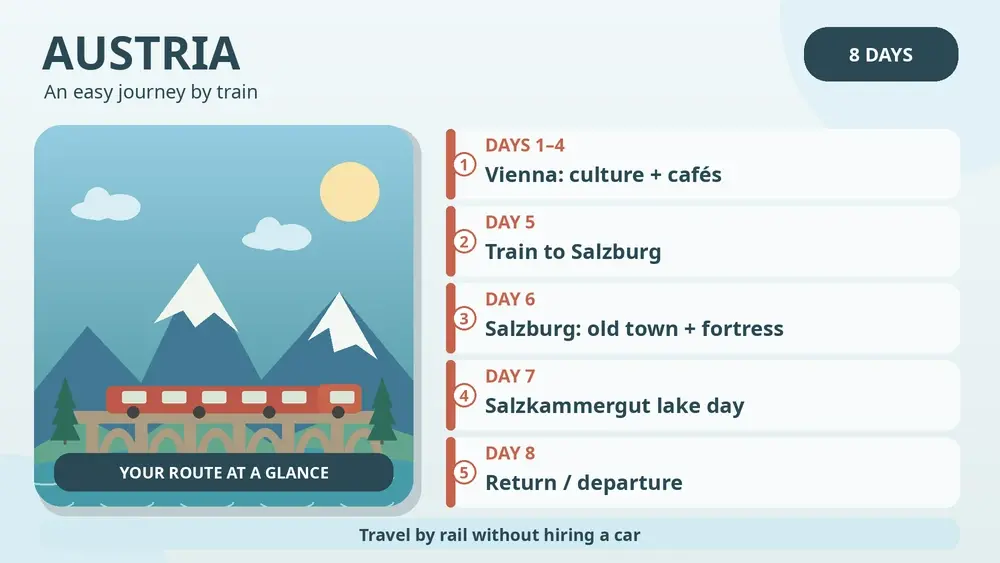
    Illustrated rail itinerary for Vienna, Salzburg and the Salzkammergut

    Families may prefer the outdoor space at Schönbrunn, while art-focused travellers may spend longer at Belvedere.

    Day 4: Vienna with fewer monuments

    Use markets, neighbourhoods, the Prater, Danube areas or a second museum according to your interests. The objective is to see how Vienna works beyond imperial interiors.

    This flexible day also absorbs any attraction you could not book earlier.

    Day 5: Train to Salzburg

    A direct train turns this into an easy transfer. Arrive, leave bags and walk the old town rather than scheduling a formal excursion.

    Salzburg’s scale is a relief after Vienna, so use the change in pace rather than filling it immediately.

    Day 6: Salzburg

    Combine the fortress area with the old town, river and one music-related sight. If you are a serious Mozart enthusiast, plan accordingly; everyone else should avoid making every hour Mozart-themed simply because the city is famous for him.

    Walk to a viewpoint if weather is good, but do not force a steep climb when clouds erase the view.

    Day 7: Salzkammergut

    Choose one route. Hallstatt is famous but can be busy; Wolfgangsee or other lake areas may offer a calmer experience. Public transport is feasible, but connections need to be read as a chain rather than a single train.

    Leave early, protect the final return connection and remember that mountain/lake weather can differ from Salzburg.

    Day 8: Flexible finish

    If your flight is later, use the morning for a final Salzburg walk or café. If departing from Vienna, calculate the rail transfer with a generous flight buffer rather than relying on the theoretical fastest connection.

    Where to stay and how many hotel changes to make

    In Vienna, a hotel near a useful U-Bahn line can be better value than one inside the Innere Stadt. Check air conditioning if travelling during a hot spell and check lift access in older buildings.

    In Salzburg, staying near the old town or between the station and centre can simplify both the lake day and your onward journey.

    Two hotels in eight days keeps the trip calm. A one-night Hallstatt stay is worthwhile only if being there after day-trippers leave is one of your main goals.

    Transport: what is worth booking in advance

    Book long-distance trains early if you want the best fares, but do not make every local segment rigid. Vienna’s urban network and Salzburg buses are easy to use day by day. For live intercity schedules and tickets, use ÖBB rather than relying on an old timetable in a travel article.

    For the Salzkammergut, plan the exact route the night before because a journey may combine train, bus and boat. A missed connection can matter more late in the day.

    A car becomes useful for remote lakes or multi-stop countryside routes, not for Vienna and Salzburg themselves.

    Food and daily rhythm

    Vienna’s cafés are part of the city’s social history, so build one into the day without treating it as a race for the most famous address. Salzburg also rewards simple Austrian meals, bakeries and beer halls beyond the tourist centre.

    Reservations can help for popular restaurants, but lunch often gives more flexibility and better value than trying to reserve every dinner.

    Families, children and older travellers

    Children need fewer interiors than adults often plan. Alternate palaces and museums with parks, river walks, fortress funiculars or lakes.

    Older travellers benefit from excellent public transport but should still check walking distances inside large complexes. A palace “visit” can involve far more steps than the map implies.

    Rail-based travel reduces the stress of parking and navigation, which makes this route especially suitable for multigenerational groups.

    Budget: where the money really goes

    Austria is not a bargain destination, but transport and sightseeing can be controlled. Compare city passes only against attractions you genuinely plan to enter.

    The biggest savings often come from booking trains and hotels early, using public transport and choosing one paid cultural highlight per day rather than several.

    Lake-region excursions can become expensive if you combine multiple boats, mountain lifts and transfers. Decide what the main experience is before buying every add-on.

    Best time to go

    Spring and autumn are excellent for cities, while summer offers long daylight and lake activity but can be busy and hot. Winter changes the trip completely with Christmas markets, shorter days and possible snow.

    Mountain weather is more variable than city weather. A clear Vienna forecast does not guarantee lake views two days later.

    If Hallstatt is central to your plan, shoulder-season weekdays can be more comfortable than peak summer weekends.

    Small Austria decisions that save more time than they cost

    Vienna and Salzburg both reward choosing accommodation around how you will actually move. A hotel that is fifteen minutes farther from the postcard centre but two minutes from a useful U-Bahn or tram can save more energy across four days than a central room reached through crowded pedestrian streets with luggage. In Salzburg, station access matters more if your Salzkammergut day starts early.

    It is also worth deciding in advance what kind of cultural traveller you are. If art museums are a priority, protect half-days for them. If music is the reason for the trip, spend on one performance you genuinely want rather than buying several generic concert packages. If cafés, parks and architecture matter most, do not let a city pass pressure you into paid interiors simply to “get value”.

    For the lake day, build a Plan A and Plan B. Clear weather may justify a boat ride, panoramic lift or longer lakeside walk; rain may make a compact town, spa, museum or shorter route the better choice. Having two versions keeps the day enjoyable without feeling that poor visibility has ruined an expensive excursion.

    Mistakes that make this trip harder than it needs to be

    • Adding Innsbruck, Graz and Hallstatt overnights to an eight-day first trip.
    • Renting a car for Vienna and Salzburg.
    • Treating Hallstatt as mandatory even when weather and crowds make another lake more appealing.
    • Scheduling two major Vienna museums back-to-back every day.
    • Ignoring the last bus/train connection from a lake region.
    • Booking an evening event without checking the programme and seat category.

    How I would adapt the itinerary

    With five days, stay only in Vienna or split 3/2 with Salzburg. With ten or twelve, add Innsbruck or a second lake-region base rather than turning the original eight days into a faster itinerary.

    Travellers who prefer nature can reverse the balance—fewer Vienna nights, more Salzburg/lakes—but should still keep only two or three bases.

    Before booking the trip

    • Compare Vienna hotel location by transit line, not only distance from St Stephen’s Cathedral.
    • Check direct-train fares before your dates fill.
    • Plan one Salzkammergut route and confirm the final return connection.
    • Reserve major palace or concert experiences only where necessary.
    • Leave airport-transfer time that does not depend on a perfect train connection.

    Austria by train works because you can remove an entire layer of logistics. With Vienna and Salzburg as stable bases, the trip gains enough structure to be easy and enough free time to feel like a holiday.

  • Tokyo for First-Time Visitors: A 5-Day Plan That Makes the City Feel Manageable

    Tokyo for First-Time Visitors: A 5-Day Plan That Makes the City Feel Manageable

    Tokyo feels intimidating before arrival because its rail map is dense and its neighbourhood names arrive all at once. Once you stop trying to understand the entire network and plan one or two connected districts per day, the city becomes surprisingly manageable. Shibuya, Shinjuku, Asakusa, Ueno, Ginza and the bay area each offer enough to justify focused time.

    This five-day plan is designed for a first visit that mixes modern Tokyo, traditional districts, food, parks and observation points. It assumes you will use trains and subways extensively but avoids unnecessary cross-city zigzags. The official GO TOKYO and Tokyo Metro resources are especially useful because service details and ticket products can change over time.

    Quick trip summary

    • Stay near a useful station, but choose the neighbourhood atmosphere you want at night.
    • Use an IC card or appropriate pass according to your journeys rather than buying every tourist pass automatically.
    • Group districts: Shibuya/Harajuku, Asakusa/Ueno and Tokyo Station/Ginza pair naturally.
    • Expect a surprising amount of walking inside stations and between platforms.
    • Leave space for food, shopping and small discoveries; Tokyo rewards unstructured neighbourhood time.

    How many days do you really need?

    For Tokyo for First-Time Visitors, the itinerary below is a starting structure rather than a contract. The number of useful days depends on arrival time, jet lag, season, mobility and how strongly you prefer museums, food, nightlife or outdoor time. If your first or last day is mostly a flight day, do not count it as a full sightseeing day. This guide to building realistic itineraries explains why transfer and arrival days need their own category.

    A reliable rule is to identify the two experiences you would genuinely regret missing, then protect time around them. Everything else should remain adjustable. That prevents a delayed train, rainstorm or tired child from turning the whole trip into a sequence of missed reservations.

    Where to stay: choose logistics before decoration

    The best neighbourhood is the one that supports the trip you actually plan to take. Look at the first journey of the morning, the final journey at night, airport access, restaurant options, hills or stairs and how easy it will be to return for a midday break. A beautiful hotel becomes less attractive if reaching it requires an awkward transfer every day.

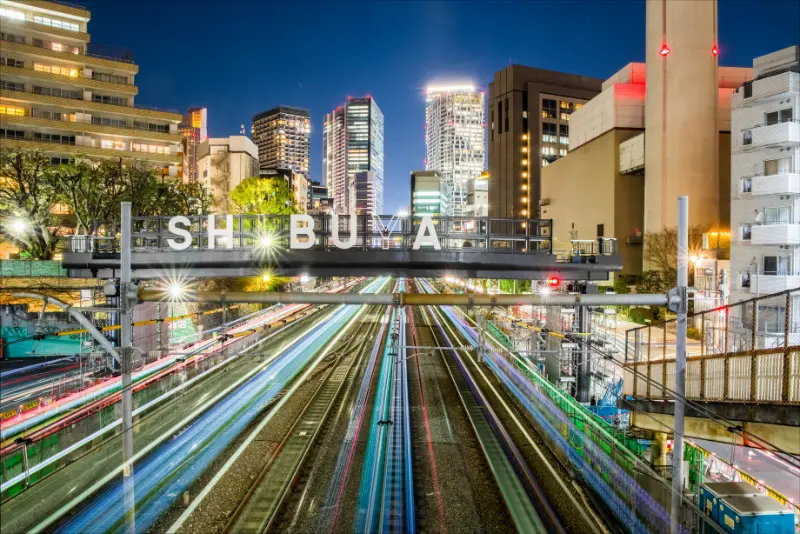
    Crowded Tokyo Shibuya Shopping Street
    AreaWhy it works — and the trade-off
    ShinjukuExcellent transport and a huge range of hotels, food and nightlife. Major stations are very large, so learn the exact exit closest to your hotel.
    ShibuyaIdeal for modern Tokyo, shopping and evening energy. It is convenient but busy, especially around the famous crossing.
    Ueno / AsakusaGood for a more traditional atmosphere, museums and easier access to the east side. Some travellers find it calmer than Shinjuku.
    Tokyo Station / GinzaCentral, polished and extremely convenient for rail connections. Accommodation can be expensive, but it simplifies day trips and onward travel.

    A realistic day-by-day plan

    Day 1: Shibuya and Harajuku

    Begin with Shibuya as an orientation to modern Tokyo. The crossing is only one moment; the surrounding streets, viewpoints, department stores and food halls can fill several hours.

    Walk or ride toward Harajuku and Meiji Jingu. The contrast between commercial streets and the shrine grounds gives the day variety without a long transfer.

    Finish in Shibuya or Omotesando. Avoid adding Shinjuku just because it is nearby on the rail map; it deserves a separate evening or day.

    Day 2: Asakusa, Ueno and old Tokyo contrasts

    Start around Senso-ji and the streets of Asakusa. Earlier hours can be calmer, and the district is enjoyable beyond the temple itself.

    Continue toward Ueno for the park, museums or Ameyoko depending on your interests. Choose one museum if you want indoor time.

    A river or Skytree-area detour is optional. The day is already complete without it, which helps families and travellers sensitive to long walking days.

    Day 3: Tokyo Station, Imperial Palace edge and Ginza

    Explore Marunouchi and the Tokyo Station area, then walk part of the Imperial Palace perimeter or gardens according to access and opening information.

    Continue to Ginza for architecture, shops and food. This is a good day to use department-store basements for an easy lunch or picnic-style dinner selection.

    If you want a traditional performance or special dinner, this central location works well for a reserved evening.

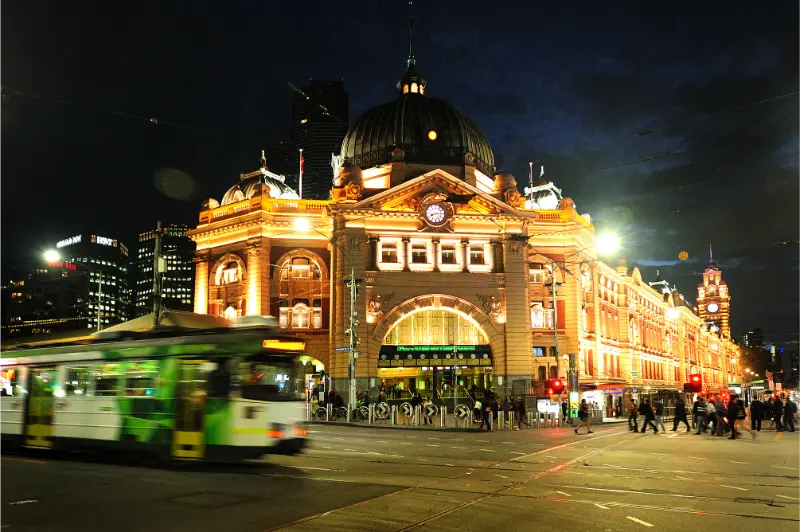
    Tokyo Station’s illuminated red-brick Marunouchi building

    Day 4: Shinjuku and your chosen Tokyo subculture

    Use Shinjuku for viewpoints, gardens, shopping or entertainment. The station is a destination in logistical terms, so note exit numbers and landmarks before you arrive.

    Add a focused interest: Nakano for pop culture, Kichijoji for a neighbourhood feel, or another western district. Do not try to combine all of them.

    Keep the evening flexible. Shinjuku after dark feels different enough that staying in the same area is not repetitive.

    Day 5: Odaiba, teamLab-style experience or a day trip decision

    Use the last day for Tokyo Bay, a booked immersive attraction, Toyosu/Tsukiji food areas or a short day trip. The correct choice depends on the rest of your Japan itinerary.

    If you are leaving Tokyo the next morning, avoid a distant excursion that returns late and complicates packing.

    Tokyo always leaves unfinished possibilities. A good first trip accepts that rather than trying to eliminate it.

    Pace check: if the morning takes longer than expected, remove the lowest-priority stop rather than compressing meals and transport. A good itinerary should become simpler under pressure, not more frantic.

    Getting around without wasting the day

    Tokyo’s transport system involves multiple operators, but travellers do not need to master every company. GO TOKYO recommends prepaid IC cards, travel passes or individual tickets depending on the journey, while Tokyo Metro provides multilingual guidance, station numbering and tourist information. Station numbers are particularly useful when pronunciation or similar names feel confusing. Large stations can add ten to twenty minutes between arriving on a train and reaching the correct street exit, so build this hidden time into reservations.

    When comparing routes, use door-to-door time rather than the minutes shown for the train, Metro or taxi itself. Walking to the platform, waiting, transfers, finding the correct exit and reaching the attraction can easily double a “short” journey. Travellers with luggage, a stroller or limited mobility should prioritize fewer transfers even when the route is slightly longer on paper.

    Food strategy: protect the trip, not just the restaurant list

    Tokyo makes spontaneous eating easy if you are comfortable choosing from what you see. Department stores, station buildings, small noodle shops, sushi counters, bakeries and convenience stores all solve different travel problems. Reserve only experiences that matter, because overbooking restaurants can make sightseeing rigid. Families can use food halls to let everyone choose something different; travellers with dietary restrictions should research key phrases and suitable chains before arrival.

    Bowls and plates of assorted food on a shared table

    A useful rhythm is one planned meal and one flexible meal per day. This gives you a reason to explore but still lets the itinerary respond to hunger, weather and energy. Keep a backup option near the hotel for the evening when everyone is too tired to cross the city for a reservation that seemed exciting months earlier.

    When to go and how the season changes the itinerary

    Spring cherry-blossom periods and autumn foliage are famous, but they also increase demand in popular areas. Summer is hot and humid, requiring a slower pace and more indoor breaks. Winter is generally cooler and can offer clear days, while rainy periods require flexible outdoor planning. Tokyo’s density makes weather adaptation easy: shopping complexes, museums and underground connections can replace exposed walking without abandoning the district.

    Instead of asking only for the “best month,” decide which compromise you prefer: better weather, smaller crowds, longer daylight, lower prices or a particular event. No season maximizes all five. The itinerary should change with daylight and temperature, especially when major parts of the day are outdoors.

    Budget: where spending makes the biggest difference

    Tokyo can be less expensive day-to-day than some travellers expect because excellent casual food and public transport are widely available, while hotels and long-distance rail can be major costs. Evaluate rail passes against your actual route; a pass is not automatically a bargain. A well-located smaller room may be a better trade than a larger hotel requiring multiple transfers. Use our itinerary-building guide if Tokyo is part of a longer Japan trip.

    The smartest upgrades are usually the ones that buy time or remove friction: a better-located hotel, a direct airport transfer after an overnight flight, a timed ticket that prevents a wasted queue or a taxi at the end of an exhausting day. Cut costs on low-value extras before cutting the parts that make the route workable.

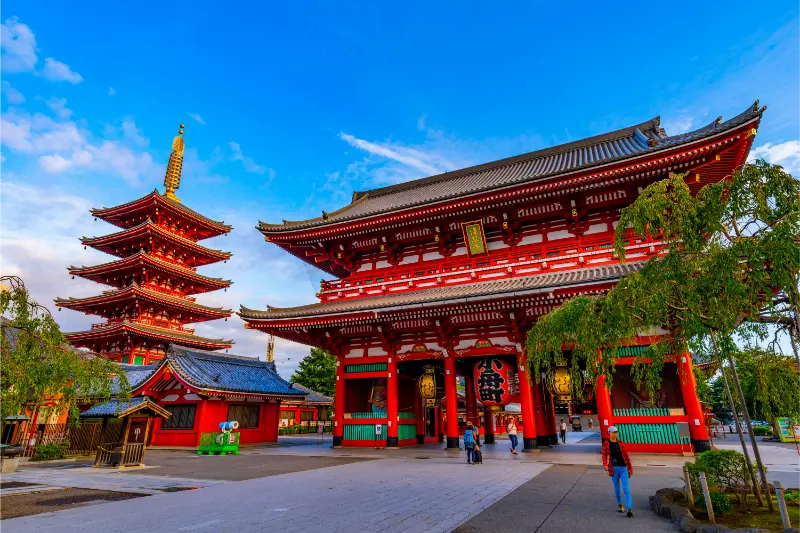
    Sensoji Temple Pagoda And Hozomon Gate Asakusa Tokyo Japan

    Common mistakes that make the trip harder

    • Trying to understand the entire rail network before arrival instead of learning the lines you actually need.
    • Planning Shibuya, Asakusa, Odaiba and Shinjuku in one day simply because trains are fast.
    • Underestimating the walking inside major stations and shopping complexes.
    • Buying a transport pass without comparing it with the journeys you will really take.
    • Filling every evening with reservations and leaving no room for Tokyo’s spontaneous food and neighbourhood discoveries.

    None of these mistakes is catastrophic, but several together can make a trip feel much more tiring than necessary. The solution is usually to remove one commitment, shorten one transfer or move one attraction to a future visit.

    Families, older travellers and mixed-age groups

    Tokyo is highly workable for families, but rush-hour trains, large stations and long transfers can be tiring with small children. Travel outside peak commuter periods when possible and keep one simple activity after a major attraction. Older travellers should choose hotels with straightforward station access and use station elevators when available rather than following the shortest stair-heavy route. Luggage forwarding can also simplify multi-city Japan journeys.

    For mixed-age groups, decide in advance which experiences are “everyone together” moments and which are optional. It is often better to split for two hours and meet for lunch than to force every traveller through an activity that only part of the group enjoys. Build seating, toilets, shade and simple transport into the plan with the same seriousness as the famous sights.

    Useful official resources

    Opening hours, transport rules, closures and visitor procedures can change. Before the trip, confirm the details that affect your dates through official sources rather than relying only on an old screenshot or social-media post.

    Final planning checklist

    • Confirm entry requirements and travel documents for your nationality and transit route.
    • Book only the scarce or high-priority attractions first; keep lower-priority activities flexible.
    • Check the exact door-to-door route from your accommodation to the first two morning activities.
    • Save offline copies of essential bookings and the hotel address.
    • Build a weather alternative for at least one half-day.
    • Leave a realistic buffer before flights, long-distance trains and non-refundable reservations.
    • Pack for the walking and climate the itinerary actually involves, not only for photographs.
    • Recheck official transport and attraction information shortly before travel.

    The best first visit is not the one that proves you saw everything. It is the one that gives you a clear sense of place, enough energy to notice what is around you and at least one reason to come back. Use this itinerary as a framework, then remove anything that does not match your own interests, mobility or travel rhythm.
  • Hong Kong in 6 Days: City, Islands and Hiking Without Changing Hotels

    Hong Kong in 6 Days: City, Islands and Hiking Without Changing Hotels

    Hong Kong is one of the rare destinations where a six-day trip can move from dense high-rise neighbourhoods to beaches and hiking trails without changing hotels. The mistake is spending every day underground in the MTR between shopping districts.

    This itinerary keeps one base and uses ferries, MTR, buses and walking to create very different days: Hong Kong Island, Kowloon, a car-free island, and one outdoor escape around Sai Kung or Dragon’s Back.

    The official Hong Kong Tourism Board transport guide describes Octopus as an essential travel card for major public transport and many everyday purchases. The same tourism board emphasises how quickly ferries and MTR can connect the city to islands and trails.

    Quick trip summary

    • Keep one hotel for all 6 days.
    • Use Octopus and public transport instead of taxis for most journeys.
    • Choose one island day: Lamma or Cheung Chau are easy first options.
    • Choose one outdoor day and move it according to weather.
    • Do not add Macau unless you genuinely want to sacrifice a Hong Kong day.

    Why this route works

    One hotel is a major advantage. Hong Kong’s transport lets you move between districts quickly while your luggage stays put.

    An island day prevents the trip from becoming six days of malls, markets and skylines. Official tourism information notes ferries from Central can reach Lamma in about 30 minutes and Cheung Chau in about 35 minutes.

    An outdoor day shows another side of Hong Kong. Trails such as Dragon’s Back or the High Island area are close enough to the city to fit naturally into a short visit.

    A realistic itinerary at a glance

    DaysBaseMain focus
    1–2Hong Kong Island / Kowloon baseHarbour, Central, old neighbourhoods
    3KowloonMarkets, museums and local districts
    4Outlying islandLamma or Cheung Chau
    5Outdoor dayDragon’s Back or Sai Kung/High Island
    6Flexible city dayWeather buffer and departure

    Day-by-day plan

    Day 1: Harbour orientation

    Use the Star Ferry and harbourfront as your introduction rather than disappearing immediately into shopping malls. See the skyline from both sides and stop when travel fatigue catches up.

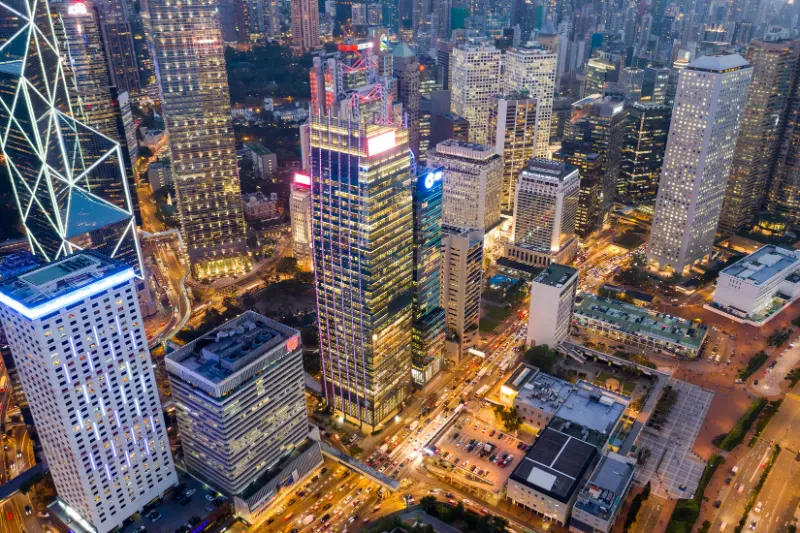
    Hong Kong Victoria Harbour Skyline At Night

    Day 2: Hong Kong Island

    Build the day around Central, Sheung Wan and one hillside/viewpoint experience. Use trams or MTR to reduce uphill walking, especially in heat and humidity.

    Day 3: Kowloon

    Choose a museum, Sham Shui Po, Mong Kok or another neighbourhood cluster and move north gradually. Night markets are more enjoyable when they are not the sixth stop of an exhausting day.

    Day 4: Lamma or Cheung Chau

    Take an early ferry from Central. Lamma works well for a paved cross-island walk and seafood; Cheung Chau offers compact village streets, beaches and easy cycling/walking. Choose one island, not both.

    Day 5: Outdoor Hong Kong

    Choose Dragon’s Back for an accessible ridge-and-beach day or Sai Kung/High Island for geology and more transport logistics. Start early in warm months and check current trail/access notices.

    Day 6: Flexible city day

    Use the last day for what weather blocked earlier: Victoria Peak, museum time, shopping, another neighbourhood or a slow dim sum meal. Keep the airport transfer uncomplicated.

    Where to stay and how many hotel changes to make

    Central/Sheung Wan are excellent for ferries and urban access but can be expensive and hilly.

    Tsim Sha Tsui is convenient for harbour views and Kowloon exploration; Jordan/Yau Ma Tei can offer a more local feel and good MTR access.

    Choose the hotel by MTR proximity and room practicality rather than only by skyline photographs; Hong Kong rooms can be compact.

    On a multi-base trip, location usually matters more than a small difference in room price. A hotel that removes two daily transfers can save more energy than a nicer room on the wrong side of town.

    Hong Kong Victoria Harbour At Night

    Read recent reviews for the practical details that booking photos rarely show: stairs, lift size, street noise, parking access, breakfast hours and the final walk from public transport.

    Transport: what is worth planning in advance

    Octopus is the easiest default for MTR, buses, ferries and many small purchases.

    The Airport Express is fast, but compare it with bus/taxi options for your exact hotel and group size.

    For hiking days, save the return route and last practical bus/ferry details before leaving urban coverage.

    Judge every move door to door rather than by the timetable alone. Checkout, reaching the terminal, waiting, luggage and the final connection to the next hotel can turn a short headline journey into half a day.

    Book the inflexible ticket only when the savings are meaningful and the day is genuinely fixed. Weather-sensitive activities and remote transfers need room to move.

    Food and daily rhythm

    Dim sum, cha chaan teng breakfasts, roast meats, noodles and neighbourhood bakeries should be spread through the trip rather than compressed into a food tour.

    Queues can be part of famous restaurants; a very good local alternative nearby is often a better use of a short holiday.

    Use meals to control the rhythm of the day. A long local lunch can be an experience and a recovery period, especially after exposed archaeological sites, mountain walks or early starts.

    Do not turn every meal into another attraction. Mix regional specialties with simple food, particularly on transfer days when everyone is already tired.

    Families, children and older travellers

    Ferries, trams and islands are often more memorable for children than observation decks.

    Older travellers can use MTR lifts, taxis and the Mid-Levels system to reduce steep walking, but station corridors can still be long.

    In summer heat, an indoor museum or long lunch is a legitimate midday plan.

    For multigenerational travel, the useful pace is the one at which the least mobile person still enjoys the day. That normally produces a better experience for everyone else too.

    Hong Kong Traditional Fishing Village Waterfront

    Children often respond better to changes of format than to more attractions: a beach after a museum, a boat after a city walk, or wildlife after a long drive.

    Budget: where the money really goes

    Hotels are the biggest expense; public transport is efficient enough that paying more for location can still be worthwhile.

    Viewpoints, ferries and neighbourhood walks provide excellent value compared with filling every day with ticketed attractions.

    Compare total cost instead of headline prices. A cheaper room can become more expensive after transfers, parking, meals and the time lost reaching it.

    The best splurges are usually the ones that remove friction: a central hotel, a reliable private transfer, a direct train, a guide where context matters or one extra night that prevents an exhausting move.

    Best time to go

    Autumn and cooler winter periods are comfortable for walking, while summer is hot, humid and affected by heavy rain/typhoon conditions.

    Outdoor plans should move around the forecast. Never force a ridge hike during unsafe weather.

    Shoulder season can offer a good balance between weather, demand and comfort, but some boats, mountain services and seasonal restaurants may run less frequently.

    Heat, rain, snow, wind and daylight should change the order of your day. Use the most comfortable hours for exposed outdoor sights and keep indoor or low-effort alternatives available.

    Comfort, accessibility and realistic pacing

    One hotel eliminates packing and lets the itinerary react quickly to weather.

    Alternate urban and outdoor days so that heat, crowds and long station walks do not accumulate.

    Travel fatigue accumulates. One difficult transfer can reduce the quality of the next two days, which is why this itinerary avoids one-night bases unless geography genuinely requires them.

    A free half-day is not wasted time. It is insurance for weather, laundry, a delayed journey, a child who needs rest or a place you discover only after arriving.

    Small decisions that improve the trip

    Use one base

    Hong Kong’s transport network removes almost every reason to change hotels.

    Hong Kong Skyline With Illuminated Bridge

    Choose one island

    A full island day feels slower and more local than collecting ferry terminals.

    Keep the hike flexible

    Weather and heat should decide which day you go.

    Skip Macau if Hong Kong itself is the priority

    A border-crossing day has a real opportunity cost on a six-day trip.

    What I would leave out on this length of trip

    Leave Disneyland, Ocean Park or Macau out unless they are genuinely important to your group.

    Skip trying to see every famous market; choose neighbourhoods with a reason to be there.

    Mistakes that make this trip harder than it needs to be

    • Spending six days only in Central, Tsim Sha Tsui and malls.
    • Underestimating summer heat on hiking trails.
    • Forgetting that MTR stations can involve long internal walks.
    • Taking an island ferry without checking return frequency.
    • Booking a hotel far from MTR to save a small amount.
    • Using the final day for a complicated cross-boundary excursion.

    How I would adapt the itinerary

    With three days, focus on harbour, Hong Kong Island and Kowloon.

    With eight days, add both an island and Sai Kung day plus one low-key neighbourhood day.

    Before booking

    • Get Octopus or set up a visitor-compatible mobile option.
    • Check weather before hiking.
    • Save ferry schedules.
    • Choose a hotel close to MTR.
    • Keep a rain/typhoon alternative.

    Practical questions

    Do I need a car?

    No. Public transport is one of Hong Kong’s biggest advantages.

    Lamma or Cheung Chau?

    Lamma suits a simple walk-and-seafood day; Cheung Chau feels more compact and beach/village focused.

    Is six days too long?

    No. Once you include islands and outdoors, six days feels balanced rather than excessive.

    Final thoughts

    Hong Kong becomes a much richer destination when the skyline is only one part of the trip.

    Six days with one hotel can contain ferries, food, neighbourhoods, beaches and hiking without the logistical cost of changing bases.

  • Osaka in 4 Days: Food, Castle District and Neighbourhoods Without Treating It as a Kyoto Add-On

    Osaka in 4 Days: Food, Castle District and Neighbourhoods Without Treating It as a Kyoto Add-On

    Osaka deserves a trip built around geography and real travel time rather than a checklist. Osaka is often reduced to one evening of food between Kyoto and another city, but it becomes much more rewarding when you give its neighbourhoods, riverfronts and different urban centres time to develop. Four days is enough for Namba, the castle area, Umeda and one flexible outer-city or day-trip block without repeating long rail journeys.

    If this destination is part of a longer journey, compare the pacing with Japan Beyond Tokyo in 10 Days: Kyoto, Nara, Hiroshima and Osaka Without Constant Packing. The useful question is not how many famous names fit on the map, but how much usable holiday time remains after transfers, check-in, meals, weather and rest.

    Quick trip summary

    • Recommended time: 4 days.
    • Best planning principle: group each day by geography and protect only the reservations that control access.
    • Best for: independent travellers, couples, families and slower-paced visitors who prefer a realistic rhythm.
    • Keep flexible: at least one half-day or one major activity that can move with weather, traffic or energy.
    • Book first: the accommodation location, scarce transport and any permit, timed entry or signature experience that shapes the rest of the trip.

    Is Osaka the right trip for you?

    Osaka works well for travellers who enjoy food, urban energy, shopping, casual nightlife and efficient public transport. Families can build around aquariums, parks and observation decks, while slower-paced visitors benefit from elevators and dense rail coverage. The city is less about one monumental list and more about contrasting districts.

    The practical test is simple: decide what would make you disappointed if you missed it, then build the trip around that one or two priorities. Everything else should earn its place by fitting the same area of the day. This is especially important when travelling with children, older relatives or anyone who enjoys a slower pace.

    Where to stay: choose location before hotel style

    BaseWhy choose it
    Namba / ShinsaibashiBest for food, nightlife and first-time atmosphere with strong transport connections.
    Umeda / Osaka StationBest for regional rail, department stores and day trips to Kyoto, Kobe or Himeji.
    TennojiBest for a slightly calmer base with good transport and access to southern districts.

    A more attractive room is not always a better travel decision. Before booking, map the first activity of the morning, the likely dinner area and the departure route. If the hotel adds two unnecessary transfers every day, the hidden cost is time as well as money.

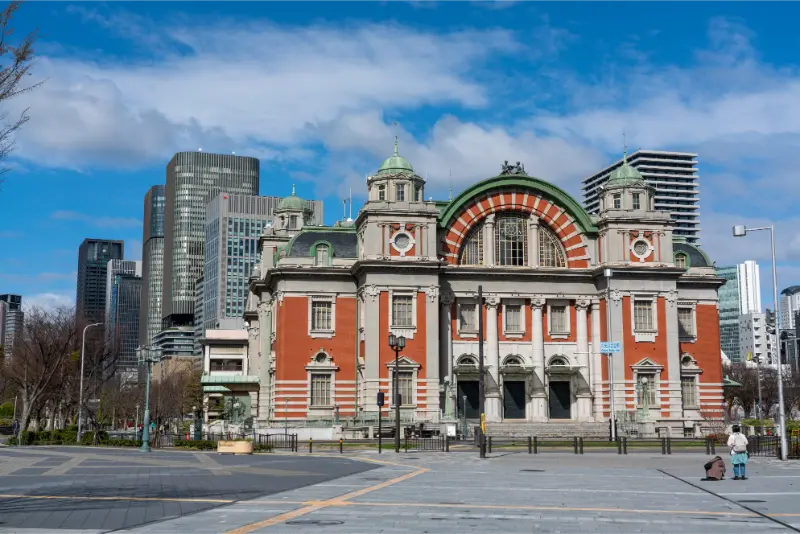
    Osaka Central Public Hall Historic Building

    A realistic 4-day itinerary

    Day 1: Namba, Dotonbori and Shinsaibashi

    Start with the southern centre, markets and canal area, but do not spend the entire day under neon signs. Add Hozenji, side streets and a slower meal, then return after dark when the district changes character.

    Day 2: Osaka Castle, riverside and central districts

    Visit the castle park and decide whether the interior is important to you, then continue through nearby riverside or museum areas. Finish in a different central district instead of returning immediately to Namba.

    Day 3: Umeda, north Osaka and city views

    Explore Osaka Station City, Umeda and one observation deck or cultural site. The northern centre has a different rhythm from Namba and deserves its own half-day or more.

    Day 4: bay area, Shinsekai or one regional day trip

    Choose based on interests: aquarium and bay area, Shinsekai and Tennoji, or one simple excursion such as Kobe. If Kyoto is already part of your wider trip, resist using Osaka days to commute back there repeatedly.

    How to move around without wasting the day

    Osaka has several rail and metro operators, so route apps are extremely useful. Choose the fastest practical route rather than insisting on one pass or one company. Walking inside large stations can add significant time, so allow extra minutes for platform changes and exits.

    Do not judge a journey only by kilometres. A short distance can include traffic, security, parking, boat boarding, luggage handling or a long final walk. For every important transfer, think in door-to-door time and keep a margin before anything expensive or difficult to replace.

    Best time to visit

    Spring and autumn are comfortable for walking, summer is hot and humid, and winter is cool but generally manageable. Rainy periods are easy to adapt because Osaka has extensive indoor shopping, stations and food areas. In peak blossom or holiday periods, expect heavier demand.

    Seasonal advice should guide the style of the trip, not become a promise. Climate averages cannot tell you the exact conditions on your dates. Check the local forecast and any official closure, transport or safety notice again shortly before each weather-sensitive day.

    What to book first

    Reserve the hotel first and any high-demand themed attraction, observation experience or restaurant that truly requires it. Most ordinary food exploration should remain spontaneous. If using Osaka as a regional base, book only the day trips that have a real capacity or timing constraint.

    Osaka Castle Moat And Stone Walls Japan

    After those anchors are secure, leave ordinary meals, short walks and secondary sights open. A timetable with every hour reserved is fragile: one delay turns the rest of the day into a sequence of apologies and missed slots.

    Food strategy: eat well without scheduling every meal

    Osaka is a place to eat often but not necessarily formally. Build the day around neighbourhoods with multiple choices and share smaller dishes when possible. Avoid spending an hour crossing the city for one famous stall when excellent alternatives exist in the district you are already visiting.

    For a multi-age group, a reliable breakfast and an easy lunch often matter more than one additional attraction. Keep water accessible, avoid waiting until everyone is exhausted to look for food and use meal stops as genuine rest rather than another item to complete quickly.

    Travelling with children

    Aquariums, trains, observation decks, parks and casual food make Osaka easy for children. Big stations can be overwhelming, so keep meeting points clear and avoid excessive transfers with tired children. Use department-store food floors for simple meal options when everyone wants something different.

    Children do not need a simplified version of every adult attraction. They usually need a different rhythm: movement, shade, snacks, toilets and periods when nobody is asking them to pay attention. Protect those needs and the whole group usually sees more, not less.

    Travelling at a slower pace or as a senior

    Stay near a major station with lifts and direct lines, and use rail to reduce unnecessary walking. Stations themselves are large, so a hotel described as five minutes from a station may still involve long internal walking. Schedule one major district per half-day.

    When mobility or stamina is limited, reduce transitions before reducing experiences. One well-located base, a direct transfer and a shorter route often preserve the most memorable parts of a trip far better than trying to keep the original schedule with longer rest stops.

    Budget: where the money really goes

    Transport is efficient but multiple short journeys can accumulate. Compare individual fares with passes only after your route is known. Food can range from inexpensive casual meals to high-end dining, so the city is easy to adapt to different budgets without sacrificing local character.

    Track the total cost of each planning choice. A lower hotel rate can be false economy after taxis, parking or long transfers, while a more expensive excursion may be reasonable if it replaces a rental car, guide and separate admission fees. Compare complete days rather than isolated prices.

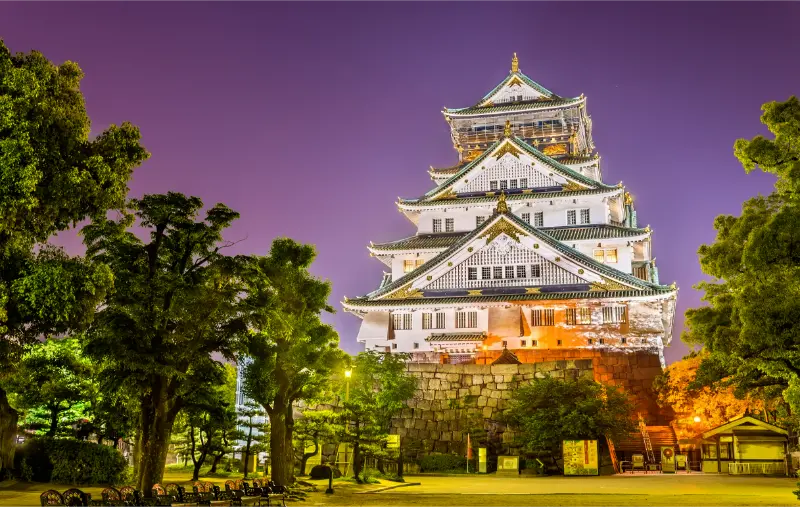
    Osaka Castle Illuminated At Night Osaka Japan

    Weather fallback plan

    Rain is rarely a reason to lose a day because stations, arcades, malls and museums provide strong indoor alternatives. In summer, move between air-conditioned stops and protect the middle of the day from long exposed walks.

    The useful fallback is not a list of random indoor attractions. It is one realistic substitute that fits the same area or preserves the next day. Keep at least one activity movable so a poor forecast does not force you to choose between losing money and doing something unsafe.

    Connectivity, cash and small practical details

    Use a transport card or mobile option where compatible, keep cash for smaller venues and save the Japanese name or map pin of your hotel. Large station complexes have multiple exits, so follow the exit number rather than only the station name.

    Save hotel addresses, tickets, permits, insurance details and the next transfer outside your email app. Offline access matters most precisely when the network is weak, your battery is low or you are trying to solve a delay.

    What to pack

    Comfortable walking shoes, a small umbrella, breathable clothing in warm months and a light layer in winter are enough for most city days. Leave luggage compact if travelling onward by train.

    A small day bag should hold water, medication, sun or rain protection and the layer you are most likely to need. The goal is not to carry everything; it is to avoid having the useful items locked in a suitcase or parked car when conditions change.

    Common mistakes to avoid

    • Treating Osaka as only a dinner stop from Kyoto.
    • Crossing the city for one viral food stall.
    • Underestimating walking time inside Umeda and Namba stations.
    • Buying an expensive transport pass without checking the actual journeys.
    • Scheduling several distant day trips and never seeing Osaka beyond the station areas.

    Responsible travel and local etiquette

    Queue neatly, keep station pathways clear and follow local rules for eating and waste. In residential streets, avoid loud late-night behaviour and treat small food businesses as working spaces rather than photo sets.

    The best rule is to treat the destination as a real place rather than a stage built for visitors. Follow staff and ranger instructions, respect residential space and protected environments, and spend with businesses that add genuine local value instead of rewarding the most aggressive sales pitch.

    If you have less or more time

    With two days, focus on Namba and one castle/Umeda day. Three days adds Tennoji, Shinsekai or the bay area. With five days, add one regional excursion while keeping at least three full days for Osaka itself.

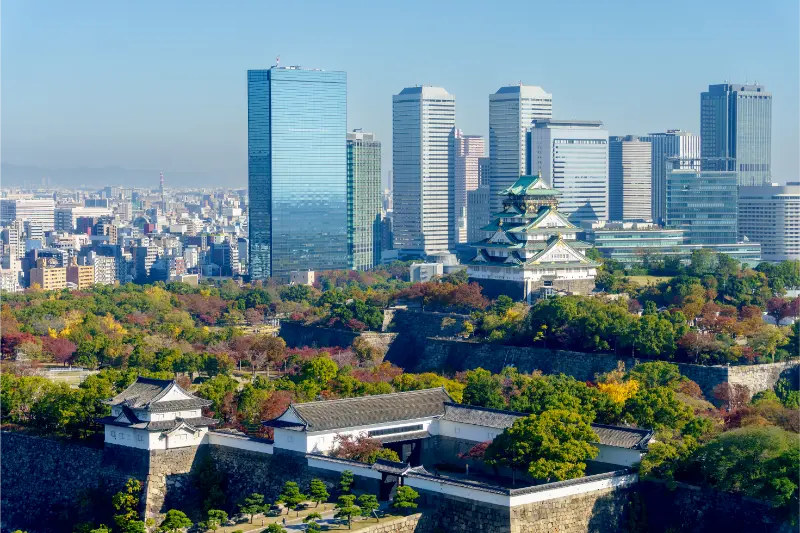
    Osaka Castle And Osaka Business Park Towers Japan

    Extra days are most useful when they reduce pressure. Before adding another distant stop, ask whether the trip improves more by sleeping in the same place, repeating a favourite beach or neighbourhood, waiting for better weather or enjoying a late breakfast without watching the clock.

    How to choose between similar experiences

    Choose Kobe for an easy urban-and-harbour excursion, Himeji for a major historic castle, and the Osaka bay area for a low-logistics family day. If Kyoto is already on the main itinerary, another Osaka neighbourhood often adds more variety than a repeat commute.

    When two options offer a similar experience, choose the one that fits the geography and energy of the day. The extra hour of transfer rarely creates an extra hour of enjoyment, especially in heat, traffic, rough water or at altitude.

    Safety and decision-making on the day

    Osaka is straightforward for most visitors, but crowded stations, nightlife districts and bicycle traffic deserve normal awareness. The bigger practical risk is missing a train or getting separated in large stations, so establish clear meeting points.

    Local warnings, ranger instructions and transport operators have more value than an itinerary written months earlier. Set a practical turnaround time for hikes, drives and water days, and change the plan when conditions deteriorate rather than trying to complete the original checklist.

    Useful official and planning resources

    Opening hours, protected-area rules, transport schedules, fees and visitor procedures change more often than the landscape. Recheck the source below shortly before departure.

    Final planning checklist

    • Confirm passport, visa, transit and health requirements for your nationality.
    • Reserve the transport, permit or timed entry that controls the rest of the itinerary.
    • Check how luggage moves between airport, road transfer, ferry, train or accommodation.
    • Download offline maps and save key tickets outside your email app.
    • Recheck weather, sea, road, trail or park notices before each critical day.
    • Keep at least one half-day that can absorb a delay or become simple rest.
    • Leave a generous buffer before international flights and other costly connections.

    A good trip to Osaka should feel like you understood the place, not merely that you passed through it. Keep the transport anchors fixed, leave room for conditions to change, and remove anything that does not fit your interests, mobility or energy. The result is usually more enjoyable than the most ambitious version of the same route.

  • Taiwan in 10 Days by Train: Taipei, Tainan and Kaohsiung Without Rushing the Island

    Taiwan in 10 Days by Train: Taipei, Tainan and Kaohsiung Without Rushing the Island

    Taiwan is one of the easiest places in Asia to overplan because the transport is so good. A map encourages you to add Taichung, Sun Moon Lake, Alishan and the east coast until a ten-day holiday becomes a sequence of departures.

    This route uses Taipei, Tainan and Kaohsiung. Taipei gets four nights, Tainan slows the pace through history and food, and Kaohsiung provides a more spacious southern finale.

    Taiwan High Speed Rail serves the western corridor from Taipei through Tainan to Zuoying in Kaohsiung. Check the official THSR site for current schedules, fares and pass products.

    Quick trip summary

    • Spend 4 nights Taipei, 3 Tainan and 2 Kaohsiung, with the tenth day for departure.
    • Use high-speed rail for the long north–south moves.
    • Remember that some HSR stations are outside the historic centre.
    • Choose only one substantial Taipei day trip.
    • Build food into the itinerary as a destination.

    Why this route works

    Taipei changes block by block and needs enough time for temples, museums, neighbourhoods, food and one weather-dependent day trip.

    Tainan provides historical depth and rewards slow street exploration rather than a rapid attraction list.

    Kaohsiung feels broader and more open, with harbour areas, art districts and light rail, creating a clear contrast with the capital.

    A realistic itinerary at a glance

    Days Base Main focus
    1–4 Taipei Neighbourhoods, food, museums and one day trip
    5–7 Tainan History, temples and markets
    8–9 Kaohsiung Harbour and southern city life
    10 Departure Southbound flight or return north with buffer

    Day-by-day plan

    Day 1: Taipei arrival

    Stay near the metro and keep the evening to one district, dinner and a short walk.

    Day 2: Historic Taipei

    Choose Longshan Temple and nearby traditional streets or another compact heritage cluster.

    Day 3: Modern Taipei

    Use one major museum/viewpoint plus a contemporary district; cloudy weather does not ruin the city.

    Day 4: One day trip

    Choose one excursion rather than combining several famous stops into a long bus circuit.

    Day 5: HSR to Tainan

    Travel south, then account for the local transfer from the high-speed station to the historic core.

    Day 6: Tainan history

    Use Anping plus one central heritage cluster and protect midday energy in hot weather.

    Day 7: Tainan food and neighbourhoods

    Return to the areas you liked or explore markets and smaller temples instead of adding a long Alishan detour.

    Day 8: Tainan to Kaohsiung

    Choose local or high-speed rail according to hotel locations and spend the first evening around the harbour/Pier-2 area.

    Day 9: Kaohsiung

    Choose one of Lotus Pond, Shoushan, Cijin or another area based on weather and mobility rather than doing everything.

    Day 10: Departure

    If the long-haul flight leaves from Taoyuan near Taipei, position north with enough time to absorb a rail disruption.

    Where to stay and how many hotel changes to make

    Taipei: choose a metro-connected district according to nightlife and sleep priorities. On a short itinerary, this is not a minor detail: a well-located hotel can save several transfers and make evenings feel spontaneous instead of logistical.

    Tainan: central accommodation reduces dependence on taxis, but older buildings may have limited lift access. Recent reviews matter because noise, stairs, lift access and the final walk from public transport can affect comfort more than an extra star on the hotel description.

    Kaohsiung: stay near MRT/light rail and remember Zuoying HSR is not the waterfront centre. For families and older travellers, paying slightly more for a practical location is often better value than compensating every day with taxis and longer walks.

    Transport: what is worth planning in advance

    THSR is best for the long western-corridor moves, but conventional rail may be more convenient for shorter segments. Treat the published journey time as only the moving part of the transfer. Add checkout, station access, luggage handling and the final connection to the hotel.

    Taipei and Kaohsiung have strong metro systems; Tainan relies more on buses, taxis and walking. Schedules, ticket products and operating rules can change, so the live official source should always win over an old screenshot or a blog post copied from a previous season.

    Keep some cash because not every market or small eatery will fit your preferred card/mobile-payment setup. The goal is not to use the fastest mode every time; it is to reduce the number of stressful transitions while keeping enough flexibility for weather and fatigue.

    Food and daily rhythm

    Do not make every dinner a night market; breakfast shops, tea, noodles and regional Tainan specialties matter just as much. Use meals to slow the day rather than treating them as gaps between attractions. One memorable local lunch can add more to the trip than another rushed ticketed sight.

    At fast-paced local venues, observe ordering systems and use translation tools politely rather than turning every meal into a challenge. Busy local places are often excellent, but a first trip is more enjoyable when you mix regional specialties with simpler meals instead of forcing every breakfast, lunch and dinner to become a culinary project.

    Families, children and older travellers

    Public transport and convenience stores make Taiwan practical for families; heat and station walking are the bigger challenges. For multigenerational travel, the useful question is not whether everyone can technically do the activity, but whether the day still feels pleasant for the slowest member of the group.

    Older travellers should use elevators and taxis strategically, especially in Tainan. Build one strong shared experience into the day, then allow optional extras. That avoids turning the itinerary into a test of endurance for children or older adults.

    High-speed rail reduces long road transfers and works very well for multigenerational groups. Transport shortcuts, elevators, taxis and rest breaks are not failures of independent travel; they are tools that preserve energy for the parts of the destination that matter.

    Budget: where the money really goes

    Food and local transport can be excellent value, while high-end hotels and famous attractions raise the spend quickly. Compare total cost rather than headline price. A cheaper room or ticket can become more expensive once extra transfers, meals, luggage storage or lost time are added.

    Compare a rail pass with your actual number of long-distance journeys before buying it automatically. The most useful splurges on this route are usually those that remove friction: a better-located hotel, a safer transfer, a guide where context matters or a comfortable seat on a long journey.

    Best time to go

    Heat, humidity, heavy rain and typhoons can affect the route at different times of year. Weather should change the order and pace of the itinerary, not automatically cancel the destination. Keep at least one flexible day or half-day in every longer base.

    Winter may be pleasant in the south while Taipei feels damp and cool, so pack for the whole route rather than one forecast. Shoulder seasons can improve comfort and accommodation value, but they may also bring shorter opening hours or reduced boat and excursion schedules.

    Comfort, accessibility and realistic pacing

    Reducing city changes is the biggest comfort improvement: four Taipei nights let you recover and move activities around weather. This is especially important on a trip with several bases because fatigue compounds: a difficult transfer on Day 3 can reduce enjoyment on Days 4 and 5 as well.

    Major stations are efficient but can involve long walks; know which exit is nearest the hotel when mobility matters. A slower day is not lost time. It is often what allows the next major experience to feel memorable rather than becoming another item photographed while tired.

    Small decisions that improve the trip

    Use HSR for long moves

    That is where the time savings are meaningful. This is the kind of small planning choice that rarely appears in a list of attractions, yet it can change how the whole trip feels.

    Give Tainan three nights

    Food and heritage are better when the city is not reduced to one hot afternoon. This is the kind of small planning choice that rarely appears in a list of attractions, yet it can change how the whole trip feels.

    Choose one Taipei day trip

    The capital deserves real city time too. This is the kind of small planning choice that rarely appears in a list of attractions, yet it can change how the whole trip feels.

    Protect the long-haul flight

    Return north the previous night if an early Taoyuan departure makes the same-day plan fragile. This is the kind of small planning choice that rarely appears in a list of attractions, yet it can change how the whole trip feels.

    What I would leave out on this length of trip

    Leave the east coast, Alishan and a full island loop for another trip unless you add several days. Leaving it for another trip is not a compromise; it protects the route you have already chosen from becoming a sequence of hurried arrivals.

    Skip trying to ‘complete’ Taiwan in ten days just because the rail system is efficient. Leaving it for another trip is not a compromise; it protects the route you have already chosen from becoming a sequence of hurried arrivals.

    Mistakes that make this trip harder than it needs to be

    • Assuming every HSR station is downtown.
    • Adding too many Taipei day trips.
    • Sightseeing continuously through midday heat.
    • Treating night markets as the only food experience.
    • Buying a rail pass without doing the arithmetic.
    • Keeping a tight Kaohsiung-to-Taoyuan connection before a long-haul flight.

    How I would adapt the itinerary

    With seven days, use Taipei plus Tainan or Kaohsiung. The important principle is to add nights before adding destinations.

    With two weeks, add Taichung, Alishan or part of the east coast depending on weather and transport conditions. The important principle is to add nights before adding destinations.

    Before booking the trip

    • Check THSR schedules/products.
    • Map the Tainan HSR transfer.
    • Keep one Taipei day weather-flexible.
    • Carry cash plus cards.
    • Protect the final airport connection.

    Practical questions before you go

    Do I need a car?

    Not for this route. Rail, metro, buses and occasional taxis cover the three cities well.

    Is Tainan worth three nights?

    Yes for food, temples and street-level history.

    Can I fly home from Kaohsiung?

    Sometimes; if your ticket departs from Taoyuan, position north conservatively.

    A few extra planning notes

    Convenience stores are genuinely useful travel infrastructure, but do not let convenience replace local breakfast shops and markets.

    Humidity can make clothing dry slowly; laundry access is often more useful than carrying a larger suitcase.

    Taiwan’s transport quality makes it easy to move quickly, but the best use of that efficiency is to move less often.

    Taipei, Tainan and Kaohsiung already show three distinct urban personalities in ten days.

  • Himeji Castle, Japan: A Beautiful Visit With or Without the Tower Climb

    Himeji Castle, Japan: A Beautiful Visit With or Without the Tower Climb

    Himeji is best known for its spectacular white castle, but an enjoyable visit involves much more than climbing to the top. The broad approach from the station, the free outer grounds, Koko-en garden and the surrounding city offer different ways to understand this remarkable Japanese fortress. The official castle website makes an essential point: reaching the main keep involves slopes and steep, narrow stairs, and the keep itself has no elevators. This guide distinguishes the famous tower climb from satisfying lower-effort alternatives and explains how to build a thoughtful day trip or overnight stay.

    At a glance
    Suggested time1 full day or 1 night
    Getting thereRail from Osaka, Kobe or Okayama
    Key experiencesWhite castle, outer bailey and Koko-en
    Plan aheadNo elevators in the main keep; steep stairs

    See the castle long before reaching the ticket office

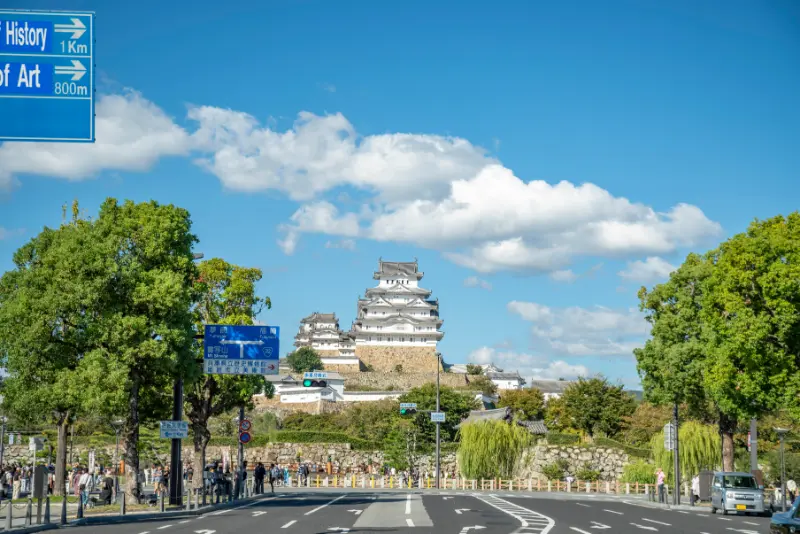
    From JR Himeji Station, the castle’s pale roofs form the visual destination at the end of Otemae-dori. Walking the broad boulevard is part of the experience, and it lets you appreciate how the castle dominates the town’s layout. The distance may be manageable for many travelers, but not every person wants to walk it with luggage or on a hot afternoon. Local buses run toward Otemon-mae; verify current stops, service and boarding access. Photographing from the station area or the boulevard can be rewarding without paying for admission.

    The main Otemon Gate leads toward San-no-maru, a large outer enclosure. The Japan National Tourism Organization describes this area as accessible before the paid inner section. It provides views of the layered white roofs and stone ramparts that are impressive even if you never enter the keep. During cherry-blossom season, the grounds attract crowds, so an early arrival can help with space and photographs. Keep paths clear for local residents and do not climb onto restricted walls for a better angle.

    Decide whether the main keep climb suits you

    Himeji Castle’s main keep is an extraordinary surviving wooden structure, with a sequence of gates, defensive approaches and increasingly elevated interior floors. You can see how the design channels visitors through narrow passages, but these features also create physical challenges. The official site warns about steep stairs, slopes and the absence of elevators inside the keep and turrets. This is not an attraction where every paying visitor can automatically reach every level. Socks or safe footwear requirements may apply on interior flooring.

    Before entering, assess whether everyone in your party can manage long stair sequences, tight turns and standing in queues. Ask staff about the sections currently open and whether a partial visit is possible. A toddler cannot safely navigate all ladders independently; someone with vertigo, poor balance or knee problems may be happier outside. Never pressure an older relative to continue upward merely because admission has been paid. The engineering can be appreciated from the lower grounds and interpretive material without ascending to the top floor.

    Look beyond the white silhouette and study the defenses

    Himeji’s beauty tends to dominate photographs, yet the stone bases, angled routes, loopholes and numerous gates reveal its military purpose. From the inner approaches, notice how the path twists instead of leading directly to the heart of the fortress. The white plaster is part of a historic fire-resistant exterior finish, not simply decoration. Interpretive signs help explain which buildings and passages belong to the early seventeenth-century complex. The castle has UNESCO World Heritage status, and preservation involves continual care rather than a static monument.

    Set a modest observation goal for children: find a gate, stone wall, opening and roof feature rather than demanding that they absorb every historical date. Photographers should check restrictions on tripods and drones. Wheelchair users need venue-specific access advice because outer approaches and interiors differ substantially; the official site’s assistance guidance should be read before booking. Avoid claiming that a paved outer area guarantees step-free movement throughout the paid enclosure. A shorter visit with focused observation often generates better memories than a tiring climb.

    Balance the castle with Koko-en Garden

    Koko-en is a landscaped garden near the castle and an excellent companion for visitors who enjoy plants, ponds and quiet seasonal design. Its sections provide a contrast to the fortress’s enclosed passages. Garden access may be more comfortable than the main tower, but bridges, gravel paths and stepping surfaces still need checking. A combined admission option may exist, although prices and eligibility have changed; consult official sources for current ticket arrangements rather than relying on an old blog’s figures.

    If traveling with a person who cannot climb, consider dividing the group: one person explores the upper keep while the others visit appropriate outer grounds or selected garden areas. Agree on a realistic meeting point and time so no one has to wait standing in heat. A garden visit works especially well in the afternoon when castle queues may be longer. Seasonal flowers and foliage change the atmosphere, but a quieter winter garden can be appealing too. Photography should respect planted areas and posted pathways.

    Himeji Castle Hyogo Japan Above City Avenue

    Add a neighborhood stop without overloading the day

    Himeji’s station area has shops, dining choices and services that simplify a day trip. Instead of rushing onto the first train after the castle, walk a few streets away from the busiest route to enjoy a meal or find a local café. Some visitors add a museum or shrine visit, but check opening times and travel distances before committing. The pleasure of a Japanese city outside the country’s most famous hubs often lies in everyday streets and an unhurried lunch as much as a headline monument.

    For families, a predictable food stop after the grounds prevents an afternoon of tired children and queue frustration. Vegetarians and travelers with allergies should request ingredient information and keep an explanatory translation ready. Restaurants near the station may be easier for wheelchair users than upper-floor establishments in older buildings, though entrances still need checking. Store bulky luggage at an appropriate station facility rather than attempting to carry suitcases through castle grounds. Keep your rail return flexible if possible.

    Reach Himeji by rail from Osaka, Kobe or Okayama

    Himeji is a convenient rail destination on routes across western Honshu, including services from Osaka, Kobe and Okayama. Which train is best depends on whether you have a rail pass, prefer speed, or need fewer transfers. A Shinkansen journey may save time but cost more than conventional services. Confirm your exact departure station and train type, especially if traveling from a hotel far from a major hub. Check railway accessibility services and reserve assistance where appropriate rather than assuming every transfer is effortless.

    For a same-day excursion, make the castle your main booking and leave room for the garden. Arriving as the gates open may help in busy seasons, but account for school groups and temporary conservation works. Drivers should use designated parking and expect traffic restrictions around major events. Overnight visitors can stay close to Himeji Station for restaurants and onward travel, then tour the castle at a gentler pace the following morning. A short overnight stop is especially useful for travelers who cannot stand in queues for hours.

    Read the current admission rules, not yesterday’s prices

    Castle admission policies can change. By October 2026, the castle’s own English website lists different adult and under-eighteen arrangements from older tourism pages, so copying a past fee is risky. Check the official castle website on the booking day for admission bands, combined tickets, last entry time and scheduled closures. Also review crowd notices and any temporary alterations to the interior route. The official information states that the last entry is earlier than closing time; allow enough time to finish before the gates close.

    Parents should look at stroller storage guidance because wheeled equipment is not suited to the keep. Visitors who require support should contact the castle about current arrangements before purchasing; the published accessibility explanation is unusually specific about steep stairs. Heat, heavy rain and crowds can make even the approach tiring. Pack water, comfortable shoes and a plan for where someone can rest. Do not base a tightly timed onward connection on finishing a full keep circuit in exactly one hour.

    Build two itineraries for different abilities

    For a more active day, walk from the station, explore San-no-maru, purchase the appropriate ticket for the inner enclosure, climb the keep if safe, then visit Koko-en and eat before returning. The sequence introduces the building from the outside before exposing its defensive interior. A calm overnight version divides the garden and outer grounds from the keep, allowing more time for the city’s ordinary life. Either route can be shortened if the weather changes or queues become uncomfortable.

    For a low-stair day, use a bus or taxi closer to the gate, enjoy the lower views, select accessible garden paths after confirmation and return to the station for lunch. This is not a lesser version of Himeji: the exterior architecture is an essential part of its significance. Families with babies, travelers with limited mobility and those simply uninterested in castle stairs can still have an excellent visit. The central principle is to respect the building’s physical reality while enjoying what it reveals from many angles.

    Frequently asked questions

    Is Himeji Castle wheelchair accessible?

    Its outer areas differ from the keep. The main keep and turrets have no elevators; consult official accessibility guidance before purchasing tickets.

    Can I enjoy the castle without climbing?

    Yes. Exterior views and the outer enclosure reveal the monument’s appearance and defensive layout without requiring the complete tower route.

    How far is the castle from the station?

    The main approach is around a twenty-minute walk for many adults, while buses also serve the castle vicinity.

    Should I book Koko-en with the castle?

    It can be an excellent combination, but check the current combined admission offer and access conditions.

    Are old ticket prices reliable?

    No. Pricing changed in 2026; use the castle’s official website for current visitor categories and admissions.

    More trip ideas from Travel Is Wonderful

    Travel resources and latest official conditions

    Before your visit, confirm opening hours, admission details, transport, conservation rules and safety notices with the official organisations listed below.

    Last reviewed: October 11, 2026.

  • Eastern Canada in 12 Days: Montreal, Quebec City and Nova Scotia Without a Cross-Country Rush

    Eastern Canada in 12 Days: Montreal, Quebec City and Nova Scotia Without a Cross-Country Rush

    Canada’s size makes “east coast” an imprecise travel phrase. Montreal and Quebec City are inland along the St. Lawrence, while Nova Scotia opens onto the Atlantic; all can fit into a strong twelve-day trip, but not if you also add Toronto, Niagara, Prince Edward Island and Newfoundland. The route works best when you use rail between Quebec’s major cities, then fly or make one deliberate long transfer to Atlantic Canada.

    This itinerary gives Montreal three nights, Quebec City three and Nova Scotia five, with the remaining time used for the regional transition. It offers French-speaking urban culture, historic streets and an Atlantic road-trip finish without pretending eastern Canada is geographically small. The best version depends on flight availability, so build the open-jaw transport before reserving every hotel.

    Quick trip summary

    • Use rail for Montreal–Quebec City and collect a rental car only in Nova Scotia.
    • Give each Quebec city at least two full days.
    • Fly from Quebec/Montreal to Halifax if the alternative would consume an entire holiday day by road.
    • Use Halifax plus one or two Nova Scotia bases instead of changing hotels every night.
    • Do not add Newfoundland or Prince Edward Island unless you remove another region or extend the trip.

    Who this itinerary is for — and when to change it

    This route is designed for a first or early visit with a moderate pace. It assumes that you want the destination’s defining experiences without turning every day into an early start, late arrival and luggage transfer. Couples, solo travellers, families and mixed-age groups can use the same geographic structure, but the number of activities inside each day should change with mobility, climate, jet lag and personal interests.

    Before booking every attraction, identify the two experiences you would regret missing. Protect those first, then build the rest of the trip around them. Weather-dependent mountains, deserts, coastlines and wildlife experiences deserve flexible placement, while museums and neighbourhood days can often move more easily.

    Where to stay: choose the base before the hotel

    Accommodation is a transport decision as much as a comfort decision. Check how you will reach the first activity in the morning, how you will return after dinner, whether the property has lifts or parking, and what happens with luggage on transfer days. A cheaper room that creates two difficult journeys every day can cost more in taxis, time and energy than a slightly more expensive base in the right place.

    BaseWhy it works — and the trade-off
    Montreal: Old Montreal / downtown edgeEasy for first-time sights and transit; touristy in parts but highly convenient.
    Montreal: Plateau / Mile EndStrong food and neighbourhood atmosphere; less direct for luggage arrivals.
    Quebec City: Old Quebec / Saint-RochOld Quebec maximises atmosphere; Saint-Roch can offer better value and a more local evening feel.
    Nova Scotia: Halifax + one coastal baseHalifax handles arrival, museums and restaurants; a second base reduces backtracking on scenic road days.

    The four decisions that shape this trip most

    DecisionBest defaultWhen to change it
    Montreal–Quebec CityTrainDrive only if you have meaningful stops planned between the cities.
    Quebec to Nova ScotiaFlight for most 12-day tripsOverland makes sense only if New Brunswick is part of the actual holiday.
    Nova Scotia carYes after Halifax arrivalDelay collection if spending the first Halifax day entirely in the city.
    Coastal focusSouth Shore or Cape BretonTrying to do both deeply in five nights creates too much driving.

    Make these decisions before filling the calendar with attractions. They determine how many hotel changes, early starts and long journeys the trip contains. Once the structure is right, individual sightseeing choices become much easier to adjust.

    A realistic day-by-day route

    Days 1–3: Montreal by neighbourhood

    Keep arrival day around Old Montreal, downtown or your local neighbourhood.

    Use one full day for Old Montreal, the riverfront and central museums, then another for Plateau/Mile End, Mount Royal or food-focused exploration.

    Montreal is easy to enjoy without a car, so avoid renting one simply because the later part of the trip requires driving.

    Days 4–6: train to Quebec City and slow down

    Take the train to Quebec City and check in before walking the old town.

    Historic stone façades and a town square in Old Québec after dark

    Use one full day for Upper/Lower Town, fortifications, museums and river views. Hills and cobbles make the walking more demanding than it appears.

    Use the second full day for Montmorency Falls, Île d’Orléans or a slower neighbourhood day according to weather and mobility.

    Day 7: transfer to Halifax

    Fly if schedules are practical and treat the transfer as the day’s main event.

    Do not schedule a long Nova Scotia drive immediately after landing if the flight arrives late.

    Spend the evening in Halifax and collect the car the next morning if that reduces parking hassle.

    Days 8–11: Nova Scotia with one coherent road-trip direction

    Use one day for Halifax and nearby waterfront/history, then choose a coastal route. The South Shore can include Peggy’s Cove, Lunenburg and smaller communities; Cape Breton deserves more driving and is better with several nights.

    Move to one coastal base for two nights rather than sleeping in a different town each evening.

    Keep one weather-flexible day for coastal scenery, hiking, whale-related activities or a slower town visit. Atlantic conditions can change quickly.

    Day 12: departure from Halifax

    Return toward Halifax with a generous fuel and rental-car buffer.

    If your flight is early, sleep close to the city/airport on night eleven rather than ending with a long dawn drive.

    Avoid adding a final remote lighthouse simply because it appears close on the map.

    Pace check: if this stage runs late, remove the lowest-priority activity rather than stealing time from meals, sleep or the next transfer. A resilient itinerary should become simpler when something changes, not more frantic.

    Transport reality: plan door to door

    Rail is a comfortable default between Montreal and Quebec City because both cities are easier without a car. The leap to Nova Scotia is where scale becomes visible: a flight can preserve a full day compared with a long overland transfer. In Nova Scotia, a rental car gives the flexibility needed for coastal routes, but choose one section rather than tracing every shore. Road conditions, ferries and seasonal services should be checked close to travel, especially outside summer.

    Door-to-door time is the number that matters. Add hotel checkout, reaching the station, airport or pier, waiting, boarding, collecting luggage, local transport at the other end and the possibility that everyone needs food immediately after arrival. This is why a “two-hour flight” or “three-hour train” can consume most of a day. Our guide to building realistic 7-, 10- and 14-day itineraries explains how to treat transfer days honestly.

    Food strategy: make meals part of the route

    Montreal and Quebec City are strong food destinations, so avoid reserving every dinner before you know how much walking each day involves. Markets, bakeries and casual lunches help balance higher-cost meals. In Nova Scotia, seafood and small-town restaurants are part of the experience, but opening hours can be seasonal. Carry snacks on long coastal drives and refuel both the car and yourselves before rural stretches.

    One planned meal per day is usually enough. Keep another meal flexible so it can respond to where you actually are, not where an old itinerary expected you to be. With children, older travellers or very hot weather, eating before everyone becomes exhausted is often more important than reaching a restaurant that looked perfect months earlier.

    When to go and how the season changes the plan

    Summer offers the broadest operating season and warmest coastal weather, while autumn brings foliage and cooler conditions. Spring can be variable and some seasonal attractions open later than urban museums and restaurants. Winter is a completely different trip, especially in Quebec, and should not use this road-trip structure without adaptation. Atlantic fog, wind and rain can affect views even in summer, so keep coastal priorities movable.

    Montreal Biosphere Parc Jean Drapeau Quebec Canada

    Instead of searching for one universal best month, decide which compromise you prefer: better weather, fewer visitors, lower prices, longer daylight, beach conditions or seasonal scenery. No month maximises everything. Recheck short-term weather and official access information shortly before each critical outdoor day.

    Budget: where spending actually improves the trip

    The trip’s main financial choices are hotel rates in Montreal/Quebec City, the regional flight and Nova Scotia rental car. Delaying car pickup until Halifax can reduce parking costs. Open-jaw international flights—arriving in Montreal and departing Halifax, for example—may cost more initially but can save a domestic backtrack. Compare the full journey rather than airfare alone.

    The most useful upgrades are often logistical rather than luxurious: a hotel that removes a daily transfer, a direct ride after a long flight, a flexible ticket, an additional night in a weather-dependent region or a guide where interpretation genuinely adds value. Cut low-value extras before cutting the pieces that keep the route reliable.

    Common mistakes to avoid

    • Calling the itinerary “east coast” and then adding Toronto, Niagara, PEI and Newfoundland without extending the trip.
    • Renting a car in Montreal for days spent entirely in the city.
    • Driving Quebec City to Nova Scotia in one huge push without making New Brunswick part of the trip.
    • Trying to cover both the South Shore and Cape Breton deeply in only a few Nova Scotia days.
    • Ending a coastal drive immediately before an early Halifax flight.

    Most difficult trips are not ruined by one large mistake. They become tiring through a sequence of optimistic assumptions: a transfer that “should” be quick, a hotel that is “only” a kilometre away, a famous walk assumed to suit everyone and a dinner reservation across town after an already long day. Leave margin before you need it.

    Families, older travellers and mixed-age groups

    Montreal and Quebec City are easy to structure for families with parks, short transit hops and indoor attractions. Old Quebec’s hills and cobbles may require stroller planning. In Nova Scotia, children often enjoy beaches, boats and shorter lighthouse stops more than hours of scenic driving, so use a coastal base and reduce daily mileage. Older travellers should prioritise hotels with lifts and central locations, and choose viewpoints that do not require rough trails.

    For mixed-age groups, agree which experiences everyone will share and which can be optional. Splitting for two hours is often healthier than forcing the entire group through one person’s priority. Build seating, toilets, shade, step-free access and realistic meal times into the plan with the same seriousness as headline attractions. Our guide to travelling with parents and older adults develops this approach in more detail.

    If you have more or less time

    With fourteen to sixteen days, add Cape Breton or Prince Edward Island with several nights, not as a one-day detour. With nine days, use Montreal, Quebec City and Halifax/South Shore only. Newfoundland deserves its own flight and a separate block of time rather than being treated as a quick extension.

    When shortening the trip, remove an entire base before cutting every destination to one night. When lengthening it, add depth before distance. An extra morning in a place you already understand often produces a better memory than another multi-hour transfer to a new pin on the map.

    Useful official resources

    Opening hours, transport timetables, road conditions, trail rules and visitor procedures can change. Use official sources for the details that affect your exact travel dates and recheck them shortly before departure.

    Final planning checklist

    • Confirm passport, visa, entry and transit requirements for your nationality and route.
    • Book the genuinely scarce transport or accommodation segment before secondary attractions.
    • Check the exact luggage journey between bases, including stairs, ferries, station exits and rental-car rules.
    • Save offline copies of essential reservations, insurance details and each accommodation address.
    • Recheck weather, road, park, trail or transport notices shortly before each critical day.
    • Keep at least one flexible half-day that can absorb rain, fatigue, a delay or a cancellation.
    • Choose clothing and footwear for the actual surfaces and climate, not only for photographs.
    • Leave a generous buffer before international flights and other connections that are expensive to miss.

    The purpose of a good itinerary is not to prove that you covered the maximum distance. It is to make the important experiences easier to enjoy and to leave enough energy for the unexpected parts that become the best memories. Use this route as a framework, then remove anything that does not fit your interests, mobility or travel rhythm.
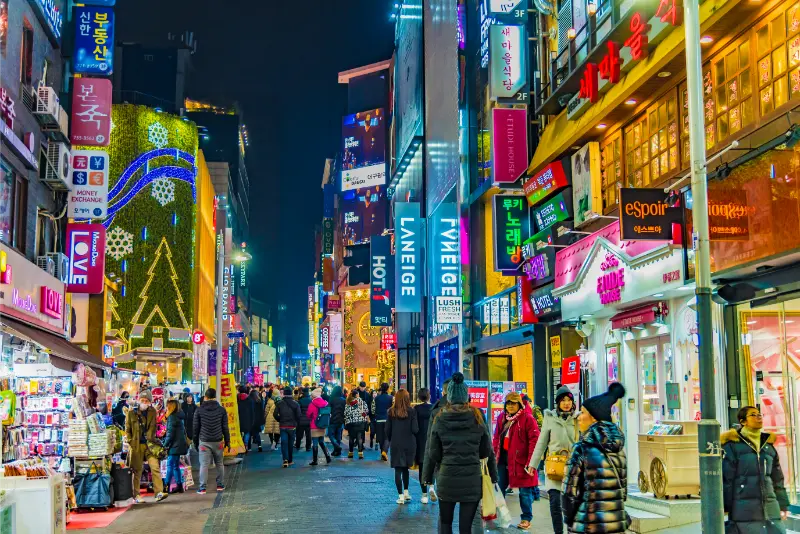
  • Niagara Falls in 4 Days: Canadian Falls, Gorge Walks and Niagara-on-the-Lake Without a One-Night Rush

    Niagara Falls in 4 Days: Canadian Falls, Gorge Walks and Niagara-on-the-Lake Without a One-Night Rush

    Niagara Falls is easy to visit badly: arrive, photograph Horseshoe Falls, spend one loud evening near Clifton Hill and leave. A four-day stay reveals a much broader destination. The falls change with light and weather, the gorge continues for kilometres, engineering history is unusually visible, and Niagara-on-the-Lake and wine country provide a complete contrast to the busiest tourist blocks.

    If this destination is part of a wider journey, compare the pacing with Ontario in 9 Days. Use the wider route for country- or region-level decisions and this guide for destination-level detail.

    Quick trip summary

    • Ideal stay: 4 days for a first visit.
    • Best approach: group each day by geography and keep one block flexible.
    • Good for: independent travellers, couples, families and slower-paced trips.
    • Main planning risk: underestimating local conditions, transfers, weather or walking effort.

    Is Niagara Falls the right trip for you?

    Niagara works for first-time Canada visitors, families, multi-generational trips and travellers who enjoy both natural sights and visitor attractions. The core area is accessible compared with many outdoor destinations, although gorge trails and some viewpoints involve stairs or uneven surfaces.

    Where to stay

    AreaWhy choose it
    FallsviewBest for iconic views and easy access to Table Rock, but usually the most expensive area.
    Clifton Hill / central tourist districtConvenient for families and entertainment, with a busier atmosphere into the evening.
    Downtown Niagara FallsQuieter in parts and useful for rail/bus access, but farther from the main falls.
    Niagara-on-the-LakeBest for a quieter wine-country stay; less convenient if your priority is seeing the falls at different times of day.

    Choose accommodation by the journeys you will repeat, not by a small difference in nightly price. Check the route to your first morning attraction, likely dinner area and departure point for any fixed excursion. Recent reviews about noise, climate control, lift access and luggage handling can be more useful than a generic star rating.

    How to get there

    Toronto is the most common gateway. Driving is straightforward outside peak traffic, while GO, VIA and regional services can connect with Niagara Falls depending on season and timetable. Once in the destination, WEGO buses link major visitor areas and attractions.

    Save the accommodation name and address offline before travelling. Keep arrival day low-risk and leave extra time for baggage, traffic, platform changes and finding the correct entrance.

    Getting around

    The main falls area is walkable, but the Niagara Parkway stretches far beyond it. Use WEGO, taxis, bikes where appropriate or a car for longer sections. Parking costs and traffic can make moving a car repeatedly less attractive than leaving it at the hotel.

    Compare journeys door to door rather than only looking at distance. Waiting time, stairs, traffic, weather and the final walk can matter more than the nominally fastest route, especially for families, senior travellers or anyone carrying luggage.

    A realistic day-by-day itinerary

    The schedule below is a framework rather than a rigid timetable. Recheck opening days, weather and local transport shortly before each block. If one major experience is closed or conditions are poor, move the entire block instead of forcing the rest of the trip to become inefficient.

    Day 1 – Horseshoe Falls, Table Rock and the park at different light

    Start with the Canadian Horseshoe Falls from Table Rock and walk through Queen Victoria Park. Do not rush to every attraction immediately. Return after dark for illumination if it is operating; seeing the water in morning light, afternoon mist and evening colour gives more value than another indoor attraction.

    Day 2 – Boat experience and Niagara Parks Power Station

    In the operating season, take the boat excursion early or at a less busy time, understanding that you will get wet despite protective gear. Pair it with Journey Behind the Falls or the Niagara Parks Power Station and tunnel rather than trying to do every premium experience in one day.

    Niagara Falls With Waves And Rainbows

    Day 3 – Gorge, Whirlpool and river geology

    Move north along the parkway. Choose the White Water Walk, Whirlpool area or Niagara Glen according to mobility and weather. Niagara Glen is a real hiking environment with uneven terrain, not a paved extension of the falls promenade. Keep the afternoon flexible.

    Day 4 – Niagara-on-the-Lake and wine country

    Use the final day for Niagara-on-the-Lake, historic streets and the surrounding agricultural landscape. Wine tasting should be arranged with a designated driver, organised transport or a tour. Families can replace winery visits with parks, heritage sites and food stops.

    Keep enough margin for meals, transport and an unscheduled stop. If this block runs long, remove the lowest-priority extra rather than turning the rest of the day into a race.

    Best time to visit

    Niagara is year-round, but the experience changes substantially. Summer has the widest attraction schedule and largest crowds. Autumn adds colour and harvest activity. Winter is cold, some boat operations stop, and ice can be spectacular. Spring is variable. Check individual attraction schedules rather than assuming all experiences operate every day.

    Do not choose dates from average temperature alone. Check daylight, rainfall or snow, local holidays, school breaks and major events. A slightly less famous month can be better if it gives you easier accommodation, comfortable walking conditions and fewer queues.

    Food and meal planning

    The region is more than chain restaurants near the falls. Niagara-on-the-Lake and the wider peninsula have wineries, farm markets, bakeries and restaurants built around local produce. Reserve one important meal and keep the rest flexible.

    Keep meal geography aligned with the day. Crossing the destination for a famous restaurant can waste more time than the meal adds. One carefully chosen reservation is usually more useful than building every sightseeing block around food bookings.

    One day trip or regional extension

    Niagara fits naturally into an Ontario trip with Toronto and Niagara-on-the-Lake. If you have more time, the wider peninsula, St Catharines and wine areas can justify extra nights. Do not treat Niagara as a detour that must be squeezed between two long driving days.

    A day trip should add a genuinely different experience. Measure it from hotel door to first attraction and back again, including waiting time, so a destination described as nearby does not quietly become a full transport day.

    How many days do you really need?

    Four days is a useful first-visit length because it gives the headline experiences their own space while protecting one flexible half-day. With only two days, remove the excursion before compressing the core sights. With five or six days, add a slower neighbourhood, second museum or nearby destination instead of extending every sightseeing day late into the evening.

    Think in half-days rather than individual attractions. A museum, historic complex, long market visit or excursion can consume much more time once transport, ticket queues, meals and rest are included. A realistic itinerary often looks modest on paper and feels much richer on the ground.

    Travelling with children

    Families have an enormous choice, which is exactly why overplanning is a risk. Pick one major falls experience, one fun attraction and one outdoor block each day. Leave space for mist, snacks and changing clothes.

    Families usually enjoy a destination more when each day has one anchor activity, one flexible stop and an obvious place to pause. Alternate long indoor visits or demanding walks with parks, viewpoints, markets or relaxed food stops.

    Niagara Falls At Sunset

    Senior travellers and a slower pace

    Senior travellers can enjoy the falls from well-developed viewpoints and use WEGO to reduce walking. Choose accommodation near the main journeys you expect to repeat. Gorge hikes can be skipped without losing the core experience.

    Do not let a four-day label force four full days of activity. A late start, long lunch or taxi across a difficult section can protect the experiences that matter most.

    Accessibility

    Many primary Niagara Parks attractions have accessibility information and paved approaches, but some natural areas do not. Check elevator status, boarding arrangements and trail conditions. Mist can make surfaces slippery even on paved areas.

    Accessibility changes not only by attraction but by route. Check lifts, ramps, surfaces, toilets, boarding procedures and the final distance from the drop-off point. Contact attractions directly when access information is unclear.

    Budget planning

    Premium attractions accumulate quickly. Decide whether your priorities are the boat, Journey Behind the Falls, power station, tower views or entertainment. You do not need all of them to understand Niagara. Walking the parkway and seeing the falls remains the central experience.

    Build the budget by day rather than only by accommodation night. Transport, timed attractions, tours and food in high-demand areas can cost more than the room itself. Keep a contingency for weather changes or a taxi when walking is no longer sensible.

    Tickets and reservations

    Reserve popular experiences in peak periods, but allow weather margin. If you plan a boat ride, avoid booking an immediate formal meal or long transfer afterward because you may need time to dry and change.

    Reserve the experiences that control the day, not every hour. Flexible blocks make it easier to react to weather, energy levels and temporary closures.

    Money and payments

    Carry more than one payment method and keep a small amount of local cash where useful. Card acceptance, tipping expectations and ATM fees vary, so check current local guidance rather than assuming the same rules apply across a whole country. Keep your main card and backup card in different places.

    Safety and situational awareness

    Stay behind barriers and marked paths. The river and gorge are powerful and dangerous, and unofficial viewpoints are not worth the risk. In winter, ice adds slip hazards; in summer, heat and crowds require water and patience.

    Use the same practical habits you would in any unfamiliar place: keep valuables unobtrusive, use licensed or well-reviewed transport, follow official warnings and avoid turning a beautiful viewpoint into a risky shortcut.

    How to handle bad weather or extreme conditions

    Build one movable block into the itinerary. In heat, shift the longest walk to morning or late afternoon; in rain, snow or strong wind, use a museum, market, long lunch or lower-level attraction as the flexible block. The goal is to reorganise the day rather than force the original order.

    Solo travel

    Solo travellers can simplify logistics by choosing a central base and joining a guided walk or small-group excursion only where it adds context or solves transport. Keep a charged phone, offline map and the accommodation address available without internet. Late at night, prioritise a simple route home over saving a small amount on transport.

    Evenings and downtime

    Do not turn every evening into another sightseeing shift. One planned dinner, performance, waterfront walk, market or neighbourhood stop is enough. Keeping some evenings light protects early starts and gives the trip the feeling of a holiday rather than a schedule that must be completed.

    Photography without turning the trip into a photo shoot

    Early morning and late afternoon often bring softer light and fewer people, but good travel photography comes from understanding a place rather than blocking it. Respect restrictions in religious, cultural and protected sites, ask before photographing people closely and never leave marked routes merely to recreate an image you saw online.

    Niagara Falls And Skylon Tower Ontario Canada

    Shopping and souvenirs

    Look for products connected to the destination rather than generic travel merchandise. Markets, museum shops and independent stores are often the easiest places to understand provenance. Check customs rules before carrying food, plants, animal products, antiques or unusually large quantities across borders.

    What to pack

    Bring a waterproof layer or clothes that dry quickly for falls experiences, comfortable shoes with grip and a spare layer. In winter, treat the mist zone as colder than the general forecast suggests.

    A small day bag is generally more useful than carrying the contents of a suitcase through museums, historic streets, trails or long walking routes. Keep medication, water and essential documents easy to reach.

    Common planning mistakes

    • Choosing accommodation by headline price without checking the repeated daily journey.
    • Booking a major attraction on arrival day with no margin for delays.
    • Crossing the destination several times because sights were listed by fame rather than geography.
    • Assuming a short map distance means an easy walk regardless of hills, heat, snow, rough surfaces or queues.
    • Keeping every day full and leaving no space for weather or fatigue.
    • Adding a day trip that duplicates a destination already scheduled later in the wider journey.

    Practical habits that make the trip easier

    • Save offline maps and the exact name of your hotel, station, terminal and meeting points.
    • Download tickets and confirmations before leaving reliable Wi-Fi.
    • Check the last practical return option before starting any excursion.
    • Carry a small amount of local cash even where cards are widely accepted.
    • Recheck opening hours and transport notices on the morning of any fixed reservation.
    • Keep one half-day flexible so a delay does not damage the rest of the trip.

    Final planning checklist

    • Confirm entry, transit and insurance requirements relevant to your nationality.
    • Choose accommodation by location, noise, access and transport as well as price.
    • Reserve only the attractions or excursions that genuinely control the day.
    • Keep offline copies of tickets, hotel details and important contact information.
    • Check the exact station, airport terminal, parking area or pickup point before travel.
    • Leave enough time for meals and unscheduled stops.
    • Recheck official information shortly before departure.

    Planning the days by geography

    Niagara Falls becomes easier when the itinerary is built around neighbourhoods, transport corridors or landscape zones instead of a ranked attraction list. Put sights that share the same streets, transit line or access road on the same day, then leave the final hours flexible. This reduces repeated transfers and makes it easier to stop for a meal, market, café or viewpoint that was not part of the original plan.

    Before each day, identify one experience that matters most and one that can be removed without regret. That simple hierarchy is more useful than a minute-by-minute schedule, particularly when weather, crowds or opening times change after you arrive.

    Arrival and departure day strategy

    Arrival and departure days are part of the trip but should not carry the same expectations as full sightseeing days. On arrival, prioritise checking in, eating, learning the immediate area and confirming the next morning’s transport. On departure, keep luggage logistics and the journey to the station, airport or onward road more important than squeezing in one last distant attraction.

    If your wider route continues elsewhere in Canada, confirm the exact station, terminal, road conditions or pickup point the evening before. Similar place names, multiple stations and seasonal timetables are common sources of avoidable stress.

    Final thoughts

    A strong trip is not the itinerary with the highest number of pins. It is the one that protects the experiences you care about, groups the day sensibly and leaves enough energy to notice what happens between attractions. Use this structure as a framework, then let weather, local events and your own pace decide the final order.

    Official information to check before you go

    Opening days, transport, weather-sensitive access and event schedules can change. Recheck the details that control fixed reservations shortly before travel, especially during public holidays, festivals or severe weather.

  • Dubrovnik in 4 Days: City Walls, Lokrum and Lapad Without Spending Every Hour in the Old Town

    Dubrovnik in 4 Days: City Walls, Lokrum and Lapad Without Spending Every Hour in the Old Town

    Dubrovnik is spectacular and physically intense. The walled city is compact, but stairs, polished stone, cruise crowds and summer heat can make a short distance feel much longer. Four days is enough to see the walls and historic core properly, spend time by the sea, visit Lokrum or another nearby island and use Lapad or the wider coast as a contrast instead of remaining inside the same lanes from breakfast to dinner.

    If Dubrovnik is part of a longer journey, compare the pacing with Croatia in 10 Days: Split, One Island and Dubrovnik Without Too Many Ferries. The useful planning rule is to protect the experiences that are difficult to replace, then leave ordinary meals, neighbourhood walks and secondary attractions flexible. A city break usually becomes less enjoyable when every hour is reserved. Door-to-door travel time, queues, weather, luggage, meal stops and fatigue are part of the itinerary even when they do not appear on a map.

    Quick trip summary

    • Recommended time: 4 days.
    • Best planning principle: group each day by geography and protect only the reservations that control access.
    • Best for: independent travellers, couples, families and slower-paced visitors who prefer a realistic rhythm.
    • Keep flexible: at least one half-day or one major activity that can move with weather, traffic or energy.
    • Book first: accommodation location, scarce transport and any timed entry that shapes the rest of the trip.

    Is Dubrovnik the right trip for you?

    Dubrovnik suits travellers who enjoy history, architecture, sea views and compact urban exploration. It is less comfortable for visitors who dislike stairs, heat or dense peak-season crowds, though careful timing makes a major difference. The main planning mistake is treating every hour outside the Old Town as time lost rather than part of the Dubrovnik experience.

    The practical test is to decide what would make you genuinely disappointed if you missed it, then build the trip around those one or two priorities. Everything else should earn its place by fitting the same area of the day. This becomes even more important when travelling with children, older relatives or anyone who values a slower rhythm.

    Where to stay: choose location before hotel style

    Base Why choose it
    Old Town Unmatched atmosphere and easy early access, but stairs, luggage restrictions, noise and higher prices can be significant.
    Pile / Ploče Excellent compromise near the walls with easier access to taxis or buses depending on the exact property.
    Lapad Best for beaches, promenade evenings and more space; use buses or taxis for the Old Town.
    Gruž Practical for ferries, buses and better-value accommodation, though less romantic for a first visit.

    A more attractive room is not always a better travel decision. Before booking, map the first activity of the morning, the likely dinner area and the departure route. If the hotel adds two unnecessary transfers every day, the hidden cost is time as well as money. Also check stairs, lift access, street noise and the final luggage route rather than relying only on the neighbourhood name.

    A realistic 4-day itinerary

    Day 1: Old Town orientation and quieter lanes

    Enter early or later in the afternoon to avoid the densest visitor wave, then explore Stradun, churches, side streets and harbour areas without immediately walking the walls. Use the first day to understand gates, stairs and routes before committing to the most exposed climb.

    Day 2: city walls and Fort Lovrijenac

    Walk the walls early when temperatures and crowds are usually easier, allowing more time than the distance suggests. Continue to Fort Lovrijenac if it fits your ticket and energy, then leave the historic core for a relaxed waterfront afternoon rather than adding another stair-heavy attraction.

    Day 3: Lokrum or one sea-focused day

    Take the boat to Lokrum when services and weather are suitable, or choose a beach and coastal day if sea conditions are poor. Do not combine Lokrum with a distant Elafiti excursion simply to maximise boat time. One island experience is enough for a four-day stay.

    Day 4: Lapad, Srđ or a flexible final day

    Use Lapad for a slower promenade and swim, then choose Mount Srđ if visibility is worthwhile. Alternatively, keep the day flexible for a missed wall walk or museum. If leaving by ferry or bus, stay near the relevant terminal for the final hours rather than crossing the city repeatedly with luggage.

    Keep the second half of the day lighter than the first. A useful itinerary creates space for an unexpectedly good museum, a long meal, a delayed train, a child who needs a break or a neighbourhood that deserves another hour. Removing one marginal stop often improves the day more than finding a faster route between two attractions.

    How to move around without wasting the day

    The Old Town is pedestrian-only and heavily stair-based, while buses and taxis connect Pile, Lapad, Gruž and other districts. Driving close to the historic core has become more restricted: the city has introduced a special traffic-management zone around the protected centre during much of the year. Visitors arriving by car should check current access and parking rules before approaching the walls.

    Do not judge a journey only by kilometres. A short distance can include traffic, station corridors, stairs, ferry boarding, parking, luggage handling or a long final walk. For every important transfer, think in door-to-door time and keep a margin before anything expensive or difficult to replace. Public transport is most useful when it removes boring distance while preserving the streets and neighbourhoods that are worth seeing on foot.

    Arrival and departure strategy

    Dubrovnik Airport lies outside the city and requires a road transfer. Airport buses, taxis and private transfers are common. If arriving by ferry or intercity bus, Gruž is the key transport area rather than the Old Town. Choose the final hotel transfer based on luggage and stairs, not just kilometre distance.

    Arrival day is rarely the right time for the most complicated attraction. Assume that baggage delivery, immigration, the airport transfer, hotel check-in and a meal will take longer than the perfect schedule suggests. On departure day, protect the connection first and use only nearby activities that can be abandoned without consequence.

    Best time to visit

    Late spring and early autumn often balance warm weather with less intense heat, while July and August can be hot and crowded. Winter is much quieter, but island boats, restaurants and seasonal attractions may operate reduced schedules. In summer, move wall walks and exposed viewpoints to morning or later afternoon rather than forcing them at midday.

    Seasonal advice should guide the style of the trip, not become a promise. Check the local forecast and official closure, transport or safety notices again shortly before each weather-sensitive day. If one experience depends heavily on good conditions, keep it movable instead of sacrificing the rest of the itinerary to a fixed booking.

    What to book first

    Book accommodation early for peak season, especially if you need a specific location with limited stairs. Reserve any high-priority boat trip or special guided experience, but keep weather-dependent sea time movable. If driving, research parking and restricted-zone rules before arrival rather than assuming the hotel can be reached by car.

    The useful planning rule is to protect the experiences that are difficult to replace, then leave ordinary meals, neighbourhood walks and secondary attractions flexible. Timed tickets can be valuable when they prevent a long queue, but a city break usually becomes less enjoyable when every hour is reserved. Book the bottlenecks, not the entire day.

    Food strategy: eat well without scheduling every meal

    Restaurants inside the Old Town vary widely in price and value. Mix one atmospheric historic-centre meal with Lapad, Gruž or other neighbourhood options. In hot weather, a long lunch can be a useful recovery block between the walls and evening walking instead of another attraction squeezed into the hottest hours.

    For a multi-age group, a reliable breakfast and an easy lunch often matter more than one additional attraction. Keep water accessible, avoid waiting until everyone is exhausted to look for food and use meal stops as genuine rest rather than another item to complete quickly. When a famous restaurant requires a large detour, ask whether it is worth sacrificing the neighbourhood you are already enjoying.

    Travelling with children

    Children often enjoy walls, boats and swimming more than formal interiors, but heat and stairs can shorten attention quickly. Start early, carry water and choose accommodation with a realistic luggage route. Lokrum or a beach afternoon can reset the trip after a dense historical morning and reduce the feeling that every day is another stone staircase.

    Choose one activity each day that allows movement and does not depend on perfect behaviour: a park, ferry, market, viewpoint, waterfront or short ride can reset the group after a museum or historic interior. Keep toilets, water and an easy route back to the hotel in mind before starting a long afternoon. A child-friendly plan changes the rhythm of the day rather than simply adding one children’s attraction to an adult schedule.

    Travelling at a slower pace or as a senior

    Dubrovnik requires honest mobility planning. Many Old Town routes involve stairs, smooth stone and limited shade, and not every scenic property is easy to reach with luggage. Staying near Pile, Ploče or a bus route can preserve the main experiences while reducing climbs. Use taxis for outer connections but remember they cannot drive into the pedestrian core.

    For older travellers or anyone who prefers a slower pace, reduce transitions before removing the highlights. A central base, one direct transfer and a shorter walking route can preserve the most memorable parts of the trip far better than trying to keep the same checklist with longer rest breaks. Check lifts, stairs, cobbles, seating and toilet access at accommodation and major attractions before booking.

    Budget: where the money really goes

    Dubrovnik is one of Croatia’s more expensive destinations, particularly for central accommodation and restaurants. Decide whether the value lies in sleeping inside the walls or visiting them early from a nearby district. Combination tickets or passes can help if you genuinely plan several included sites, but do not buy them simply because the city feels expensive.

    Compare the total cost of a day rather than the price of one ticket. A cheaper hotel can become expensive after repeated taxis and long transfers, while a well-located room can reduce both transport costs and fatigue. Build the budget around accommodation, the few major paid attractions you genuinely value, food, local transport and one contingency reserve instead of trying to estimate every coffee in advance.

    City passes and bundled tickets

    City cards and transport passes only save money when they match the itinerary you would choose anyway. Add up the normal cost of the attractions already on your plan, include any public-transport value you will genuinely use, and compare the total. Do not add museums simply to justify a pass or race between included attractions because a clock is running.

    Weather fallback plan

    Strong sun and heat are the most common itinerary disruptors in summer, while wind and sea conditions can affect boats. Keep the island day flexible and use museums, churches or a long meal during severe heat. If the walls are exposed to poor weather, move them rather than turning a signature experience into an endurance test.

    A useful weather fallback is not a random list of indoor attractions. It is one realistic substitute that fits the same area and does not damage the following day. Keep at least one museum, market, neighbourhood or café block movable. A flexible final day is especially valuable because it can absorb a missed attraction, become a rest block or take advantage of unexpectedly good conditions.

    Connectivity, cash and small practical details

    Croatia uses the euro, and cards are widely practical, though small cash can help for minor purchases. Save boat schedules, hotel directions and gate information offline. If accommodation is inside or above the Old Town, ask for the exact recommended arrival route because navigation apps do not always communicate the number of stairs.

    Save the hotel address, tickets, passport or identity details, insurance information and the next transfer outside your email app. Offline access matters most when the network is weak, the battery is low or you are trying to solve a delay. Carry a small power bank, keep medication in your day bag and confirm the final public-transport service before a late evening far from the hotel.

    What to pack

    Bring shoes with good grip for polished stone, sun protection, a refillable bottle and swimwear. A hat is particularly useful on the walls, where shade is limited. Pack light if your accommodation requires stairs, and use a small day bag rather than carrying beach gear through the historic centre all day.

    A small day bag should hold water, medication, sun or rain protection and the layer you are most likely to need. The goal is not to carry everything; it is to avoid having the useful items locked in a suitcase when conditions change. Comfortable footwear matters more than packing multiple outfits for a short city break.

    Common mistakes to avoid

    • Walking the city walls at the hottest, busiest time of day.
    • Booking a beautiful Old Town room without checking how many stairs luggage must climb.
    • Driving toward the historic core without checking current restricted-zone rules.
    • Trying to combine Lokrum, Elafiti islands and a full Old Town programme in four days.
    • Eating every meal inside the busiest central streets and assuming the rest of Dubrovnik has little to offer.

    Responsible travel and local etiquette

    Treat the destination as a real place rather than a stage built for visitors. Follow staff instructions, keep residential areas passable, use bins and public transport normally, and spend with businesses that add genuine local value. In religious, memorial or residential spaces, adapt to the setting instead of expecting the setting to adapt to sightseeing.

    Popular destinations function better when visitors spread some spending beyond the most photographed streets, avoid blocking narrow passages and respect the purpose of religious, memorial and residential spaces. Small decisions about timing and behaviour often improve the experience for the traveller as well.

    If you have less or more time

    With two days, focus on Old Town, walls and one coastal viewpoint. Three days adds Lokrum or a beach block. With five days, add an Elafiti excursion, more Lapad time or a slow day outside the walls. If Croatia includes Split and an island, avoid repeating a ferry-heavy schedule in Dubrovnik simply for completeness.

    Extra days are most useful when they reduce pressure. Before adding another distant stop, ask whether the trip improves more by staying in the same place, repeating a favourite neighbourhood, waiting for better weather or enjoying a slow morning without watching the clock. More time should create depth, not merely a longer checklist.

    How to choose between similar experiences

    Choose Lokrum for a short island escape close to the Old Town; choose an Elafiti trip for a longer boat day and village atmosphere. Choose Mount Srđ for the classic panoramic view, or the walls for views integrated with city history. In intense summer heat, you may enjoy one of these more by skipping the other.

    When two options offer a similar experience, choose the one that fits the geography and energy of the day. The extra hour of transfer rarely creates an extra hour of enjoyment, especially in heat, traffic, rough water or after a long museum morning. A famous option is not automatically the best option for every traveller.

    Safety and decision-making on the day

    Heat, slippery stone, stairs and sea conditions are the practical risks most visitors notice. Hydrate, use shade and avoid climbing when anyone in the group is already exhausted. Follow boat-operator and local authority guidance, and respect traffic-control rules around the protected centre rather than trying to improvise a vehicle route.

    The most useful safety habit is situational awareness rather than anxiety. Keep valuables controlled in crowded transport and tourist zones, use official or clearly identified transport, and avoid walking while focused on a phone at road crossings. Local warnings, attraction staff and transport operators have more value than an itinerary written months earlier, so change the plan when conditions deteriorate.

    Set a practical turnaround time for long walks, excursions and transfer days. When conditions deteriorate, change the plan rather than trying to complete the original checklist. A missed secondary sight is cheaper than a missed flight, unsafe walk or exhausted final day.

    Useful official and planning resources

    Opening hours, transport schedules, fees, access rules and visitor procedures change more often than the basic geography. Recheck the source below shortly before departure.

    Final planning checklist

    • Confirm passport, visa, transit and health requirements for your nationality.
    • Reserve the transport, permit or timed entry that controls the rest of the itinerary.
    • Check how luggage moves between airport, station, ferry, road transfer and accommodation.
    • Download offline maps and save key tickets outside your email app.
    • Recheck weather, road, sea, trail or attraction notices before each critical day.
    • Keep at least one half-day that can absorb a delay or become simple rest.
    • Leave a generous buffer before international flights and other costly connections.

    A good city break should feel as though you understood how the place fits together, not merely that you collected its famous names. Keep the fixed reservations that matter, group the rest by geography and remove anything that creates more transit than experience. The result is usually more memorable than the most ambitious version of the same trip.